Key Points
- Andy Burnham, the Labour MP tipped to succeed Sir Keir Starmer as prime minister, set out a vision to overhaul Britain’s political and economic system on Monday.
- He pledged to create a “Number 10 North” to redistribute power away from Westminster and into the regions.
- Mr Burnham promised the “biggest council house building programme since the post-war period.”
- He outlined a 10-year plan covering utility reform, reindustrialisation and urban regeneration, drawing on his record as Mayor of Greater Manchester.
- The speech, delivered in Manchester, did not address health, immigration, foreign policy or national security.
- Mr Burnham did not take questions from journalists after the event.
- Tim Bale, professor of politics at Queen Mary University of London, told the ABC the speech offered “a sense of direction” but lacked detail.
- Opposition figures, including Kemi Badenoch and Richard Tice, criticised the plan as vague and questioned the legitimacy of an uncontested leadership transition.
- Mr Burnham is currently the only declared candidate to replace Sir Keir, who announced his resignation last Monday following poor local election results.
- If unopposed, Mr Burnham could become Britain’s seventh prime minister in a decade by the middle of July.
Manchester (Britain Today News) June 29, 2026 — Andy Burnham, the British MP widely tipped to replace outgoing prime minister Sir Keir Starmer, promised “radical change” to the nation’s “broken” political system on Monday, as he used a speech in Manchester to set out the first details of his policy vision should he take charge of the country.
- Key Points
- Who Is Andy Burnham and Why Is He Tipped to Become Prime Minister?
- What Did Andy Burnham Say About Fixing Britain’s ‘Broken’ Politics?
- What Is ‘Number 10 North’ and How Would It Work?
- What Did Burnham Promise on Housing and Council Building?
- How Does Burnham’s 10-Year Plan Aim to Raise Living Standards?
- What Did the Speech Leave Out?
- Why Didn’t Burnham Take Questions From Journalists?
- What Have Political Analysts Said About the Speech?
- How Have Opposition Parties Responded to Burnham’s Plan?
- What Led to Sir Keir Starmer’s Resignation?
- What Happens Next in the Race to Succeed Starmer?
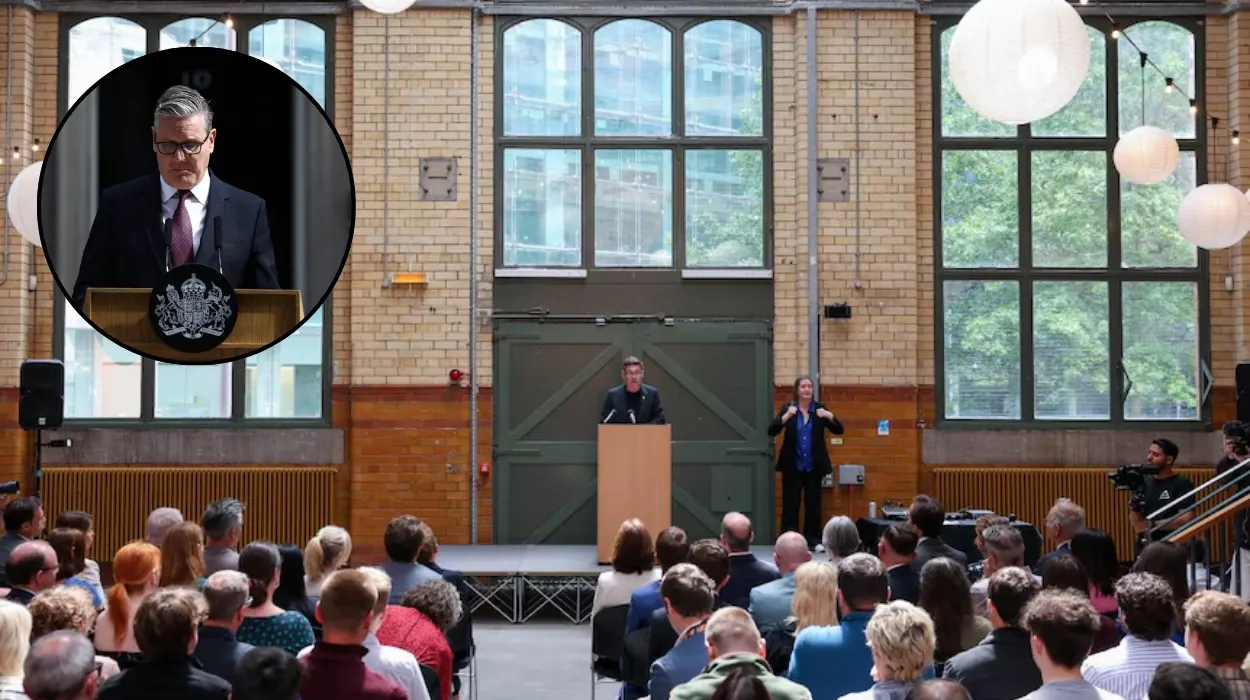
The former minister, who returned to national politics earlier this month via a by-election, told a room of supporters that he would hand more power to local councils, raise living standards and significantly ramp up the construction of affordable housing. Mr Burnham, who most recently served as Labour’s Mayor of Greater Manchester, said he intended to create a body he called “Number 10 North,” so that policy direction was no longer set purely from the prime minister’s office at 10 Downing Street in central London.
The speech, delivered at the People’s History Museum, represents the clearest signal yet of how Mr Burnham would govern if he becomes Britain’s next prime minister — a prospect that has gathered pace since Sir Keir’s sudden resignation last week.
Who Is Andy Burnham and Why Is He Tipped to Become Prime Minister?
Mr Burnham, 56, is a former long-serving MP who previously held ministerial posts in Gordon Brown’s government before stepping back from Westminster politics in 2017 to become Mayor of Greater Manchester. He built a national profile in that role, particularly during the Covid-19 pandemic, when his public clashes with the government in London over regional restrictions raised his standing among Labour members and the wider public.
He returned to the House of Commons earlier this month after winning a by-election, a move widely interpreted as a precursor to a leadership bid. With Sir Keir’s resignation, Mr Burnham is currently the only declared candidate to take over the role. If no challenger emerges, he could become prime minister by the middle of July — making him Britain’s seventh prime minister in a decade, a turnover rate that has become a recurring talking point in British political commentary.
What Did Andy Burnham Say About Fixing Britain’s ‘Broken’ Politics?
Addressing supporters directly, Mr Burnham did not soften his assessment of the current state of British governance.
“Westminster hasn’t been working for people, and it hasn’t working for a very long time. In fact, it is broken,”
he said, referring to the London borough where the majority of government departments are based.
He went further, telling the room:
“The country isn’t where it should be. It is stuck in a rut, and clearly we can’t go on like this.”
The remarks set the tone for a speech that positioned Mr Burnham not simply as a caretaker successor to Sir Keir, but as a figure seeking a fundamental reset of how Britain is governed — with power moved away from the centre and into the country’s regions and city authorities.
What Is ‘Number 10 North’ and How Would It Work?
The centrepiece of Mr Burnham’s address was his proposal for “Number 10 North,” a body he said would oversee the redistribution of political power and economic resources away from London.
“Number 10 North will be the nerve centre of a rewired Britain,”
he told the audience.
“It will be the conduit through which we redistribute power and resources across the UK.”
He added that, if he became prime minister, he would pursue “the biggest rebalancing of power [the UK] has seen” — language that suggests his government would attempt structural changes to the relationship between Westminster and the rest of the country, rather than incremental devolution measures.
While the speech did not specify where Number 10 North would be physically based, the name itself signals Mr Burnham’s intention to anchor a second seat of policy influence outside the capital, likely drawing on his experience running the Greater Manchester Combined Authority.
What Did Burnham Promise on Housing and Council Building?
Housing formed a significant part of Mr Burnham’s economic pitch. He pledged that, working with local areas, his government would deliver
“the biggest council house building programme since the post-war period,”
directly linking the housing shortage to wider economic strain.
“Britain’s housing crisis is having a ruinous impact on its public finances,”
Mr Burnham said, framing the construction pledge as both a social policy and a fiscal necessity. The commitment addresses an issue that has produced long waiting lists for state-subsidised housing in many parts of the country, a problem Mr Burnham said his administration would prioritise from the outset.
By framing the housing pledge in fiscal rather than purely social terms, Mr Burnham appeared to be making a deliberate appeal to voters and commentators concerned about the cost to the public purse of an unresolved housing shortage, rather than presenting the policy solely as a welfare measure. The reference to working “with local areas” also reinforced the broader theme of his speech: that any large-scale building programme would be delivered in partnership with, rather than imposed upon, regional and council authorities.
How Does Burnham’s 10-Year Plan Aim to Raise Living Standards?
Beyond housing, Mr Burnham used the speech to confirm a broader 10-year plan focused on raising living standards through regional reform. He said this would involve supporting regions to reform essential utilities, reindustrialise local economies, and regenerate cities and towns he described as having been neglected by successive governments.
Central to this vision is his record in Greater Manchester, which he described as a major engine of UK economic growth under his leadership. Mr Burnham said he wanted to take what had worked there and apply similar approaches elsewhere in the country, effectively positioning his mayoral tenure as a template for national government.
He also pledged to help young people find employment, framing access to jobs as inseparable from his broader regional investment strategy.
What Did the Speech Leave Out?
Despite its scope, Mr Burnham’s address was notable for what it did not cover. The speech confirmed economic policy priorities that had largely been anticipated, but it made no mention of health policy or immigration — two of the most consistently prominent issues in British politics. Nor did it include any detail on foreign policy or national security, areas that any incoming prime minister would typically be expected to address early in setting out their platform.
The absence of detail on these fronts has left open questions about how a Burnham government would approach areas of policy that fall outside his traditional focus on regional economic development and devolution.
Why Didn’t Burnham Take Questions From Journalists?
Mr Burnham did not take questions from journalists following Monday’s event. His team has said he is not avoiding scrutiny and that he intends to engage with the media in due course, though no timeline was given for when that engagement would begin.
The decision not to open the floor to questions has drawn attention given the scale of the announcement and the likelihood that Mr Burnham will shortly be leading the country, with reporters likely to press him further on the gaps in his platform, particularly around health, immigration and national security.
For a politician who built much of his public profile through high-visibility, combative media appearances during his time as Mayor of Greater Manchester, the choice to step away from the podium without fielding questions stood out to those watching closely. It raises a practical question for the weeks ahead: at what point, if any, Mr Burnham will allow his proposals to be tested in real time by journalists, rather than delivered as a prepared address to a supportive room.
Explore More about Politics:
Andy Burnham Set to Replace Keir Starmer as UK Prime Minister
Labour MPs criticise Badenoch over PMQs clash in Commons
What Have Political Analysts Said About the Speech?
Tim Bale, a professor of politics at Queen Mary University of London, offered a measured assessment of the speech. Professor Bale said the address was designed to give
“the impression that this was going to be a big reset for British politics and economic policy in particular.”
He said he believed Mr Burnham’s promises on devolution of power and council house building were significant, but added that the speech was “missing a great deal of detail.”
“It was really a broad-brush kind of a speech, there were no figures in there at all. He’s not promising to spend X million or X billion on this or that,”
Professor Bale said.
He characterised the address as one intended to convey momentum rather than a fully costed programme:
“It was very much a speech giving, if you like, a sense of direction and a sense of energy rather than a spreadsheet kind of speech.”
How Have Opposition Parties Responded to Burnham’s Plan?
Reaction from opposition parties was swift and critical. Kemi Badenoch, Leader of the Opposition and head of the Conservative Party, dismissed the substance of the plan in a separate speech delivered earlier on Monday.
“He doesn’t have a plan beyond telling the mayors to go and sort it out,” she said. “If he wants to be the leader of our country, it’s time to start acting like it.”
Richard Tice, an MP for the right-wing populist Reform UK party, took a different line of attack, focusing on the process by which Mr Burnham is set to become prime minister rather than the policy content itself. He described the speech as further evidence of what he called “Burnham’s coup,” a reference to the prospect of Mr Burnham assuming the premiership without a general election. “We need a general election,” Mr Tice wrote on social media.
What Led to Sir Keir Starmer’s Resignation?
The context for Mr Burnham’s emergence as the leading successor lies in the rapid decline of Sir Keir Starmer’s position. Sir Keir won a general election less than two years ago but announced his resignation last Monday amid plummeting opinion polling and mounting pressure from his own colleagues.
His tenure as prime minister had been marked by a series of missteps and scandals that steadily eroded his political standing. For many MPs and political analysts, Labour’s disastrous performance in last month’s local elections proved to be the final blow, accelerating calls from within his own party for him to step aside.
What Happens Next in the Race to Succeed Starmer?
As things stand, Mr Burnham remains the only declared candidate for the Labour leadership and, by extension, the premiership. Should no rival candidate come forward, the formal process would likely see him installed as prime minister by the middle of July, according to current expectations.
That timeline has itself become a point of political contention, with critics such as Mr Tice arguing that a change of prime minister without a general election lacks democratic legitimacy, even though such transitions are constitutionally standard practice in the British parliamentary system when a sitting party retains its majority.
For now, attention will turn to whether other Labour figures choose to contest the leadership, and whether Mr Burnham follows through on his team’s pledge to engage more directly with the press in the coming weeks.
Until then, Monday’s speech is likely to stand as the clearest public statement of intent from the man expected to become Britain’s next prime minister — a vision built around regional empowerment and housebuilding, but one that, by Mr Burnham’s own choice of emphasis, leaves substantial parts of the national policy agenda still to be addressed.