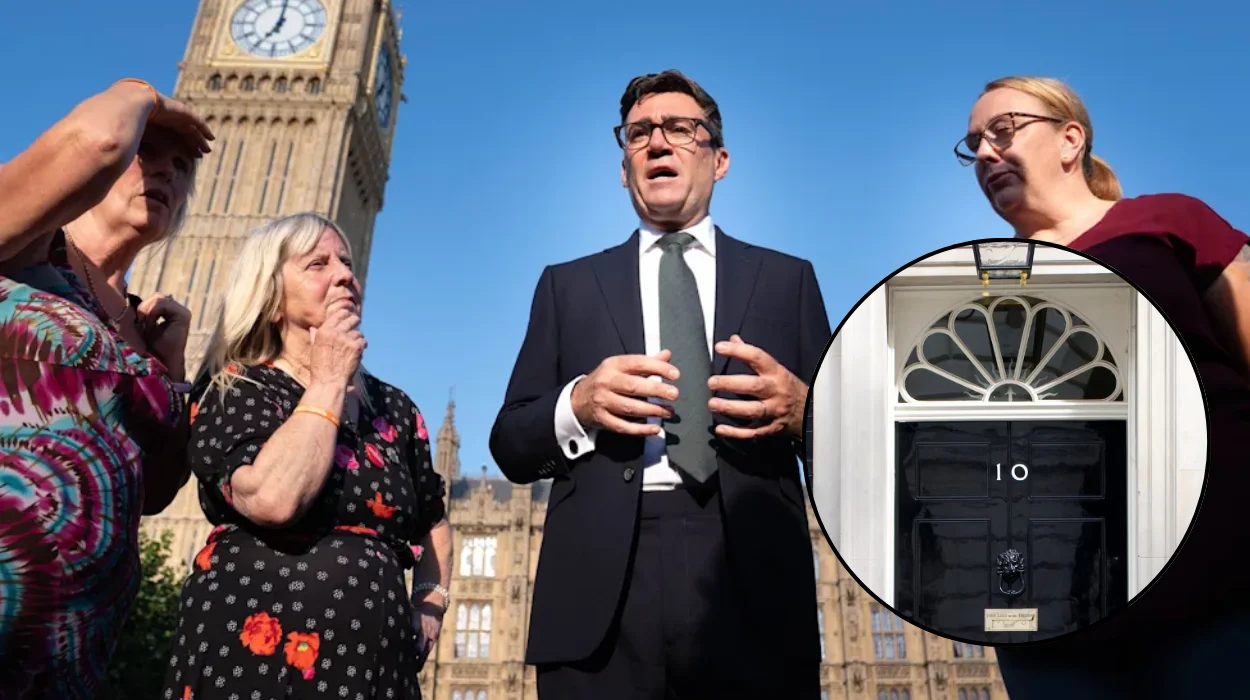
Key Points
- Andy Burnham was confirmed as leader of Britain’s governing Labour Party on Friday, 17 July 2026, clearing the final hurdle before taking office as prime minister.
- He formally moves into 10 Downing Street on Monday, when outgoing Prime Minister Sir Keir Starmer tenders his resignation to King Charles III at Buckingham Palace.
- Burnham secured nominations from 379 of the 403 Labour MPs in the House of Commons and stood unopposed for the leadership.
- In his first speech as leader, delivered at a special Labour Party conference at the Trades Union Congress headquarters in central London, Burnham pledged to build a “new politics” and called the moment the most significant shift in Britain’s politics in 40 years.
- He drew a direct contrast between his planned direction and the policies of Conservative Prime Minister Margaret Thatcher in the 1980s, blaming four decades of centralisation for hollowing out Britain’s regions.
- Burnham will become the United Kingdom’s seventh prime minister in a decade, following Rishi Sunak, Sir Keir Starmer and others amid prolonged political turbulence.
- The Greater Manchester mayor returned to Parliament only last month after winning the Makerfield by-election, having left Westminster in 2017.
- Speculation is mounting over Burnham’s first cabinet, with reports suggesting Home Secretary Shabana Mahmood could be promoted to Chancellor, potentially becoming the first Muslim woman to hold the post.
- Starmer’s departure follows sustained pressure over the government’s handling of the economy, falling living standards and internal party rebellion.
- The next general election is not required until 2029, meaning Burnham takes office without needing to seek a fresh mandate from voters immediately.
London (Britain Today News) July 17, 2026 – Andy Burnham was confirmed as leader of Britain’s Labour Party on Friday, all but completing an extraordinary rise to power for the Greater Manchester mayor, who is set to take office as prime minister on Monday. Speaking at a special party conference held at the Trades Union Congress headquarters in central London, Burnham pledged to “build a new politics” that “works for all people and places,” setting out an agenda he says will mark a decisive break from four decades of British governance.
- Key Points
- Who is Andy Burnham and how did he become Labour’s new leader?
- What did Burnham say in his first speech as Labour leader?
- Why did Burnham compare his rise to Margaret Thatcher’s era?
- How did Andy Burnham return to Parliament after leaving in 2017?
- When will Andy Burnham officially become prime minister?
- Why is Keir Starmer stepping down as prime minister?
- What challenges will Andy Burnham face as Britain’s new prime minister?
- Who might be appointed to Burnham’s cabinet?
- How has the political reaction been to Burnham’s rise?
- What does Burnham’s premiership mean for the future of British politics?
Who is Andy Burnham and how did he become Labour’s new leader?
Burnham, long nicknamed the “King of the North,” spent nearly a decade away from Westminster after standing down as an MP in 2017 to become mayor of Greater Manchester, a post he had held for three terms. His route back to national politics was unconventional. With Starmer’s popularity sliding for months, Burnham persuaded a sitting Labour MP to resign their seat, then won the resulting Makerfield by-election last month, re-entering the House of Commons for the first time since leaving it. Within weeks, he had launched and won an uncontested bid for the party leadership.
Friday’s announcement, in the end, was a formality. Burnham secured nominations from 379 of the 403 Labour MPs sitting in the Commons, leaving no rival candidate able to mount a serious challenge.
What did Burnham say in his first speech as Labour leader?
Addressing delegates at the special conference, Burnham struck a tone of humility mixed with ambition. He told the audience he wanted to serve as a leader “for all” of the country, returning repeatedly to the “for us” slogan that carried him through last month’s by-election campaign.
“I am for us, for all of us,”
he said.
“And I want people to say once again that Labour are for us.”
He also called for a reset in the tone of British politics, arguing that the public has grown weary of point-scoring between rival parties.
“We might enjoy the ‘point scoring’ against others. The public don’t,”
Burnham said, adding that voters “switch off” when politicians trade blame while living standards continue to fall.
Why did Burnham compare his rise to Margaret Thatcher’s era?
Burnham used his speech to frame his leadership as a rupture with the direction British politics has taken since the early 1980s. He argued that power had been steadily stripped from Britain’s regions and handed to Westminster and private interests over the past 40 years, a trend he traced back to the government of Conservative Prime Minister Margaret Thatcher, who pursued privatisation, deindustrialisation and political centralisation during her premiership.
“Slowly, at times imperceptibly, over four decades, political and economic power drained away out of our communities in every region and nation of the U.K.,”
Burnham told delegates, describing the change now under way as
“the most significant change moment in our politics for 40 years.”
He went further in outlining what he sees as the root cause, saying Britain took “a series of wrong turns in the 1980s” when “political power was centralised and economic power privatised.” Burnham has signalled that reversing that trend will be a defining theme of his premiership, with expected commitments to devolve greater powers to England’s cities and regions.
How did Andy Burnham return to Parliament after leaving in 2017?
Burnham’s path back to Westminster required him to give up the security of a directly elected mayoralty for the uncertainty of a parliamentary contest. Having built a reputation as one of Labour’s most recognisable regional figures, he had spent much of the past year facing recurring speculation that he might attempt to challenge Starmer, speculation he had previously dismissed as “rubbish” when it surfaced in the press.
That changed once a Westminster seat became available. Burnham stood in the Makerfield by-election and won comfortably, allowing him to re-enter the Commons as a serving MP for the first time in nearly a decade. His victory gave him the eligibility he needed under Labour’s rules, which require the party leader – and, by extension, the prime minister when Labour is in government – to hold a seat in the House of Commons.
When will Andy Burnham officially become prime minister?
Burnham’s formal transition to Downing Street will take place on Monday. Under the conventions of Britain’s parliamentary system, Sir Keir Starmer will travel to Buckingham Palace to tender his resignation to King Charles III. The King will then invite Burnham to form a new government, a step that, once accepted, makes him the country’s prime minister and First Lord of the Treasury.
Because Labour retains its majority in the Commons, no general election is required for the transfer of power. Britain’s next scheduled national election does not have to be held until 2029, meaning Burnham can take office and begin implementing his agenda without an immediate test at the ballot box.
Why is Keir Starmer stepping down as prime minister?
Starmer’s departure caps months of mounting pressure inside his own party. Although he led Labour to a landslide victory in the 2024 general election, his government faced sustained criticism over its handling of the economy, a squeeze on living standards, and a series of difficult political episodes that eroded confidence among Labour MPs. Burnham’s swift rise through the by-election and leadership contest ultimately forced the issue, with Starmer confirming he would step down as both prime minister and party leader once Burnham’s path to the top job became clear.
What challenges will Andy Burnham face as Britain’s new prime minister?
Burnham inherits a country grappling with many of the same difficulties that dogged his predecessor. Britain continues to face a sluggish economy, a cost-of-living squeeze compounded by conflicts in Ukraine and the Middle East, and public services that remain under significant strain. He will also have to manage delicate diplomatic relationships, including with the United States, at a time when transatlantic ties have grown more complicated.
Despite these pressures, Burnham has sought to strike an optimistic note, promising to restore what he has described as public “hope” in politics and pledging the
“courage to fix the big things that politics has neglected.”
He arrives in office relatively unknown to voters outside the North West of England, having given few national interviews or press conferences in the lead-up to his leadership win, and is widely regarded within Labour as one of the party’s more natural communicators, with a notably more relaxed public style than Starmer.
Who might be appointed to Burnham’s cabinet?
Attention has already turned to who will serve in Burnham’s top team once he enters Downing Street. He is expected to announce his choice for Chancellor shortly after taking office on Monday. While Energy Secretary Ed Miliband had been widely tipped for the role, reports suggest the position could instead go to Shabana Mahmood, the current Home Secretary, following pressure from trade unions and business figures who favour a more centrist figure at the Treasury. Such an appointment would make Mahmood the first Muslim woman to serve as Chancellor of the Exchequer.
Should Mahmood move to the Treasury, Miliband could be redeployed as Foreign Secretary, a shift that would leave veteran minister Yvette Cooper without a defined role unless she is handed another cabinet position. There is also speculation that John Healey could return to the defence brief. Burnham’s broader policy priorities are understood to include expanded devolution for England’s cities and regions, efforts to reduce energy costs including renewed North Sea oil exploration, and a symbolic move to bring Thames Water into public control.
Explore More about Politics:
UK Government Unveils Midnight Social Media Curfew for Teens
UK Lawmakers Back Jonathan Haskel as Next OBR Chair
How has the political reaction been to Burnham’s rise?
Burnham’s confirmation as Labour leader lands at a moment of considerable volatility in British politics, with Labour having endured a difficult stretch in the opinion polls and Reform UK, led by Nigel Farage, continuing to register strongly with voters. Burnham is seen by figures within his own party as one of Labour’s most effective campaigners, and his supporters argue that his regional profile and communication style give the party a stronger footing heading into the years before the next election.
Burnham has previously been critical of the Trump administration in Washington, and commentators have noted that navigating that relationship, alongside Labour’s contested plans to restrict social media access for under-16s, could present early friction points for his government. Domestically, his emphasis on devolving power away from London is expected to shape both the tone and substance of his first months in office.
What does Burnham’s premiership mean for the future of British politics?
Burnham’s ascent marks the seventh change of prime minister in Britain in the space of a decade, a run of instability that has become a defining feature of recent British politics. Analysts have already begun weighing how long his tenure might last, given that he inherits many of the same structural and economic pressures that shortened his predecessors’ time in office. Burnham, for his part, has framed his premiership not as a continuation of the recent past but as a genuine turning point, telling supporters that the country is “crying out” for a new approach to politics after decades of what he characterises as centralised, top-down governance.
Whether that promise translates into lasting change will become clearer once Burnham begins governing from Downing Street on Monday, when the practical business of forming a cabinet, setting a legislative programme and confronting Britain’s economic challenges gets under way in earnest.