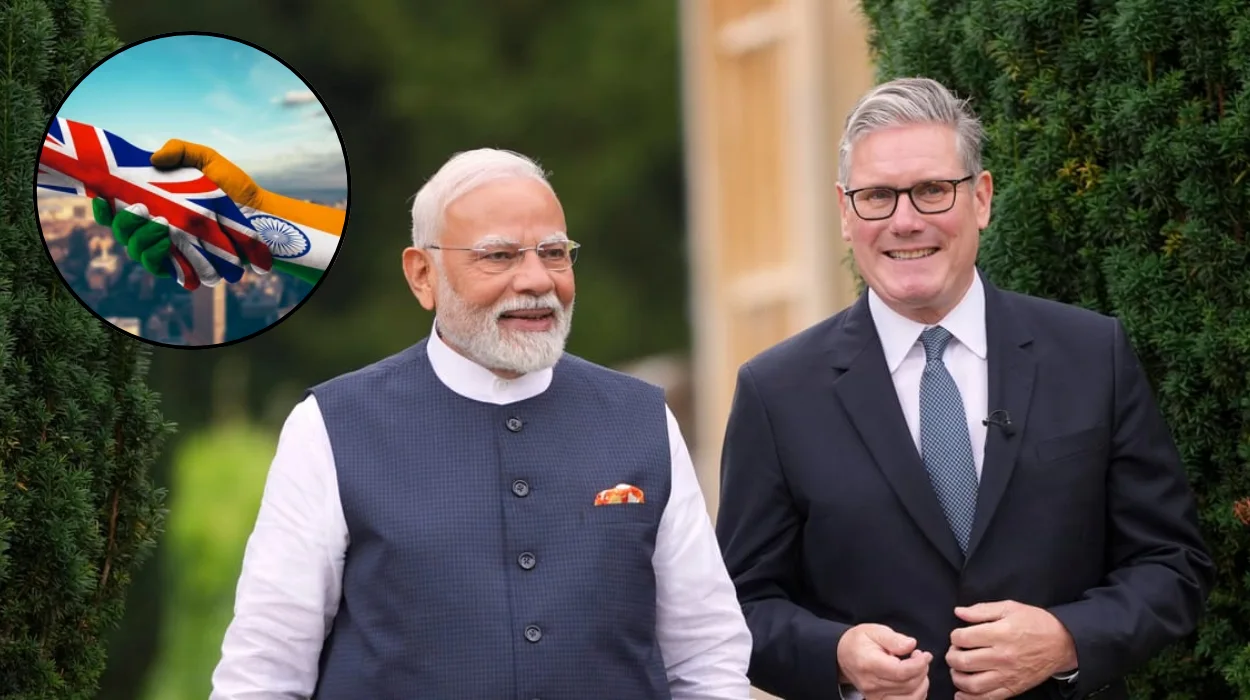
Key Points
- Prime Minister Narendra Modi calls the India-UK Comprehensive Economic and Trade Agreement (CETA) a “historic milestone” as it takes effect on 15 July 2026.
- Modi says the FTA will significantly boost bilateral trade and investment and support India’s Viksit Bharat 2047 vision.
- British High Commissioner to India Lindy Cameron confirms the Free Trade Agreement (FTA) comes into effect on 15 July 2026 and calls it a landmark moment.
- The India‑UK FTA (CETA) was signed in July 2025 after nearly three years of negotiations and aims to increase bilateral trade by an estimated £25.5 billion annually.
- The agreement delivers substantial tariff reductions across sectors — textiles, whisky, cars — and opens 99.1% of UK tariff lines at zero duty immediately.
- The Government of India expects 90.2% of India’s exports to the UK to become duty‑free, improving market access for Indian exporters.
- The FTA is expected to create thousands of jobs in textiles, leather, footwear, sports goods and engineering in both countries.
- The deal commits to doubling bilateral trade by 2030 and includes measures to support MSMEs, startups, innovators, farmers and workers.
- PM Modi and UK PM Keir Starmer discussed the pact while at the G7 Summit in Evian; both leaders welcomed the momentum it brings to economic ties.
- The India‑UK FTA forms part of a broader multi‑alignment economic approach by India, alongside advancing talks with Canada and the EU.
United Kingdom (Britain Today News) June 17, 2026 – Prime Minister Narendra Modi on Wednesday described the India‑UK Comprehensive Economic and Trade Agreement (CETA) coming into force on 15 July 2026 as a “historic milestone” that will significantly strengthen economic engagement between India and the United Kingdom and open opportunities across key sectors, while the British High Commissioner to India, Lindy Cameron, called the pact an “historic moment for the modern UK‑India partnership.”
- Key Points
- What are the headline economic gains from the India‑UK FTA?
- How will the FTA affect Indian farmers, MSMEs and startups?
- How much will trade increase and by when?
- What did leaders say while at the G7 Summit?
- What does the UK side highlight about the pact?
- How was the agreement negotiated and when was it signed?
- What are the rules on tariff lines and immediate duty relief?
- How will jobs and industries be affected in both countries?
- What commitments exist on non‑trade topics and regulatory cooperation?
- How does this pact fit into India’s broader international trade strategy?
- Will the agreement affect supply chains and investment flows?
- What safeguards and sensitive sector protections are included?
- What do business groups and industry associations say?
- What are the next steps for implementation?
- What are the political implications domestically in India and the UK?
- How does the FTA interact with ongoing talks with Canada and the EU?
As reported by Prime Minister Narendra Modi on his official X account, he said:
“A historic milestone for India‑UK relations. Delighted to note that the India‑UK Comprehensive Economic and Trade Agreement will enter into force on 15th July 2026.”
He added:
“This agreement will significantly boost our bilateral trade and investment,”
and said it
“will also unlock numerous opportunities for Indian farmers, workers, MSMEs, startups and innovators and contribute meaningfully to the realisation of Viksit Bharat 2047.”
As reported by Lindy Cameron, British High Commissioner to India, in a post on X, she wrote:
“The countdown begins! The UK and India have agreed that the Free Trade Agreement will come into effect on 15 July.”
She described the FTA as
“An historic moment for the modern UK‑India partnership, unlocking a new era of growth for both our economies.”
The announcement marks the last formal step ahead of implementation of the pact that was signed in July 2025 after almost three years of negotiations. The India‑UK FTA — officially styled the Comprehensive Economic and Trade Agreement (CETA) — aims to lift annual bilateral trade by around £25.5 billion and promises immediate tariff relief and market access changes designed to benefit exporters, manufacturers and service providers in both countries.
What are the headline economic gains from the India‑UK FTA?
The FTA provides substantial tariff reductions across a wide range of goods and sectors. Under the agreement, the UK has offered 99.1 per cent of tariff lines with 100 per cent trade value, mostly at zero duty immediately upon enforcement. The Government of India projects that 90.2 per cent of India’s exports to the UK will become duty‑free, significantly improving market access for Indian businesses.
Key sectors named for immediate benefits include textiles, leather, footwear, sports goods, engineering products, automobiles and whisky. The pact also contains tariff relief on intermediate inputs, which could lower production costs for exporters in both countries. Officials project thousands of new jobs will be created across these industries as trade expands, while services liberalisation and regulatory cooperation aim to boost bilateral investment flows.
How will the FTA affect Indian farmers, MSMEs and startups?
PM Modi emphasised that the agreement will
“unlock numerous opportunities for Indian farmers, workers, MSMEs, startups and innovators.”
The FTA contains provisions intended to support small and medium enterprises and exporters by streamlining customs procedures, reducing tariffs on key inputs and improving market access for processed agricultural products and value‑added goods.
Officials say simplified rules of origin, expedited customs clearances and technical cooperation on standards will help smaller firms scale exports to the UK market. For startups and innovators, the pact includes measures promoting regulatory cooperation on digital trade, intellectual property protections and professional services — areas India has prioritised to support its technology and services exporters.
How much will trade increase and by when?
Negotiators for both countries have set an explicit target to double bilateral trade by 2030. Independent estimates cited in official statements place potential gains at about £25.5 billion in additional annual trade. These forecasts assume tariff reductions, regulatory cooperation and enhanced market access result in higher two‑way flows of goods and services as well as increased foreign direct investment.
What did leaders say while at the G7 Summit?
As reported by Prime Minister Narendra Modi from the G7 Summit in Evian, he noted that
“Both PM Starmer and I, who are in Evian for the G7 Summit, are naturally very happy with the significant momentum being added to our economic ties.”
The remark underlines that leaders used the summit setting to highlight the bilateral achievement and to signal continued high‑level commitment to deepen strategic and economic relations.
What does the UK side highlight about the pact?
British High Commissioner Lindy Cameron framed the deal as catalysing a new era of growth, saying the agreement was
“an historic moment for the modern UK‑India partnership, unlocking a new era of growth for both our economies.”
UK officials emphasise the immediate opening of UK markets to Indian goods, particularly in sectors where India has strong export potential, and underscore expected gains in services trade and investment.
How was the agreement negotiated and when was it signed?
The FTA was signed in July 2025 following nearly three years of talks between New Delhi and London. Negotiations covered tariffs, services, investment, rules of origin, technical barriers to trade, sanitary and phytosanitary measures, intellectual property, and dispute‑settlement mechanisms. The final agreement reflects compromise across sensitive sectors while seeking higher market access on both sides.
What are the rules on tariff lines and immediate duty relief?
Under the terms announced, the UK has liberalised 99.1 per cent of its tariff lines by trade value, with most lines at zero duty on day one of implementation. India expects 90.2 per cent of its exports to the UK to become duty‑free. The deal phases some tariff changes over time for sensitive items, while putting in place safeguard mechanisms and transition periods for specific sectors to allow domestic industries to adjust.
How will jobs and industries be affected in both countries?
Both governments expect job creation in labour‑intensive and export‑oriented sectors. Indian textiles, leather, footwear, sports goods and engineering exports stand to benefit from reduced UK tariffs, potentially generating thousands of jobs across manufacturing clusters. UK producers — notably in automotive, whisky and specialised services — will gain from improved access to the Indian market, which could spur investment and employment in the UK supply chain.
What commitments exist on non‑trade topics and regulatory cooperation?
The agreement contains commitments beyond simple tariff cuts, including stronger regulatory cooperation to reduce non‑tariff barriers, provisions on digital trade, intellectual property protections and technical assistance for standards alignment. These elements are designed to facilitate smoother two‑way trade and to protect the interests of innovators, service providers and investors on both sides.
How does this pact fit into India’s broader international trade strategy?
India’s government describes the FTA with the UK as part of a wider multi‑alignment approach that seeks diversified economic partnerships. Statements alongside the CETA announcement reference parallel progress in negotiations with Canada (CEPA) and ongoing engagement with the European Union, framing the UK pact as one tangible outcome among several diplomatic and commercial advances under India’s global outreach.
Will the agreement affect supply chains and investment flows?
Yes. By lowering tariffs on inputs and finished goods and by improving regulatory alignment, the FTA aims to make supply chains between India and the UK more competitive. The enhanced predictability and market access are expected to stimulate two‑way investment: Indian firms may invest more in UK distribution and services, while UK companies may deepen manufacturing and technology partnerships in India.
What safeguards and sensitive sector protections are included?
The agreement includes phased tariff reductions and safeguard measures for sectors deemed sensitive by either side. Transitional periods are applied to certain categories to give domestic industries time to adapt while monitoring mechanisms will assess the real‑time impact on farmers, workers and specific industries. Both governments have emphasised that these protections are embedded to balance liberalisation with domestic stability.
What do business groups and industry associations say?
Industry groups in both countries welcomed the deal’s potential to expand exports and lower costs, while urging attention to implementation details. Indian exporters and trade associations have highlighted the importance of prompt and predictable customs procedures and robust rules of origin enforcement. In the UK, manufacturers and spirit producers noted the potential for market expansion in India but underlined the need for continued regulatory cooperation.
Explore More about UK:
Ryanair Passengers Stranded Athens Mega Queue Flight Leaves 2026
The UK’s Opportunity to Keep Climate Policy Out of Culture Wars
What are the next steps for implementation?
With 15 July 2026 confirmed as the entry‑into‑force date, officials in both capitals and at ports and customs agencies are preparing to implement tariff schedules, update tariff codes, train officials on new procedures and notify businesses about rules of origin and certification. Bilateral committees established under the agreement will meet to oversee implementation, resolve technical issues and monitor trade flows.
What are the political implications domestically in India and the UK?
In India, the pact is framed as a deliverable supporting the Viksit Bharat 2047 agenda — a long‑term development plan emphasising manufacturing, exports and technological advancement. In the UK, the deal is presented as an important post‑Brexit trade partnership that opens fast‑growing markets for British goods and services. Both governments will need to manage domestic political expectations by ensuring implementation benefits a broad range of stakeholders.
How does the FTA interact with ongoing talks with Canada and the EU?
Indian officials point to parallel progress with Canada — where leaders expressed satisfaction with CEPA negotiations and hope to conclude talks in 2026 — and continued engagement with the European Union on a comprehensive deal. The India‑UK pact is portrayed as part of an integrated diplomatic push to secure multiple high‑value trade partnerships that collectively expand market access and investment opportunities.
Prime Minister Narendra Modi on his official X account, he said:
“A historic milestone for India‑UK relations. Delighted to note that the India‑UK Comprehensive Economic and Trade Agreement will enter into force on 15th July 2026.”
As reported by Lindy Cameron, British High Commissioner to India, in a post on X, she said:
“The countdown begins! The UK and India have agreed that the Free Trade Agreement will come into effect on 15 July,”
and called the deal
“An historic moment for the modern UK‑India partnership, unlocking a new era of growth for both our economies.”
As reported by the Ministry of Commerce and Industry (Government of India), the agreement is expected to make 90.2 per cent of India’s exports to the UK duty‑free and improve market access substantially.
As reflected in the original text of the FTA announcement, the deal was signed in July 2025 after almost three years of negotiations and seeks to increase bilateral trade by an estimated £25.5 billion annually.