Key Points
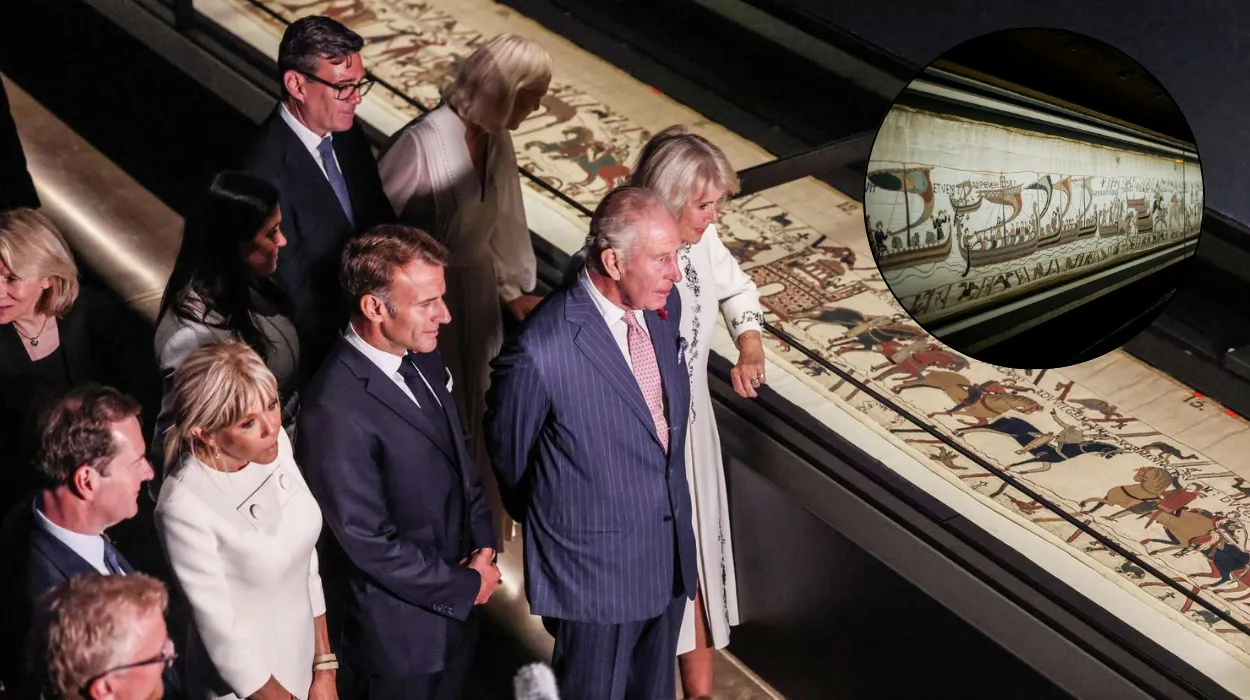
- The Bayeux Tapestry was displayed to French President Emmanuel Macron and King Charles III in the British Museum in London on 2 September 2026.
- The visit was accompanied by Queen Camilla, Brigitte Macron, Prime Minister Andy Burnham and Marie-France van Heel.
- The nearly 1,000-year-old, 70-metre Bayeux Tapestry has returned to England for the first time since it was made.
- The loan was, in King Charles’ words, a “spectacular emblem of trust and renewed Anglo-French friendship.
- The tapestry was presented by Macron and Charles as a symbol of the intermingling of the countries’ histories, and not merely as evidence of the warfare of the Middle Ages.
- The loan is contained in a broader cultural agreement in which Britain is sending Sutton Hoo treasures, Lewis chess pieces and others to French museums.
- A digital display and replicas, casts and educational activities will be travelling to communities around Britain as part of the British Museum’s programme, Bayeux Around Britain.
- Over 80,000 people lined up online at ticket release and ticket sales were in excess of £2.5m.
- The public exhibition will open on 10 September 2026 and will continue until July 2027.
- Macron and Burnham will also meet on bilateral issues related to migration, trade, energy, Ukraine and other common international issues.
London (Britain Today News) September 02, 2026 — French President Emmanuel Macron and King Charles III have hailed the historic return of the Bayeux Tapestry to England as a symbol of the close and evolving relationship between Britain and France, as they joined Prime Minister Andy Burnham and their spouses to view the medieval masterpiece at the British Museum.
- Key Points
- Why did King Charles and Emmanuel Macron visit the Bayeux Tapestry together?
- What did Emmanuel Macron say about Britain and France?
- What did Andy Burnham say about the historic loan?
- What is the Bayeux Tapestry and why is it important?
- How did the Bayeux Tapestry return to England after nearly 1,000 years?
- What is Britain lending France in return for the tapestry?
- Why has the exhibition attracted such strong public interest?
- How will Bayeux Around Britain bring the exhibition to communities?
- What educational programmes are planned around the tapestry?
- What will Macron and Burnham discuss during the wider UK visit?
- What does the Bayeux Tapestry loan mean for UK-France relations?
The visit brought together Charles, Queen Camilla, Macron, Brigitte Macron, Burnham and his wife Marie-France van Heel for a private viewing of the approximately 70-metre embroidered artwork, which depicts the events surrounding William, Duke of Normandy’s conquest of England in 1066. The tapestry has returned to British soil for the first time in almost 1,000 years under a temporary loan arrangement between France and the UK.
The British Museum has described the exhibition as an exceptional cultural event, while the UK government has linked it to a broader effort to deepen cooperation with France. The visit also launched the Bayeux Around Britain programme, intended to take the story of the tapestry beyond London through digital exhibitions, replicas, educational activities and loans to museums and heritage sites.
Why did King Charles and Emmanuel Macron visit the Bayeux Tapestry together?
The visit was both cultural and diplomatic, with the tapestry providing an unusually direct link between British and French history.
According to The Independent, journalist Maryam Zakir-Hussain reported that Charles, Camilla, Burnham, Macron and Brigitte Macron walked along the length of the 70-metre artwork, stopping at significant scenes while curators explained episodes including Harold Godwinson’s coronation and the depiction of his death at the Battle of Hastings.
The appearance of the two heads of state alongside the new British prime minister gave the exhibition a wider significance. The tapestry records a conflict that transformed England, yet its temporary return has been framed by both governments as an opportunity to emphasise centuries of connection.
King Charles, speaking at the British Museum reception, described the loan as the “best possible symbol” of the renewed “entente amicale” between France and Britain. As reported by Caroline Davies in the Guardian, the King also said that although the tapestry recounts conflict, nearly 1,000 years later it had become a “precious symbol of trust” between the two nations.
The choice of the expression “entente amicale” builds on Charles’s earlier use of the phrase to describe the modern relationship between the countries.
What did Emmanuel Macron say about Britain and France?
Macron used the historic artwork to underline the depth of the relationship between the two countries while acknowledging that disagreements remain.
Reporting from London, Le Progrès said Macron expressed the hope that France and Britain could develop a connection as close as the threads of the thousand-year-old embroidery. The report also said he stressed that the two countries do not always agree but continue to respect one another and remain open to discussion, including over the future relationship between the UK and the European Union.
The comments were significant because Macron’s visit comes against the backdrop of Britain’s departure from the EU and continuing discussions about the shape of UK-European cooperation.
The tapestry therefore served two purposes during the event. Historically, it illustrates the Norman conquest and the dramatic political transformation of England. Diplomatically, its temporary presence in London provides a highly visible example of cooperation between France and Britain.
AFP reported that Macron began a two-day visit to the UK by meeting King Charles at his London residence before joining the King and Queen for the tapestry viewing. The agency described the event as the beginning of Macron’s engagement with the new Burnham government.
What did Andy Burnham say about the historic loan?
Burnham presented the tapestry’s return as a major moment for both nations and linked the exhibition to his government’s wider approach to Britain’s relationship with France.
The UK government reported that Burnham said:
“The return of the Bayeux Tapestry to England is a landmark moment in the history of our two nations.”
He added that the Bayeux Around Britain campaign would give communities throughout the UK an opportunity to learn about one of the defining stories of the past.
Burnham also said that Britain and France could use their shared heritage as a foundation for stronger relations.
The Independent reported that during his first Prime Minister’s Questions, Burnham connected the French-British cooperation represented by the loan with other areas of bilateral cooperation. He said the arrangement was a “great example of French-British co-operation”, while referring to cooperation on small-boat crossings.
His meeting with Macron is also politically important because Macron is the first European leader to visit Britain since Burnham became prime minister, according to The Independent. The pair are scheduled to hold their first bilateral meeting at Downing Street.
What is the Bayeux Tapestry and why is it important?
The Bayeux Tapestry is an approximately 70-metre-long medieval embroidery made from wool thread on linen. It depicts events leading up to and including the Norman conquest of England, culminating in William of Normandy’s victory over Harold at the Battle of Hastings in 1066.
The British Museum says the work contains 58 scenes, 626 characters and 202 horses, alongside representations of ships, architecture, weapons, armour and aspects of medieval life. The museum describes it as an exceptional source for understanding the period in Normandy and England.
Although commonly called a tapestry, the work is technically an embroidered textile rather than a woven tapestry. Its narrative follows political and military events before the Norman victory and provides visual evidence about medieval society.
The artwork has remained closely associated with Bayeux in Normandy for centuries. Its temporary departure was made possible partly because the Bayeux Museum is undergoing a major renovation.
The British Museum has said the loan represents the first time the artwork has been displayed in the UK since its creation almost 1,000 years ago.
How did the Bayeux Tapestry return to England after nearly 1,000 years?
The return required extensive planning because of the age and fragility of the textile.
The Associated Press, in reporting by Jill Lawless, said France loaned the embroidery for a 10-month exhibition and that it was insured for €960 million, equivalent to about $1.1 billion at the time of the report. The artwork was transported from Bayeux to London through a high-security operation involving road and rail travel.
Reuters also reported that the tapestry arrived following elaborate logistical and security arrangements. The news agency said the artwork would be displayed to the public from 10 September and remain in London until July 2027.
The transportation was particularly sensitive because of the tapestry’s age. Its physical condition has long been a consideration whenever proposals have been made to move it.
The temporary loan is part of a broader reciprocal cultural arrangement rather than a one-way transfer. France has allowed the British public to see the Bayeux Tapestry while Britain is lending important historical objects to French museums.
What is Britain lending France in return for the tapestry?
The cultural agreement includes major British objects travelling in the opposite direction.
The British Museum said the exchange includes Sutton Hoo treasures and the Lewis chess pieces, along with other works from its collection. The arrangement was announced in 2025 as part of the agreement that would bring the Bayeux Tapestry to London.
The Sutton Hoo material represents Anglo-Saxon England and includes objects associated with the famous ship burial discovered in Suffolk. The Lewis chess pieces, carved from walrus ivory and dating from the 12th century, are among the most recognisable medieval archaeological objects connected with Scotland and the wider British Isles.
A UK government administrative arrangement states that the temporary loan of the nearly 70-metre Bayeux Tapestry to Britain is linked to exceptional loans of the Sutton Hoo Treasure, selected Lewis chess pieces and other masterpieces to France.
The exchange gives the agreement a wider cultural dimension. Instead of presenting the tapestry simply as a French loan, officials have positioned the arrangement as a reciprocal sharing of important European heritage.
Why has the exhibition attracted such strong public interest?
Public demand for the exhibition has been unusually high.
Reuters reported that the exhibition became the British Museum’s best-selling show after ticket sales reached approximately £2.5 million. The first tickets sold rapidly, reflecting intense interest in seeing the medieval artwork in Britain.
The Independent’s Bryony Gooch reported in July that the museum recorded its biggest single day of ticket sales in its history when tickets went on sale. Tens of thousands of people joined an online queue, with waiting times reaching several hours.
The Times subsequently reported that around 80,000 people joined the online queue, with further ticket releases planned for later exhibition periods.
The response reflects the unusual circumstances surrounding the exhibition. The tapestry has spent most of its history in Normandy, and its appearance in England provides British visitors with an opportunity to see an object directly connected with one of the defining events in the country’s medieval history.
The exhibition will officially open to the public on 10 September 2026 and is scheduled to continue until July 2027.
How will Bayeux Around Britain bring the exhibition to communities?
The British Museum is planning to extend the exhibition well beyond its London gallery through the Bayeux Around Britain programme.
According to the UK government, more than 70 partner organisations across all four nations have joined the programme. Digital versions of the tapestry are expected to appear in museums, galleries, castles, cathedrals and heritage sites around the country.
The programme is designed to address one of the central limitations of the London exhibition: not everyone can travel to the capital to see the original.
Burnham said the initiative would allow people across the country to engage with the story of the tapestry, while Culture Secretary Lisa Nandy said the project was intended to ensure that children from different backgrounds had the opportunity to encounter the work.
Nandy said:
“Britain and France have a unique shared history, and nothing symbolises it more than the Bayeux Tapestry.”
British Museum director Dr Nicholas Cullinan said the programme would ensure that the exhibition was not confined to London. He described it as the museum’s most ambitious and inclusive programme of its kind.
What educational programmes are planned around the tapestry?
Education is a central element of the wider exhibition programme.
The UK government said thousands of schoolchildren will take part in a live national history lesson on 14 October 2026, examining the significance of the Bayeux Tapestry and its place in the shared history of Britain and France.
The programme will also use digital displays to reach pupils and communities that cannot visit London.
The Stothard Cast, one of the earliest known sets of replicas made directly from the original tapestry, is also due to travel around Britain. According to FAD Magazine’s Mark Westall, the rare hand-painted plaster casts will visit venues including Hastings Museum & Art Gallery, Norwich Castle Museum & Art Gallery, the National Library of Wales, Rievaulx Abbey, The Great Tapestry of Scotland and Rochester Cathedral.
English Heritage said three of the casts will be displayed at Rievaulx Abbey in March 2027, with the objects showing scenes featuring Harold Godwinson and William, Duke of Normandy.
The Great Tapestry of Scotland will also use the opportunity to explore historical connections between Scotland, France and the Bayeux Tapestry through its Two Nations: Two Tapestries programme.
Explore More about the UK:
Scotland Police Chief Pays Tribute to Officers Killed in A66 Crash
PIA Boosts Weekly London Flights From Four To Seven
What will Macron and Burnham discuss during the wider UK visit?
The tapestry viewing forms part of a broader two-day visit by Macron.
The UK government said Macron and Burnham are expected to discuss shared challenges and opportunities involving migration, trade, energy, Russia’s aggression in Ukraine and the situation in the Strait of Hormuz.
The Independent reported that their first bilateral meeting at Downing Street is expected to include small-boat crossings, Ukraine, Iran, trade and energy, placing the cultural event within a much broader diplomatic agenda.
The discussions come as Britain continues to consider the future shape of its relationship with European partners following Brexit.
For Macron, the tapestry provides a particularly powerful backdrop because its history demonstrates how closely the development of England and France has been intertwined. For Burnham, the event offers an opportunity to demonstrate the government’s intention to strengthen cooperation with European neighbours.
The political discussions, however, remain separate from the cultural significance of the exhibition. The tapestry itself is being presented as a shared historical object rather than evidence for any single modern political position.
What does the Bayeux Tapestry loan mean for UK-France relations?
The significance of the loan extends beyond the exhibition itself.
King Charles’s description of the artwork as a symbol of trust reflects the diplomatic importance attached to its arrival. The Guardian’s Caroline Davies reported that the King pointed to the contrast between the tapestry’s depiction of medieval conflict and its role today as an expression of cooperation.
Macron likewise used the occasion to emphasise dialogue despite disagreements.
The loan also has a long diplomatic history. The Guardian reported that Macron noted that the first British request to borrow the tapestry dates back to 1931, demonstrating how long British institutions have wanted to bring the work to England.
Its arrival therefore represents the culmination of decades of interest and negotiations rather than a routine museum loan.
The reciprocal movement of cultural treasures reinforces the principle that major historical objects can become instruments of cultural diplomacy. France is sharing one of its most internationally recognised historical works with British audiences, while Britain is sending major objects associated with Anglo-Saxon and medieval history to France.
For visitors, however, the immediate significance is simpler: a textile connected to the Norman conquest of England has returned to the country whose history it depicts for the first time in nearly a millennium.
The British Museum exhibition consequently brings together history, diplomacy, education and public engagement in one event. Charles, Macron and Burnham’s appearance has given the opening an additional political dimension, but the central object remains the 70-metre medieval embroidery itself.
As the exhibition opens to the public on 10 September, the scale of ticket demand suggests that interest will extend well beyond the diplomatic ceremony. The Bayeux Tapestry is set to spend the coming months in London while replicas, digital displays and educational projects take its story to audiences across Britain — turning an extraordinary return from France into a nationwide cultural event.