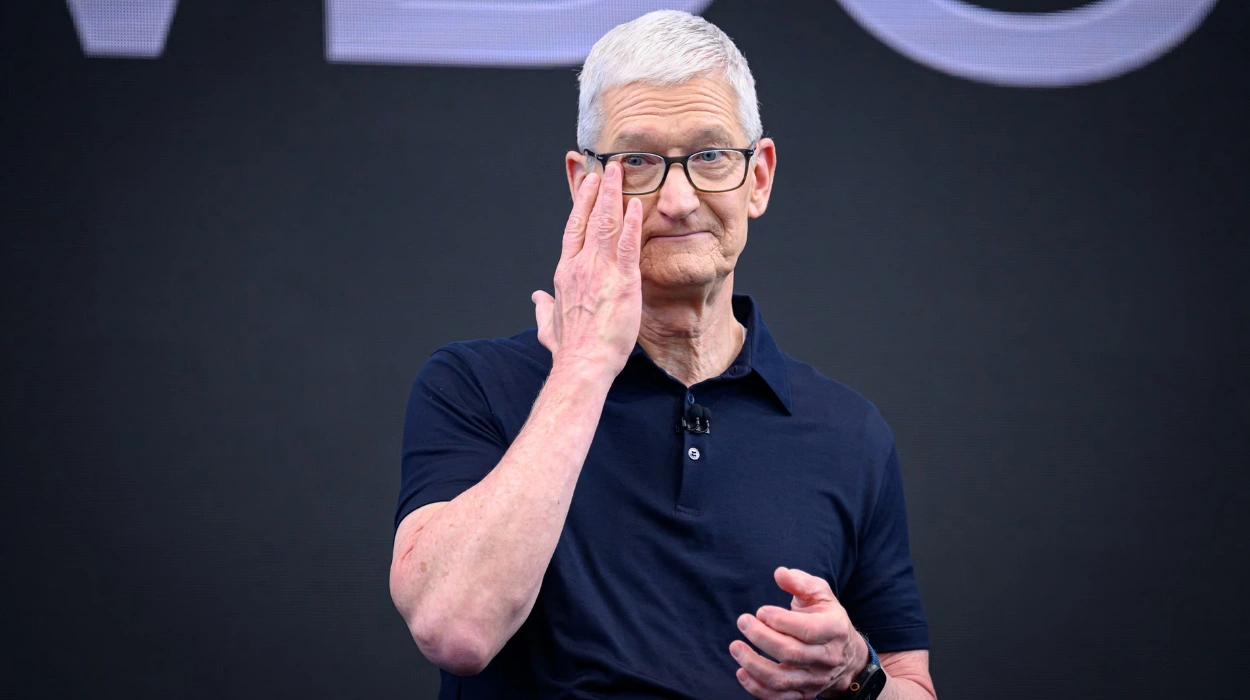
Tim Cook is an American business executive who served as Chief Executive Officer of Apple Inc. from August 24, 2011, to August 31, 2026. He succeeded Apple co-founder Steve Jobs and led the company’s expansion from a smartphone and computer maker into a global ecosystem of devices, services, and custom silicon. On September 1, 2026, Cook transitioned to Executive Chairman of Apple’s Board of Directors, and John Ternus, Apple’s former Senior Vice President of Hardware Engineering, became Apple’s new CEO. This article covers Cook’s net worth, career timeline, compensation structure, leadership record, and his current role at Apple.
- Who Is Tim Cook?
- What Is Tim Cook’s Net Worth?
- How Did Tim Cook Build His Wealth?
- How Much Apple Stock Does Tim Cook Own?
- What Is Tim Cook’s Annual Salary and Compensation?
- What Was Tim Cook’s Career at Apple?
- What Executive Roles Did Cook Hold Before Becoming CEO?
- When Did Tim Cook Become Apple CEO?
- What Were Tim Cook’s Major Achievements as CEO?
- What Is Tim Cook’s Current Role at Apple?
- What Is Tim Cook’s Personal Life?
- What Is Tim Cook’s Legacy at Apple?
- Key Facts Summary
Who Is Tim Cook?
Tim Cook is a 65-year-old American business executive, engineer, and philanthropist who led Apple Inc. as CEO for nearly 15 years and now serves as the company’s Executive Chairman. He was born Timothy Donald Cook on November 1, 1960, in Mobile, Alabama.
Cook grew up in Robertsdale, Alabama, in a middle-class household. His father, Donald Cook, worked at a shipyard, and his mother, Geraldine Cook, worked at a pharmacy. Cook attended Robertsdale High School before enrolling at Auburn University, where he earned a Bachelor of Science degree in Industrial Engineering in 1982. He later earned a Master of Business Administration from Duke University’s Fuqua School of Business in 1988.
Before joining Apple, Cook held operations and supply-chain roles at IBM for 12 years and served as Chief Operating Officer at Intelligent Electronics. He then spent six months as Vice President of Corporate Materials at Compaq Computer Corporation. Steve Jobs recruited Cook to Apple in March 1998, hiring him as Senior Vice President for Worldwide Operations.
What Is Tim Cook’s Net Worth?
Tim Cook’s net worth is estimated between $2 billion and $2.9 billion as of 2026, according to Forbes and other financial trackers. Estimates vary by source because Cook has never published a personal balance sheet, and figures rely on SEC filings and Apple stock valuation.
Forbes places Cook’s net worth at approximately $2.9 billion as of mid-2026, ranking him number 1,504 on its 2026 global billionaires list. Celebrity Net Worth estimates a lower figure of roughly $2.2 billion. GuruFocus, which calculates net worth strictly from SEC-reported insider stock holdings, estimates Cook’s Apple shareholding alone at just over $1 billion.
The variation between these figures stems from methodology. Forbes and similar outlets factor in cash accumulated from past stock sales, real estate, and other assets. GuruFocus counts only the current market value of disclosed Apple share holdings. All estimates agree that Apple stock performance is the primary driver of Cook’s wealth.
How Did Tim Cook Build His Wealth?
Tim Cook built his wealth almost entirely through Apple stock compensation rather than company founding or outside investments, distinguishing him from tech founders like Jeff Bezos or Elon Musk. As a hired executive rather than a company founder, his fortune reflects long-term equity grants tied to performance and tenure.
Cook joined Apple in 1998 with a compensation package that included a signing bonus and restricted stock units to offset benefits he forfeited by leaving Compaq. When Jobs named Cook CEO in 2011, Apple’s board awarded him a landmark grant of one million restricted stock units, then valued at roughly $376 million, vesting over ten years through 2021. This single grant became the foundation of Cook’s fortune, as Apple’s stock price rose substantially during the vesting period.
Since 2011, Apple’s market capitalisation grew from approximately $350 billion to roughly $4 trillion, a more than tenfold increase. Cook’s remaining equity holdings appreciated in step with this growth, even as he sold shares periodically to cover tax obligations and diversify his assets.
How Much Apple Stock Does Tim Cook Own?
As of April 2026 SEC filings, Tim Cook owned approximately 3.28 million shares of Apple Inc. stock, representing less than 0.03 per cent of the company’s total outstanding shares. At an Apple share price of roughly $255 in early 2026, this stake was valued at approximately $850 million to $978 million.
Cook is not Apple’s largest individual shareholder. That distinction belongs to Arthur Levinson, former non-executive chairman of Apple’s board, who holds approximately 4.07 million shares. Institutional investors own the vast majority of Apple’s stock. The Vanguard Group holds approximately 8.3 per cent of outstanding shares, and BlackRock holds approximately 6 per cent, making them Apple’s two largest shareholders overall.
Cook has sold more than $1 billion worth of Apple stock over the course of his tenure, according to Forbes calculations based on SEC Form 4 filings. A single stock sale in April 2026 netted him approximately $17 million. These periodic sales, combined with unsold holdings, contribute to the range of net worth estimates published by different outlets.
What Is Tim Cook’s Annual Salary and Compensation?
Tim Cook’s base salary has remained fixed at $3 million per year since 2016, while his total annual compensation, including stock awards and bonuses, reached $74,294,811 in fiscal year 2025. This total compensation was approximately 533 times the median Apple employee’s annual pay, according to Apple’s proxy statement.
Apple’s 2026 proxy filing (DEF 14A) itemises Cook’s fiscal 2025 compensation as follows: a $3 million base salary, a $12 million cash bonus tied to company revenue and operating income targets, $57.5 million in performance-based restricted stock unit awards, and approximately $1.7 million covering personal security and private air travel. Apple has required Cook to use company aircraft, a Gulfstream jet, for all business and personal travel since 2017, a policy the company attributes to security considerations rather than personal preference.
Cook’s compensation structure has shifted over his tenure from primarily salary-based to overwhelmingly stock-based, aligning his personal financial outcomes with Apple’s long-term share performance rather than short-term earnings.
What Was Tim Cook’s Career at Apple?
Tim Cook joined Apple in March 1998 as Senior Vice President for Worldwide Operations and was promoted through several executive roles before becoming CEO in August 2011. His original mandate was to overhaul Apple’s supply chain, which he accomplished by closing factories and warehouses and shifting to contract manufacturing partnerships.
When Cook joined Apple, the company held months of unsold inventory sitting in warehouses. Within roughly a year, he reduced this to days, a transformation Steve Jobs later credited as instrumental to Apple’s operational turnaround. Cook’s supply-chain restructuring included forging Apple’s long-term manufacturing relationship with Foxconn in China, which became central to Apple’s ability to produce iPhones, iPads, and other devices at global scale.
What Executive Roles Did Cook Hold Before Becoming CEO?
Tim Cook held three major executive titles at Apple before his 2011 CEO appointment: Senior Vice President of Worldwide Operations (1998), Executive Vice President of Worldwide Sales and Operations (2005), and Chief Operating Officer (2007). Each promotion expanded his authority over Apple’s global business functions beyond manufacturing and logistics.
As COO starting in 2007, Cook assumed responsibility for Apple’s sales, service, and support operations in addition to operations and supply chain management, effectively becoming the company’s second-highest-ranking executive. During this period, he also served as Acting CEO on three separate occasions when Jobs took medical leave: in 2004, from January to June 2009, and from January 2011 until Jobs’s formal resignation in August 2011.
When Did Tim Cook Become Apple CEO?
Tim Cook became Apple’s permanent CEO on August 24, 2011, following Steve Jobs’s resignation due to declining health from pancreatic cancer. Jobs, who remained Apple’s chairman until his death, wrote in his resignation letter that Cook should be his successor, a recommendation the Apple board unanimously approved.
Jobs died on October 5, 2011, six weeks after Cook’s appointment. Cook inherited a company widely viewed as inseparable from its co-founder’s personal vision, and many industry analysts at the time questioned whether Apple could sustain its innovation and growth trajectory without Jobs. Cook addressed this scepticism by shifting Apple’s strategic emphasis toward operational discipline, services expansion, and incremental product refinement rather than the disruptive product launches that defined the Jobs era.
What Were Tim Cook’s Major Achievements as CEO?
Under Tim Cook’s leadership from 2011 to 2026, Apple’s market capitalisation grew from approximately $350 billion to roughly $4 trillion, making it the first publicly traded U.S. company to reach $1 trillion in market value in 2018. Cook also diversified Apple’s revenue beyond hardware sales by building a large-scale services business.
Three areas define Cook’s tenure as CEO. First, financial growth: Apple’s revenue and profit more than doubled within the first decade of his leadership, driven by sustained iPhone demand and expansion into new product categories including the Apple Watch, launched in 2015, and AirPods, launched in 2016. Second, services diversification: Apple Music, Apple TV+, Apple Pay, iCloud, and the App Store collectively grew into a services segment generating tens of billions of dollars in annual revenue, reducing Apple’s historical dependence on iPhone sales alone. Third, supply chain and manufacturing: Cook expanded Apple’s custom silicon strategy, transitioning Mac computers from Intel processors to Apple-designed chips beginning in 2020, a move that improved performance and profit margins across the product line.
Cook also expanded Apple’s public commitments on environmental sustainability, privacy policy, and corporate social responsibility, positioning these areas as core elements of Apple’s brand identity rather than peripheral initiatives.
What Is Tim Cook’s Current Role at Apple?
Tim Cook became Apple’s Executive Chairman of the Board of Directors on September 1, 2026, after stepping down as CEO the previous day. In this role, Cook focuses on strategic matters and Apple’s relationships with policymakers and governments worldwide, rather than day-to-day operational leadership.
Apple announced the leadership transition on April 20, 2026, stating that the change followed a long-term succession planning process unanimously approved by the board of directors. Cook remained CEO through the summer of 2026 to oversee a structured handover before his final day in the role on August 31, 2026. Bloomberg reported that Cook’s responsibilities as Executive Chairman include managing Apple’s relationships with the U.S. presidential administration and the Chinese government, two relationships he cultivated extensively during his time as CEO.
Arthur Levinson, who had served as Apple’s non-executive chairman for the prior 15 years, became lead independent director effective the same date, September 1, 2026.
Who Replaced Tim Cook as Apple CEO?
John Ternus, Apple’s former Senior Vice President of Hardware Engineering, became Apple’s CEO on September 1, 2026, ending Cook’s nearly 15-year tenure in the role. Ternus, 51, is a 25-year Apple veteran who joined the company’s product design team in 2001.
Ternus studied mechanical engineering at the University of Pennsylvania, graduating in 1997, and briefly worked designing virtual-reality headsets before joining Apple. He rose through Apple’s hardware organisation, becoming Vice President of Hardware Engineering by 2013. In January 2021, he was promoted to Senior Vice President of Hardware Engineering, succeeding Dan Riccio, who stepped aside to focus on the Vision Pro headset project. During his tenure overseeing hardware, Ternus held responsibility for product development across the iPhone, iPad, Mac, and AirPods lines.
Apple’s official succession filing describes Ternus as bringing extensive executive leadership experience in engineering, product design, and innovation to the board. Cook publicly praised Ternus’s character and product intuition in his transition announcement to Apple employees, stating confidence in his successor’s ability to lead the company forward.
Ternus’s first major public event as CEO is Apple’s “Surprise and Shine” product event, scheduled for September 9, 2026, expected to serve as his inaugural keynote presentation. Apple’s product roadmap under Ternus includes iOS 27, macOS 27, a Siri overhaul incorporating artificial intelligence, new Apple Watch models, and reported development of Apple’s first foldable iPhone.
What Is Tim Cook’s Personal Life?
Tim Cook has never married and publicly disclosed that he is gay in a 2014 essay published by Bloomberg Businessweek, becoming the first CEO of a Fortune 500 company to do so while in office. He maintains a private personal life and rarely discusses relationships publicly.
Cook was raised in a Baptist household in Alabama and has described his religious upbringing as influential to his personal values, though he maintains a private stance on religious practice as an adult. He has stated publicly that he intends to donate the majority of his wealth to philanthropic causes before his death, following a pledge similar to the Giving Pledge established by Warren Buffett and Bill Gates.
Cook has directed philanthropic giving toward causes including educational access, environmental conservation, and civil rights organisations. He has also served on the board of directors of Nike Inc., where SEC filings show he holds approximately 130,480 shares of Nike stock, worth over $5 million.
Explore More about Business:
Motley Fool Stock Analysis: Best Picks for Long-Term Growth
Monzo App Not Working? Latest Issues and Fixes
What Is Tim Cook’s Legacy at Apple?
Tim Cook’s legacy centres on transforming Apple from a company defined by a single visionary founder into a durable, diversified corporate institution capable of sustaining growth after founder-led leadership ended. Financial analysts frequently cite Apple’s transition from approximately $350 billion to $4 trillion in capitalisation as the clearest quantitative measure of this achievement.
Cook’s approach differed fundamentally from Jobs’s product-first, secrecy-driven management style, emphasising operational efficiency, supply chain mastery, and steady incremental improvement over the kind of disruptive product revolution that characterised Apple under Jobs. Critics during his tenure periodically argued that Apple deprioritised refinement over radical innovation, pointing to extended product cycles for major new categories. Supporters counter that Cook’s operational rigour and services diversification insulated Apple from smartphone market saturation risks that affected competitors more severely.
As Apple enters its post-Cook era under John Ternus, the company faces new strategic questions centred on artificial intelligence competitiveness, a domain where rivals including Google, Microsoft, and OpenAI have moved aggressively. Cook’s continued involvement as Executive Chairman, particularly in government and regulatory relationships, suggests his influence over Apple’s strategic direction will persist even after his departure from day-to-day operational control.
Key Facts Summary
| Category | Detail |
|---|---|
| Full Name | Timothy Donald Cook |
| Born | November 1, 1960, Mobile, Alabama |
| Education | Auburn University (B.S. Industrial Engineering, 1982); Duke University Fuqua School of Business (MBA, 1988) |
| Joined Apple | March 1998, as SVP Worldwide Operations |
| Became CEO | August 24, 2011 |
| Left CEO Role | August 31, 2026 |
| Current Role | Executive Chairman, Apple Board of Directors (since September 1, 2026) |
| Successor | John Ternus, effective September 1, 2026 |
| Estimated Net Worth (2026) | $2 billion–$2.9 billion |
| Base Salary | $3 million annually (since 2016) |
| FY2025 Total Compensation | $74,294,811 |
| Apple Shares Held (April 2026) | Approximately 3.28 million |
This article reflects publicly available information as of September 2026 and will require updates as Apple’s leadership transition progresses and financial disclosures are updated in future proxy filings.