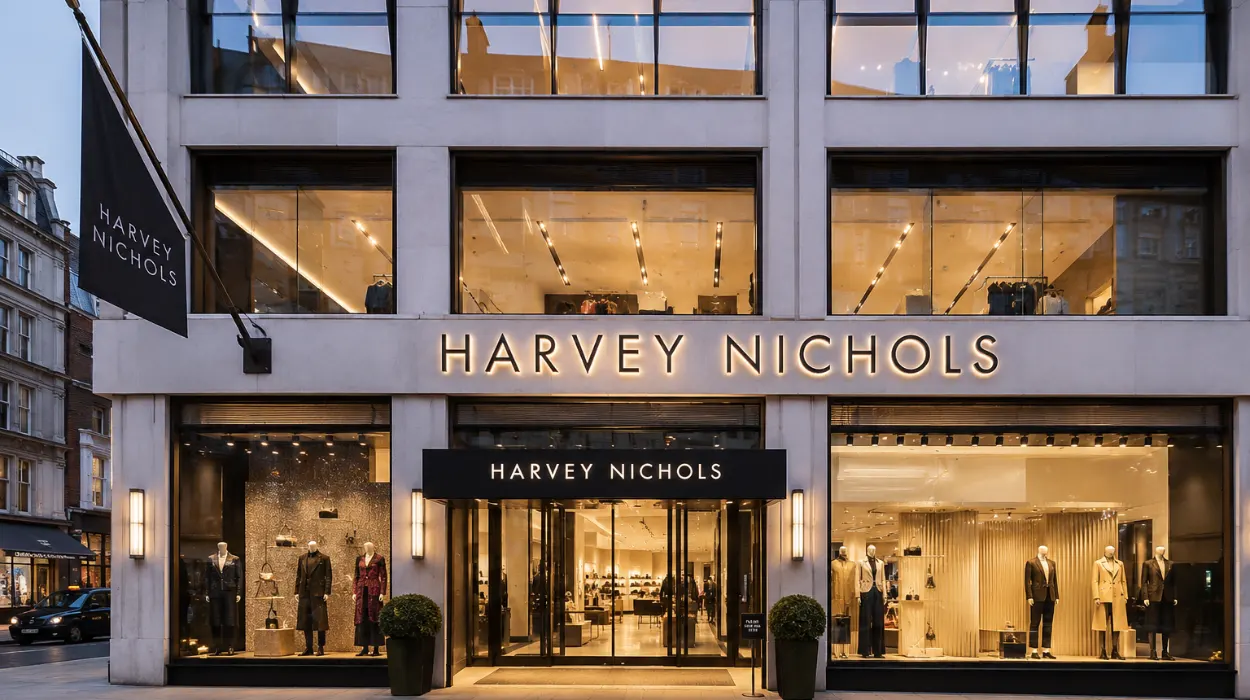
Harvey Nichols is a British luxury department store chain headquartered in Knightsbridge, London. The company sells designer fashion, prestige beauty products, fine food, and wine across the United Kingdom, Ireland, and several franchise markets in the Middle East and Asia. Founded in 1831, Harvey Nichols has operated for 195 years as a central reference point in British luxury retail. In August 2026, ownership of the company changed hands through a pre-pack administration process, marking the most significant structural shift in its modern history.
- What Is Harvey Nichols?
- When Was Harvey Nichols Founded and by Whom?
- Who Has Owned Harvey Nichols Throughout Its History?
- Where Are Harvey Nichols Stores Located?
- What Role Has Harvey Nichols Played in British Fashion Culture?
- What Happens to Harvey Nichols Under Frasers Group Ownership?
- Why Does Harvey Nichols Matter to UK Luxury Retail?
What Is Harvey Nichols?
Harvey Nichols is a British luxury department store group founded in 1831, selling designer fashion, beauty, food, and wine from a flagship store in Knightsbridge, London, and additional branches across the UK, Ireland, and franchise territories in the Middle East.
The company operates as Harvey Nichols Group Limited, trading under the name Harvey Nichols. Its core business model centres on multi-brand retail: a single store houses hundreds of third-party fashion and beauty labels alongside food halls and hospitality venues. This model distinguishes department stores from single-brand boutiques, as customers can browse multiple designers, cosmetics houses, and food producers under one roof. Harvey Nichols is often referred to informally as “Harvey Nicks.” The flagship store sits at 109–125 Knightsbridge, close to Harrods and Sloane Street, in one of London’s principal retail districts. As of 2025, the group operated 13 store locations across its owned and franchise network, spanning the United Kingdom, Ireland, China, Kuwait, Qatar, Saudi Arabia, and the United Arab Emirates.
When Was Harvey Nichols Founded and by Whom?
Benjamin Harvey founded Harvey Nichols in 1831 as a small linen shop on the corner of Knightsbridge and Sloane Street in London. The business became Harvey Nichols & Co. in 1850 following a partnership between Harvey’s widow and shop assistant James Nichols.
Benjamin Harvey opened his linen shop in a terraced house in 1831. By 1835, four years after opening, Harvey expanded into the adjoining property at No. 8, beginning a pattern of incremental growth that continued for decades. In 1841, Harvey employed James Nichols, a shop assistant from Oxfordshire. Nichols was promoted to a management role in 1845 and married Harvey’s niece, Anne Beale, in 1848. Benjamin Harvey died in 1850. His widow, Anne, entered a business partnership with James Nichols, forming the company Harvey Nichols & Co. The pairing of the two surnames created the brand name still used today. Anne Harvey died in 1872, and James Nichols died in 1873, leaving Benjamin Charles Harvey, the founder’s son, as the sole remaining partner. By 1874, the business occupied the entire block between Seville Street and Sloane Street.
How Did the Flagship Store Take Its Current Form?
Architect C. W. Stephens designed the current Harvey Nichols flagship building, constructed between 1889 and 1894 after the original properties were demolished to accommodate a purpose-built department store.
Stephens also designed the façade of Harrods and the Claridge’s hotel extension, giving Knightsbridge several buildings sharing a common architectural lineage. Construction of the new Harvey Nichols building began in 1889 and finished in 1894, replacing the row of converted terraced houses that had served the business since 1831. The address was formally changed to 109–125 Knightsbridge in 1904, although the physical location remained unchanged. The building’s red-brick exterior and multi-level layout established the template still recognisable in the store today. In 1919, the store expanded its department offering to include haberdashery and hosiery.
Who Has Owned Harvey Nichols Throughout Its History?
Harvey Nichols changed ownership four times: Debenhams acquired it in 1920, the Burton Group bought it in 1985, Hong Kong businessman Sir Dickson Poon purchased it in 1991, and Frasers Group completed a takeover in August 2026.
Debenhams acquired Harvey Nichols in 1920, integrating it into a wider department store portfolio. The company remained under Debenhams’ ownership for 65 years. In 1985, the Burton Group, a British retail conglomerate, purchased Debenhams along with Harvey Nichols. This ownership period lasted six years. In October 1991, Dickson Poon, through his company Dickson Concepts, acquired Harvey Nichols for £53.6 million. Poon’s ownership, which lasted 35 years, oversaw the store’s transformation into an internationally recognised luxury retail brand, including its expansion beyond London.
Why Did Harvey Nichols Change Ownership in 2026?
Harvey Nichols reported a pre-tax loss of £34 million and a 5% revenue decline in its most recent financial year, prompting owner Sir Dickson Poon to appoint advisers and initiate a sale process that concluded with a Frasers Group acquisition in August 2026.
Company filings for the 52 weeks ending March 29, 2025, showed the retailer’s accounts prepared on a break-up basis rather than a going-concern basis, reflecting the expectation of a sale or wind-down. Director Julia Goddard stated that without a completed sale or additional funding, the group would cease trading. Multiple retail groups expressed interest during the sale process, including Next plc, Mike Ashley’s Frasers Group, and Modella Capital, a private equity firm known for acquiring distressed UK retailers such as Hobbycraft and the UK arm of Claire’s. Frasers Group, which already held stakes in Hugo Boss, Mulberry, and Burberry and owned House of Fraser and Flannels, emerged as the frontrunner. On August 13, 2026, Frasers Group completed the acquisition of Harvey Nichols Group through a pre-pack administration process, with more than 1,000 employees transferring to the new ownership structure. Analysts estimated the transaction value at approximately £40 million, reflecting the retailer’s financial distress rather than a valuation based on historic brand equity. The Knightsbridge flagship building itself is leased rather than owned, with approximately five years remaining on the lease as of the acquisition; the freehold belongs to Cadogan, the principal landowner across Chelsea and Knightsbridge.
Where Are Harvey Nichols Stores Located?
Harvey Nichols operates directly owned stores in Knightsbridge, Leeds, Edinburgh, Manchester, Birmingham, Bristol, and Dublin, alongside franchise locations in Hong Kong, Dubai, Riyadh, Kuwait, and Doha.
The Knightsbridge flagship remains the company’s headquarters and largest store, spanning seven floors of fashion, beauty, food, and wine. Harvey Nichols opened its first store outside London in Leeds in 1996, housed in the city’s Victoria Quarter. The Edinburgh store opened in St Andrew Square in 2002, following Harvey Nichols’ interest in establishing a Scottish presence. The Manchester store opened the same year, in 2002, on New Cathedral Street, as part of the city’s rebuilding program following a 1996 bombing; the store sits adjacent to Selfridges. Additional UK stores operate in Birmingham and Bristol, while a Dublin location extends the brand into the Irish market. International franchise stores in Hong Kong, Dubai, Riyadh, Kuwait, and Doha operate under licensing arrangements rather than direct ownership, meaning these locations were not included in the 2026 Frasers Group acquisition.
What Products and Departments Does Harvey Nichols Sell?
Harvey Nichols stocks designer fashion, prestige beauty and fragrance brands, accessories, homeware, and gourmet food and wine, typically organised across multiple floors with dedicated men’s, women’s, beauty, and food departments.
The Knightsbridge flagship dedicates its lower ground floor primarily to men’s fashion, including footwear, denim, tailoring, and accessories. The ground floor is dedicated chiefly to beauty products, perfumes, and accessories, positioning cosmetics and fragrance as the first category customers encounter upon entry. Fashion brands stocked across Harvey Nichols locations include Gucci, Valentino, Stella McCartney, Alexander McQueen, Loewe, and Vince, among hundreds of others spanning ready-to-wear, footwear, and accessories. Beauty brands carried in-store include Armani Beauty, Lancôme, Cartier fragrance, and Balmain Beauty. Each UK store includes a Foodmarket, typically located on an upper floor, stocking confectionery, condiments, and store-cupboard staples alongside the retailer’s own-label food and wine range. The Knightsbridge store’s Fifth Floor houses a café, bar, and Foodmarket combination that has operated since a major 1990s refurbishment.
What Role Has Harvey Nichols Played in British Fashion Culture?
Harvey Nichols pioneered mixed-brand fashion floors in the 1980s, became a recurring cultural reference through the sitcom Absolutely Fabulous in the 1990s, and served as a regular retail destination for Diana, Princess of Wales.
During the 1980s, under Burton Group ownership, Harvey Nichols encouraged designers including Max Mara and Nicole Farhi to create multi-piece collections rather than single-department ranges, a departure from prevailing department store conventions. Four of the store’s six floors were devoted to fashion during this period, with a dedicated basement zone, branded “Zone,” targeting teenage shoppers. The store’s first standalone restaurant, named Harvey’s, opened on the fifth floor in 1975 and became a favoured dining spot for Diana, Princess of Wales, who reserved a table at the back of the restaurant. In 1996, Harvey Nichols opened the OXO Tower Restaurant, Bar, and Brasserie on London’s South Bank, its first restaurant venture located away from a department store site, offering views across the River Thames. The store gained further cultural visibility through repeated references in Absolutely Fabulous, a British sitcom that aired through the 1990s and became one of the decade’s most recognised comedies, cementing Harvey Nichols as shorthand for aspirational London fashion retail.
Who Has Led Harvey Nichols as Chief Executive?
Joseph Wan served as Harvey Nichols CEO for 21 years before Stacey Cartwright succeeded him in February 2014; Cartwright departed in April 2018, after which Julia Goddard became CEO roughly two years before the 2026 ownership change.
Joseph Wan’s 21-year tenure spanned much of the company’s expansion beyond London, including the Leeds, Edinburgh, and Manchester store openings. Stacey Cartwright took over as CEO on February 17, 2014, and led the company for just over four years before leaving on April 30, 2018. Following Cartwright’s departure, Daniela Rinaldi and Manju Malhotra jointly took charge of company leadership. In the financial year ending March 30, 2019, Harvey Nichols generated revenue of £229 million under this leadership structure. Julia Goddard later became CEO, taking the role approximately two years before the August 2026 sale, and was reported to have driven a performance improvement at the London flagship store during her tenure, even as the wider group faced mounting losses.
What Happens to Harvey Nichols Under Frasers Group Ownership?
Frasers Group, led by CEO Michael Murray and majority shareholder Mike Ashley, completed its acquisition of Harvey Nichols on August 13, 2026, adding the retailer to a luxury portfolio that already includes House of Fraser, Flannels, and stakes in Hugo Boss, Mulberry, and Burberry.
The acquisition transferred more than 1,000 employees to Frasers Group as part of the deal. Reports ahead of the transaction indicated Mike Ashley expected the business to sell for no more than £40 million, reflecting a pre-pack administration structure that allows a buyer to acquire operating assets while leaving certain liabilities behind. This structure gives Frasers Group greater flexibility to restructure the business than a standard going-concern acquisition would allow. Frasers Group’s existing luxury retail experience, built through Flannels and its investments in premium fashion houses, positions the company to integrate Harvey Nichols into a broader strategy spanning sport, high-street, and luxury retail formats. The franchise stores in Hong Kong, Dubai, Riyadh, Kuwait, and Doha were not included in the UK acquisition, as these operate under separate licensing agreements with local partners. Industry commentary noted that some beauty and fashion brands had expressed reservations about a Frasers-led ownership structure prior to the deal completing, though Frasers CEO Michael Murray publicly disputed reports of brand reluctance, citing the company’s payment record and continued investment in retail expansion.
Explore More about Business:
Coughlans Bakery: Menu, Cakes, Bread and Customer Favourites
Peter Ruis: Latest News, Profile and Career Updates
Why Does Harvey Nichols Matter to UK Luxury Retail?
Harvey Nichols represents one of the United Kingdom’s longest-running luxury retail institutions, and its 2026 ownership change reflects broader pressures facing premium department stores, including reduced tourist spending and declining luxury goods demand.
The removal of VAT-free shopping for international tourists following the UK’s departure from the European Union reduced a significant revenue stream for London luxury retailers, Harvey Nichols among them. Combined with a broader downturn in global luxury goods spending over the five years preceding the 2026 sale, these pressures contributed directly to the retailer’s financial difficulties despite continued investment in refurbishing the Knightsbridge flagship. The company’s near two-century operating history means its ownership changes carry symbolic weight beyond their immediate commercial terms, given the store’s association with British fashion retail since the Victorian era. Harvey Nichols’ trajectory under new ownership will influence how other legacy department stores navigate similar pressures, including changing consumer shopping habits, e-commerce competition, and the increasing consolidation of independent retail brands under larger conglomerate structures. The outcome of the Frasers Group integration, including decisions on the Knightsbridge lease renewal and the future shape of the regional store network, will determine whether Harvey Nichols continues operating as a standalone luxury brand or is absorbed more fully into Frasers Group’s wider retail architecture.