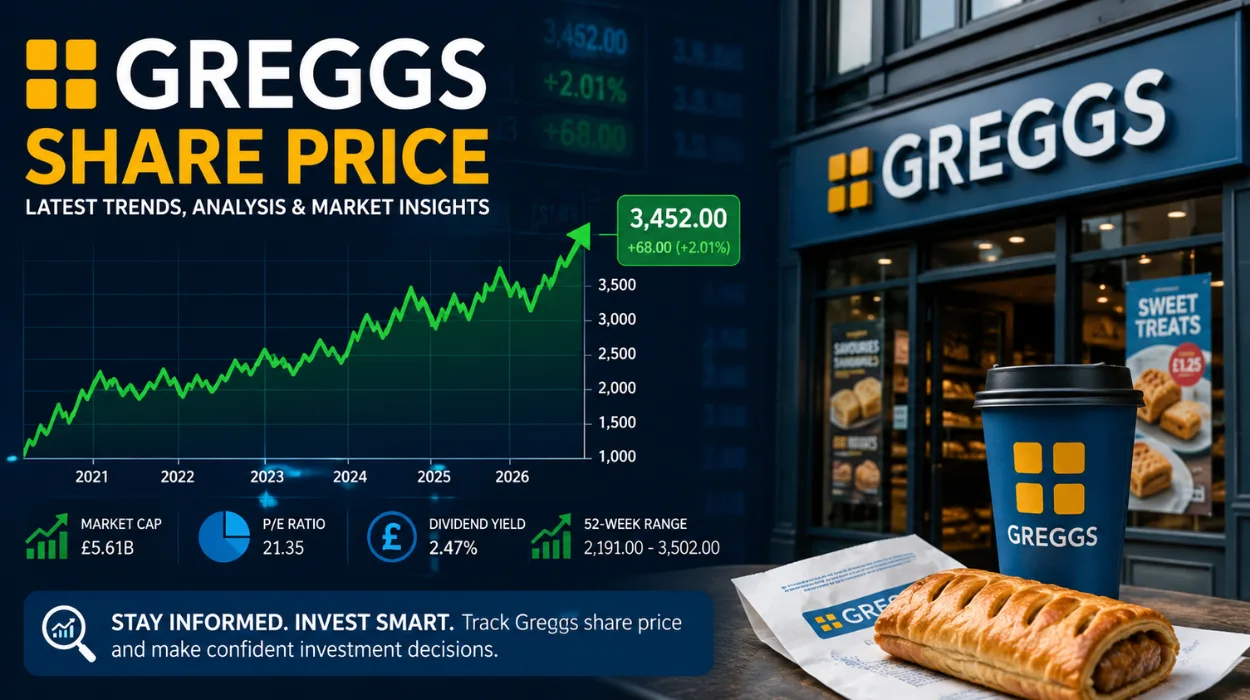
Greggs plc is a British bakery and food-on-the-go retailer listed on the London Stock Exchange under the ticker GRG. The company’s share price reflects consumer demand, food-to-go market share, cost inflation, and broader retail sector performance. This article examines the structure, history, drivers, and outlook of the Greggs share price for investors and researchers seeking a factual, data-based reference.
- What Is Greggs plc and What Does the Company Do?
- What Is the Current Greggs Share Price?
- How Has the Greggs Share Price Performed Historically?
- What Factors Influence the Greggs Share Price?
- What Do Greggs’ Financial Results Reveal About Share Price Trends?
- How Does Greggs Compare to Its Industry Peers?
- What Are Analysts Forecasting for Greggs Shares?
- What Are the Risks Facing Greggs Investors?
- What Is the Future Outlook for Greggs Share Price?
What Is Greggs plc and What Does the Company Do?
Greggs plc is a UK bakery and food-on-the-go chain founded in 1939 in Gosforth, Newcastle upon Tyne, by John Gregg. It operates more than 2,500 shops, employs approximately 33,000 people, and trades on the London Stock Exchange under ticker GRG.
Greggs began as a bread and cake delivery business using bicycles around Newcastle. The company incorporated as Greggs Bakeries Limited in 1951 and later became Greggs plc following its 1984 stock market listing. Its core business sells fresh bakery products, including sausage rolls, pastries, sandwiches, pizzas, cakes, doughnuts, and baguettes, through company-managed shops, franchise outlets, and delivery partnerships. Greggs operates two reporting segments: company-managed retail activities, which generate the majority of revenue, and a business-to-business channel supplying wholesale and franchise partners. The company is vertically integrated, operating its own bakery and distribution network across the UK. Roisin Currie serves as Chief Executive, and Ian Durant serves as Group Chairman. For the 2025 financial year, Greggs reported revenue of £2,151.2 million, operating income of £187.5 million, and net income of £122.2 million.
What Is the Current Greggs Share Price?
Greggs shares (LSE: GRG) trade in British pence (GBp) on the London Stock Exchange main market. The share price fluctuates during trading hours based on buy and sell order volume, company announcements, and broader FTSE 250 index movements.
Greggs is a constituent of the FTSE 250 index, the segment of the London Stock Exchange covering companies ranked 101st to 350th by market capitalisation. The company’s market capitalisation has fluctuated between approximately £1.7 billion and £1.96 billion across recent trading periods, with roughly 102 million shares in issue. Live share price data for GRG is available through the London Stock Exchange website, Yahoo Finance, and licensed stockbroker platforms. The share price is quoted in pence per share; a quote of 1,900p is equivalent to £19.00 per share. Investors track the price alongside key metrics including the price-to-earnings (P/E) ratio, earnings per share (EPS), dividend yield, and trading volume, all of which contextualise whether the current price reflects the company’s underlying financial performance.
Key Trading Metrics for Greggs Shares
Greggs’ trailing twelve-month P/E ratio has recently stood at approximately 16.2, with trailing EPS of approximately 119p. The forward dividend has been set at 69p per share, equivalent to a dividend yield near 4.1% at prevailing price levels. The company’s ex-dividend date in 2026 fell on 30 April. Trading beta, a measure of volatility relative to the broader market, has been recorded between 1.15 and 1.43, indicating the stock experiences larger price swings than the FTSE 250 index average.
How Has the Greggs Share Price Performed Historically?
Greggs listed on the London Stock Exchange on 27 April 1984 at 135 pence per share, with a market capitalisation of £15 million and 261 shops. A 10-for-1 stock split occurred in 2009. The share price has since risen substantially over four decades, despite periods of sharp decline.
At its 1984 flotation, Greggs generated £37 million in annual sales and operated primarily in northern England. The company used IPO proceeds to fund expansion, opening new regional divisions in Birmingham in 1984, South Wales in 1985, and north London in 1986. By 1994, a decade after listing, Greggs operated more than 500 stores across seven regional divisions. That year, the company acquired the retail baking interests of Allied Bakeries Limited, adding 424 shops and the Bakers Oven brand, nearly doubling its estate. The 2009 stock split divided each existing share into ten shares, adjusting the nominal share price without changing overall shareholder value. Long-term returns have been substantial: 100 shares purchased at the 1984 IPO price, adjusted for the 2009 split, would have grown into 1,000 shares. Including share price appreciation and reinvested dividends, an original £135 investment has generated returns exceeding £18,000 in share value alone, plus approximately £7,000 in cumulative dividend payments, according to historical return calculations published in 2025.
Recent Share Price Volatility
The share price has shown significant volatility in recent trading years. During 2025, Greggs shares declined by nearly 50% from prior highs, falling from levels above 2,800p to a 52-week low of 1,407.20p. Single trading sessions in mid-2025 saw declines of 13.7% and 15.2% following earnings updates, with trading volumes reaching more than 9.5 million shares in a single day, several times the average daily volume of approximately 1.29 million shares. The share price subsequently recovered through 2026, reaching a 52-week high of 1,929.00p by late July 2026, coinciding with the release of improved half-year financial results.
| Metric | Value |
|---|---|
| IPO price (1984) | 135p |
| IPO market capitalisation | £15 million |
| Stock split | 10-for-1 (2009) |
| 52-week low | 1,407.20p |
| 52-week high | 1,929.00p |
| Trailing P/E ratio | ~16.2 |
| Forward dividend yield | ~4.1% |
| Market capitalisation (2026) | ~£1.95–1.96 billion |
What Factors Influence the Greggs Share Price?
The Greggs share price responds to like-for-like sales growth, food-to-go market visit share, input cost inflation, wage costs, new store openings, menu innovation, and macroeconomic conditions affecting UK consumer spending.
Like-for-like (LFL) sales growth, which measures sales performance at shops open for more than a year, is a primary driver of investor sentiment. Greggs reports LFL growth separately for company-managed shops and franchise-operated shops. In the first half of 2026, company-managed LFL sales grew 2.1%, while franchise LFL system sales grew 1.3%. Food-to-go visit share, a measure of Greggs’ proportion of total UK food-to-go market visits, is a second key metric; Greggs increased this share to 8.7% during a period when overall market visits declined by 1.9%, indicating market share gains during a contracting sector. Cost inputs, including wheat, dairy, and energy prices, directly affect gross margins, since Greggs operates its own bakeries and supply chain rather than outsourcing production. UK National Living Wage increases affect labour costs across the company’s 33,000-person workforce. Menu innovation also influences sales momentum; recent additions including a Chicken Roll, Iced Matcha Lattes, and an expanded salad range have supported LFL sales growth. Distribution partnerships, such as the Bake-at-Home range launched with Tesco and an expanded product range with Iceland, extend Greggs’ grocery retail channel beyond its own shops.
Macroeconomic and Sector-Wide Factors
Broader UK economic conditions affect discretionary consumer spending on food-to-go purchases. Inflation rates, interest rate policy set by the Bank of England, and consumer confidence indices influence footfall at Greggs shops located on high streets, in retail parks, and at travel hubs. The company’s performance is also benchmarked against the FTSE 100 and FTSE 250 indices and compared with other UK-listed hospitality and retail companies, including Domino’s Pizza Group, J D Wetherspoon, and Compass Group.
What Do Greggs’ Financial Results Reveal About Share Price Trends?
Greggs reported first-half 2026 pre-tax profit of £76.0 million, up 19.7% year-on-year, and total sales growth of 7.2% to £1,101.5 million. Diluted earnings per share rose 21.2% to 54.9p from 45.3p, driving a share price increase of 14.01% on the results announcement date.
The company’s half-year 2026 results marked a recovery from a difficult 2025 trading period. Operating profit rose 22.9% to £86.5 million, reflecting both sales growth and disciplined cost control against a weaker prior-year comparator. The scale of the earnings improvement directly correlates with the share price movement recorded on 29 July 2026, when GRG shares rose from a previous close of 1,690.00p to an intraday high of 1,929.00p, a gain exceeding 14% in a single trading session. This price reaction illustrates the sensitivity of Greggs’ valuation to earnings surprises relative to analyst expectations. For full-year 2025, Greggs reported revenue of £2,151.2 million, representing continued top-line growth despite the share price decline experienced during that calendar year, demonstrating that short-term share price movements do not always track annual revenue trends directly. Instead, the market responds more strongly to profit margin trends, LFL sales momentum, and forward guidance provided by management alongside results.
How Does Greggs Compare to Its Industry Peers?
Greggs competes in the UK food-to-go and quick-service bakery sector against Domino’s Pizza Group, Pret A Manger, and supermarket meal-deal offerings. Its vertically integrated bakery model and franchise expansion strategy differentiate it from peers reliant on third-party supply chains.
Within London Stock Exchange-listed hospitality and consumer sector comparisons, Greggs is frequently benchmarked against Domino’s Pizza Group plc, J D Wetherspoon plc, Compass Group plc, Marston’s plc, and regional brewers including Fuller, Smith & Turner and Young & Co.’s Brewery. Unlike many UK hospitality companies that lease significant freehold or leasehold pub and restaurant estates, Greggs operates a shop-based model with lower average unit capital costs, supporting faster store rollout. The company’s franchise model, used for smaller-format shops in travel hubs, supermarkets, and forecourts, allows expansion without proportional increases in capital expenditure, a structural factor that supports margin resilience during periods of sales volatility.
What Are Analysts Forecasting for Greggs Shares?
Sell-side analyst ratings on Greggs shares have ranged from “buy” to “sell” during 2025 and 2026, with price targets spanning from 1,330p to 3,250p. Consensus one-year price targets have been recorded near 1,700p, reflecting a divided outlook following 2025’s share price decline.
Berenberg Bank maintained a “buy” rating on Greggs shares through mid-2025, initially setting a price target of 3,250p before revising it downward to 3,040p following weaker trading updates. Shore Capital restated a “buy” rating during the same period. In contrast, Deutsche Bank maintained a “sell” rating with a price target of 1,330p, reflecting concerns over margin pressure and slowing LFL sales growth at that time. Yahoo Finance’s aggregated one-year target estimate for GRG stood at approximately 1,700.60p as of mid-2026, below the 52-week high recorded following the July 2026 earnings announcement, indicating that consensus estimates had not yet fully incorporated the improved half-year results. This divergence between analyst targets and actual trading price illustrates how sell-side forecasts for Greggs shares are revised in response to quarterly and half-year trading updates rather than set on a fixed annual basis.
What Are the Risks Facing Greggs Investors?
Key risks to the Greggs share price include input cost inflation, UK wage cost increases, slowing like-for-like sales growth, execution risk in franchise expansion, and sensitivity to discretionary consumer spending during periods of economic uncertainty.
Greggs’ vertically integrated bakery model exposes the company directly to wheat, dairy, and energy price volatility, since production costs are not passed through a third-party supplier relationship. Rising UK labour costs, driven by statutory National Living Wage increases, affect a workforce of approximately 33,000 employees, a significant proportion of the company’s cost base given its labour-intensive shop-floor and bakery operations. A balance sheet debt-to-equity ratio of 66.19, alongside a current ratio of 0.80 and a quick ratio of 0.88, indicates the company carries meaningful leverage and holds current liabilities exceeding current assets, a structural factor analysts monitor when assessing financial resilience during downturns. Slowing LFL sales growth, as observed during parts of 2025, has historically triggered sharp single-day share price declines exceeding 13%, reflecting the market’s sensitivity to any deceleration in Greggs’ core growth metric. Additionally, the food-to-go sector overall experienced a 1.9% decline in visits during the period covered by Greggs’ 2026 half-year results, indicating sector-wide headwinds that Greggs must continue to outperform through market share gains to sustain earnings growth.
Explore More about Business:
Grant Thornton CBIZ Deal: Benefits, Risks & Outlook
Steven Bartlett on Entrepreneurship and Modern Wealth
What Is the Future Outlook for Greggs Share Price?
Greggs’ future share price performance depends on sustained like-for-like sales growth, continued food-to-go market share gains, successful grocery channel expansion through retail partnerships, and management of input cost inflation. The company’s 2026 half-year recovery signals renewed earnings momentum after 2025’s decline.
Following the 40th anniversary of its London Stock Exchange listing, marked in July 2024, Greggs has continued pursuing a growth strategy built on new shop openings, franchise expansion, and product range diversification. The 2026 half-year results, showing diluted EPS growth of 21.2% and pre-tax profit growth of 19.7%, indicate the operational adjustments made following 2025’s weaker trading period have begun improving profitability. Continued expansion of grocery retail partnerships, including the Bake-at-Home range with Tesco and an expanded Iceland range, provides an additional revenue channel beyond traditional shop-based sales, a factor likely to influence long-term earnings diversification. Menu innovation, including hot and cold beverage range expansion, continues to support average transaction values and LFL sales growth. Long-term shareholders have benefited from Greggs’ 42-year listed history, during which the company grew from a 261-shop regional bakery with a £15 million market capitalisation into a national food-to-go retailer with a market capitalisation approaching £2 billion. As with any publicly traded equity, historical performance does not guarantee future share price movements, and prospective investors are advised to review Greggs’ published annual reports, half-year trading statements, and regulatory filings available through the London Stock Exchange and Greggs’ corporate investor relations website before making investment decisions.