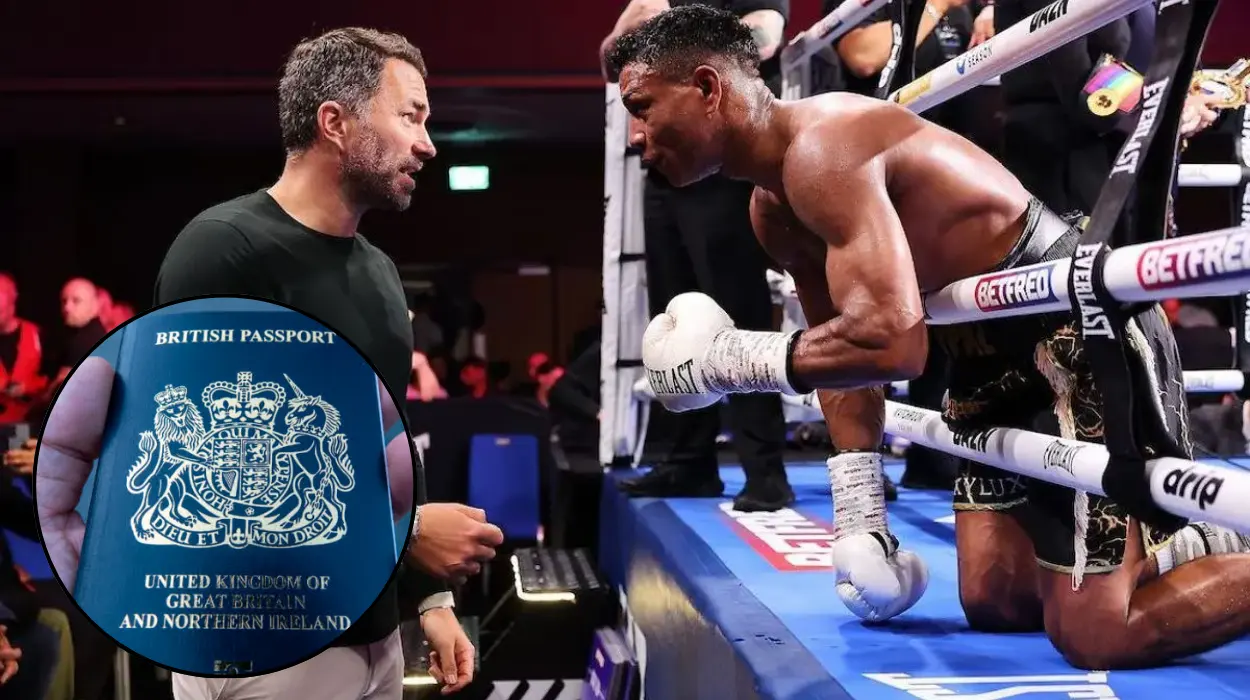
Key Points
- Bilal Fawaz, a British light-middleweight champion, still does not have a British passport after living in the UK for more than 20 years.
- His promoter Eddie Hearn says the situation is preventing Fawaz from fighting abroad and taking his family on holiday.
- Fawaz was trafficked to the UK at the age of 14 and says he has not left the country since.
- Born in Nigeria to a Beninese mother and a Lebanese father, he says he was confined, forced to work and kept out of school after arriving in London.
- He represented England six times as an amateur before turning professional after securing a work permit at 33.
- Fawaz has won the English title and later the British and Commonwealth championships, but remains on a 10-year route to settlement.
- The Home Office declined to comment on the individual case and said it was not responsible for the decision to place him on the 10-year route.
- Fawaz says the lack of a passport has left him feeling trapped and denied the chance to fulfil his potential on the world stage.
- Hearn says the government should act quickly and called the delay “embarrassing”.
London (Britain Today News) July 27, 2026 — Bilal Fawaz’s long fight for a British passport has returned to the spotlight after the British light-middleweight champion said he remains unable to travel abroad or fully pursue the career opportunities that should come with his titles.
Why is Bilal Fawaz still without a British passport?
Fawaz has lived in the UK for more than two decades but still has no British passport, despite becoming a recognised champion in the sports. The report says the 38-year-old was trafficked to the country at 14 and has remained in Britain ever since, unable to leave the UK because of his immigration status. That restriction, in practical terms, blocks him from taking fights overseas and from travelling abroad with his family.
The issue is not just about paperwork. It affects whether Fawaz can build the sort of career that top fighters are expected to have, including overseas bouts in major markets such as Saudi Arabia and the United States. In boxing, that matters because international fights are often where reputations are made, belts are unified and bigger purses become available. For Fawaz, the passport problem has become a barrier to both sporting and personal freedom.
What did Eddie Hearn say about the delay?
Promoter Eddie Hearn has been one of the most outspoken voices on the case. As quoted by Boxing News, Hearn asked:
“What on earth is the hold-up?”
He added:
“You want to go down to Number 10 and bang on the door and say: ‘Any chance of dealing with this?’”
Hearn also said:
“If you were them, you’d almost be embarrassed. Someone should look at it and go, ‘What are you guys doing? Give him his passport.’”
His criticism reflects a wider frustration that a boxer who has represented England and won British titles still faces such severe travel restrictions. In Hearn’s view, the state is denying Fawaz the chance to chase world-title opportunities that should be within reach.
Who is Bilal Fawaz?
Fawaz’s story stretches far beyond boxing. Born in Nigeria to a Beninese mother and a Lebanese father, he says he was brought to London on the understanding that he would reunite with his father, only to find himself confined and forced to work. He has described a childhood defined by isolation, and he says he was not allowed to attend school or socialise normally.
He later escaped into the care system, where he says he struggled with minor convictions as a young person. Yet boxing gave him structure and purpose. He trained at the All Stars Boxing Club in west London and began building a reputation as a talented amateur before later moving into the professional ranks.
How did boxing change his life?
Fawaz has spoken openly about the sport’s role in stabilising his life.
“Boxing saved me,”
he said.
“It’s my addiction.”
He added:
“Boxing gave me the feeling that I deserve more. I’ve worked hard. When will I get the dues and respect that I deserve?”
Those remarks capture the emotional centre of the story. For Fawaz, boxing is not just a career but a route out of the damage of his early years. It gave him a sense of discipline, belonging and progress when much of his childhood had been marked by control and deprivation. That is why the passport issue feels so significant to him: it is tied to recognition, dignity and the right to move freely.
What titles has Bilal Fawaz won?
Fawaz’s rise in the ring has been strong. He represented England six times as an amateur before turning professional after receiving a work permit at 33. In the professional ranks, he won the English light-middleweight title and later added the British and Commonwealth championships.
According to the Boxing News report, he defeated Junaid Bostan for the English title and Ishmael Davis for the British and Commonwealth belts. The piece also notes that a BBC documentary, Fighting for Freedom, follows Fawaz around his British title defence against Ryan Kelly in Wolverhampton in May. That documentary framing underlines how unusual and powerful his story has become in British boxing.
Why can’t he fight abroad?
The absence of a passport has direct sporting consequences. Without the right travel documents, Fawaz cannot easily accept international bouts, including potentially lucrative fights abroad. The report says this has affected his opportunities in Saudi Arabia and the United States.
That limitation matters because modern boxing careers are often built on mobility. Fighters frequently move from domestic success to overseas showcases, where titles are defended or elevated and where broadcasters and promoters can offer larger stages. Fawaz, however, is locked out of that path. He has said he feels as though he is “in prison”, because he can fight for Britain but still cannot move like a British citizen.
What has Fawaz said about his past?
Fawaz has described his early life in stark terms. He said:
“My best friend was the window.”
He explained that he could see other children playing outside, but he was not allowed to join them. That line underlines the isolation he says he experienced as a child.
He also defended himself against the assumption that his early convictions define him.
“I’ve never robbed anything. I’ve never beaten anyone up. I’ve never done anything that’s atrocious,”
he said.
“I was just a kid who needed guidance and I never had that. Somebody should have taken care of me and fixed my whole life before I turned 18.”
Those comments help explain why this case resonates beyond boxing circles. It is a story about trafficking, care, identity, rehabilitation and the gap between sporting success and legal status. Fawaz’s public voice makes the issue harder to dismiss as a routine immigration matter.
How does the 10-year route work?
The Boxing News report says Fawaz is on a 10-year route to settlement, which means he must complete 10 years of lawful residence before becoming eligible to apply for indefinite leave to remain and, later, British citizenship if all requirements are met. It also states he will not be eligible for British citizenship until he is 43.
That timetable has obvious consequences for someone whose sporting career is time-sensitive. Boxing careers are short compared with most professions, especially at elite level. Waiting nearly another decade for full citizenship can effectively close the door on peak opportunities. For Fawaz, that could mean losing his best chance to fight globally while he is still in championship condition.
What did the Home Office say?
The Home Office declined to comment on the individual case. The report also says the department previously stated that the decision to place Fawaz on the 10-year settlement route was not made by the Home Office. That leaves the public with a situation in which responsibility appears blurred, while the boxer remains unable to move forward.
From a reporting perspective, that refusal to engage with the specifics is important. It means the central facts remain uncontested in broad terms, but the precise reasoning behind the immigration pathway is not being explained publicly. For Fawaz, that lack of clarity only deepens the sense of being stuck.
Explore More about Sports:
Hodgkinson, Asher-Smith and Johnson-Thompson named in GB Europeans squad
Spain Nations League Schedule: Full List Of La Furia Roja’s Matches After World Cup Glory 2026
Why does this case matter beyond boxing?
Fawaz’s case speaks to wider questions about immigration, trafficking and fairness. A man who has lived most of his life in the UK, represented England and won British titles is still unable to travel as a British boxer. That contradiction has made the story politically and emotionally charged.
It also raises the issue of how societies treat people who were brought up in damaging circumstances and later rebuild their lives. Fawaz’s supporters see a worker, athlete and father who has contributed to British sport. His critics may focus on the immigration history and any minor convictions, but the scale of his boxing achievement remains significant. The case therefore sits at the intersection of law, public policy and merit.
Can he still become a world champion?
Hearn believes Fawaz has missed out on major chances already. He said the government is denying him opportunities that could have been available earlier in his career. In the promoter’s view, the inability to secure a passport has delayed or blocked the sort of fights that can turn a good domestic champion into a world contender.
Fawaz agrees that the restrictions have limited his ceiling. Without the passport, he cannot take the international stage as freely as other fighters can. That does not erase his existing success, but it does shape how history may remember his career. He has already proved himself in Britain; the unresolved question is how much further he could have gone with full freedom of movement.
What happens next?
The story is likely to remain live because the underlying problem has not been solved. Fawaz still lacks a British passport, still faces travel restrictions and still cannot access the wider boxing opportunities he believes he has earned. The promoter’s public pressure may keep the issue in the spotlight, but there is no sign in the report of an immediate policy change.
For now, the boxer’s situation remains a striking contradiction: a British champion who cannot fully operate like one. That contrast is what makes the case so powerful and so difficult to ignore. It is also why the story is likely to continue attracting attention from readers interested in sport, immigration and human resilience.