Key Points
- West African leaders formally endorsed the Nigeria-Morocco Atlantic Gas Pipeline at an Ecowas summit in Freetown, Sierra Leone, on Sunday, 19 July 2026.
- The pipeline will stretch roughly 6,800km along the Atlantic coast, linking 13 Ecowas member states plus Morocco, and eventually connecting to Europe’s gas network via Spain.
- Construction is expected to begin in 2028, with the total project cost estimated at $25bn (£19bn).
- Once operational, the pipeline could carry up to 30 billion cubic metres of gas annually, with roughly half earmarked for Moroccan and European markets.
- The agreement establishes the legal and governance framework for the pipeline, marking the last major political hurdle before financing and construction can move forward.
- Construction will begin with the Morocco-Mauritania-Senegal section before extending eastward, with Nigeria connected in the final phase.
- The project is being jointly developed by Nigeria’s state oil firm, NNPC Ltd, and Morocco’s National Office of Hydrocarbons and Mines (ONHYM).
- Analysts say the pipeline could reduce Africa’s reliance on exporting raw gas for external processing, while boosting the continent’s industrial base and geopolitical leverage.
- Financing, security along the pipeline route and shifting European demand for gas remain significant challenges ahead of construction.
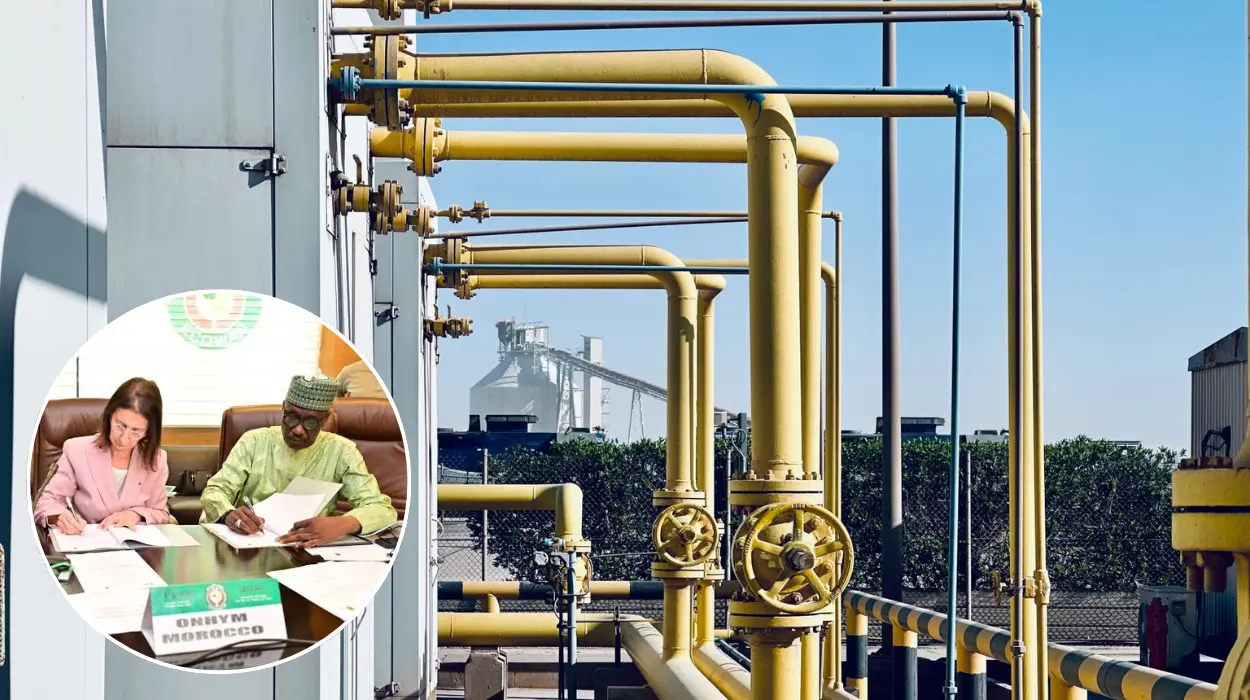
Freetown (Britain Today News) July 21, 2026 — One of Africa’s most ambitious energy infrastructure projects has been formally endorsed at the highest political level, after the heads of state and government of the Economic Community of West African States (Ecowas) signed an intergovernmental agreement backing the long-planned Nigeria-Morocco Atlantic Gas Pipeline. The signing took place on Sunday evening in Freetown, Sierra Leone, at an Ecowas summit chaired by the bloc’s current head, Sierra Leonean president Julius Maada Bio.
- Key Points
- What Was Agreed in Freetown?
- What Route Will the Pipeline Take?
- How Much Will It Cost and When Will Building Start?
- Why Is This Being Called a Turning Point for African Energy?
- What Have Officials and Analysts Said About the Deal?
- How Will the Project Be Built and Financed?
- Why Does Nigeria Come Last in the Construction Schedule?
- What Security and Financial Risks Remain?
- Who Is Leading the Project?
- What Challenges Could Still Derail the Pipeline?
- What Could the Pipeline Mean for Europe and Global Markets?
What Was Agreed in Freetown?
The intergovernmental agreement signed on Sunday establishes the legal and institutional framework that will govern the pipeline’s development, bringing all Ecowas member states formally into the project’s governance structure. Regional leaders and officials have described the moment as the last significant political hurdle before the scheme moves into financing and construction. President Bio struck an optimistic tone as the deal was concluded, telling the gathered leaders:
“Don’t be surprised when the gas comes your way.”
The agreement does not itself commit money to construction. Instead, it sets out how the pipeline will be governed, how member states will participate, and how disputes or obligations between countries will be handled once gas begins to flow. Officials say the framework gives the project the political backing it needs to attract investors ahead of a final investment decision.
What Route Will the Pipeline Take?
The pipeline is designed to run for approximately 6,800km along the Atlantic coastline, passing through 13 Ecowas member states before reaching Morocco, a non-Ecowas nation that has been closely involved in the project from the outset. From Morocco, the gas would connect into the existing pipeline network linking Rabat to Spain, giving it a route into the broader European gas market. The scale of the route would make it one of the longest offshore gas pipelines in the world, and officials say the coastal path was deliberately chosen to steer largely clear of the more volatile security zones associated with the Sahel.
How Much Will It Cost and When Will Building Start?
The total estimated cost of the project stands at $25bn (£19bn), according to officials involved in its planning. Construction is expected to begin in 2028, once financing arrangements and the final investment decision are settled. Feasibility studies and front-end engineering design (FEED) work have already been completed, and the pipeline’s route has largely been agreed between the participating nations, putting the scheme in a more advanced technical and political position than at any point since it was first proposed in 2016.
Why Is This Being Called a Turning Point for African Energy?
Energy specialists say the pipeline represents a departure from the traditional pattern in which gas is extracted from African nations, processed abroad, and then re-imported at a significantly higher cost. Nigerian energy expert and former government adviser Charles Majomi, speaking to the BBC’s Focus on Africa programme, argued that this model amounts to a “complete devaluation” of resources that are abundant in countries such as Nigeria. He said that practice needed to end.
Beyond the economics, analysts believe a functioning pipeline could strengthen Africa’s hand in international negotiations. Majomi suggested that supplying energy to European and Asian markets would give African nations a stronger position at the global table when it comes to regional security and diplomacy.
What Have Officials and Analysts Said About the Deal?
Alongside President Bio’s remarks in Freetown, academics have pointed to the pipeline’s symbolic value as much as its commercial potential. Professor Ganiyat Adejoke Adesina-Uthman of the National Open University of Nigeria described the project, in comments reported by the BBC, as a demonstration of what African nations can achieve through collaboration. She added that the pipeline would extend beyond energy security to open up Africa as a corridor into wider international markets, and would help create industries and jobs while building what she called a genuinely global project rather than a purely regional one.
How Will the Project Be Built and Financed?
Rather than being constructed in a single continuous phase, the pipeline will be developed in segments, starting with the stretch connecting Morocco, Mauritania and Senegal, before extending to a Ghana-Côte d’Ivoire section. According to Majomi’s comments to the BBC, the final connection to Nigeria — the country supplying the gas — will come later in the build-out. Analysts have noted that Nigeria was initially seen as a potential source of delay in negotiations, which is one reason the western and central sections of the route are being prioritised.
Financing remains one of the most significant open questions. The projected $25bn budget could rise because of inflation and construction costs, and the project’s success depends on all participating governments meeting their obligations to protect the infrastructure once it is built.
Why Does Nigeria Come Last in the Construction Schedule?
By building the Morocco-facing end of the pipeline first, developers can begin generating regional revenue and testing governance arrangements before tackling the more complex final leg into Nigeria itself. This phased approach is also intended to reduce financial risk, allowing investors to commit to shorter, more manageable segments rather than underwriting the full 6,800km route in one go. Officials involved in the scheme have indicated that Nigeria’s connection, while essential to the pipeline’s ultimate purpose of exporting Nigerian gas, is being treated as the final and most complex stage of construction.
What Security and Financial Risks Remain?
Protecting a pipeline that stretches across 13 countries presents a considerable security challenge, particularly given the varied political and security conditions along the West African coast. Majomi told the BBC that whether individual countries meet their obligations to supply gas will depend heavily on their ability to provide security along the route and to involve local communities in protecting the infrastructure, while also making use of technology such as drones and aerial monitoring.
Unlike the rival Trans-Saharan Gas Pipeline, which runs through Niger and Algeria and passes through some of the region’s most insecure territory, the Atlantic route largely avoids the Sahel. However, its extensive offshore sections bring their own engineering costs and complexities.
Who Is Leading the Project?
The pipeline is being jointly developed by Nigeria’s state oil company, NNPC Ltd, and Morocco’s National Office of Hydrocarbons and Mines, ONHYM. Regional and international institutions supporting the scheme include Ecowas itself, the Islamic Development Bank, and the Opec Fund for International Development. The project was originally launched following discussions between Morocco’s King Mohammed VI and Nigeria’s then-president in 2016, and has continued to receive backing from successive Nigerian administrations since.
Beyond its role as an export corridor, the pipeline is intended to supply natural gas to West African nations that currently depend on costly imported fuel, potentially supporting new power stations, fertiliser plants, petrochemical facilities and manufacturing along the Atlantic coast. For Nigeria, the project offers a route to monetise its substantial gas reserves while deepening economic ties across West and North Africa.
Explore More about World:
Trump Imposes 50% Tariffs on Canadian Goods Over Trade Row
Lorde Blasts Spotify’s AI Song Feature Over Inaccurate Description
What Challenges Could Still Derail the Pipeline?
Despite the political momentum generated by Sunday’s signing, several obstacles remain before construction can begin in earnest. Securing financing, protecting the pipeline route, and maintaining political stability across the participating nations are all significant hurdles. The project also faces competition from alternative export routes, including liquefied natural gas (LNG) schemes and the rival Nigeria-Algeria Trans-Saharan Gas Pipeline.
A further uncertainty lies in the pace at which European demand for natural gas may fall as the continent pushes ahead with its transition to renewable energy sources, a shift that could affect the long-term economics of exporting gas northward from West Africa.
What Could the Pipeline Mean for Europe and Global Markets?
If the project proceeds as planned, the pipeline would serve an estimated 400 million consumers, carrying up to 30 billion cubic metres of gas a year and connecting directly into Europe’s gas network through Spain. Professor Adesina-Uthman argued that the scheme was about more than simply extracting energy, suggesting that Morocco’s position as a gateway could open access to cleaner energy sources for a range of countries while supporting industrial growth, employment and a genuinely international market.
For now, attention turns to the next steps in the process, including the anticipated signing of a bilateral agreement between Morocco and Mauritania, expected to take place in the presence of Nigeria’s president. With the political framework now in place, the coming years will determine whether the $25bn Atlantic Gas Pipeline can move from agreement to construction — and ultimately, from construction to the gas flows officials in Freetown promised were on their way.