Key Points
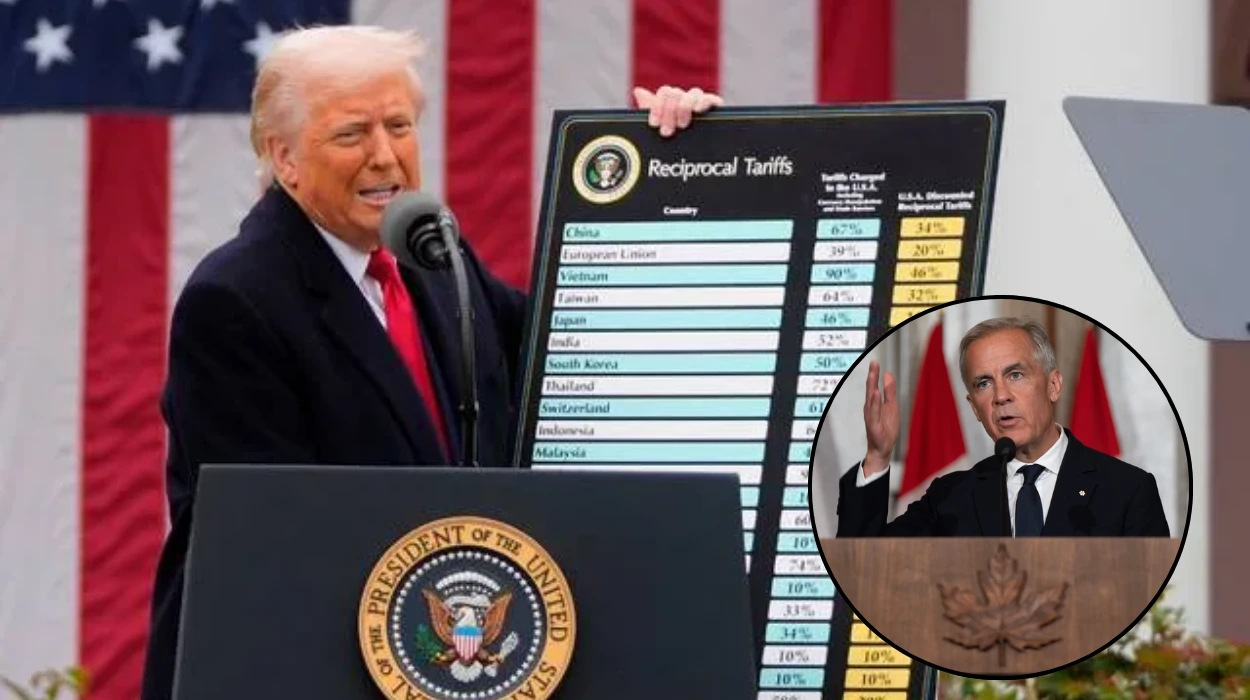
- US President Donald Trump has imposed 50% tariffs on most Canadian goods, accusing Ottawa of unfairly discriminating against American autos, alcohol and dairy products.
- The tariffs were signed via three proclamations under Section 338 of the 1930 Trade Act, a never-before-used authority.
- Energy products, potash, fish and critical minerals are excluded, but goods previously shielded by the USMCA are not.
- The measures take effect in 30 days, leaving a window for negotiation between Washington and Ottawa.
- Canadian Prime Minister Mark Carney has pledged to “engage intensively” with the US while defending Canada’s record on free trade.
- Ontario Premier Doug Ford has called for Canada to respond “tariff for tariff, dollar for dollar.”
- The Canadian Chamber of Commerce and the US Distilled Spirits Council have both urged a negotiated settlement.
- Analysts warn the use of Section 338 could extend “massive uncertainty” to America’s other trading partners, not just Canada.
- The move follows a Supreme Court ruling in February that struck down Trump’s earlier emergency-powers tariffs, forcing the administration to seek alternative legal routes.
- The dispute carries political risk for Trump ahead of the November midterm elections, with inflation already under pressure from tariffs and the war in Iran.
Washington (Britain Today News) July 21, 2026 — President Donald Trump on Monday imposed 50% tariffs on most Canadian goods, declaring that Canada has unfairly discriminated against American autos, alcohol and dairy products. As reported by Josh Boak of the Associated Press, with additional reporting contributed by Jim Morris from Vancouver, British Columbia, the move could unleash a fresh wave of economic disruption, straining relations between two nations whose economies had been closely interwoven before Trump’s return to the White House.
- Key Points
- Why Has Trump Imposed These New Tariffs on Canada?
- Which Goods Are Covered by the New Tariffs — and Which Are Exempt?
- When Will the Tariffs Take Effect?
- How Has Canada’s Government Responded?
- Could the Dispute Escalate into a Wider Trade War?
- Why Are Experts Concerned About the Use of Section 338?
- What Political Risks Does This Pose for Trump?
- Why Did the Administration Turn to Section 338 in the First Place?
- Is the Trade Dispute Already Affecting Inflation?
- Has Trump Considered Further Tariffs Linked to Canadian Wildfires?
- What Was the Significance of Trump and Carney’s World Cup Meeting?
- What Happens Next in the US–Canada Trade Dispute?
An administration official previewing the action, speaking on condition of anonymity during a call with reporters, said Canada was one of the only nations besides China to retaliate against Trump’s earlier tariffs and “must be held accountable.” The official confirmed that Trump signed three separate proclamations to launch the tariffs under Section 338 of the 1930 Trade Act — a provision so rarely invoked that several Democratic lawmakers last year proposed repealing it altogether, warning it gave the president scope to destabilise the economy.
Why Has Trump Imposed These New Tariffs on Canada?
Trump’s proclamations accuse Canada of discriminating against American autos, alcohol and cheese relative to other trading nations. However, much of his argument rests on retaliatory measures Canada introduced after the US president first imposed tariffs on Canadian goods under the pretext of pushing Ottawa to do more to curb fentanyl smuggling.
As detailed in his autos proclamation, Trump noted that Canada had maintained, from April 2025 onward, a 25% tariff on US motor vehicle imports that did not qualify for preferential treatment under the United States–Mexico–Canada Agreement (USMCA). On the question of alcohol, the White House stated that all but two Canadian provinces and territories had halted the purchase and retailing of American alcoholic beverages beginning last year — itself a reaction to Trump’s tariffs and his repeated suggestions that Canada become the “51st state.” Trump has also long objected to Canada’s treatment of American cheese, arguing in his proclamation that Canada discriminates against the US relative to Europe on dairy products.
Which Goods Are Covered by the New Tariffs — and Which Are Exempt?
The new 50% tariffs exclude energy products, potash, fish and critical minerals. Crucially, however, they extend to goods that had previously been shielded from import taxes under the USMCA. That 2020 trade pact was not renewed by the United States, triggering a fresh round of negotiations that could, under current timelines, run until 2036.
When Will the Tariffs Take Effect?
According to a White House fact sheet, the tariffs are due to come into force in 30 days. That timeframe leaves room for negotiation, particularly given that Trump has not always followed through on previously announced tax hikes on imports.
How Has Canada’s Government Responded?
Canadian Prime Minister Mark Carney said in a statement that his government continues to believe in “the benefits of free and fair trade,” pointing to the more than 20 new economic and security partnerships Canada has signed. He said Ottawa remains prepared to negotiate with the Trump administration.
“This trade dispute has raised costs for families, particularly in the US,”
Carney said.
“Canada stands ready to engage intensively to address outstanding issues with the US to the mutual benefit of our citizens.”
Could the Dispute Escalate into a Wider Trade War?
The tariffs carry a real risk of escalating into a broader trade war as Canada looks to protect its economy. Ontario Premier Doug Ford signalled as much, warning of a possible showdown ahead.
“If these tariffs proceed, Canada should respond tariff for tariff, dollar for dollar,”
Ford wrote in a social media post.
Candace Laing, chief executive of the Canadian Chamber of Commerce, described the Trump administration’s move as “regrettable,” while urging both countries to use the 30-day window “to make meaningful progress in advancing formal talks.”
On the American side, Chris Swonger, chief executive of the Distilled Spirits Council of the United States, echoed the call for a negotiated outcome:
“We encourage policymakers on both sides of the border to pursue a negotiated solution that restores market access for US spirits and avoids further harm to the US hospitality sector.”
Why Are Experts Concerned About the Use of Section 338?
The invocation of a Great Depression-era statute to impose the tariffs broadens the risks well beyond Canada, according to Scott Lincicome, vice president of general economics at the Cato Institute, a libertarian think tank. He warned that the same authority could be applied to other US trading partners, injecting what he called “massive uncertainty” into the global economy.
“We crossed the Rubicon,”
Lincicome said.
“The invocation of 338 is the nuclear option for Trump tariffs.”
What Political Risks Does This Pose for Trump?
The new tariffs carry significant political and economic risk for Trump ahead of the November midterm elections, which will determine control of Congress. His so-called “Liberation Day” tariffs last April triggered a financial market meltdown amid fears of inflation and recession, forcing him to walk back the rates to allow for a period of negotiation.
Rep. Suzan DelBene, D-Wash., who chairs the Democratic Congressional Campaign Committee, was blunt in her criticism:
“These new taxes will raise prices on American families and likely lead to retaliation against the very industries Trump purportedly wants to protect.”
Why Did the Administration Turn to Section 338 in the First Place?
The Supreme Court ruled in February that Trump had lacked the legal authority to impose tariffs by declaring an economic emergency, forcing the administration to search for alternative legal avenues to raise import taxes. Section 338 of the 1930 Trade Act became one such route.
Tariffs function as taxes on imports, costs that companies can pass on to consumers through higher prices. Trump maintains that tariffs will ultimately drive manufacturing back to the United States, though there is limited evidence of that shift appearing in current economic data.
Is the Trade Dispute Already Affecting Inflation?
The latest import taxes threaten to worsen Trump’s already weak ratings on the economy. He had promised voters during his campaign that he would bring prices down, yet the annual inflation rate has risen since he returned to office, driven in part by tariffs and by the war in Iran pushing up oil prices.
Has Trump Considered Further Tariffs Linked to Canadian Wildfires?
According to the administration official who previewed Monday’s announcement, Trump has also asked aides to examine additional tariffs on Canada in response to wildfires that have affected air quality in the United States — a threat he had previously raised in social media posts.
Explore More about World:
Lorde Blasts Spotify’s AI Song Feature Over Inaccurate Description
Kapchorwa School Bus Tragedy: 24 Dead as Uganda Suspends All Educational Trips
What Was the Significance of Trump and Carney’s World Cup Meeting?
At the World Cup final on Sunday, Trump watched the match alongside Carney. The administration official was careful to stress that their time together at the game was not a working visit to discuss trade or tariffs, despite the timing coming just a day before the tariffs were formally announced.
How Has the Trump–Carney Relationship Evolved?
Trump and Carney have maintained a notably frosty relationship. Carney, a former central banker, pledged during his election campaign last year to go “elbows up” in defending Canadian interests. Speaking at the World Economic Forum in Davos, Switzerland, in January, Carney criticised Trump without naming him directly, saying that the “most powerful” countries were using economic leverage to coerce less powerful nations.
Trump responded at the time with a pointed remark of his own:
“Canada lives because of the United States.”
What Happens Next in the US–Canada Trade Dispute?
With the tariffs not taking effect for 30 days, both governments now face a narrow window to pursue talks aimed at averting further escalation. Business groups on both sides of the border have urged restraint, but with Ontario’s premier calling for retaliation and analysts warning of wider economic uncertainty, the coming weeks are likely to prove decisive for the future of North American trade relations.