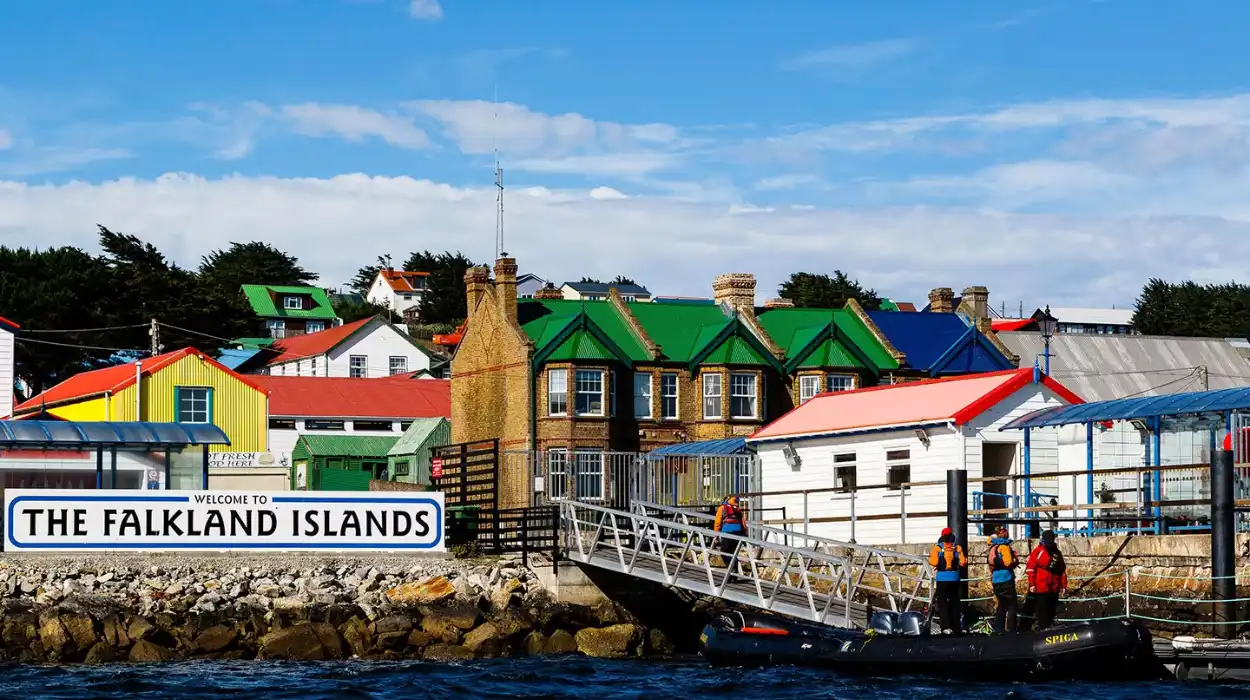
The Falkland Islands are a British Overseas Territory in the South Atlantic Ocean, located approximately 300 miles (480 km) northeast of South America’s southern tip. The archipelago consists of two main islands, East Falkland and West Falkland, and 776 smaller islands, covering a total area of 12,000 square kilometers (4,700 square miles). Argentina calls the territory Islas Malvinas and disputes British sovereignty over it. The islands remain a rare 21st-century example of an active, unresolved territorial dispute between two nations with formal diplomatic relations.
- What Are the Falkland Islands?
- Where Are the Falkland Islands Located?
- What Is the History of the Falkland Islands?
- Early European Discovery and Settlement
- The 1833 British Return
- Argentina’s Continuing Sovereignty Claim
- What Caused the 1982 Falklands War?
- Who Governs the Falkland Islands Today?
- What Is the Falkland Islands Sovereignty Dispute?
- What Is the Economic Structure of the Falkland Islands?
- Why Are the Falkland Islands Strategically Important?
- Falkland Islands: Key Historical Timeline
- What Is the Future Outlook for the Falkland Islands?
What Are the Falkland Islands?
The Falkland Islands are a self-governing British Overseas Territory in the South Atlantic Ocean, comprising 778 islands with a combined population of approximately 3,465 people as of 2026. The capital is Stanley, located on East Falkland.
The territory sits on the Patagonian Shelf at a latitude of roughly 52 degrees south. Under the Falkland Islands Constitution of 2009, the islands hold full internal self-government. The United Kingdom retains responsibility for defense and foreign affairs. The Monarch of the United Kingdom serves as head of state. Executive authority is exercised by a governor appointed by the Crown, currently Governor Colin Martin-Reynolds, who took office in July 2025. Andrea Clausen serves as Chief Executive, a role she assumed on April 1, 2025, becoming the first woman and first Falkland Islander to hold the position. Spanish speakers and the Argentine government refer to the archipelago as Islas Malvinas, a name derived from French settlers who called the islands “Malouines” in 1764, after their home port of Saint-Malo, France.
Where Are the Falkland Islands Located?
The Falkland Islands lie in the South Atlantic Ocean, roughly 300 miles (480 km) east of the Strait of Magellan and the southern Patagonian coast of Argentina, and 752 miles (1,210 km) from the northern tip of the Antarctic Peninsula.
Geographically, the islands occupy a strategic position between South America and Antarctica. This location places the Falklands along key South Atlantic shipping and maritime routes historically used for navigation around Cape Horn before the construction of the Panama Canal in 1914. The islands’ remoteness, combined with their proximity to Antarctic waters, contributes to their ongoing military and scientific relevance. Stanley, the capital and largest settlement, functions as the administrative, commercial, and transport hub. An international airport operates at the Mount Pleasant Complex, roughly 35 miles (56 km) southwest of Stanley, connecting the territory to the United Kingdom and South America.
What Is the History of the Falkland Islands?
European sailors first sighted the Falkland Islands in the late 16th century, with the first confirmed landing in 1690. France, Britain, Spain, and later Argentina each established or claimed settlements between 1764 and 1833, creating the foundation of today’s sovereignty dispute.
The islands are believed to have had no permanent human population before European contact. French navigator Louis-Antoine de Bougainville established the first settlement, Port Louis, in 1764. Britain founded a separate settlement at Port Egmont in 1765, unaware of the French presence. Spain purchased the French colony in 1767 and administered it through the Viceroyalty of the Río de la Plata. Britain withdrew its garrison in 1774 for economic reasons, leaving behind a plaque asserting a continuing claim on behalf of King George III.
Early European Discovery and Settlement
Spain’s colonial administration in the Falklands continued until Argentina’s declaration of independence disrupted regional governance. During the Napoleonic Wars, the islands’ Spanish governor evacuated the territory in 1806. Spain’s remaining garrison departed in 1811, leaving only a small number of gauchos and fishermen. The islands then lacked formal government until 1820, when Colonel David Jewett, acting on behalf of the United Provinces of the Río de la Plata (a precursor to modern Argentina), asserted a territorial claim based on Buenos Aires’ 1816 declaration over former Spanish possessions in the South Atlantic.
The 1833 British Return
Louis Vernet, appointed governor of the settlement by Buenos Aires in 1829, attempted to regulate fishing and sealing activity, provoking a dispute with the United States that led to a punitive raid by the USS Lexington in 1831. Britain reasserted its claim in January 1833, when British naval forces removed the Argentine administration and reestablished control. In 1840, the Falkland Islands officially became a British Crown colony. Scottish settlers subsequently developed a permanent pastoral, sheep-farming economy that shaped the territory’s demographic and cultural identity for the next century.
Argentina’s Continuing Sovereignty Claim
Argentina has formally protested British control of the islands since the 1833 reassertion. Argentina’s claim rests on principles of geographic proximity, succession from Spanish colonial territory, and the 1820s Buenos Aires administration. The United Kingdom’s claim rests on continuous administration since 1833, the principle of self-determination under the United Nations Charter, and the stated wishes of the Falkland Islands’ resident population. The United Nations has listed the Falkland Islands as one of 17 Non-Self-Governing Territories, and its General Assembly has repeatedly invited both nations to negotiate a peaceful resolution without prescribing an outcome.
What Caused the 1982 Falklands War?
Argentina’s military government invaded the Falkland Islands on April 2, 1982, to reassert its sovereignty claim and divert domestic attention from economic crisis and political repression. The United Kingdom responded with a naval task force, retaking the islands after a 74-day conflict.
Argentina’s ruling military junta, led by General Leopoldo Galtieri, ordered the invasion amid severe inflation, mass unemployment, and mounting public opposition to human rights abuses committed during the country’s “Dirty War” (1976–1983). Argentine forces landed at Stanley on April 2, 1982, and quickly overwhelmed the small British garrison. The United Kingdom, under Prime Minister Margaret Thatcher, declared the invasion a violation of international law and dispatched a naval task force of over 100 ships across roughly 8,000 miles (12,875 km) of ocean.
Key Events of the Conflict
British forces recaptured South Georgia on April 25, 1982. The sinking of the Argentine cruiser ARA General Belgrano on May 2, 1982, killed 323 sailors and marked a major escalation. Argentina’s air force sank several British vessels, including HMS Sheffield, using French-made Exocet missiles. British troops landed at San Carlos Bay on May 21, 1982, and advanced toward Stanley over the following three weeks, fighting battles at Goose Green, Mount Longdon, and Mount Tumbledown.
Outcome and Casualties
Argentine forces surrendered on June 14, 1982. The war resulted in 649 Argentine deaths, 255 British deaths, and 3 Falkland Islander civilian deaths. The conflict led to the collapse of Argentina’s military junta within months and contributed to the country’s transition to democratic government in 1983. In the United Kingdom, the successful campaign strengthened Margaret Thatcher’s political standing and reinforced Britain’s commitment to defending its overseas territories. Since 1982, the United Kingdom has maintained a permanent military presence at Mount Pleasant, including fighter aircraft, naval assets, and army garrison units.
Who Governs the Falkland Islands Today?
The Falkland Islands operate under a system of internal self-government established by the 2009 Constitution. A Crown-appointed governor oversees defense and foreign affairs, while a locally elected Legislative Assembly manages domestic policy, taxation, and public services.
The Legislative Assembly is a unicameral body composed of eight elected members, five representing Stanley and three representing the rural area known as “Camp,” alongside the chief executive and the Director of Finance as non-voting ex officio members. Members serve four-year terms elected by universal suffrage, with voting rights beginning at age 18. No political parties exist in the Falkland Islands; every elected official runs as an independent. The Executive Council, chaired by the governor, includes the chief executive, the Director of Finance, and three elected Legislative Assembly members, and it advises the governor on domestic administration. The territory’s judicial system follows English common law, overseen through a Supreme Court and Magistrates’ Court structure.
What Is the Falkland Islands Sovereignty Dispute?
Argentina claims sovereignty over the Falkland Islands based on geographic proximity and historical succession from Spanish colonial rule, while the United Kingdom bases its position on continuous administration since 1833 and the principle of self-determination for the resident population.
The dispute remains unresolved despite decades of diplomatic exchanges. In a 2013 referendum organized by the Falkland Islands Government, 1,513 of 1,517 valid votes (99.8%) favored remaining a British Overseas Territory, with a turnout of 92%. The United Kingdom cites this result as definitive evidence of local political will. Argentina does not recognize the referendum’s legitimacy, arguing that the current population descends primarily from British settlers who displaced the original Argentine administration in 1833, making self-determination inapplicable under international law. Argentina’s constitution, amended in 1994, formally asserts sovereignty over the “Malvinas, Georgias del Sur and Sandwich del Sur Islands” as a national objective. The dispute periodically resurfaces in United Nations forums, where the Special Committee on Decolonization has repeatedly called for bilateral negotiations, though no binding resolution has been achieved.
What Is the Economic Structure of the Falkland Islands?
The Falkland Islands economy relies primarily on commercial fishing licenses, sheep farming and wool exports, tourism, and increasingly, offshore hydrocarbon exploration. Fishing license revenue historically accounts for the largest share of government income.
The Falkland Islands Government issues licenses to foreign fishing fleets operating within its 200-nautical-mile Exclusive Fishing Zone, generating substantial annual revenue used to fund public services, including free healthcare and education. Squid and finfish represent the primary commercial catches. Sheep farming remains a historic economic pillar, with wool exports continuing a tradition established by Scottish settlers in the 1840s. Tourism has grown steadily, driven by cruise ship visits and the islands’ wildlife, including significant populations of penguins, albatross, and elephant seals. Since the early 2010s, exploratory offshore oil and gas surveys in Falklands waters have identified potentially significant hydrocarbon reserves, though commercial extraction has not reached large-scale production. The territory maintains its own currency, the Falkland pound, pegged at parity with the British pound sterling.
Explore More about UK:
Explore Wales: Top Destinations, History and Travel Tips
Oxford City Travel Guide: History & Hidden Gems
Why Are the Falkland Islands Strategically Important?
The Falkland Islands hold strategic value due to their proximity to Antarctica, control over South Atlantic shipping routes, exclusive fishing rights across a large maritime zone, and potential offshore energy reserves, reinforced by a permanent British military presence.
The islands function as a logistical gateway to British Antarctic Territory and support scientific research operations in the region. Control of the surrounding waters grants access to fishing grounds worth tens of millions of pounds annually in license revenue. The British Forces South Atlantic Islands garrison, based at Mount Pleasant, maintains fighter jets, naval patrol vessels, and army units, providing regional defense capability and reinforcing deterrence against renewed territorial challenges. The islands also serve as a refueling and resupply point along South Atlantic maritime routes. Offshore basins near the Falklands have drawn continued interest from international energy companies conducting exploratory drilling, adding an economic dimension to the territory’s strategic profile.
Falkland Islands: Key Historical Timeline
| Year | Event |
|---|---|
| 1690 | First recorded European landing on the islands |
| 1764 | France establishes Port Louis, the first permanent settlement |
| 1765 | Britain establishes a separate settlement at Port Egmont |
| 1767 | Spain purchases the French settlement and assumes administration |
| 1774 | Britain withdraws its garrison, leaving a sovereignty claim marker |
| 1820 | United Provinces of the Río de la Plata assert a claim |
| 1833 | Britain reasserts control and removes the Argentine administration |
| 1840 | Falkland Islands become an official British Crown colony |
| 1982 | Argentina invades; Falklands War lasts 74 days |
| 2009 | New Falkland Islands Constitution grants expanded self-government |
| 2013 | Referendum: 99.8% vote to remain a British Overseas Territory |
What Is the Future Outlook for the Falkland Islands?
The Falkland Islands are expected to remain a British Overseas Territory in the near term, supported by strong local political will, continued British military commitment, and no formal negotiation process between the United Kingdom and Argentina on sovereignty transfer.
Economic diversification, particularly in offshore energy and sustainable fisheries management, is likely to shape the territory’s long-term development. The population, though small, has remained relatively stable due to near-zero unemployment and adequate social welfare provisions, including free healthcare and education. Argentina continues to raise the sovereignty question in international forums, including periodic statements at the United Nations General Assembly, without altering the practical status of British administration. Climate and environmental research tied to the islands’ proximity to Antarctica is expected to grow as a secondary strategic function, alongside the territory’s established roles in fishing regulation, regional defense, and South Atlantic logistics.