Key Points
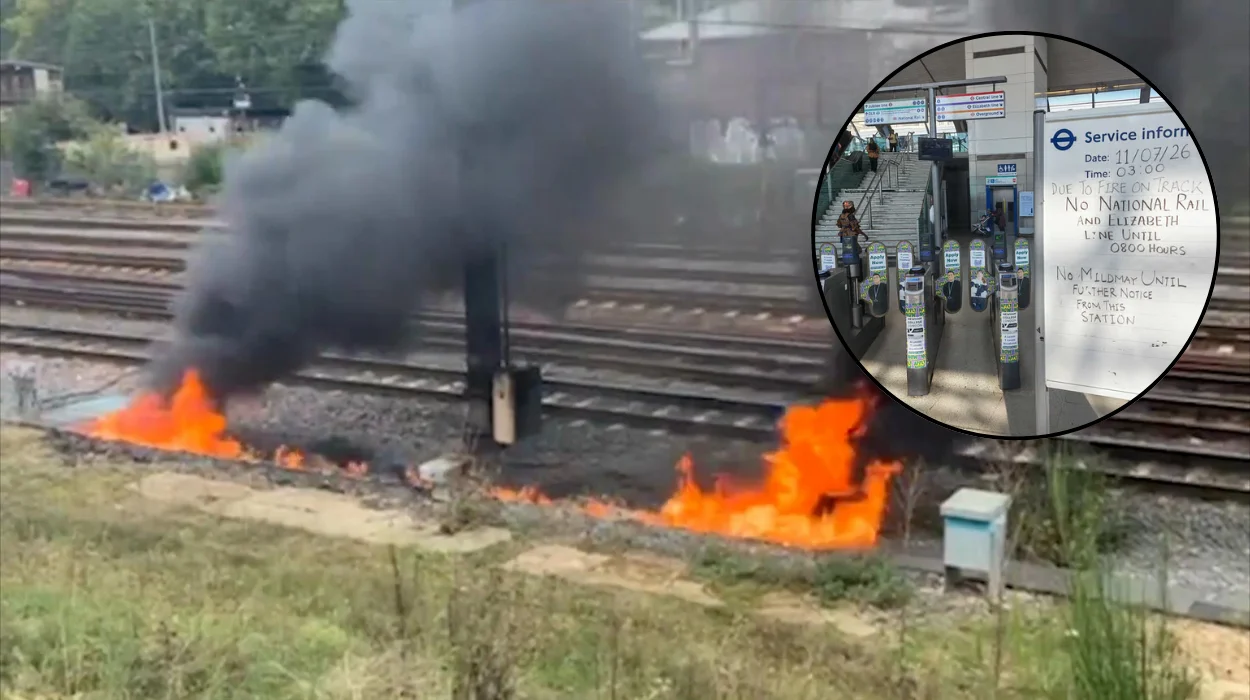
- A fire broke out near the railway line close to Stratford station, one of London’s busiest interchanges.
- Eight fire engines and around 60 firefighters were called to the scene to tackle the blaze.
- The fire involved trackside vegetation and shrubbery beside the railway line.
- Around 1,400 passengers were evacuated from trains brought to a standstill outside the station.
- Footage from the scene showed passengers running to safety as debris fell.
- Network Rail engineers are carrying out urgent repairs to damaged signalling and telecoms equipment.
- Disruption is expected to continue until 6am on Monday.
- Elizabeth Line, Greater Anglia and London Overground services are all affected.
- Passengers have been urged to avoid travelling through the area where possible and to check before setting out.
North London (Britain Today News) July 11, 2026 – Passengers travelling through Stratford face major disruption this weekend after a fire broke out near the tracks close to one of London’s busiest interchange stations. Eight fire engines and around 60 firefighters were called to tackle the blaze, which involved vegetation and shrubbery beside the railway line, bringing services to a standstill outside Stratford station and forcing the evacuation of around 1,400 passengers from stranded trains. Network Rail engineers are now working to repair the damage, with disruption expected to continue across several operators until early Monday morning.
- Key Points
- What happened at Stratford station?
- Why did the fire break out near Stratford station?
- What did footage from the scene show?
- What damage has the fire caused to the railway line?
- What has Network Rail said about the repair work?
- What disruption is affecting Greater Anglia services?
- When are services expected to return to normal?
- What should passengers travelling this weekend do?
- What has been the wider impact of the Stratford fire?
What happened at Stratford station?
A significant fire broke out near the railway tracks close to Stratford station, one of the busiest and most heavily used interchanges in London. The blaze prompted an immediate emergency response, bringing rail services in and around the station to a standstill. Passengers on board affected trains were left stranded outside the station as fire crews worked to bring the situation under control. The scale of the response reflected the seriousness of the incident, with the fire threatening critical railway infrastructure including signalling and telecoms equipment running alongside the line.
Stratford is a major hub connecting several parts of London, and any disruption at the station tends to have a far-reaching effect on the wider transport network. The station is used daily by tens of thousands of commuters, shoppers and travellers, many of whom rely on it to change between different lines and operators. A fire of this scale, so close to the tracks, was always likely to have significant consequences for services running through the area, and that has proved to be the case over the course of the weekend.
Why did the fire break out near Stratford station?
According to the details of the incident, the fire involved vegetation and shrubbery growing beside the railway line. Trackside fires involving dry foliage are not uncommon during periods of warm weather, and they can spread quickly along embankments that run close to overhead lines and signalling cables. In this case, the fire caused enough damage to the surrounding infrastructure that emergency repair work has since been required to restore normal operations. The exact cause of the fire has not been confirmed.
Fires that start in vegetation beside railway lines can be particularly difficult to manage because of their proximity to live equipment. Firefighters often have to coordinate closely with railway staff to ensure that power to the lines is safely isolated before crews can move in to tackle the flames directly. This kind of coordination takes time, which can explain why an incident involving shrubbery, rather than a building or a train itself, was still able to cause such extensive disruption to services across multiple operators.
How many firefighters were sent to tackle the blaze?
The scale of the emergency response underlines how serious the fire was. Eight fire engines and approximately 60 firefighters were dispatched to the scene to bring the blaze under control. This represents a substantial mobilisation of London’s fire and rescue resources, reflecting both the size of the fire and its proximity to live railway infrastructure and passengers on board nearby trains. Crews worked to contain the fire and prevent it from spreading further along the line or towards the station itself.
How many passengers were evacuated from trains?
As the fire took hold, services were brought to a complete standstill outside Stratford station. Around 1,400 passengers were evacuated from trains that had been halted in the vicinity of the blaze. The evacuation was carried out as a precautionary measure to ensure passenger safety while the fire was being tackled. Footage from the scene showed passengers running to safety as debris fell from the sky, illustrating the chaotic and frightening scenes that unfolded as the incident developed.
The evacuation of such a large number of passengers at once is a significant undertaking, requiring close coordination between train crews, station staff and emergency services. Passengers were guided away from the affected trains and out of the danger zone as quickly as possible, with safety the immediate priority while firefighters continued to work on containing the blaze nearby.
What did footage from the scene show?
Video and images circulating from the scene captured the moment debris fell from the sky as the fire took hold near the tracks. The footage showed passengers moving quickly away from the danger, running to safety as the situation unfolded around them. Scenes of this nature, involving evacuated commuters near a major London station, understandably caused alarm among those caught up in the incident, as well as concern among family members and colleagues trying to reach them once news of the fire began to spread.
What damage has the fire caused to the railway line?
The fire has left Network Rail engineers facing an urgent repair job. The blaze caused damage to key infrastructure running alongside the line, including signalling and telecoms equipment that trains rely on to operate safely. As reported in a statement, a spokesperson for Network Rail confirmed the extent of the task ahead:
“Network Rail engineers have assessed the damage and are working as quickly as possible to repair the damaged infrastructure and restore the signalling and telecoms equipment back to normal.”
What has Network Rail said about the repair work?
Network Rail has moved to reassure passengers that repair work is progressing, while cautioning that the knock-on effects of the fire will be felt for some time. The Network Rail spokesperson added:
“As a result of this a reduced number of Greater Anglia train services can run via Stratford. It is expected that trains that do run will be busier than usual. Please do check the website and app for the most up to date service information – check before you travel.”
The statement makes clear that while some services are resuming, capacity will remain limited, and passengers who do travel through the area should expect more crowded conditions than usual as the network works to recover.
How are Elizabeth Line passengers affected?
Elizabeth Line services have been able to resume running through the affected area, though passengers are still being warned to expect disruption. Cancellations, alterations and delays are affecting services across the wider Elizabeth Line network as a direct consequence of the fire. In addition, there are minor delays reported between Whitechapel and Shenfield, meaning even passengers travelling on routes away from Stratford itself may notice some knock-on impact on their journeys.
What disruption is affecting Greater Anglia services?
Greater Anglia has been among the hardest hit operators as a result of the fire. Services travelling through Stratford are severely disrupted on all routes running in and out of the station. Passengers using Greater Anglia services have been urged to check before they travel, given the scale of disruption affecting the operator’s entire network through this key interchange. With Network Rail confirming that only a reduced number of Greater Anglia trains can currently run via Stratford, those services that do operate are expected to be significantly busier than normal.
How has London Overground been affected by the fire?
London Overground passengers are also facing considerable disruption as a result of the incident. Services are running with severe delays across the Mildmay line, one of the network’s busiest routes through east and north London. In addition, services on the line will be part suspended between Willesden Junction and Clapham Junction, cutting off a section of the route entirely and forcing affected passengers to seek alternative means of completing their journeys.
When are services expected to return to normal?
National Rail has warned that disruption caused by the fire is expected to continue until 6am on Monday. This timeline gives engineers a window over the weekend to complete urgent repairs to the damaged line, signalling and telecoms equipment before services can be expected to return to a normal timetable. Until that point, passengers across the Elizabeth Line, Greater Anglia and London Overground networks should continue to expect cancellations, alterations, delays and part-suspended routes.
Explore More about London:
Minister Criticises London Councils Over Evictions
Last-Minute Tickets Still Available for Lily Allen’s Final O2 Show
What should passengers travelling this weekend do?
Given the scale and duration of the disruption, passengers have been strongly advised to avoid travelling through the Stratford area where possible over the coming days. Those who do need to travel are being urged to check the latest service information before setting out, using operator websites and apps to plan journeys and avoid being caught out by last-minute cancellations or alterations. With reduced capacity on some routes and part-suspended services on others, forward planning is being presented as essential for anyone relying on the affected lines this weekend.
What has been the wider impact of the Stratford fire?
The disruption illustrates how a single trackside incident can ripple out across multiple rail operators sharing the same infrastructure. Stratford serves as a critical junction for the Elizabeth Line, Greater Anglia and London Overground, meaning damage to the line in this location has had a disproportionately large effect on journeys across east and north London. The evacuation of 1,400 passengers, the deployment of eight fire engines and around 60 firefighters, and the warning that disruption could last until Monday morning all point to an incident of considerable scale, with Network Rail engineers continuing urgent repair work to restore the line to full working order as quickly as possible.