Key Points
- A serious rail collision involving two passenger trains operated by East Midlands Railway (EMR) occurred just south of Bedford.
- Unverified social media footage and eyewitness accounts indicate a high-impact crash where one train ran into the other, forcing at least one carriage off the rails while remaining upright.
- Multiple passenger injuries have been confirmed by media outlets and on-scene passengers, with emergency services designating the crash a “major incident.”
- A massive rescue operation was deployed, including the East of England Ambulance Service, the Hazardous Area Response Team (HART), air ambulances, and Bedfordshire Fire and Rescue Service.
- All rail lines between Luton and Bedford have been completely blocked. EMR and Thameslink suspended all services in and out of London St Pancras International for the remainder of the evening, issuing a strict “DO NOT TRAVEL” warning.
- Transport Secretary Heidi Alexander expressed deep concern and confirmed that the government is working closely with the rail industry and local partners to manage the crisis.
Bedford (Britain Today News) June 19, 2026 – A major emergency rescue operation is underway in Bedfordshire after two East Midlands Railway passenger trains collided on the main line south of Bedford on Friday evening, leaving multiple passengers injured and completely crippling rail travel between London and the East Midlands. The high-impact collision, which occurred during the peak Friday evening commute, triggered an immediate deployment of air ambulances, specialized trauma crews, and fire engines to the tracks near the Elstow interchange. Network Rail and emergency services have blocked all lines between Luton and Bedford, forcing the complete suspension of all train services running in and out of London St Pancras International for the remainder of the night, with rail operators issuing urgent notices advising the public to abandon all travel plans along the affected routes.
- Key Points
- What Happened During the Bedford Train Collision?
- What Are Eyewitnesses Saying From the Scene?
- How Did Emergency Services Respond to the Major Incident?
- What Official Statements Have Rail Operators Issued?
- How is the UK Government Responding to the Crash?
- What Are Local Political Leaders Saying About the Collision?
- What Diversion Routes Are Available For Stranded Passengers?
- What Will the Rail Safety Investigation Focus On?
What Happened During the Bedford Train Collision?
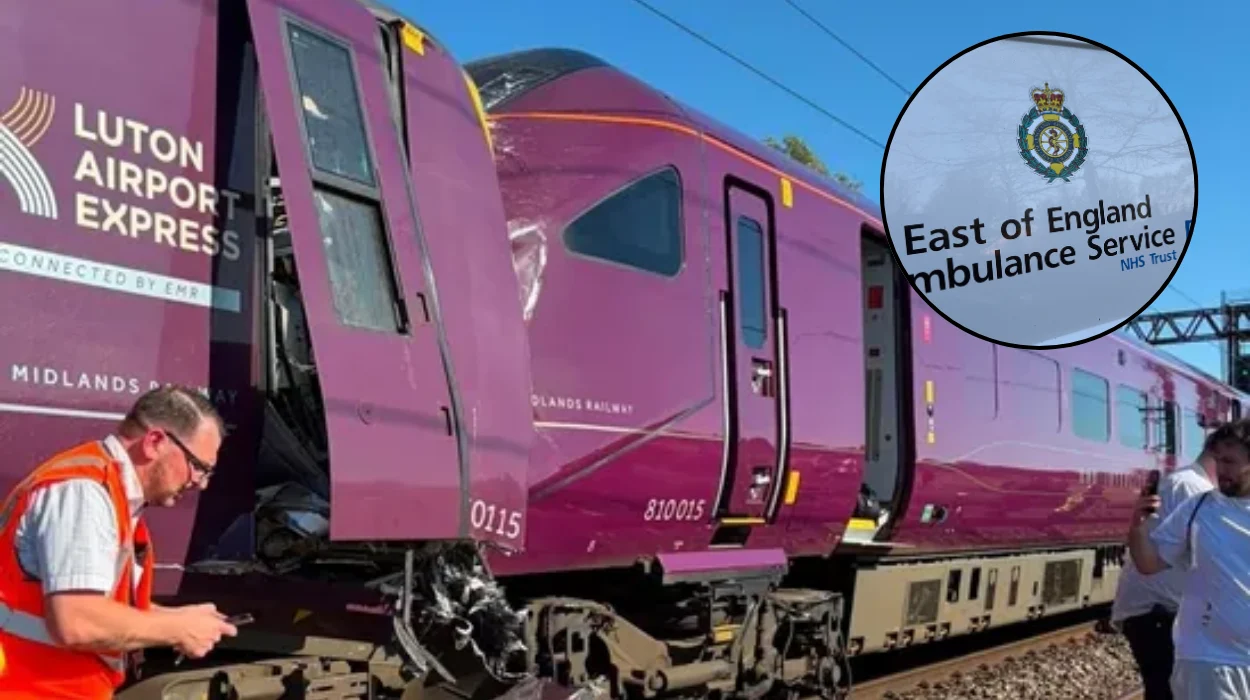
The collision occurred on the line connecting London St Pancras International and Leicester, specifically on a section of the railway situated just south of Bedford, a market town located approximately 56 miles (90 kilometres) north of London. As reported by journalists covering the unfolding crisis, the incident took place during the height of the Friday evening rush hour, a time when thousands of commuters and weekend travellers populate the dual-operator line. Initial reports indicate that the two trains involved were both passenger services operated by East Midlands Railway, with at least one identified as a purple-liveried Luton Airport Express service.
Images and unverified video footage captured by stranded passengers and widely circulated across social media networks depicted a stark scene of the aftermath. The visual evidence shows two damaged East Midlands Railway trains positioned closely together on the tracks, with visible structural impact damage on the outer shells of the carriages. Although the trains managed to remain largely upright along the railway corridor rather than overturning down the embankment, the force of the sudden impact was severe enough to derail structural components of the carriages, prompting immediate panic among those trapped inside.
As the emergency services began arriving at the scene, passengers were filmed climbing down from the damaged rail carriages and gathering in groups along the neighbouring fields and tracks running parallel to the line. The collision site itself is understood to be located just south of the busy Elstow interchange, which sits between the arterial A421 and A6 roads, creating significant logistical challenges for rescue vehicles attempting to access the isolated stretch of track.
What Are Eyewitnesses Saying From the Scene?
First-hand testimony from inside the carriages has revealed the terrifying and instantaneous nature of the crash. As documented by transport reporters, passengers on board experienced a violent impact without any structural warning from the train’s operating systems.
As reported by a journalist for The Guardian, an on-scene passenger, Dr Pete Knapp, provided a harrowing live account of the crash on social media, detailing the precise timing and the immediate physical toll on those inside the carriages. Dr Pete Knapp stated that:
“Train heading south from Bedford crashed at 17:12. Front of train ok, third carriage off rails. I’m ok with bloody legs and back impact. Others are not good. Sudden crash, no slowing down or horns. No warning. No explosion, just stopped instantly.”
This eyewitness account underscores the extreme force of the kinetic deceleration, which caught passengers completely off guard as they were thrown from their seats. The description of the third carriage being forced completely “off the rails” provides crucial early context regarding the physical mechanics of the collision, highlighting that while the train bodies remained upright, a partial derailment had indeed taken place. Dr Knapp’s observations that “others are not good” lent immediate weight to early fears that emergency medical teams would be dealing with complex, severe trauma injuries at the scene.
How Did Emergency Services Respond to the Major Incident?
The scale of the collision prompted a rapid, multi-agency mobilization from regional emergency services, who quickly designated the collision site as a “major incident” to streamline resources and medical priorities. The East of England Ambulance Service took to social media to confirm the deployment of an extensive network of specialized medical assets to the railway lines south of Bedford.
A spokesperson for the East of England Ambulance Service outlined the scope of the medical deployment on social media, stating that the service had sent “a number of resources, including air ambulance and our Hazardous Area Response Team, to a major incident on the railway south of Bedford.” The inclusion of the Hazardous Area Response Team (HART) indicates that specialized paramedics trained to operate in hazardous environments, such as unstable rail corridors and active track zones, were essential to safely extricating injured passengers from the damaged carriages.
Simultaneously, local fire crews were dispatched to secure the physical scene and prevent any secondary hazards, such as electrical fires from the overhead lines or structural collapses of the damaged rolling stock. As reported by regional correspondents, a spokesperson for the Bedfordshire Fire and Rescue Service confirmed their active deployment, stating that
“crews are currently in attendance at an incident on the railway just south of Bedford.”
Both the police and fire services issued urgent public appeals throughout Friday evening, requesting that motorists and local residents entirely avoid the area surrounding the Elstow interchange to ensure that emergency access routes remained completely clear for incoming ambulances and rescue equipment.
What Official Statements Have Rail Operators Issued?
In the immediate wake of the collision, East Midlands Railway released a sequence of brief statements via its official communication channels, acknowledging the severity of the situation while working alongside Network Rail to assess the damage to the infrastructure.
As reported by Sophie Fagone Buscimese of the Leicester Mercury, East Midlands Railway initial statements focused on the immediate suspension of service, announcing via social media that
“emergency services are dealing with an incident between London St Pancras and Leicester,”
without initially providing granular details regarding the operational cause of the crash. As the evening progressed and the structural reality of the collision became clear, an East Midlands Railway spokesperson updated the public regarding the total shutdown of the network, stating that:
“Trains are unable to run in or out on London St Pancras for the remainder of this evening. Passengers are advised do not travel.”
This total operational halt severely affected all principal EMR routes radiating from the capital, directly impacting services traveling between London St Pancras and major regional hubs including Leicester, Nottingham, Sheffield, and Corby.
The disruption quickly cascaded to secondary operators sharing the rail corridor. The commuter rail line Thameslink, which provides vital transit links across the home counties, reported a total blockage of its primary lines. A spokesperson for Thameslink issued an update via their official X account, stating that
“all lines are blocked between Luton and Bedford… due to a problem under investigation.”
Thameslink representatives subsequently advised their passengers to expect delays of at least 60 minutes and to seek extensive diversions via alternative rail operators.
How is the UK Government Responding to the Crash?
The gravity of a double-passenger train collision drew an immediate response from the highest levels of the UK Department for Transport. Government officials were briefed on the operational details of the collision as emergency services worked to triaging casualties in the field.
As reported by political correspondents across the British media, Transport Secretary Heidi Alexander expressed profound alarm over the initial reports coming out of Bedfordshire. Writing in an official statement published on X, Transport Secretary Heidi Alexander stated that:
“I’m deeply concerned to hear reports of the collision involving 2 East Midlands Railway passenger trains. I’m grateful to emergency services who are on the scene, attending to those affected. We’re working quickly with the rail industry and local partners to support passengers.”
The Transport Secretary’s statement confirms that a coordinated government response has been established between civil civil servants, the British Transport Police, and Network Rail executives to oversee both the immediate humanitarian response and the preliminary phase of the upcoming safety investigation.
Explore More about UK:
Malverns Classic Cycling Festival Returns This August
Chinese spies jailed in London for running secret “shadow policing” operation in landmark espionage case
What Are Local Political Leaders Saying About the Collision?
Local members of parliament and union leaders representing rail workers have voiced their distress regarding the incident, emphasizing the need to support the emergency services during the initial rescue phase.
As reported by local news editors, the Member of Parliament for Bedford and Kempston, Mohammad Yasin, issued an immediate message of support to his constituents via his official Facebook page. MP Mohammad Yasin stated that:
“I’m very sorry to hear there has been a train collision between Bedford and Luton. Emergency services are at the scene. I will try to share more details soon.”
The sudden crash has also raised serious questions within the wider rail industry regarding operational safety protocols along the Midland Main Line. Commenting on the structural significance of the crash, the General Secretary of the Transport Salaried Staffs Association (TSSA), Maryam Eslamdoust, highlighted the union’s deep anxiety over the incident. General Secretary Maryam Eslamdoust stated that it is “devastating to hear of the collision” and that “safety on our railways is always our number one priority.” She further added:
“It’s vital now to let the emergency services do their work. The thoughts of the entire union are with those affected.”
What Diversion Routes Are Available For Stranded Passengers?
With London St Pancras International completely closed to incoming and outgoing trains for the rest of Friday evening, National Rail and East Midlands Railway have coordinated with alternative rail companies to establish emergency diversion routes for tens of thousands of displaced commuters.
As reported by transport logs compiled by regional journalists, passenger diversion agreements have been enacted at no additional cost to ticket holders. The established emergency routes include the following primary transits:
- Leicester-bound Passengers: Travelers attempting to reach Leicester from London have been instructed to depart from London Euston station, utilising West Midlands Trains or Avanti West Coast services to reach Nuneaton, where they can subsequently transfer onto regional cross-country services heading into Leicester.
- Nottingham-bound Passengers: Passengers whose destination is Nottingham have been advised to divert entirely to London King’s Cross station, where they can board London North Eastern Railway (LNER) trains traveling north to Grantham, before connecting to local services into Nottingham.
- Derby-bound Passengers: Commuters traveling to Derby are being routed out of London Euston toward Birmingham New Street, where secondary connections can take them northward into Derbyshire.
National Rail has emphasized that while these inter-operator ticket agreements are active, journey times will be extended by at least one to two hours, and severe overcrowding is anticipated across alternative London terminal stations.
What Will the Rail Safety Investigation Focus On?
While the immediate priority remains the medical treatment of injured passengers and the clearance of the physical wreckage from the tracks south of Bedford, attention is already turning toward the official investigation that will be launched to determine how two passenger trains managed to collide on the same track.
Train collisions are historically rare in modern British rail history due to the stringent implementation of electronic signalling blocks and automatic train protection systems designed to prevent two services from occupying the same structural section of track. The upcoming investigation, which will be spearheaded by the Rail Accident Investigation Branch (RAIB) alongside the British Transport Police, is expected to analyze several critical operational vectors.
Investigators will examine the digital data logs from the trackside signalling infrastructure and the internal black box recorders located within both East Midlands Railway trains. A primary focus will center on determining whether the collision was caused by a mechanical failure within the signalling system, an infrastructure fault, or human operational error. Furthermore, investigators will scrutinize why no warning horns or braking indicators were experienced by passengers prior to the impact, as noted in the eyewitness testimony of Dr Pete Knapp. The structural integrity of the Class 360 units and other rolling stock involved will also be evaluated to understand how the carriages deflected the force of the impact.
National Rail has already indicated that the process of clearing the tracks, repairing damaged rail infrastructure, and validating safety signals means that major disruption along the route will persist well into the weekend, with rolling cancellations expected to affect morning services.