Key Points
- The United Kingdom Government has formalised an absolute commitment to speed up the development, production, and deployment of advanced Directed Energy Weapons (DEWs) across the Armed Forces to actively counter asymmetric, low-cost drone threats.
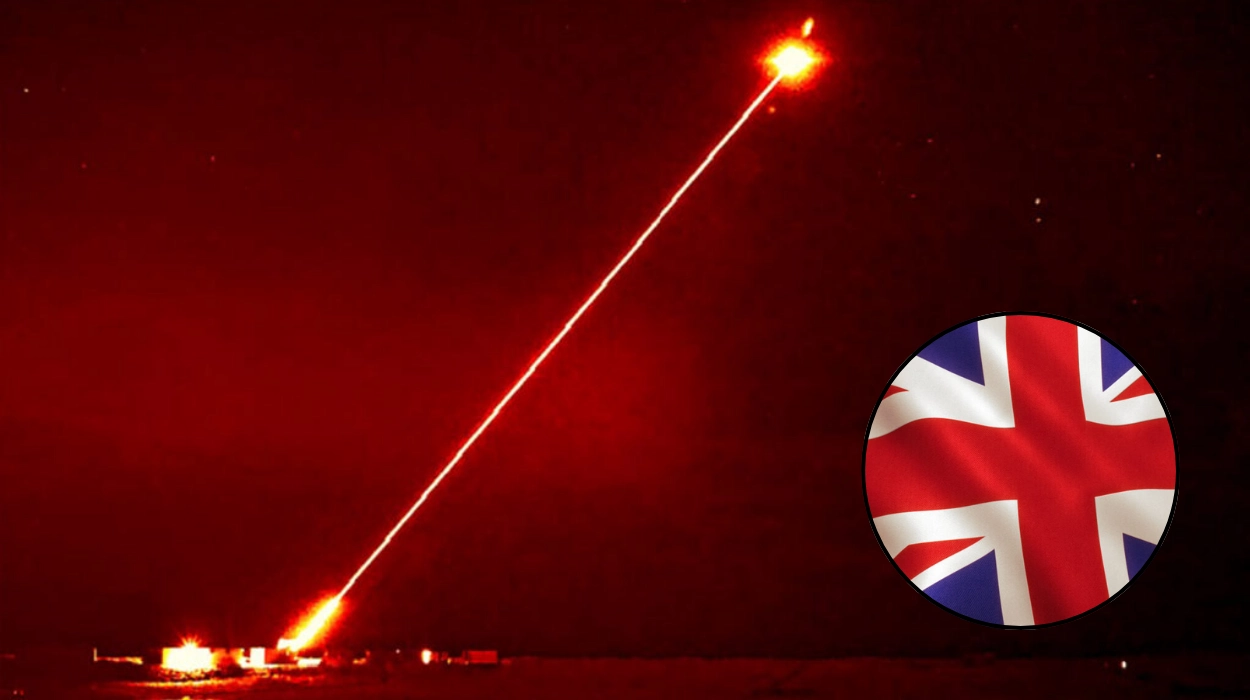
- The sovereignly designed DragonFire high-energy laser weapon is officially scheduled for permanent installation aboard a Royal Navy Type 45 destroyer by 2027, cutting five full years from the initial military procurement timeline.
- Operating at an estimated cost of just £10 ($13) per single high-power firing, these advanced systems present a highly sustainable alternative to traditional interceptor missiles, which routinely cost hundreds of thousands of pounds per unit.
- The accelerated installation sequence positions the United Kingdom to become the premier European NATO member nation to operationally deploy fully functional, high-power laser directed energy technology within an active theater.
- While initial deployment focuses heavily on safeguarding frontline Royal Navy surface vessels, simultaneous defence initiatives are underway to adapt parallel laser variants to defend British Army ground elements and fixed military installations.
- The technological acceleration is structurally anchored by a landmark £316 million ($414 million) production contract finalized with industrial lead contractor MBDA UK, building upon a multi-year joint investment exceeding £100 million.
London (Britain Today News) June 19, 2026 – The United Kingdom Ministry of Defence has confirmed an aggressive acceleration in the development and operational deployment of frontline directed energy weapons, specifically engineering high-precision laser frameworks to systematically neutralize low-cost uncrewed aerial systems (UAS) currently threatening global maritime and land forces.
- Key Points
- When Will Directed Energy Weapons Be Available to the UK Armed Forces?
- What Is the DragonFire Laser System and How Does It Function?
- Why Are the Economics of Directed Energy Weapons Essential in Modern Warfare?
- How Did Recent Trials Validate the Weapon’s Frontline Preparedness?
- What Strategic Steps Are Being Taken to Close the Naval Defense Gap?
- What Impact Does This Have on the UK’s Role Within NATO?
- What Are the Remaining Technical and Logistical Challenges?
- How Will the DragonFire System Scale Across the Future Fleet?
This official defense directive, underscored by a comprehensive £316 million ($414 million) production contract, ensures the pioneering British-designed DragonFire high-energy laser system will be fast-tracked onto an active Royal Navy Type 45 destroyer by 2027. The strategic adjustment moves the operational readiness window forward by five years relative to initial military projections, positioning the United Kingdom to establish a critical technological precedent as the first European NATO member nation to field shipborne laser capabilities in an active theatre of operations.
The state-directed push to weaponise high-energy lasers and radio frequency capabilities responds directly to the asymmetric economic challenges observed in modern conflict zones, most notably within Ukraine and across critical shipping lanes in the Red Sea. In these modern spaces, state actors and non-state groups routinely deploy swarm tactics utilizing cheap, commercially manufactured drones costing mere hundreds of pounds.
Currently, Western militaries rely heavily on highly sophisticated but financially draining kinetic defensive layers, frequently intercepting these low-cost aerial threats with conventional surface-to-air missiles that command unit costs extending well into hundreds of thousands of pounds. The implementation of directed energy systems fundamentally alters this paradigm, reducing the cost-per-shot metric to approximately £10 ($13), while ensuring a virtually limitless operational ammunition capacity driven entirely by onboard electrical power generation.
When Will Directed Energy Weapons Be Available to the UK Armed Forces?
The definitive timeline regarding the arrival of directed energy weapons on the front line was explicitly clarified during a formal parliamentary session within the House of Lords. In response to a pointed written question submitted by the Labour peer Lord Spellar, who sought precise logistical clarity on when directed energy weapons designed to combat low-cost drones would be available to the UK armed forces, the Minister of State at the Ministry of Defence, Lord Coaker, provided a definitive structural outline of the government’s revised procurement strategy.
As reported by parliamentary defense analysts recording the official written answers, Lord Coaker stated that the government was
“committed to accelerating the development and deployment of directed energy weapons”
to counter low-cost drones. The Defence Minister further elaborated on the international standing of the domestic industrial sector, explicitly describing the United Kingdom as “a world leader” in research on high-energy lasers and radio frequency weapons, working with key allies who share its aims in the field.
The legislative disclosure directly validates previous reports detailing the structural overhaul of British military procurement procedures. Under the revised framework, the Ministry of Defence has prioritised the rapid transition of advanced technological demonstrators out of prolonged evaluation phases and directly into active frontline inventory. Rather than waiting for a completely perfected, multi-role system initially projected for a 2032 introduction, the revised timeline accepts operational prototypes early to gather real-world performance metrics.
According to technical briefs later verified by military logistics experts, the 2027 sea deployment aboard a Daring-class Type 45 guided-missile destroyer will serve as the definitive operational testing ground, with government planning documents referencing an expanded, long-term ambition to equip up to four Royal Navy warships with variations of the system depending on initial maritime operational trials.
What Is the DragonFire Laser System and How Does It Function?
To fully appreciate the scope of this technological shift, it is necessary to examine the underlying mechanics of the premier system spearheading this initiative. DragonFire is a sovereign British 50-kilowatt-class laser directed energy weapon (LDEW) developed through an intricate industrial partnership. The overarching technical architecture is managed by a dedicated consortium consisting of MBDA UK as the prime systems integrator, Leonardo UK providing advanced electro-optics and precise pointing tracking systems, QinetiQ delivering the core high-power laser source, and the government’s internal Defence Science and Technology Laboratory (DSTL) overseeing sovereign scientific validation.
The precise technical methodology behind the weapon’s destructive capability relies heavily on a specialized spectral beam-combining architecture. According to unclassified engineering specifications published by technical writers at MBDA UK, the system functions by channeled electrical energy through tens of specialized glass-fiber laser amplifiers, combining multiple independent sub-beams into a single, highly concentrated coherent laser beam characterized by near diffraction-limited quality. This combined beam is directed via a highly stabilized turret structure that houses a complex array of tracking sensors, including an electro-optical camera and a secondary, low-power target illumination laser.
The system achieves an unprecedented standard of tracking and engagement precision. The Ministry of Defence has consistently noted that the physical precision required for an effective engagement is equivalent to hitting a standard £1 coin (measuring just 23 millimeters in diameter) from a distance of one kilometer away. Operating strictly as a line-of-sight system, the laser travels at the speed of light, leaving targeted drones with zero window for evasion or defensive maneuvering once a positive track is established.
When the primary high-power beam strikes an incoming target, it does not rely on explosive kinetic impact. Instead, it continuously deposits extreme thermal energy onto a highly localized surface area. Within a span of mere seconds, this concentrated energy shears through structural metals, vaporizes composite outer shells, and directly detonates onboard fuel reservoirs or payload warheads, causing instantaneous structural failure.
Why Are the Economics of Directed Energy Weapons Essential in Modern Warfare?
The strategic rationale driving the acceleration of the DragonFire project is deeply rooted in the foundational financial mathematics of modern air defense. Throughout recent operations in the Red Sea, Royal Navy destroyers such as HMS Diamond have successfully defended international commercial shipping lanes against hostile uncrewed aerial vehicles launched by Houthi rebel forces. However, these engagements highlighted a glaring economic disparity. The Type 45 destroyers successfully obliterated incoming threats using their primary Sea Viper air defense system, which fires advanced Aster-15 and Aster-30 interceptor missiles. While flawlessly effective, each individual Aster missile commands an operational cost often exceeding £1 million.
When contrasted against modern asymmetric threats—where hostile actors utilize mass-produced, long-range attack drones costing between £1,000 and £20,000—the long-term financial unsustainability of traditional kinetic defense becomes starkly apparent. A state actor could theoretically deplete a warship’s limited magazine capacity simply by launching successive waves of low-cost drones. Directed energy weapons fundamentally invert this tactical dynamic. As confirmed in official statements by the Ministry of Defence, the direct electrical operating cost of firing the DragonFire laser is roughly £10 ($13) per shot, determined primarily by the localized fuel consumption of the vessel’s main gas turbine generators during power accumulation.
Furthermore, the implementation of laser weaponry permanently resolves a critical maritime logistical vulnerability: magazine depth. Standard guided-missile destroyers are bound by the physical dimensions of their vertical launching systems (VLS), meaning that once their complement of defensive missiles is expended, the vessel must withdraw from the combat zone to undergo a complex ammunition replenishment process at a specialized port.
Because DragonFire generates its destructive force using raw electrical energy rather than physical munitions, its ammunition capacity is bounded only by the continuous fuel supply and cooling capacity of the host ship. This allows for virtually unlimited firing opportunities during prolonged multi-threat engagements.
How Did Recent Trials Validate the Weapon’s Frontline Preparedness?
The decision by government ministers to bring the deployment timeline forward by five years was not an arbitrary political gesture; it was directly justified by a sequence of highly successful live-fire testing campaigns conducted under rigorous environmental conditions. As reported by field correspondents monitoring British military testing ranges, the DragonFire system completed two major periods of high-power firing trials at the Ministry of Defence Hebrides Range located off the coast of Scotland. These extensive live-fire operations validated the system’s capacity to detect, track, and neutralise dynamic aerial threats under operationally representative conditions.
During these classified exercises, the laser system successfully engaged above-the-horizon, high-velocity target drones traveling at speeds reaching up to 650 kilometers per hour (approximately 400 miles per hour). The tracking mechanisms maintained an uninterrupted lock through complex lateral maneuvers, culminating in the total destruction of the targets without producing a scattered debris cloud. This achievement marked a historic first within the United Kingdom’s defense sector for the long-range interception of high-speed aerial threats using directed energy technology.
Simultaneously, parallel testing tracks have proved that the operational utility of directed energy technology extends well beyond naval applications. At the Radnor Range situated within a steep valley in central Wales, the British Army’s 16th Regiment Royal Artillery—a specialized unit tasked with providing comprehensive air defense for frontline ground maneuvers—conducted extensive live-fire testing utilizing a separate, highly portable laser variant mounted directly to a heavy Wolfhound six-wheel armored personnel carrier.
Developed under a separate £16.8 million contract managed by industrial partners at Raytheon UK, this land-based demonstrator successfully tracked and brought down dozens of moving quadcopter drones at distances exceeding one kilometer. The ground-based trials demonstrated that the underlying technology could be successfully containerized and ruggedized to withstand the physical vibrations, dust, and rapid deployment demands characteristic of mobile land warfare, confirming its suitability for protecting fixed military bases, radar installations, and forward-deployed land forces.
What Strategic Steps Are Being Taken to Close the Naval Defense Gap?
The stated commitment by Lord Coaker to accelerate directed energy capabilities does not exist in a vacuum. Instead, it sits alongside a separate, highly coordinated military effort to rapidly enhance the close-in survival capabilities of Royal Navy warships against modern uncrewed systems. These two distinct acquisition tracks are unfolding simultaneously, illustrating a broader defense-wide push to close the dangerous tactical gap currently existing between the rapid proliferation of cheap unmanned systems and the legacy defensive suites traditionally fielded by Western militaries.
While the long-term objective centers on permanent laser integration, immediate stop-gap upgrades are currently being implemented across the surface fleet. The Royal Navy has steadily enhanced the short-range lethality of its existing platforms by updating the software and tracking loops of its automated 30mm small-caliber cannons and Phalanx Close-In Weapon Systems (CIWS).
Furthermore, the integration of the Common Anti-air Modular Missile (CAMM), utilizing the Sea Ceptor architecture, provides an intermediate layer of agile defense capable of intercepting multiple incoming threats at closer ranges than legacy systems allowed. The eventual addition of the DragonFire system to this layered defense architecture means that command commanders will soon possess a multi-tiered tactical continuum, allowing them to allocate ultra-low-cost laser intercepts to minor drone threats while reserving high-end Aster missiles exclusively for complex, supersonic anti-ship cruise missiles.
Explore More about Technology:
UK Critical Infrastructure Hit by 200 Cyberattacks in a Single Year, Agency Reports
UK Considers Rolling Back EV Mandate as Automakers Raise Concerns
What Impact Does This Have on the UK’s Role Within NATO?
The geopolitical implications of the DragonFire acceleration extend significantly across the wider NATO alliance. As Western European nations collectively reassess their defensive posturing in light of shifting security paradigms, the vulnerabilities of shared industrial supply chains and ammunition stockpiles have become prominent concerns. By stepping forward to operationally deploy advanced laser directed energy technology ahead of its continental peers, the United Kingdom is positioning itself as a primary doctrinal architect for future European air defense frameworks.
The technological insights gained from the 2027 Type 45 deployment will likely inform the development of shared technical standards across NATO. Key allies, including the United States—which has been independently testing its own shipborne laser variants such as the HELIOS system aboard Arleigh Burke-class destroyers—are watching the integration of the British fiber-combined laser architecture with immense interest.
The successful operationalization of DragonFire provides European NATO forces with a viable, sovereign technological template that reduces their long-term dependence on American-manufactured kinetic interceptors, directly strengthening the collective resilience and strategic autonomy of the alliance when facing modern asymmetric warfare.
What Are the Remaining Technical and Logistical Challenges?
Despite the optimism surrounding the 2027 deployment window, experienced defense engineering analysts emphasize that transitioning a highly complex laboratory asset into a harsh, salt-water maritime environment presents substantial technical hurdles. One of the primary engineering challenges centers directly on the management of thermal dynamics and power distribution. A 50-kW class continuous-wave laser requires an immediate, massive draw of electrical energy, which places a significant instantaneous load on a ship’s electrical grid.
To mitigate this impact without destabilizing the vessel’s core propulsion and radar systems, engineers must integrate advanced energy storage mechanisms, such as specialized high-speed flywheel energy storage systems, designed to deliver rapid electrical pulses.
Furthermore, environmental degradation remains a persistent variable for line-of-sight optical systems. Atmospheric conditions such as heavy maritime fog, sea spray, low-hanging cloud cover, and suspended dust particles can scatter and attenuate the laser beam, reducing the total energy density delivered to the target at long ranges. The partnership must ensure that Leonardo’s optical tracking sensors and beam directors can dynamically adjust and compensate for atmospheric distortion in real time.
Additionally, the long-term maintenance of pristine optical coatings on the external turret lens—while subjected to continuous salt crusting and the physical concussions of adjacent conventional deck guns—presents a demanding logistical challenge that the Royal Navy must address as it transitions this technology from an experimental novelty into a dependable tool of frontline defense.
How Will the DragonFire System Scale Across the Future Fleet?
As the Ministry of Defence looks beyond the initial 2027 milestone, the long-term scaling strategy for directed energy weapons is poised to reshape the architecture of the future British surface fleet. Assuming the initial Type 45 trials yield positive operational outcomes, the procurement pathway outlines the systematic integration of the DragonFire system across subsequent generations of warships. This includes the Type 26 Global Combat Ships and Type 31 general-purpose frigates currently under construction.
By designing these modern platforms from the outset with modular spaces and substantial electrical margins, the Royal Navy ensures that the integration of future directed energy assets will avoid the costly structural retrofitting required for legacy vessels.
The ultimate vision extends into a comprehensive, multi-domain defense matrix where sovereign laser technology safeguards every tier of national defense. From protecting Royal Air Force installations against low-altitude surveillance assets to shielding mobile armored columns on the move, the fast-tracking of the DragonFire program marks the definitive end of the theoretical era for directed energy weapons. Driven by the stark economic realities of modern conflict, the United Kingdom has firmly committed to a path where light-speed precision will form the foundational baseline of its national defense architecture.