Key Points
- The newly concluded free trade agreement (FTA) between the United Kingdom and the Gulf Cooperation Council (GCC) marks the first comprehensive trade pact signed between the six-nation Gulf bloc and a G7 member state. Wikipedia
- The deal will eliminate a significant proportion of trade duties from day one, allowing Qatari and wider GCC exports to enter Britain duty-free while saving British exporters approximately £580 million ($780 million) annually. Qatar news agency
- New regulatory frameworks guarantee that standard shipments will clear customs in less than 48 hours, with perishable goods being expedited within a matter of hours to protect supply chain integrity. Qatar news agency
- Total bilateral trade between the United Kingdom and Qatar currently stands at approximately £5.8 billion ($7.8 billion), a baseline that the new framework is poised to accelerate significantly. Qatar news agency
- Beyond traditional merchandise, the agreement features historic, modern clauses covering cross-border data flows, fintech, artificial intelligence, and extended professional mobility for corporate entities. The National News
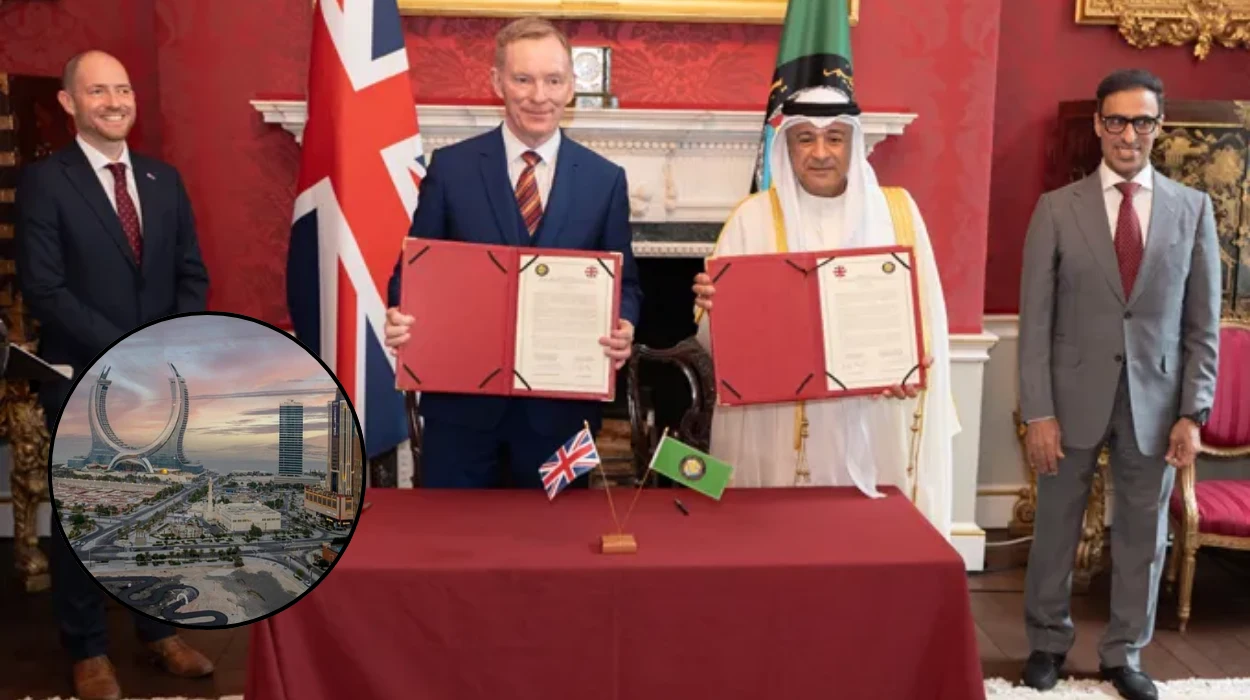
Doha (Britain Today News) May 21, 2026 – A historic, multi-billion-pound free trade agreement successfully concluded between the Gulf Cooperation Council and the United Kingdom is set to aggressively slash import tariffs, simplify cross-border customs regulations, and inject unprecedented momentum into the $7.8 billion bilateral trade relationship shared between Britain and Qatar. The expansive trade pact, which marks the first time the six-member Gulf bloc has secured a comprehensive free trade agreement with a Group of Seven nation, establishes a modernised commercial framework specifically engineered to deconstruct long-standing regulatory barriers, safeguard digital economic infrastructure, and stimulate massive cross-border investment flows across both regions.
- Key Points
- How Will the New UK-GCC Free Trade Agreement Impact Qatar-UK Trade?
- What Practical Mechanisms Will Accelerate Customs Processing Times?
- In What Ways Does the Deal Support Digital Trade, Fintech, and Artificial Intelligence?
- How Will the Agreement Facilitate Corporate Mobility and Professional Services?
- Why is a Diversified Economic Partnership Critical in the Current Global Climate?
- How Does this Treaty Safeguard Long-Term Investment Flows?
How Will the New UK-GCC Free Trade Agreement Impact Qatar-UK Trade?
As reported by political correspondents tracking international trade dynamics, the newly sealed economic partnership fundamentally restructures the financial terms of engagement between London and the Gulf capitals. Under the finalized stipulations of the pact, Qatari and wider GCC exports are granted completely duty-free entry into the United Kingdom marketplace. Conversely, British businesses exporting goods to the Gulf region are projected to save an estimated £580 million ($780 million) every year in tariffs once the agreement is fully implemented across all participating territories.
As stated by His Excellency Neerav Patel, the United Kingdom Ambassador to the State of Qatar, a very significant proportion of these restrictive tariffs will be entirely removed from day one of the enforcement. Ambassador Neerav Patel emphasized that this immediate relief is strategically designed to lower market consumer prices, improve retail and industrial competition, and directly strengthen the operational margins for commercial businesses operating on both sides of the geographic corridor. Currently, the bilateral trade volume between the United Kingdom and Qatar is securely anchored at around £5.8 billion ($7.8 billion), providing a robust foundation for the targeted market expansions.
What Practical Mechanisms Will Accelerate Customs Processing Times?
According to structural briefings released detailing the operational pillars of the agreement, an immense focus has been directed toward administrative efficiency at international entry points. The trade pact mandates a profound acceleration of border customs processing through heavily simplified declaration procedures and a coordinated reduction in bureaucratic paperwork.
As detailed by Ambassador Neerav Patel, international shipments moving between the territories will be fully capable of clearing local customs departments in less than 48 hours, provided that all pre-established regulatory requirements are systematically met by the shipping entities. Furthermore, highly sensitive perishable goods will receive fast-track clearances within mere hours of arrival. Ambassador Neerav Patel noted that these precise logistical measures would proactively help reduce costly transit delays and commercial losses while vastly strengthening the overall reliability of international supply chains connecting the British Isles with the Qatari peninsula.
In What Ways Does the Deal Support Digital Trade, Fintech, and Artificial Intelligence?
As reported by financial analysts examining the modern chapters of the text, the agreement moves far beyond the exchange of physical commodities by incorporating groundbreaking, future-facing rules on the digital economy. The deal explicitly supports secure cross-border data flows and systematically reduces the digital operating costs incurred by multinational tech corporations.
As stated by Ambassador Neerav Patel, these digital trade provisions align perfectly with Qatar’s national economic diversification ambitions, particularly within high-growth sectors such as financial technology, artificial intelligence, and cloud-based digital services. By prohibiting unjustified data localization rules, the agreement ensures that innovative tech firms can operate seamlessly across borders without the mandatory burden of constructing localized, hyper-expensive data storage facilities.
Explore More about Business:
UK Announces Landmark Trade Deal with Six Gulf States Worth £3.7bn a Year 2026
Nationwide Pledges to Keep All 605 Branches Open Until 2030
How Will the Agreement Facilitate Corporate Mobility and Professional Services?
According to corporate legal experts reviewing the services chapters of the document, the free trade agreement drastically improves long-term market access to premium service sectors including finance, international legal services, corporate consultancy, and advanced engineering fields. The framework introduces transparent licensing protocols and sets up unified qualification recognition rules to eliminate arbitrary domestic barriers.
As explained by Ambassador Neerav Patel, the implementation of simplified visa procedures alongside permission for longer business stays will allow qualified engineers, corporate lawyers, and specialized consultants to move far more quickly between the United Kingdom and the various GCC member states. This enhanced mobility is intended to directly support complex, multi-layered project delivery across the region, ensuring that human capital can be deployed exactly when and where it is required.
Why is a Diversified Economic Partnership Critical in the Current Global Climate?
As reported by global macroeconomic strategists, the timing of the pact is highly significant given the structural shifts and geopolitically driven fragmentation currently observed across traditional international trade routes. The agreement provides a highly predictable, legally binding environment for international investors, which remains a core necessity for corporate confidence during periods of wider global economic volatility.
Reflecting on the comprehensive, multi-layered nature of the bilateral relationship, Ambassador Neerav Patel stated that
“it goes so much wider, there is not a single sector or area of public life where we are not connected, and we are surging ahead in future-facing sectors.”
Ambassador Neerav Patel further elaborated on the deep strategic importance of this economic breadth, asserting that
“trade, investment and security cooperation are the backbone but the relationship is expanding, into technology, energy transition, and long-term economic development. This breadth matters. It means we are not reliant on a single sector, we are building a genuinely diversified partnership.”
How Does this Treaty Safeguard Long-Term Investment Flows?
According to trade ministry summaries outlining investor protections, the treaty provides explicitly clear rules and legally binding protections for international investors who are actively financing large-scale assets across infrastructure, clean energy, industrial manufacturing, and the technology services sectors. These enhanced protections are expected to drive significant capital allocations into future-facing sectors, moving away from a singular reliance on historic energy trade.
Highlighting the long-term institutional stability provided by the finalization of the trade framework, Ambassador Neerav Patel stated that
“this agreement strengthens that foundation and gives us the tools to take it further. The FTA reflects that shift. It gives businesses a more predictable environment to operate, which is essential in a more uncertain global economy.”
Ambassador Neerav Patel concluded his remarks by noting that the agreement successfully formalizes a deeper layer of strategic integration between the GCC and the United Kingdom, mirroring exactly how highly sophisticated, modern economies operate in an era dominated by digital trade networks, cross-border corporate investment, and deep innovation partnerships.