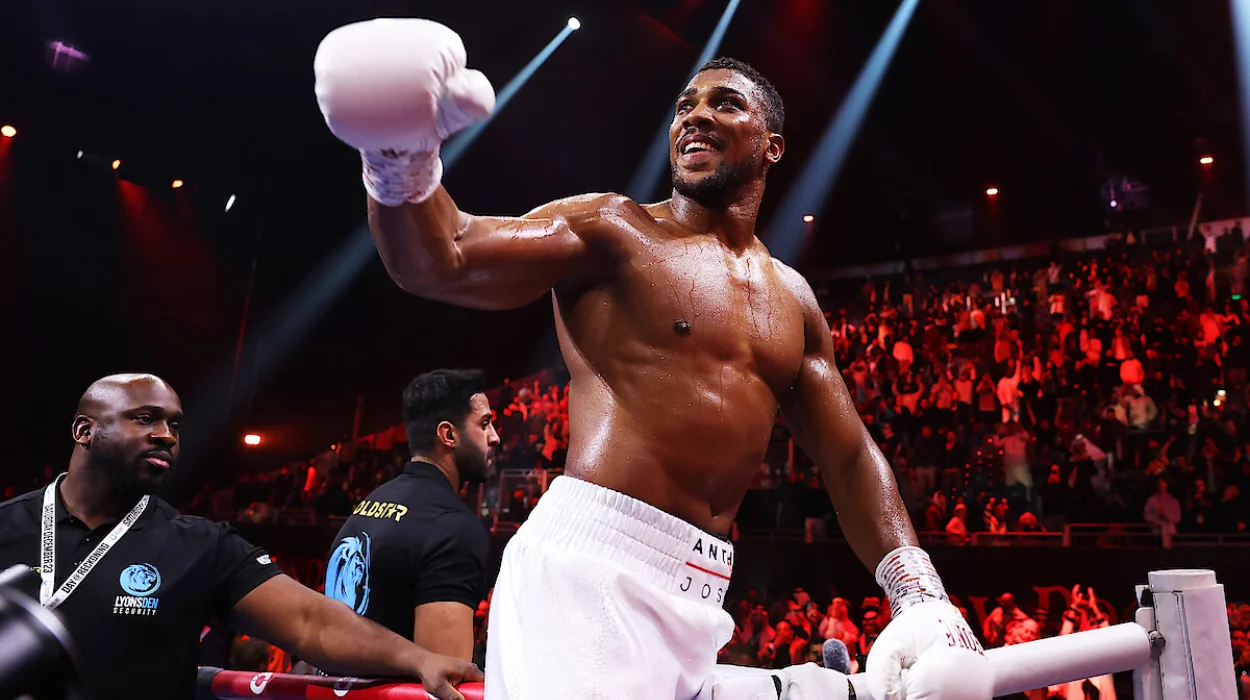
Anthony Joshua is a British heavyweight boxer with one of the most widely searched modern boxing records. His profile combines Olympic gold, two reigns as unified world heavyweight champion, and a knockout-heavy professional ledger that defines his legacy.
- What is Anthony Joshua’s boxing record?
- How did Anthony Joshua become a heavyweight champion?
- Why is Anthony Joshua known for knockouts?
- Which fights define Anthony Joshua’s career highlights?
- What are Anthony Joshua’s major losses?
- What titles has Anthony Joshua won?
- How good are Anthony Joshua’s stats in context?
- What is Anthony Joshua’s legacy in British boxing?
- Why does Anthony Joshua remain relevant today?
- What should readers remember about Anthony Joshua’s record?
What is Anthony Joshua’s boxing record?
Anthony Joshua’s professional record stands at 28 wins and 4 losses, with 25 wins by knockout in widely cited boxing profiles, while some updated listings also show 29 wins and 4 losses after his most recent result. His core identity remains elite heavyweight power, world-title success, and sustained top-level relevance.
Joshua’s record is usually presented in two ways because boxing databases update at different speeds. Some sources list him at 28-4 with 25 knockouts, while newer profiles list 29-4 with 26 knockouts. BoxRec also lists his career as 2013-2025 with 33 bouts and an 89.66 percent knockout rate across all fights.
His record matters because it reflects both volume and quality. Joshua has fought across the full heavyweight elite, including Charles Martin, Wladimir Klitschko, Andy Ruiz Jr., Kubrat Pulev, Oleksandr Usyk, and Daniel Dubois. Those opponents define his career profile far more than raw win-loss totals alone.
How did Anthony Joshua become a heavyweight champion?
Joshua became a heavyweight champion through a rapid rise from Olympic gold medalist to world-title winner, capturing the IBF belt in April 2016 and later adding the WBA and WBO titles to become a two-time unified heavyweight champion.
Joshua won Olympic gold at London 2012 in the men’s super-heavyweight division, an achievement confirmed by Team GB and Olympics.com. He turned professional in 2013 and built momentum with a fast sequence of early stoppages, which created a clear path to championship fights.
His first world title came on 9 April 2016 when he stopped Charles Martin in the second round to win the IBF heavyweight belt. That victory established Joshua as a major force in the division and started his climb toward unification.
He later beat Wladimir Klitschko at Wembley in April 2017, one of the defining fights of modern heavyweight boxing. That win elevated Joshua from titleholder to global attraction and formed the peak of his first championship phase.
Why is Anthony Joshua known for knockouts?
Joshua is known for knockouts because his professional style produces a very high stoppage rate, with around 89 to 90 percent of his wins coming inside the distance across major boxing databases.
His knockout reputation began early in his professional career. ESPN noted that his first 17 professional fights all ended in victories by knockout, a run that made him look like a dominant finisher from the start of his career.
BoxRec lists Joshua’s knockout percentage at 89.66 percent, and TrillerTV lists 26 knockouts from 29 wins. Those figures place him among the most dangerous punchers in the heavyweight division of his era.
The knockout record also shapes how opponents approach him. Heavyweights who face Joshua usually respect his single-shot power, especially his right hand and his ability to end contests once he commits to sustained offense. His stoppages over Charles Martin, Dillian Whyte, Alexander Povetkin, and Kubrat Pulev are central examples of that power.
Which fights define Anthony Joshua’s career highlights?
Joshua’s defining career highlights include his Olympic gold medal, his win over Charles Martin for the IBF title, his victory over Wladimir Klitschko at Wembley, and his title-reclaiming win over Andy Ruiz Jr. in the rematch.
The first major highlight is London 2012. Joshua won Olympic gold in the super-heavyweight category, which gave him international status before his professional career began. That amateur success set the foundation for everything that followed.
The second major highlight is the Charles Martin fight in 2016. Joshua won the IBF title by second-round stoppage, and that result accelerated his rise into the global heavyweight conversation.
The third major highlight is the Wladimir Klitschko fight in 2017. Joshua won by stoppage in front of a huge crowd at Wembley Stadium, and that fight became one of the signature heavyweight events of the decade.
The fourth major highlight is the Andy Ruiz Jr. rematch in December 2019. Joshua recovered from his first professional defeat and regained unified status by unanimous decision. That result showed that his career was not defined by one upset loss.
What are Anthony Joshua’s major losses?
Joshua’s major losses are the shock defeat to Andy Ruiz Jr. in 2019 and two points losses to Oleksandr Usyk in 2021 and 2022, with newer records also reflecting a later defeat to Daniel Dubois.
The Ruiz loss was the most dramatic because Joshua entered the fight as the favorite and then suffered a knockout defeat on his United States debut at Madison Square Garden. That result changed the public view of his invincibility and forced a major career reset.
Joshua then lost twice to Oleksandr Usyk, first on all three scorecards in 2021 and then by split decision in 2022. Those fights mattered because Usyk’s speed, movement, and accuracy exposed the tactical limits Joshua faced against an elite southpaw technician.
Updated 2026 reports also refer to a later loss to Daniel Dubois, which is one reason some current summaries no longer match older career totals. Boxing records change quickly after recent fights, so the exact loss count depends on the reporting date.
What titles has Anthony Joshua won?
Joshua has won Olympic gold, the IBF heavyweight title, the WBA heavyweight title, and the WBO heavyweight title, and he has held unified championship status twice.
His first major title at the professional level was the IBF belt, won in 2016 against Charles Martin. He then defeated Klitschko and Joseph Parker to build a unified title collection that made him one of the division’s central champions.
The WBA profile confirms that Joshua held the WBA, IBF, and WBO world titles during his championship run. ESPN also identifies him as a former two-time unified WBO, IBF, and WBA heavyweight champion.
At the amateur level, his Olympic gold in 2012 remains one of the strongest background markers in his profile. That medal often appears in his official bios because it shows that his elite status began before the professional stage.
How good are Anthony Joshua’s stats in context?
Joshua’s stats place him in the top tier of modern heavyweight boxers because they combine a high win total, a knockout rate above 89 percent, Olympic gold, and multiple world-title reigns against elite opposition.
A win-loss record alone does not capture his career value. In heavyweight boxing, the quality of opposition matters as much as the ledger, and Joshua has faced champions, former champions, and title challengers at the top of the division.
His physical measurements also matter in the statistical profile. Media and profile pages list him at about 6 feet 6 inches with an 82-inch reach and orthodox stance, a build that supports long-range power punching in heavyweight boxing.
His record also shows two distinct phases. The first phase was the rise from prospect to unified champion. The second phase has been a more complex championship period shaped by losses, adjustments, and comeback wins.
What is Anthony Joshua’s legacy in British boxing?
Joshua’s legacy in British boxing rests on Olympic success, stadium-level popularity, elite heavyweight titles, and a career that made him one of the most commercially and competitively significant British fighters of the modern era.
He helped turn heavyweight boxing into a major British stadium product again. His fights at Wembley and other major venues drew huge crowds and turned championship boxing into mainstream sporting events.
He also became a reference point for the post-Olympic heavyweight pathway in Britain. Joshua showed that an amateur gold medalist can move into the professional ranks, win titles quickly, and become a global headliner.
His career also carries tactical relevance. Joshua’s fights against Ruiz and Usyk showed that elite heavyweight success requires more than power. It also requires adaptability, conditioning, and the ability to solve different styles across 12 rounds.
Why does Anthony Joshua remain relevant today?
Joshua remains relevant because he is still part of the active heavyweight conversation, with recent reporting in 2026 linking him to major comeback plans and future high-profile bouts.
Recent coverage has connected Joshua with comeback-fight plans and possible heavyweight showdowns later in 2026. That keeps his name central in boxing news even when he is not in the ring.
His relevance also comes from search intent. Readers look up his record, knockout count, title history, and career highlights because Joshua is still one of the most recognizable figures in world boxing. That makes his profile an evergreen topic with long-term demand.
What should readers remember about Anthony Joshua’s record?
Readers should remember that Anthony Joshua’s record is built on elite power, Olympic pedigree, unified world titles, and a career that remains active, high-profile, and heavily discussed in boxing media.
His record is not just a number line. It is a map of heavyweight boxing over the last decade, from the rise of a London 2012 champion to the title fights that shaped the division.
The most stable facts are clear. Joshua won Olympic gold in 2012, became a world champion in 2016, beat Klitschko in 2017, regained unified titles in 2019, and remains one of the defining heavyweight names of his generation.
His knockout record is the reason casual readers and boxing fans keep returning to his profile. A heavyweight with close to a 90 percent stoppage rate always stays relevant in rankings, previews, and historical comparisons.