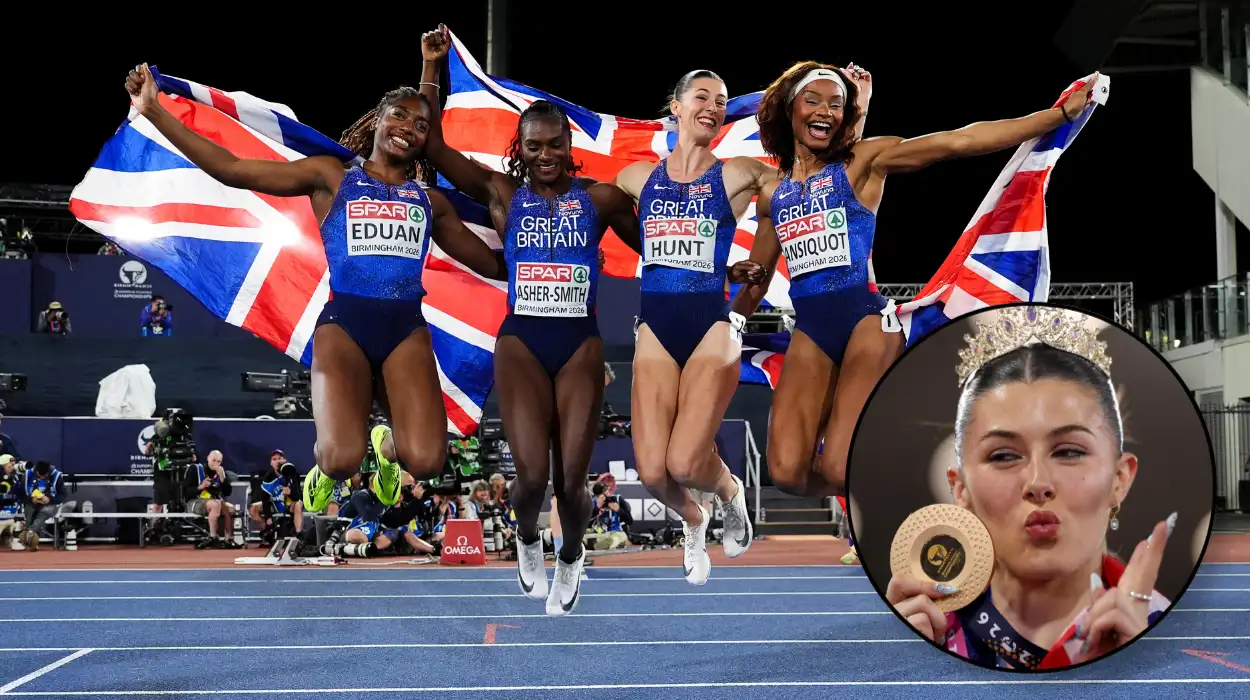
Key Points
- Amy Hunt won her first four gold medals in one European Championship.
- The 24-year-old accomplished a sprint double in the women’s 100m and 200m.
- Hunt then moved to a relay victory for Great Britain with the women before finishing off the first-ever mixed 4x100m relay.
- The team of four mixed relays for Great Britain broke a European record at Alexander Stadium in Birmingham, running 39.97 seconds.
- Hunt toasted to her historic milestone with champagne, Kentucky Fried Chicken, a massage and hardly any sleep.
- Confident athletes should be able to reach out to the public, and shouldn’t be afraid to talk about their aspirations, the Cambridge graduate said.
- Hunt feels that sport is making a comeback in 2026 in Britain.
- The sport has “swaggered back” from the Birmingham championships, she said.
- Having had the successes she has, Hunt is now in the running for the BBC Sports Personality of the Year.
- She has been training in northern Italy under coach Marco Airale, which has helped her to keep her distance from the sudden attention.
- “It is not a bad thing to be a celebrity,” Hunt said.
- Her historic European campaign is followed by a 200m at Lausanne.
Birmingham (Britain Today News) August 17, 2026: Amy Hunt has declared that athletics is “coming back with a swagger” after becoming the first athlete in European Athletics Championships history to win four gold medals at a single edition of the competition.
- Key Points
- How did Amy Hunt make European history?
- What did Amy Hunt say after the mixed relay?
- How did Hunt celebrate her four gold medals?
- Why did Hunt say she is not afraid of ambition?
- What were Hunt’s four European titles?
- What other record was set by Dina Asher-Smith?
- Could Amy Hunt win Sports Personality of the Year?
- How has Hunt handled growing fame?
- Why does Hunt train in northern Italy?
- What did Hunt say about British athletics?
- What is next for Amy Hunt?
- Why is Hunt’s achievement important for athletics?
The British sprinter completed an unprecedented quadruple in front of a home crowd at Birmingham’s Alexander Stadium. Hunt first won the women’s 100m, then secured the 200m title before helping Great Britain claim women’s 4x100m relay gold. Twenty-four hours later, she anchored the British team to victory in the inaugural European mixed 4x100m relay.
Hunt said her success reflected a renewed public interest in track and field during a year without either an Olympic Games or a World Championships.
“I think it just speaks to the resurgence and the kind of reignition of track and field in 2026,” Hunt said, according to the Herald Scotland. “It’s been amazing to see the public fall back in love with us a little bit and to be in people’s minds and hearts.”
She added:
“I think athletics coming back with a swagger is what everyone needs.”
How did Amy Hunt make European history?
Hunt’s historic achievement was completed on Sunday when Great Britain won the mixed 4x100m relay, an event making its European Championships debut in Birmingham.
The British quartet of Jeremiah Azu, Dina Asher-Smith, Zharnel Hughes and Hunt crossed the line in 39.97 seconds. The time was recognised as a European record and placed Great Britain ahead of Germany, who finished in 40.11 seconds, while Spain took third place.
The result was confirmed only after a lengthy review, adding further tension to a race that had already carried historic importance.
The mixed relay provided Hunt with the opportunity to achieve a record that had not previously been possible. With the event introduced to the European Championships for the first time, she was able to pursue a fourth title after winning the two individual sprint races and the women’s relay.
ESPN reported that Azu began the British challenge with a 10.54-second opening leg. Asher-Smith then produced a 10.04-second second leg before handing over to Hughes. Hughes completed his section in 9.53 seconds and sent Hunt towards the finish.
Hunt brought the team home in 9.86 seconds, ensuring that the home nation secured the inaugural European title in the event.
What did Amy Hunt say after the mixed relay?
Hunt said she was delighted to complete the record with several of her closest friends in the sport.
“Oh my gosh, I’m over the moon,” Hunt said, as quoted by ESPN. “And I think to finish it off with some of my best friends in the sport, me and Jeremiah actually have the same birthday so we’re kind of twins.”
The British sprinter also revealed that the team had practised the decisive changeover for the first time during the warm-up shortly before the race.
“To do it all together is incredible, especially because that was the first time we kind of did that changeover about an hour ago in warm-up,” she said, according to ESPN. “First time ever — and look how smooth it was. Such professionals.”
Hunt compared the experience to the feeling of completing a rollercoaster ride.
“It was a bit like, you know when you’re queuing for a rollercoaster and you’re like a little bit nervous and you’re seeing the drops and stuff, and then when you get off you want to do it again?” she said. “It was that adrenaline kick certainly. I loved the event.”
The comments captured Hunt’s mixture of excitement, relief and humour after a week in which she repeatedly performed under intense expectation.
How did Hunt celebrate her four gold medals?
Hunt’s celebrations reflected the scale of her achievement, although they were far removed from the formal atmosphere of the medal ceremonies.
As reported by the Guardian, the British athlete enjoyed champagne, ate Kentucky Fried Chicken, received a massage and eventually went to sleep at around four o’clock in the morning.
The relaxed celebrations came after Hunt had completed the final race of a demanding championship programme. Her four victories required her to manage individual sprint rounds, recovery periods, relay preparations and the pressure associated with competing before a home audience.
The decision to celebrate with fast food also underlined the informal personality Hunt has shown throughout the championships. Rather than presenting herself as distant or overly cautious, she has spoken openly about her ambitions, emotions and lifestyle.
Her approach has helped make her one of the most prominent figures of the Birmingham championships.
Why did Hunt say she is not afraid of ambition?
Hunt had announced her ambitions before the European Championships began. Drawing on the line from High School Musical, she said:
“I want it all.”
Her statement was not presented as a cautious prediction. Instead, it became a clear declaration that she intended to pursue every available gold medal.
The 24-year-old later said that athletes should not be reluctant to speak openly about wanting to win.
“I think speaking confidently kind of draws people in,” Hunt said, according to the Herald Scotland. “I think people are attracted to that kind of no facade, full confidence, full-throttle kind of way of speaking.”
She argued that athletes can sometimes be more hesitant than competitors in other sports when discussing their ambitions.
“In other sports, if you’re going to a Wimbledon final, it’s obviously quite clear you want to win,” Hunt said, as reported by the Herald Scotland. “But I think sometimes, in athletics, there’s a lot more jeopardy involved in what we do.”
Hunt explained that a sprint race involves several athletes competing simultaneously, which can make a bold prediction appear more exposed.
“Because there are a lot more people on the line running against us, sometimes people are a bit more afraid of voicing their ambitions,” she said.
However, she said athletes should not allow that fear to silence them.
“But I think life is short. Why not be ambitious? We’re all thinking these things, so why not say them out loud?”
What were Hunt’s four European titles?
Hunt’s four gold medals came across individual and relay events.
Her first title was won in the women’s 100m, where she recorded 11.00 seconds in Birmingham. The victory represented her first senior international championship gold in that event.
She then secured the women’s 200m title, completing the individual sprint double. Hunt had previously won silver in the 200m at the 2025 World Championships, but Birmingham provided her with the opportunity to claim a major senior title.
Her third gold medal came in the women’s 4x100m relay. Hunt joined Dina Asher-Smith and the rest of the British team to help the hosts win relay gold on Saturday.
The final title arrived in the mixed 4x100m relay. Hunt ran the anchor leg after Azu, Asher-Smith and Hughes had established a strong position for Great Britain.
Together, the four victories made Hunt the first athlete to win four gold medals at one European Athletics Championships.
What other record was set by Dina Asher-Smith?
Hunt was not the only British athlete to make history in the mixed relay.
ESPN reported that Asher-Smith moved to the top of the all-time European Athletics Championships medal list for male and female competitors. Her third medal of the Birmingham championships took her total to 11, surpassing the previous record of 10 held by Poland’s Irena Szewinska.
Asher-Smith also moved to eight European gold medals, two more than Szewinska’s total of six.
The achievement added another significant chapter to Britain’s successful championships. Asher-Smith’s experience provided an important part of the mixed relay team, while Hunt represented the next generation of British sprinting.
The pair’s involvement in the same historic race created a notable connection between one of Britain’s most decorated European athletes and one of its newest champions.
Could Amy Hunt win Sports Personality of the Year?
Hunt’s four-medal achievement has placed her among the leading names being discussed for the BBC Sports Personality of the Year award.
According to the Herald Scotland, bookmakers have made Hunt the outright favourite in several early markets. Josh Kerr, who recently broke the world mile record, is also among the leading contenders, while Birmingham’s European 1500m champion Georgia Hunter Bell has entered the wider conversation.
The potential shortlist discussion is significant because British athletics has often competed for public attention against football, tennis and other high-profile sports.
Hunt’s combination of historic success, outspoken confidence and a memorable home championship has helped her reach a wider audience.
Her achievement is also notable because it came in a year without an Olympic Games or World Championships. That means British athletics had fewer traditional global events around which public interest usually builds.
Hunt believes the Birmingham championships have nevertheless created a strong connection between athletes and supporters.
How has Hunt handled growing fame?
Hunt’s rapid rise has brought increased media attention, public recognition and speculation about her prospects at the highest level of the sport.
The Cambridge graduate said she was proud of how little time she spent looking at screens during the championships. She suggested that limiting outside distractions helped her remain focused on competition and recovery.
However, she acknowledged that her new level of fame could require advice from athletes who have already experienced it.
Hunt joked that she may need to send a message to Keely Hodgkinson to ask how she manages the attention that comes with becoming a leading British sports figure.
At the same time, Hunt stressed that she does not view fame as a threat.
“But it’s definitely not something I shy away from,” she said, according to the Herald Scotland. “I’m not scared of it at all. I think it’s a privilege to be famous as a track person.”
Her comments reflect a willingness to embrace the public responsibilities associated with success while retaining a sense of perspective.
Why does Hunt train in northern Italy?
Hunt believes her training base in northern Italy has helped shield her from some of the pressure created by her rapid rise.
She works under coach Marco Airale and described the arrangement as a “secluded set-up”. The environment gives her distance from the intense media scrutiny and public attention that can follow a British athlete after a major victory.
The approach has parallels with the career decisions of other young British sports stars. The Herald Scotland compared Hunt’s situation with Jude Bellingham, who moved to Borussia Dortmund to develop away from the most intense early-career spotlight surrounding the England national team.
For Hunt, the Italian training base provides a protective bubble without removing her from elite competition.
It also allows her to focus on technical development, physical recovery and preparation for the next stage of her career.
What did Hunt say about British athletics?
Hunt said the Birmingham championships had shown that the British public remained willing to support athletics when athletes were able to connect with fans.
She believes confident performances and expressive personalities can help the sport regain a stronger place in the national conversation.
Her own campaign provided an example of that approach. Hunt openly stated her desire to win every available title, delivered memorable performances and spoke directly about the pressure involved.
“It’s been amazing to see the public fall back in love with us a little bit and to be in people’s minds and hearts,” Hunt said, as reported by the Herald Scotland.
The phrase “coming back with a swagger” became the defining description of her view of the sport’s current direction.
It also reflected the confidence she displayed throughout Birmingham, where she competed as an athlete who expected to contend for victory rather than simply participate.
Explore More about Sports:
Vicky Foxcroft Named Britain’s New Gambling Minister
Amazon Founder Bezos Nears Liverpool Stake Deal in 2026
What is next for Amy Hunt?
Hunt is scheduled to compete in the 200m in Lausanne on Friday after completing her Birmingham campaign.
The race will provide her with an immediate opportunity to build on her European success. It will also test how she manages the transition from a historic home championship to the regular international circuit.
The challenge will include travel, recovery and maintaining concentration after a week of unprecedented attention.
Hunt’s victory in Birmingham has already changed the scale of expectations around her. She will now be viewed not only as a European champion but also as an athlete capable of producing a major championship sweep.
Her performance in Lausanne will therefore attract interest from fans and analysts seeking to assess whether the momentum from Birmingham can continue.
For now, Hunt’s focus remains on enjoying the achievement while preparing for the next race. Her four gold medals have established a new European Championships record, and her message is clear: she intends to remain ambitious.
Why is Hunt’s achievement important for athletics?
Hunt’s quadruple is significant on both a personal and wider sporting level.
Individually, it marks the biggest achievement of her career and confirms her position among Europe’s leading sprinters. It also demonstrates her ability to handle multiple events, intense scheduling and the demands of relay competition.
For British athletics, the victory provides a major home success in Birmingham. The performances of Hunt, Asher-Smith, Hunter Bell and other British athletes helped create a championships narrative that extended beyond individual results.
The introduction of the mixed 4x100m relay added a new dimension to the programme and allowed Hunt to compete for a record that had never previously been available.
Her public confidence has also challenged the traditional image of the cautious athlete. Hunt has argued that openly expressing the desire to win can bring supporters closer to competitors.
After champagne, fast food, a massage and a short night’s sleep, Hunt emerged from Birmingham with four European titles and a clear assessment of the sport’s direction.
Athletics, she believes, is not merely returning to public attention. It is returning with confidence, personality and swagger.