Key Points
- Nigel Farage, Reform UK leader, called for banning mass public prayers by Muslims at historic British sites like Trafalgar Square, describing a recent Eid prayer event as an “open, deliberate, wilful attempt to overtake, intimidate and dominate our way of life”.
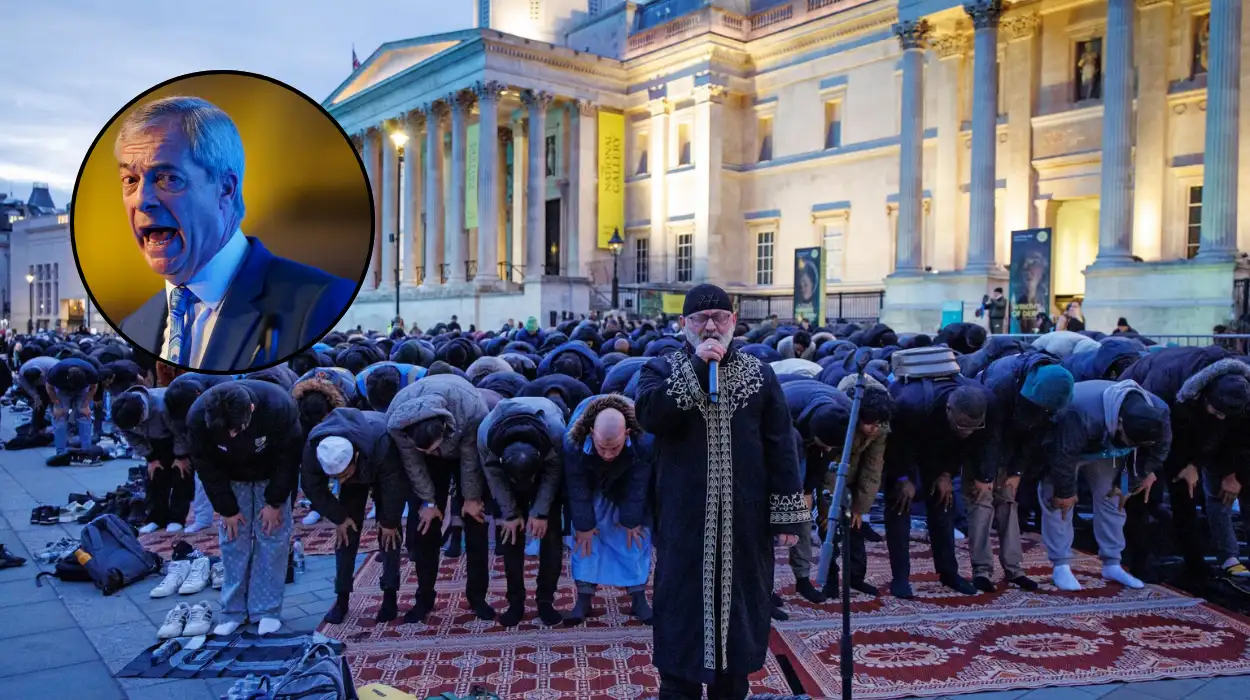
- The event, organised by the Ramadan Tent Project, took place in London’s Trafalgar Square this week with hundreds of Muslims and others praying before Eid celebrations; London Mayor Sadiq Khan attended, and it has occurred five times previously without incident.
- Farage made remarks at Reform UK’s Scottish parliament elections manifesto launch near Glasgow, alongside Scotland leader Malcolm Offord, to about 500 supporters.
- Farage noted mass prayer is banned in many Middle Eastern Muslim countries and advocated stopping such “provocative demonstrations” in historic sites, while clarifying individuals could still pray privately.
- Conservative leader Kemi Badenoch backed shadow justice secretary Nick Timothy, who called Islamic public prayers an “act of domination”; Badenoch questioned if such expressions fit “British cultural norms”.
- Humza Yousaf, former Scottish First Minister and SNP MSP, accused Farage of bigotry for targeting Muslim prayers while ignoring Christian, Hanukkah, Vaisakhi or Diwali events in Trafalgar Square.
- Scottish Labour leader Anas Sarwar labelled Farage’s remarks “toxic, poisonous politics” and Reform as “failed Tories” offering Scotland nothing.
- Shaista Gohir, crossbench peer and leader of Muslim Women’s Network UK, argued responsible gatherings without disruption should not be banned, attributing objections to “deep-seated hatred toward Muslims”.
- Akeela Ahmed, chief executive of the British Muslim Trust, warned Muslims must not become a “political football” and urged upholding British values of tolerance and equality.
- Reform UK manifesto pledges to make Scotland “most successful part of UK”, scrap high taxes, SNP net zero targets, restrict homelessness support in Glasgow amid asylum concerns.
- Recent polls showed Reform neck-and-neck with Scottish Labour, but latest Ipsos survey indicates slipping popularity.
- Labour condemned Conservatives for “gutter politics of prejudice”; PM Keir Starmer called for Timothy’s sacking.
Glasgow (Briatin Today News) March 19, 2026 – Nigel Farage, leader of Reform UK, sparked widespread condemnation today after calling for a ban on mass public prayers by Muslims in the UK, labelling a recent gathering in London’s Trafalgar Square as a provocative attempt to dominate British culture.
Farage’s comments came during the launch of his party’s manifesto for the May 2026 Scottish Parliament elections at a country club near Glasgow, attended by around 500 rowdy supporters alongside Reform UK’s Scotland leader, Malcolm Offord. He described the Trafalgar Square event, organised by the Ramadan Tent Project and joined by London Mayor Sadiq Khan, as
“a wake up call and a warning to everybody”.
This multi-faith prayer before Eid drew hundreds and has occurred five times before without controversy.
What Did Nigel Farage Exactly Say?
As reported in The Guardian, Farage stated the Trafalgar Square gathering was
“an open, deliberate, wilful attempt, not at the private observance of a different religion, but the attempt to overtake, intimidate and dominate our way of life”.
Asked if he would ban such events, he replied:
“We wouldn’t want to stop individuals praying but mass prayer is banned in many Muslim countries in the Middle East itself. So, yes, we have to stop this kind of mass demonstration, provocative demonstration, in historic British sites”.
Reuters detailed that Farage framed it as necessary to prevent dominance over historic sites if Reform UK were elected. The Independent noted he extended the call to “all mass religious observances”. The Evening Standard reported Farage’s specific reference to the Iftar event joined by Mayor Sadiq Khan.
Such restrictions, as acknowledged across sources, vary by country and often relate to public safety or tensions, not uniform bans.
Why Was the Trafalgar Square Event Controversial?
The event in central London’s historic square involved around 3,000 diverse attendees breaking fasts in the Open Iftar programme, one of the largest in the West. BBC coverage linked it to prior criticism by Nick Timothy, who called public Islamic prayers “an act of domination and division”.
Kemi Badenoch, Conservative leader, supported Timothy, stating:
“This debate which Nick is having is not about freedom of religion. It is about how religion is expressed in a shared public space, and whether those expressions fit within the norms of a British culture”.
She disliked footage of the event, amid Tory concerns over gender-separated prayers.
The Telegraph highlighted Farage’s direct call post-gathering. Straits Times quoted Farage on Middle East comparisons.
How Did Muslim Leaders Respond?
Crossbench peer Shaista Gohir of the Muslim Women’s Network UK questioned:
“When these gatherings are conducted responsibly – without obstructing roads, causing disruption, and with proper safety measures – why then do some politicians seek to ban them? The answer is simple: they object to the sight of them. This reflects a deep-seated hatred toward Muslims. No other faith communities face comparable scrutiny”.
Akeela Ahmed, chief executive of the British Muslim Trust, cautioned:
“British Muslims must not become a political football. Words have consequences – and those who genuinely believe in the British values of tolerance, equality under the law and freedom of religion must not allow those values to be cast aside in attempt to marginalise British Muslims”.
Leaders warned of a “growing tide of hate”.
What Was Humza Yousaf’s Reaction?
Former First Minister and SNP MSP Humza Yousaf, the UK’s first Muslim holder of the office, said:
“Nigel Farage seems to have no issues with Christian prayer, Hanukkah, Vaisakhi or Diwali all being celebrated in Trafalgar Square. He only has a problem with Muslims praying. There is a word for that, bigotry”.
He added:
“While I have come to expect nothing less from a charlatan like Nigel Farage, I am angry and disappointed that such rhetoric has been mainstreamed from the likes of Nick Timothy MP, a member of His Majesty’s opposition”.
Did Other Politicians Criticise Farage?
Scottish Labour leader Anas Sarwar deemed Farage’s remarks emblematic of his “toxic, poisonous politics”.
“The Farage circus came to town, and once again, he demonstrated that he is a cynical chancer who wants to divide us. Reform are just failed Tories and offer Scotland nothing”.
Labour accused Conservatives of “gutter politics of prejudice” over Badenoch’s support for Timothy. Prime Minister Keir Starmer called for Timothy’s dismissal.
What Is in Reform UK’s Scottish Manifesto?
At the launch, Malcolm Offord introduced candidates for all Holyrood seats, pledging to
“make Scotland the most successful part of the UK”.
Key promises include scrapping Scotland’s six-band income tax system where higher earners pay more, as Scots face
“the highest taxes anywhere in the UK”.
BBC analysis covered the 23-page document’s scrutiny. It pledges to axe SNP net zero targets, subsidies and quangos; restrict homelessness support in Glasgow, the UK’s biggest asylum dispersal area after London, citing social cohesion concerns
“not something we are making up”.
How Are Polls Reacting?
Recent opinion polls placed Reform UK neck-and-neck or ahead of Scottish Labour, but a Thursday Ipsos Scottish Political Pulse survey suggested their popularity was slipping.
What Is the Broader Context?
The row follows Timothy’s post, backed by Badenoch, with shadow environment secretary Victoria Atkins defending a
“sensible conversation about the balance of rights”.
Farage weighed in amid Reform’s Scottish push.
This controversy highlights tensions over public religious expression, with critics seeing selective targeting and supporters cultural preservation concerns.