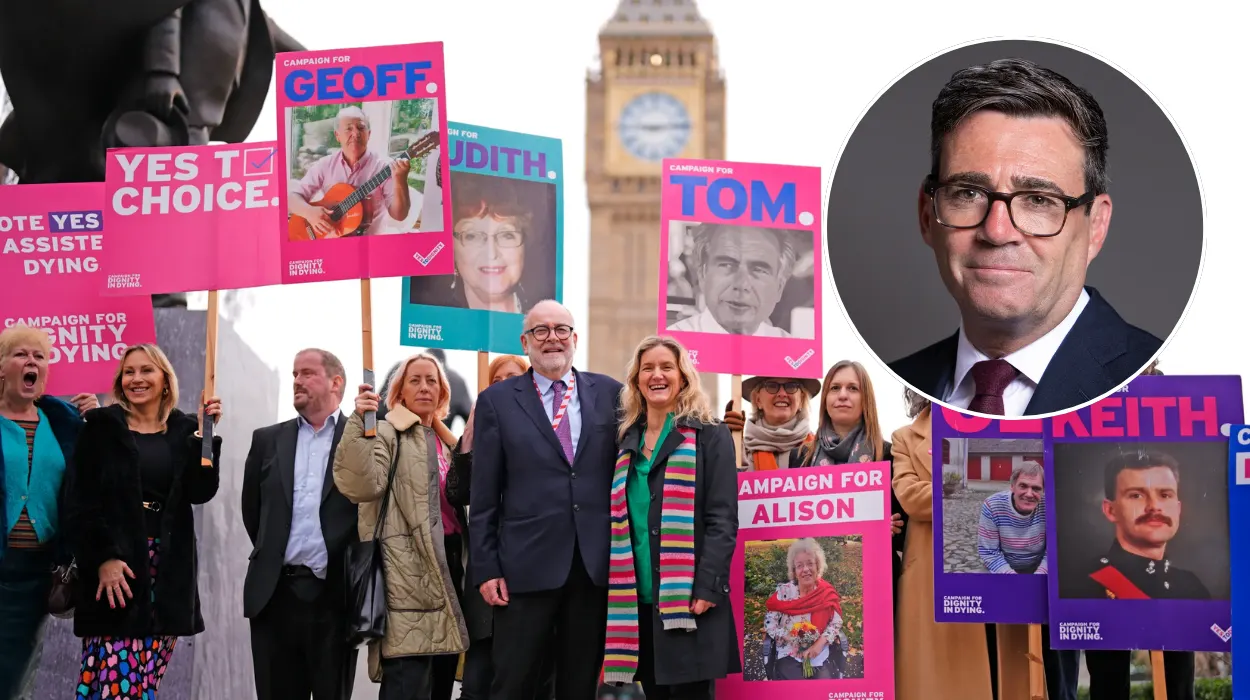
Key Points
- Lauren Edwards, the MP who has reintroduced the Terminally Ill Adults (End of Life) Bill, says legalising assisted dying and improving end-of-life care can happen at the same time.
- The Bill is set to return to Parliament for debate in September.
- Prime Minister Andy Burnham has said palliative and social care funding needs fixing before the wider assisted dying debate can move forward.
- Ms Edwards says the Bill’s four-year implementation period gives ministers until 2031 to address gaps in palliative and social care.
- The Bill was originally introduced by Kim Leadbeater in late 2024 and passed two Commons votes before falling in the House of Lords after peers tabled hundreds of amendments.
- Mr Burnham will get a vote on the Bill this time; he previously indicated in 2024 he would likely support it, having abstained in a 2015 vote.
- Archbishop John Sherrington of the Catholic Bishops’ Conference of England and Wales has welcomed the Prime Minister’s comments as “highly significant”.
- Labour MP Jess Asato, an opponent of the Bill, has echoed calls for a properly funded palliative and social care system.
- Pro-change campaigners have raised the possibility of using the Parliament Act to pass the Bill without the consent of the House of Lords.
Westminster (Britain Today News) July 29, 2026 – End-of-life care can be improved at the same time as legalising assisted dying, according to the MP behind the campaign to change the law, after Prime Minister Andy Burnham said he believes palliative care needs to be fixed first. Lauren Edwards, who has reintroduced the Terminally Ill Adults (End of Life) Bill to Parliament ahead of a debate scheduled for September, insisted there is sufficient time to overhaul end-of-life care before any assisted dying service would take effect under her proposed legislation.
- Key Points
- What Is the Terminally Ill Adults (End of Life) Bill?
- What Has Lauren Edwards Said About Balancing Law and Care?
- Why Does the Bill Include a Four-Year Implementation Period?
- What Is Prime Minister Andy Burnham’s Position on Assisted Dying?
- How Has the Bill Progressed Through Parliament So Far?
- What Has Andy Burnham Said About Assisted Dying in the Past?
- How Has the Catholic Church Responded to the Prime Minister’s Comments?
- What Do Other MPs Say About Palliative Care and the Bill?
- What Does Lauren Edwards Say About Cross-Party Support for the Bill?
- What Happens Next for the Assisted Dying Bill?
What Is the Terminally Ill Adults (End of Life) Bill?
The Terminally Ill Adults (End of Life) Bill is the piece of legislation designed to legalise assisted dying for terminally ill adults in England and Wales. It was first introduced in late 2024 by Kim Leadbeater and has since become one of the most closely watched pieces of proposed legislation in recent parliamentary history. The Bill sets out a legal framework under which terminally ill people would, subject to strict safeguards, be permitted to seek assistance to end their own lives. Lauren Edwards has since taken carriage of the Bill after it ran out of parliamentary time earlier this year, and it is now due to return to the House of Commons for further debate in September.
When Will the Assisted Dying Bill Return to Parliament?
The Bill is scheduled to come back before Parliament for debate in September, giving MPs a further opportunity to scrutinise, amend and vote on its provisions. This will not be the first time the legislation has been put to a vote. It has already passed two votes in the House of Commons, although the second of these passed with a narrower majority than the first. It subsequently fell in the House of Lords, where peers tabled hundreds of amendments and were accused of effectively talking the Bill out of time. Its return in September represents a fresh attempt to see the legislation through to completion.
What Has Lauren Edwards Said About Balancing Law and Care?
Ms Edwards has been firm in her view that reforming the law on assisted dying and improving palliative and social care are not mutually exclusive goals, but can and should be pursued in tandem. She said:
“Improving social and palliative care and offering choice in the last weeks of a dying person’s life can and must go hand in hand.”
She went on to point to the built-in timeline of the Bill as evidence that there is space to address existing shortcomings in care before any new service begins operating. She said:
“The Bill that has been before Parliament and thoroughly debated since October 2024 provides for a four-year implementation period.”
Ms Edwards added:
“That means if my current Bill becomes law next year, we would have until 2031 to fix the status quo that Andy Burnham rightly says is broken and has let people down for too long. As he said today, the risks of failing to act are too great.”
Why Does the Bill Include a Four-Year Implementation Period?
The four-year implementation period built into the Bill is central to Ms Edwards’s argument that the legislation need not wait for palliative and social care reform to be completed first. Under this timetable, should the Bill become law next year, the assisted dying service itself would not begin operating until 2031 at the earliest. Ms Edwards has used this gap to argue that ministers would have ample opportunity to address the funding and structural problems in palliative and social care that both she and the Prime Minister acknowledge exist, without needing to delay the legislative process itself.
What Is Prime Minister Andy Burnham’s Position on Assisted Dying?
Asked about assisted dying, the Prime Minister set out his current thinking on Monday, drawing a distinction between his personal view of the principle and his concerns about the practical context in which any debate would take place. He said:
“I take the view that that debate – and I don’t say that there shouldn’t be a debate at some point about those issues – personally, I think there’s something that needs to happen first.”
He continued:
“That is the fixing of the funding of palliative care and social care.”
Mr Burnham elaborated on why he believes the timing matters, saying:
“I think it is very challenging to introduce that wider debate in a context of people not receiving that care and having the peace of mind about that care.”
He concluded:
“That’s the way I kind of see this, and that’s the position that I will stick to.”
How Has the Bill Progressed Through Parliament So Far?
The Bill’s journey through Parliament has been lengthy and, at times, fraught. Having been introduced by Kim Leadbeater in late 2024, it passed two votes in the House of Commons. However, the second of those votes saw its majority narrow considerably compared with the first, reflecting the depth of division among MPs on the issue. The Bill subsequently fell in the House of Lords, where peers tabled hundreds of amendments, a move that campaigners for change have characterised as an attempt to talk the legislation out rather than engage with it on its merits. Ms Edwards has since taken over responsibility for the Bill after it ran out of time in the last parliamentary session, reintroducing it for debate in September.
Could the Parliament Act Be Used to Pass the Bill?
Campaigners in favour of changing the law have previously raised the prospect of invoking the Parliament Act to secure the Bill’s passage. The Parliament Act is a rarely used piece of legislation that allows Bills which have been backed by the House of Commons in two successive parliamentary sessions, but rejected by the House of Lords, to become law without the consent of peers. Given that the Bill has already passed two Commons votes and fallen in the Lords once, its supporters see the Act as a potential mechanism to overcome further resistance from the upper chamber should history repeat itself.
What Has Andy Burnham Said About Assisted Dying in the Past?
Mr Burnham’s current position marks a notable evolution from his earlier stance on the issue. In 2024, shortly before the first Commons vote on the assisted dying Bill, Mr Burnham, who was then mayor of Greater Manchester and therefore held no vote on the matter, told BBC Manchester that he would “probably vote in favour of it.” This represented a shift from his position as an MP in 2015, when he abstained from a vote on an earlier Bill to legalise assisted dying, citing concerns over safeguards and the risk of people feeling under pressure to end their lives.
Explaining the change in his outlook, he said in his 2024 interview that he had
“family experience in the nine years since that has changed my view.”
He added:
“I think we do allow people to suffer and families to suffer too much.”
At the time, Mr Burnham was careful to caveat his support as being for the underlying principle of assisted dying, insisting he would want a guarantee before any new law was implemented that hospices would be “properly funded and sorted out.” He has also spoken previously of his Catholic background and the influence it has had on his politics, noting that “Catholic social teaching underpins my politics,” despite describing himself as “not particularly religious” today.
Explore More about Politics:
Andy Burnham Vows to Fix Britain’s Broken Social Care System
MP’s Education Role Focuses on Best Possible Education in 2026
How Has the Catholic Church Responded to the Prime Minister’s Comments?
The Catholic Church, which is staunchly opposed to assisted dying legislation, has welcomed Mr Burnham’s latest remarks. Archbishop John Sherrington, the lead bishop for life issues for the Catholic Bishops’ Conference of England and Wales, described the Prime Minister’s comments as “highly significant.” He said:
“It is highly significant that the Prime Minister has confirmed his position about the need for proper palliative and social care ahead of the Second Reading of the fundamentally flawed Terminally Ill Adults (End of Life) Bill in September.”
Archbishop Sherrington also used the opportunity to renew the Church’s long-standing calls for greater investment in end-of-life care, saying the Church had
“consistently called for meaningful investment in palliative and end-of-life care.”
He warned that the sector
“remains woefully underfunded and there is an existential threat to these places of compassion and care should this legislation be passed.”
What Do Other MPs Say About Palliative Care and the Bill?
Mr Burnham’s intervention has found support among several other prominent parliamentarians who have likewise called for greater investment in palliative care ahead of any move to legalise assisted dying, including Liberal Democrat leader Sir Ed Davey. Among them is Labour MP Jess Asato, an opponent of the Bill, who welcomed the Prime Minister’s position. She said:
“There can be no meaningful choice and no dignity at the end of life if we don’t have a palliative care system that provides basic support for the vulnerable, and an affordable social care system that gives everyone dignity at the end of their lives.”
Ms Asato added:
“It’s really welcome that the PM recognises this and has committed the Government to fixing our broken social care system.”
What Does Lauren Edwards Say About Cross-Party Support for the Bill?
Despite the divisions the Bill has exposed, Ms Edwards maintains that there remains substantial appetite among MPs to see the legislation pass while care provision is simultaneously strengthened. She said she believes there is
“still widespread support amongst MPs (for the Bill) and a real desire to deal with this issue while fixing social care and palliative care at the same time.”
She also struck a conciliatory note towards the Prime Minister, welcoming his “commitment to tackling the crisis in social care” and stating that everyone wants “to see better social, palliative and hospice care in every part of the country.” Ms Edwards said:
“The Government has already made better palliative care provision a priority and it is very welcome that the new Prime Minister wants to take that even further.”
She pointed to international precedent to support her argument that reform of care provision and legalisation of assisted dying are not incompatible, adding:
“The evidence from around the world is that this can happen alongside providing the choice of an assisted death to that small minority for whom even the very best palliative care cannot relieve their suffering.”
What Happens Next for the Assisted Dying Bill?
With the Bill due to return to Parliament in September, MPs face a further round of debate and scrutiny on one of the most sensitive and consequential pieces of legislation to come before them in recent years. Mr Burnham, unlike during his time as mayor of Greater Manchester, will now have a vote on the Bill when it returns to the Commons, having previously abstained as an MP in 2015 before indicating support in 2024. His predecessor, Sir Keir Starmer, voted in favour of the Bill when it was previously debated.
Whether the Bill can navigate the House of Lords a second time, whether the Parliament Act might ultimately be invoked, and whether palliative and social care funding can be addressed within the timeframe Ms Edwards has set out, remain open questions. For now, both sides of the debate appear to agree on one point: that the state of palliative and social care in Britain requires urgent attention, even as they continue to disagree over the sequencing of reform and legalisation.