Key Points
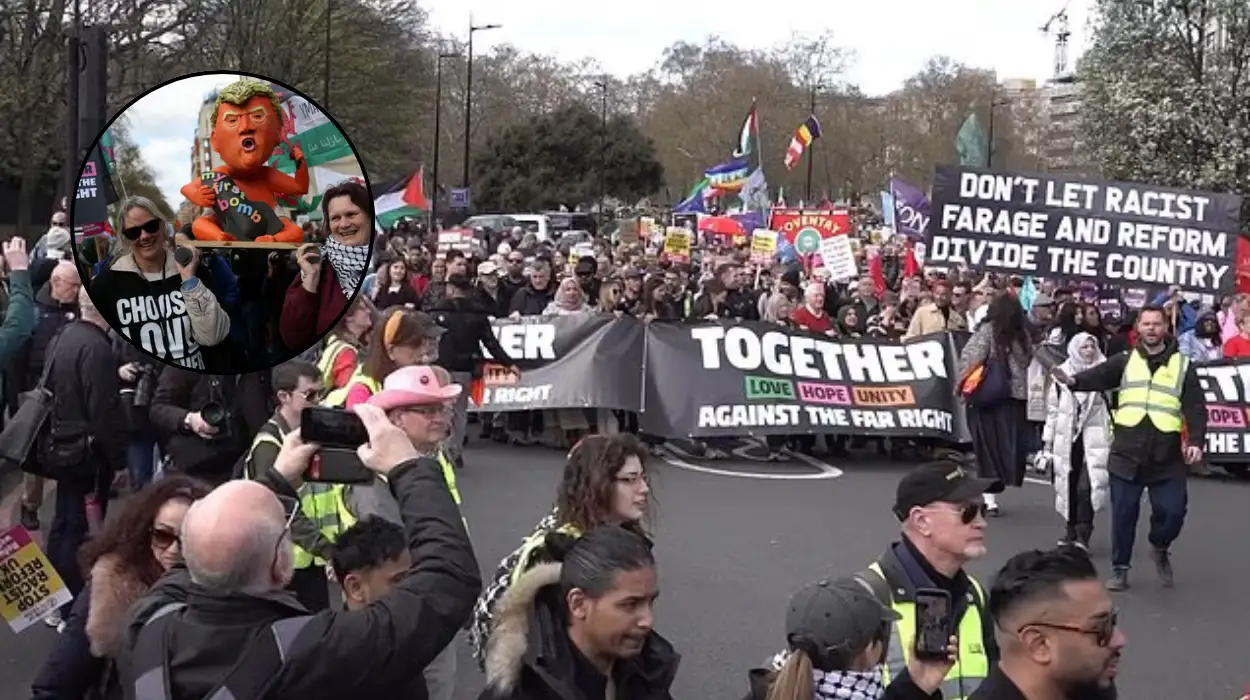
- Hundreds of thousands marched through central London on Saturday in what organisers called the largest ever demonstration against the far right in British history.
- The Together Alliance march was backed by about 500 groups, including trade unions, antiracism campaigners, and Muslim representative bodies.
- Organisers claimed half a million participants; Metropolitan Police estimated approximately 50,000, noting challenges in accurate counting due to spread-out crowds.
- Crowds converged on Whitehall near the Houses of Parliament, drawing diverse participants of all ages from across the country.
- Kevin Courtney, chairman of the Together Alliance, told crowds the march “gives us all confidence to carry on.”
- A small group of counterprotesters waved Israeli flags and Iran’s pre-1979 monarchical flag.
- Trade union activist Aadam Muuse told Al Jazeera that racism and Islamophobia have entered mainstream politics, “being pushed by parliamentarians,” and the march was needed to push back against Reform leader Nigel Farage.
- Al Jazeera’s Milena Veselinovic reported from the march that demonstrators opposed “the politics of hate and division” in the UK.
- Activist and writer Hamja Ahsan attended after Tommy Robinson’s rally drew 150,000 and saw violence injuring police; Robinson plans another in May.
- Ahsan said the march shows “we’re the majority” and likened the atmosphere to Notting Hill Carnival, uniting people from pensioners to children.
- Museum worker Charlotte Elliston expressed unease at the far right’s rise, saying “you see that it is getting scary.”
London (Birtain Today News) – March 28, 2026. Hundreds of thousands of people marched through central London on Saturday in what organisers have hailed as the largest demonstration against the far right in British history. The Together Alliance-led event drew a diverse crowd from across the country, converging on Whitehall near the Houses of Parliament in a powerful show of unity against rising extremism.
- Key Points
- What Was the Scale of the London Anti-Far-Right March?
- Who Organised the Together Alliance March?
- How Did Counterprotesters Respond to the March?
- Why Did Participants Join the Anti-Far-Right Protest?
- What Context Fuels Concerns Over Far-Right Rise in the UK?
- How Did Authorities Handle the Large Crowds?
- What Makes This the Largest Anti-Far-Right March in History?
- Will This March Influence UK Politics?
What Was the Scale of the London Anti-Far-Right March?
Organisers from the Together Alliance, a coalition backed by approximately 500 groups including trade unions, antiracism campaigners, and Muslim representative bodies, claimed an unprecedented turnout of half a million participants. This figure underscored the event’s significance as a landmark in British protest history.
London’s Metropolitan Police, however, provided a more conservative estimate of around 50,000 attendees. Officers acknowledged the difficulty in obtaining precise numbers, given how the crowds spread out across central London. As reported by Al Jazeera staff, the disparity highlighted the logistical challenges of policing such a sprawling demonstration.
The march united people of all ages and backgrounds, creating an atmosphere of solidarity. Kevin Courtney, chairman of the Together Alliance, addressed the crowds directly, stating the event
“gives us all confidence to carry on.”
His words resonated amid chants and banners decrying division.
Who Organised the Together Alliance March?
The Together Alliance spearheaded the protest, assembling support from a broad spectrum of organisations. Trade unions played a prominent role, alongside antiracism groups and bodies representing Muslim communities. This coalition effort amplified the message, positioning the march as a national response to perceived threats.
As covered extensively by Al Jazeera, the event built on recent tensions, including a far-right rally led by activist Tommy Robinson in September 2025 that drew 150,000 people and resulted in violence injuring several police officers. Robinson, whose real name is Stephen Yaxley-Lennon, is reportedly planning another rally in May 2026, further fuelling concerns among opponents.
How Did Counterprotesters Respond to the March?
The anti-far-right demonstration faced a much smaller group of counterprotesters. These individuals waved Israeli flags alongside Iran’s pre-1979 monarchical flag, symbols associated with opposition to certain progressive or Islamist narratives. Though outnumbered, their presence added tension to the otherwise peaceful proceedings.
Police maintained order throughout, with no major incidents reported. The Metropolitan Police’s crowd estimate reflected their focus on safety amid the disparity in turnout claims.
Why Did Participants Join the Anti-Far-Right Protest?
Trade union activist Aadam Muuse provided stark insight into the motivations. Speaking to Al Jazeera, Muuse asserted that
“racism and Islamophobia had moved from the fringes into mainstream politics, and was ‘being pushed by parliamentarians’.”
He emphasised the march’s necessity
“to push back against [Reform leader Nigel] Farage and his ilk,”
urging that the populist Reform UK party
“must be defeated at the ballot box.”
Al Jazeera’s Milena Veselinovic, reporting live from the march, captured the sentiment: demonstrators were pushing back against what they perceived as
“the politics of hate and division”
in the United Kingdom. Her on-the-ground coverage highlighted the crowd’s determination to reclaim public spaces.
Activist and writer Hamja Ahsan echoed this resolve. Telling Al Jazeera he was motivated by Tommy Robinson’s violent September rally, Ahsan declared,
“We need to show them that we’re the majority.”
He described the atmosphere as akin to the Notting Hill Carnival, uniting “from pensioners to children” across backgrounds.
“At a street level, the far right won’t take over our streets,”
he added firmly.
Museum worker Charlotte Elliston voiced personal fears. In an interview with Al Jazeera, she said,
“You think this would never happen here, and then all of a sudden this might happen.”
She continued,
“You see that it is getting scary,”
reflecting broader anxieties about the far right’s encroachment.
What Context Fuels Concerns Over Far-Right Rise in the UK?
The march arrives amid heightened debates over immigration, populism, and cultural shifts. Reform UK’s Nigel Farage has gained prominence, with critics like Muuse accusing him of mainstreaming divisive rhetoric. Tommy Robinson’s rallies, including the disruptive 2025 event that drew over 100,000 according to Al Jazeera’s 13 September 2025 report, have intensified fears of street-level extremism.
Organisers framed Saturday’s turnout as proof of a silent majority’s rejection of such politics. Courtney’s speech reinforced this, boosting morale for ongoing activism.
How Did Authorities Handle the Large Crowds?
The Metropolitan Police deployed resources to manage the event, focusing on Whitehall’s vicinity. Their 50,000 estimate contrasted sharply with organisers’ claims, a common occurrence in mass protests where aerial and ground counts vary. Officers noted the crowds’ dispersion complicated tallies, yet praised the largely peaceful nature.
No arrests or clashes were widely reported, allowing the message to dominate headlines.
What Makes This the Largest Anti-Far-Right March in History?
Organisers’ half-a-million claim positions it as unprecedented in Britain. Backed by 500 groups, the event’s scale and diversity set it apart. Veselinovic’s reporting for Al Jazeera noted the carnival-like energy, with families and elders marching side by side.
Ahsan’s comparison to Notting Hill Carnival evoked London’s multicultural vibrancy, countering far-right narratives. Elliston’s unease, shared by many, underscored the urgency.
Will This March Influence UK Politics?
Participants like Muuse called for electoral action against Reform UK. Courtney’s confidence-boosting address suggested sustained momentum. With Robinson’s May plans looming, the demonstration signals robust opposition.
As Al Jazeera detailed, the event responds to Tommy Robinson’s rallies, including the violent September 2025 gathering that injured police. London’s streets, once a far-right flashpoint, now hosted a counter-narrative of unity.
This comprehensive turnout, from trade unionists to museum workers, illustrates deepening public resolve. Journalists like Veselinovic and sources such as Muuse, Ahsan, and Elliston provide vivid testimony to its impact.