Key Points
- Iran’s Islamic Revolutionary Guard Corps (IRGC) claims to have shot down a US F-35 over central Iran.
- The aircraft allegedly originated from RAF Lakenheath in Suffolk, England.
- Wreckage with tail code “LN” identified it as belonging to the 48th Fighter Wing.
- British Ministry of Defence (MoD) declined to comment; Pentagon is yet to respond.
- Iranian media released photos said to show remains of the downed aircraft.
- Increased US military activity observed at RAF Lakenheath and nearby RAF Mildenhall.
- Iran’s ambassador to the UK warns Tehran is “considering” strikes on British bases.
- UK Prime Minister Keir Starmer earlier approved US access to British bases for Iran operations.
- British Foreign Secretary Yvette Cooper hosted multinational talks to pressure Iran to reopen Strait of Hormuz.
- Tensions between Washington, Tehran and London continue to escalate amid regional instability.
England (Britain Today News) April 3, 2026 — A dramatic escalation in the US-Iran confrontation unfolded on Friday as Iran’s Islamic Revolutionary Guard Corps (IRGC) claimed it had shot down a United States F-35 fighter jet that allegedly took off from RAF Lakenheath in Suffolk, eastern England. The revelation, reported by Tasnim News Agency, has thrust the British base—long known for hosting American forces—into the centre of mounting global scrutiny.
- Key Points
- How did Iran claim responsibility for shooting down the F-35?
- What is RAF Lakenheath’s role in US operations?
- Is Iran considering retaliation against the UK?
- How has Britain responded diplomatically?
- What has been Washington’s stance?
- How is the local community in Suffolk reacting?
- What does the shooting mean for Britain’s position?
How did Iran claim responsibility for shooting down the F-35?
According to the IRGC statement released early Friday, Iranian air defences intercepted what they identified as a “hostile stealth aircraft” over central Iran. The force said the wreckage bore a tail code “LN,” denoting the 48th Fighter Wing of the US Air Force, based at RAF Lakenheath. The downed jet, an F-35—manufactured by Lockheed Martin—is among America’s most advanced multirole fighters capable of stealth missions.
Iranian state outlet Tasnim News Agency published images purporting to show debris from the fighter, with parts marked with the code linked to the Suffolk base. Iran’s claim follows weeks of US sorties reportedly targeting Iranian missile installations and naval infrastructure after Tehran’s closure of the Strait of Hormuz in early March.
As reported by Middle East Eye, the British Ministry of Defence declined to comment on Iran’s assertion, while the Pentagon remained silent by Friday evening. Neither government has confirmed nor denied whether any F-35s have been lost.
What is RAF Lakenheath’s role in US operations?
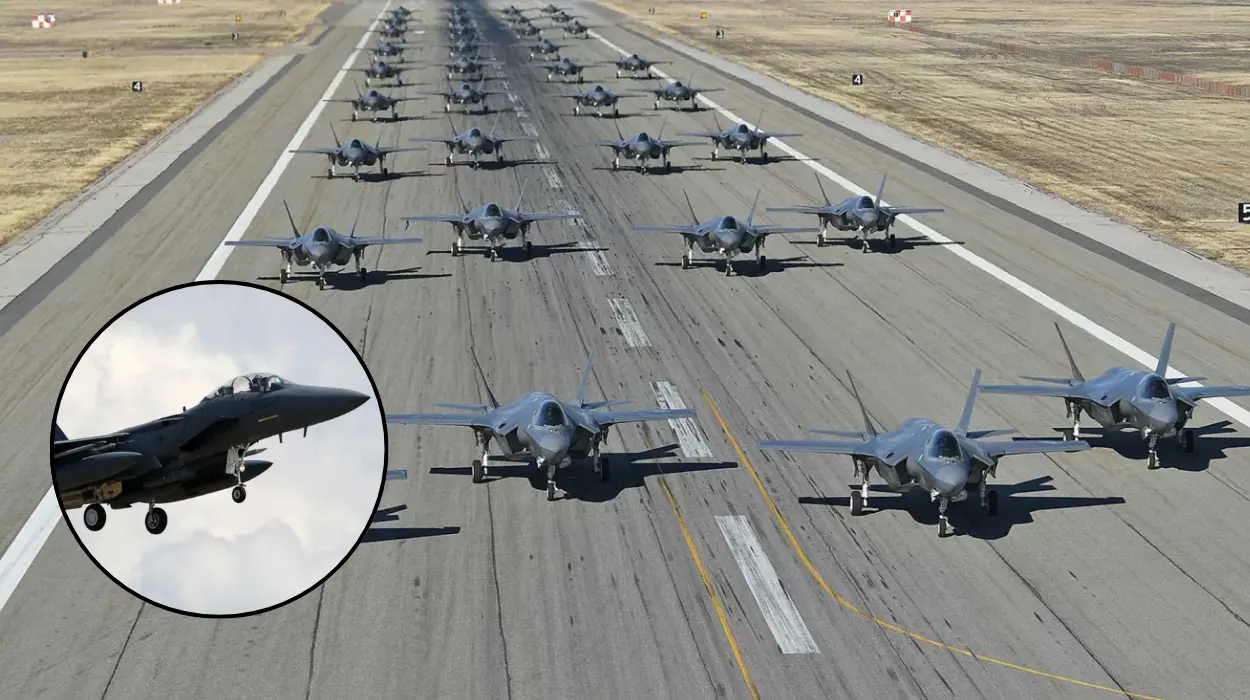
RAF Lakenheath, located near Thetford Forest, is the largest US Air Force fighter base in Europe. Owned by the UK’s Ministry of Defence and leased to the United States, it houses the 48th Fighter Wing and hosts dozens of F-15 and F-35 aircraft.
Recent aviation activity at the base suggests intensified military movement linked to the Iran conflict. On 24 March, witnesses reported five F-35C fighters landing at Lakenheath. Days later, on 31 March, twelve A-10C Thunderbolt IIs—commonly known as “Warthogs”—arrived at the base. The A-10 is renowned for its close air support and anti-armour capabilities, fuelling speculation they are part of an offensive operation plan in the Middle East.
Local observers told British media outlets that on the morning of 2 April, more than twenty aircraft took off from Lakenheath in succession, heading southeast. The Ministry of Defence and the US Air Force again refused to share operational details.
Nearby RAF Mildenhall, another American-operated site in Suffolk, has also seen heightened movement this week. Spotters confirmed the arrival of two EA-37B Compass Call electronic warfare aircraft, used for disabling enemy communications and radar, landing at Mildenhall on 31 March.
Is Iran considering retaliation against the UK?
Iranian Ambassador to the UK, Seyed Ali Mousavi, speaking on Times Radio on Wednesday, warned that Tehran was “considering” whether British military bases could become targets in retaliation for allowing the US to launch operations against Iran. Mousavi stated that “grounds for self-defence” may be invoked if UK-based assets are used to carry out attacks on Iranian territory.
The ambassador’s remarks follow Britain’s policy shift under Prime Minister Keir Starmer, who in mid-March allowed US forces to use British bases for air missions against Iranian missile and naval targets. Initially, the UK had refused permission for strikes launched from the joint Diego Garcia facility, but the stance reversed within two days, signalling London’s growing alignment with Washington’s military strategy.
Two weeks later, Starmer authorised American use of British bases to “protect international shipping” through the Strait of Hormuz—a move critics argue effectively deepened UK involvement in the US-Israel conflict with Iran.
How has Britain responded diplomatically?
Foreign Secretary Yvette Cooper on Thursday chaired an emergency summit involving more than forty foreign ministers to address the ongoing closure of the Strait of Hormuz. The corridor—through which roughly one-fifth of global oil passes—has been effectively shut since the IRGC seized control in early March.
After the meeting, Cooper said the coalition of states “comprehensively rejected” any effort by Iran to impose tolls on ships. She warned that Tehran
“must not be allowed to hold the global economy hostage,”
referencing reports that Iran sought to charge ships for safe passage once fighting subsided. Britain is reportedly preparing new sanctions “to bear down on Iran,” targeting its energy and security entities.
Hours after Cooper’s remarks, Iran’s foreign ministry announced it was developing a separate proposal together with Oman—an ally known for mediating regional disputes—to issue permits to vessels after the conclusion of hostilities. This proposal appears aimed at countering Western economic isolation efforts.
What has been Washington’s stance?
While Washington has not verified Tehran’s F-35 claim, US officials privately briefed allied diplomats that one aircraft from an unspecified European base had “lost communication” during a mission over Iranian airspace. No confirmation of loss has followed publicly. President Donald Trump, who has taken a confrontational stance against Iran since returning to office in January, criticised both Iran’s government and what he termed “wavering allies” who question the US strategy.
Trump has also targeted Britain’s leadership, calling Starmer’s “defensive posture” weak while insisting that the US
“would proceed with or without allied airspace access.”
Analysts note that these remarks underline the fraying of the so-called “special relationship” between Washington and London amid diverging public sentiments.
How is the local community in Suffolk reacting?
Anti-war groups and peace activists in Suffolk have voiced growing alarm at the volume of military traffic and the risk of repercussions for local populations. Members of the Lakenheath Action Group held a small vigil outside the base’s main gate on Wednesday evening, urging both the UK and US governments to “step back from escalation.” Residents reported aircraft activity throughout the night, describing constant jet noise and visible refuelling operations.
A spokesperson for the group said the latest reports
“confirm the most serious fears—that our community could become a frontline logistical hub in a dangerous war we never consented to join.”
What does the shooting mean for Britain’s position?
Defence analysts suggest that confirmation of Iran’s claim would place Britain in a diplomatic quandary. Hosting foreign aircraft for offensive operations could expose the UK to reciprocal threats while testing its legal commitments under international law. Former Ministry of Defence strategist Dr. Amanda Hales told an independent defence briefing that
“If the jet was indeed launched from Lakenheath, the UK may face direct retaliatory risk, regardless of operational control being American.”
The Ministry of Defence has remained silent on the matter, maintaining its long-standing policy not to discuss the details of US deployments from British soil.
As the crisis deepens, London faces pressure to balance alliance obligations with domestic and international calls for de-escalation. With Iran’s threats of reprisal and the Strait of Hormuz still effectively closed, Britain’s involvement in the latest Middle East confrontation seems set to intensify before any hint of resolution emerges.