Key Points
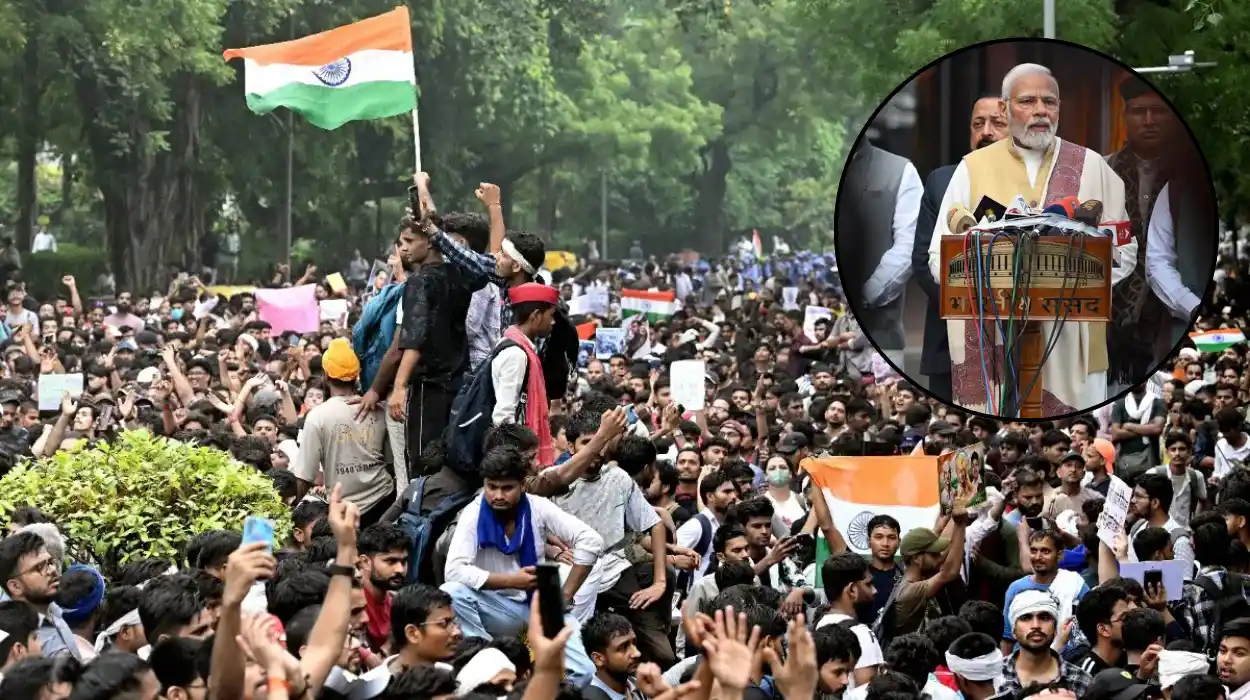
- Crowds at the Jantar Mantar protest site in New Delhi swelled to several thousand people on Wednesday, as the Cockroach Janta Party (CJP) movement kept up its campaign for accountability over examination scandals.
- Protesters are demanding the resignation of Education Minister Dharmendra Pradhan and have vowed not to leave Jantar Mantar until he steps down.
- The movement, driven largely by young students on social media, has become one of the biggest challenges to Prime Minister Narendra Modi’s government since his re-election in 2024.
- Opposition parties, including the Congress party and the Samajwadi Party, have thrown their support behind the protests, staging sit-ins and demonstrations in and around parliament.
- Congress leader Rahul Gandhi, briefly detained on Tuesday, has demanded the government apologise for a police crackdown on protesters on Monday.
- Police used tear gas and baton charges against demonstrators on Monday, in what has been described as Delhi’s largest street rally in five years.
- Rights groups, including Amnesty International, have accused police of using excessive and disproportionate force.
- India’s Supreme Court declined on Wednesday to hear a petition alleging police brutality against the protesters.
- The CJP movement began in May as a satirical response to remarks reportedly made by Chief Justice Surya Kant, comparing young people to “cockroaches” and “parasites”.
- Education Minister Dharmendra Pradhan has pledged reform and accountability, while support for the protests has spread to Mumbai, Bengaluru and Goa.
New Delhi (Britain Today News) July 22, 2026 – Crowds of supporters of India’s online “cockroach” movement grew on Wednesday at a protest site in the heart of the capital, as their campaign for accountability and reform following a series of examination scandals gained fresh momentum inside parliament from opposition lawmakers.
- Key Points
- What is happening at Jantar Mantar in New Delhi?
- Why are protesters demanding Education Minister Dharmendra Pradhan’s resignation?
- What did Rahul Gandhi and the Congress party say?
- What did Akhilesh Yadav and the Samajwadi Party do in parliament?
- What happened during the police crackdown on Monday?
- Why have rights groups accused police of using excessive force?
- Why did the Supreme Court refuse to hear the police brutality petition?
- What have protesters at the scene said about the movement?
- What has Education Minister Dharmendra Pradhan promised in response?
- What happens next for the Modi government?
What is happening at Jantar Mantar in New Delhi?
Thousands of demonstrators have gathered at the Jantar Mantar protest site in central New Delhi, with numbers swelling further on Wednesday. The protesters, organised under the banner of the Cockroach Janta Party (CJP) movement, have refused to disperse and say they intend to remain at the site until their central demand is met. The gathering has grown into one of the largest sustained demonstrations the Indian capital has seen in recent years, drawing students from across the country who say they have been failed by repeated administrative failures in the education system.
Who are the Cockroach Janta Party and what are they demanding?
The Cockroach Janta Party is a social media-driven youth movement that has rapidly emerged as one of the most significant challenges to Prime Minister Narendra Modi’s government since his re-election in 2024. The group commands millions of followers online and has translated that digital reach into sustained street mobilisation. Its central demand is the resignation of Education Minister Dharmendra Pradhan, whom protesters hold responsible for a string of examination failures that have affected millions of Indian students.
CJP spokesman Ashutosh Ranka addressed cheering supporters at the protest site, making clear the movement would not back down.
“We will not leave Jantar Mantar until Dharmendra Pradhan resigns,”
he told the crowd. He went further, framing the protest as part of a broader awakening among India’s youth:
“In the country where people had forgotten how to ask questions, in the country where criticising the government was considered treason — we have now awakened that country.”
Why are protesters demanding Education Minister Dharmendra Pradhan’s resignation?
The protests were triggered by a series of examination irregularities that have infuriated students and their families across the country. Chief among them was the leak of India’s medical entrance examination paper, an incident so serious that it forced more than two million candidates to retake the test. A separate controversy involving the online marking of examinations taken by nearly two million high school students has further fuelled public anger, with many students and parents accusing the education ministry of incompetence and a failure to safeguard the integrity of national testing systems.
How has the opposition supported the protest movement?
The demonstrations received a significant boost on Tuesday when opposition parties formally threw their weight behind the movement. Members of the opposition staged a sit-in outside the prime minister’s official residence, signalling that the students’ grievances had moved from the streets into the heart of India’s political establishment. The involvement of established political parties has amplified the movement’s visibility and placed additional pressure on the government to respond.
What did Rahul Gandhi and the Congress party say?
Senior Congress leader Rahul Gandhi has been among the most vocal political figures to back the protesters. He has called on the government to apologise for the police crackdown on tens of thousands of demonstrators on Monday. Gandhi, 56, was himself briefly detained by police on Tuesday. He appeared in parliament on Wednesday dressed in black, a visible gesture of solidarity with the protesters, and used his appearance to demand greater accountability from the government over both the examination failures and the handling of the demonstrations.
What did Akhilesh Yadav and the Samajwadi Party do in parliament?
The opposition Samajwadi Party also staged its own protest within the parliament premises on Wednesday. Party leader Akhilesh Yadav accused the prime minister of failing to address an issue that, in his words, affects every young Indian. Yadav argued that Modi’s continued silence on the examination scandals and the subsequent unrest amounted to a dereliction of responsibility towards the country’s youth.
How did the Cockroach Janta Party movement begin?
The origins of the CJP movement can be traced back to May, when it emerged initially as a satirical response to comments reportedly made by Chief Justice Surya Kant, who is said to have likened young people to “cockroaches” and “parasites” during a court hearing. The remarks sparked widespread outrage among students and young professionals, providing the spark for what began as an online movement of mockery and protest before evolving into a much broader political force.
Since then, the movement has significantly broadened its agenda. It now encompasses concerns over unemployment and a lack of opportunities for young people, alongside accusations that Modi’s government has adopted an increasingly authoritarian style of governance. What began as a reaction to a single remark has grown into a wide-ranging critique of the state of opportunity and accountability in modern India.
What happened during the police crackdown on Monday?
Tensions escalated sharply on Monday, the opening day of parliament’s monsoon session, when police fired tear gas and baton-charged demonstrators attempting to march towards parliament. As the confrontation intensified, protesters responded by hurling stones at police lines. The clash marked what has been described as the capital’s largest street rally in five years, underlining the scale of public anger that has built up around the examination scandals and the broader grievances of the CJP movement.
Why have rights groups accused police of using excessive force?
The scale and intensity of Monday’s police response has drawn strong criticism from human rights organisations. Amnesty International issued a statement raising serious concerns about the proportionality of the police operation.
“The Delhi Police’s actions raise serious questions about whether their response met the requirements of legality, necessity, and proportionality under international human rights standards,”
the organisation said. The statement adds to mounting pressure on authorities to justify the tactics used against what were, for the most part, peaceful demonstrators.
Why did the Supreme Court refuse to hear the police brutality petition?
In a further setback for those seeking accountability over Monday’s events, India’s Supreme Court on Wednesday declined to hear a petition alleging police brutality against the protesters. The court’s refusal to take up the case has added to frustrations among demonstrators and their supporters, who had hoped the judiciary might provide an avenue for redress after Monday’s violent scenes.
What have protesters at the scene said about the movement?
At the Jantar Mantar site, where a core group of activists has now been camping for nearly a month, the mood among demonstrators reflects both determination and apprehension. One protester described the moment as historic, saying it marked the first time the country’s youth had genuinely had the opportunity to raise their voice on a national stage.
Kavya, a 20-year-old student who gave only her first name, spoke of the fear she felt after witnessing Monday’s violence but insisted the movement had to continue.
“I am scared because on Monday I saw the police beating people and using force, but we have no choice but to keep our movement going,”
she said.
Explore More about World:
West Africa Signs Off $25bn Nigeria-Morocco Gas Pipeline Deal
Trump Imposes 50% Tariffs on Canadian Goods Over Trade Row
What has Education Minister Dharmendra Pradhan promised in response?
Facing growing pressure, particularly over the medical entrance examination scandal, Dharmendra Pradhan issued his first public comments since Monday’s protests late on Tuesday. In a social media post, he said the government remained committed to reform and to discussing the issue within parliament.
“We owe them (students) answers, reforms and accountability,”
he wrote. He added a pointed appeal for calm and constructive engagement:
“They deserve certainty over chaos, solutions over slogans and responsibility over disruption.”
Despite the minister’s comments, protesters at Jantar Mantar have shown no sign of softening their central demand for his resignation, suggesting that words alone are unlikely to defuse the standoff.
Has support for the protests spread beyond Delhi?
The movement’s reach is no longer confined to the capital. Smaller solidarity protests have also been held in Mumbai, Bengaluru and Goa, indicating that the frustrations driving the CJP movement resonate with students and young people across India, not just those able to travel to Jantar Mantar. This geographical spread suggests the government may face sustained pressure from multiple fronts in the weeks ahead, even if the demonstrations in Delhi were to subside.
What happens next for the Modi government?
With opposition parties now firmly aligned with the protesters, the Supreme Court declining to intervene, and rights groups continuing to scrutinise police conduct, the Indian government faces a delicate balancing act. Ministers must weigh the political cost of appearing unresponsive to student grievances against the challenge of managing a protest movement that shows no sign of losing momentum. As parliament’s monsoon session continues, all eyes will remain on whether Dharmendra Pradhan’s position becomes untenable, and whether the government’s promises of reform translate into concrete action capable of satisfying a generation of students who say they have simply run out of patience.