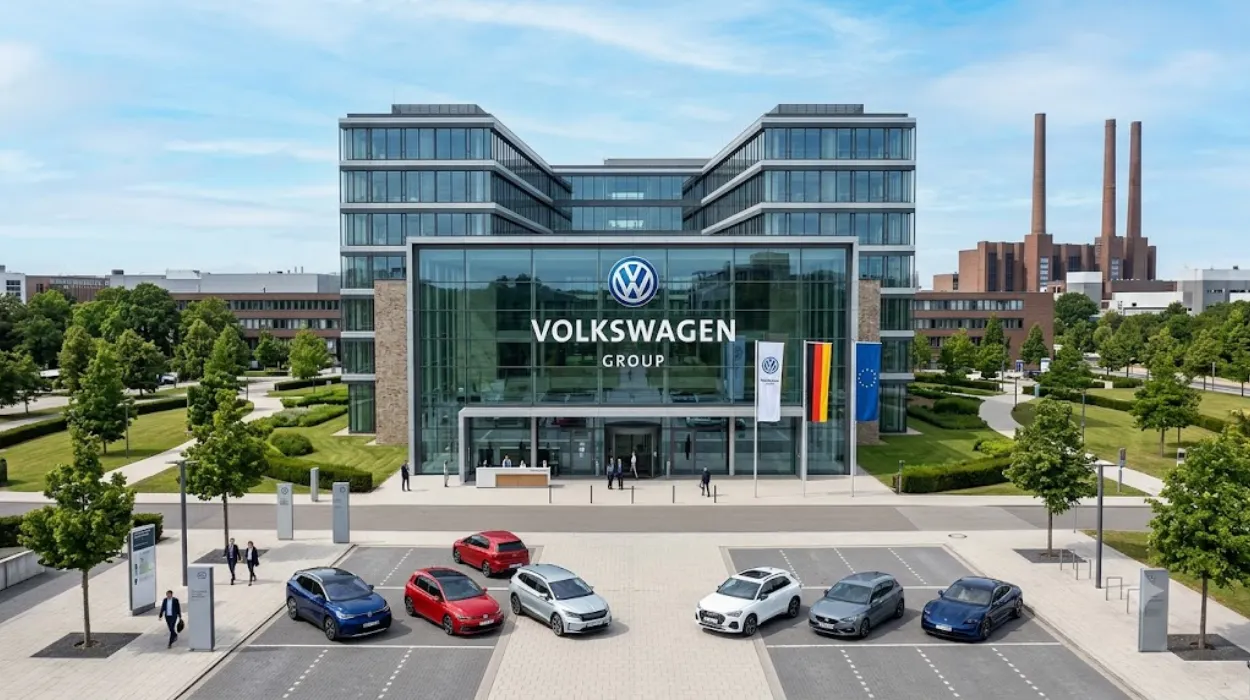
Volkswagen Group is the parent company of twelve automotive brands, including Volkswagen, Audi, Porsche, Škoda, SEAT, CUPRA, Bentley, Lamborghini, and the Traton truck division. Headquartered in Wolfsburg, Germany, the company delivered 9.0 million vehicles in 2025 and employs workers across production sites in Europe, China, North America, and South America. In July 2026, the Executive Board presented a new future plan built around 12 initiatives and a 2030 target picture, positioning the company to remain competitive amid tariffs, regulatory pressure, and intensifying global competition. This article covers the company’s investment strategy, electric vehicle roadmap, battery production plans, artificial intelligence initiatives, restructuring measures, and financial targets.
- What Is Volkswagen Group’s Future Plan for 2030?
- How Much Is Volkswagen Group Investing Through 2030?
- What Are Volkswagen Group’s Electric Vehicle Expansion Plans?
- Which New Electric Models Is Volkswagen Group Launching?
- How Is Volkswagen Group Building Battery Production Capacity?
- How Is Volkswagen Group Restructuring Its Business?
- How Is Volkswagen Group Using Artificial Intelligence?
- What Software and Technology Partnerships Support Volkswagen Group’s Strategy?
- How Is Volkswagen Group Performing in Key Global Markets?
- What Are the Financial Targets of Volkswagen Group’s Future Plan?
- What Challenges Does Volkswagen Group Face in Its Transformation?
- What Does Volkswagen Group’s Future Plan Mean for the Automotive Industry?
What Is Volkswagen Group’s Future Plan for 2030?
Volkswagen Group’s future plan is a package of 12 initiatives and a 2030 target picture designed to make the company more resilient, efficient, and competitive. The plan concentrates resources on the automotive core business, technology leadership, and regional market alignment.
The plan was presented to the Supervisory Board in July 2026 by the Executive Board, led by CEO Oliver Blume. It responds to geopolitical tensions, rising tariff-driven costs, growing regulatory requirements, and intensified competition, particularly from Chinese automakers. The plan rests on eight areas of action: reducing complexity, intensifying the focus on core technologies, reducing production overcapacity, strengthening regional responsibility, streamlining the investment portfolio, increasing operating efficiency, accelerating digitalization, and reinforcing financial discipline.
Volkswagen Group has stated a central goal: to become the world’s most attractive automotive company by 2030. This ambition covers five dimensions — iconic brands, inspiring products, leading technologies, robust financial results, and reliable capital market performance. The company describes the transformation as a permanent process rather than a fixed-term project, meaning cost discipline and efficiency measures will continue indefinitely rather than end at a fixed deadline.
How Much Is Volkswagen Group Investing Through 2030?
Volkswagen Group plans to invest 160 billion euros between 2026 and 2030, focused primarily on Germany and Europe. The investment covers products, technologies, production facilities, and infrastructure, including battery cells, software, and autonomous driving.
This figure represents a reduction from the previous five-year plan, which allocated 165 billion euros for 2025–2029, and the 2024–2028 plan, which allocated 180 billion euros. The declining investment total reflects the company’s broader strategy of reducing production capacity and complexity rather than expanding output. CEO Oliver Blume confirmed the 160-billion-euro figure, stating that the investment prioritizes Germany and Europe while continuing to fund future-oriented technology fields.
A separate lever of the plan involves streamlining the equity and investment portfolio. In 2026, Volkswagen Group entered an exclusive arrangement with Bain Capital, a global private equity firm, to sell a 51 percent majority stake in Everllence, a manufacturer of large engines, turbomachinery, and decarbonization equipment for shipping, data centers, and the energy sector. The transaction generates proceeds of approximately 7.4 billion euros for Volkswagen Group, strengthening its financial position while retaining a 49 percent minority stake in Everllence.
What Are Volkswagen Group’s Electric Vehicle Expansion Plans?
Volkswagen Group achieved higher EV market share than combustion-engine market share in Europe for the first time in 2025. Global all-electric deliveries rose 32 percent in 2025, with European EV deliveries increasing 66 percent, giving the Group a 27 percent European battery-electric vehicle market share.
The Group’s EV expansion spans multiple brands and price segments. Five of the ten best-selling electric models in Europe in 2025 came from Volkswagen Group brands. In the first half of 2026, the Group’s order book for all-electric vehicles in Europe rose by more than 50 percent, indicating accelerating consumer demand ahead of delivery. Total Group deliveries reached 4.1 million vehicles in the first half of 2026 across all powertrain types.
In the first quarter of 2026, Volkswagen Group became the market leader in China, a milestone in a market where the Group had faced years of declining share against domestic electric vehicle manufacturers such as BYD and NIO. The Group also achieved its strongest market share in South America in more than ten years during the same period.
Which New Electric Models Is Volkswagen Group Launching?
Volkswagen Group is expanding its electric lineup across entry-level, mainstream, and premium segments. The ID.2all, an all-electric small car, is scheduled to reach dealerships in 2026 as Volkswagen’s first entry-level battery-electric vehicle, priced below 25,000 euros. A further entry-level model, developed under the Group’s Brand Group Core division, is planned at a target price of approximately 20,000 euros, extending affordable electric mobility to a broader customer base.
The Porsche Macan Electric, built on the Premium Platform Electric (PPE) architecture shared with Audi, launched and ramped up production during 2024 and 2025. The PPE platform is a joint development between Porsche and Audi designed for larger, higher-performance electric vehicles, distinct from the Modular Electric Drive Matrix (MEB) platform used for compact and mid-size Volkswagen-brand EVs. By 2024, Volkswagen Group had delivered more than 1 million cumulative electric vehicles built on the MEB platform.
Scout Motors, a Volkswagen Group brand focused on rugged, off-road electric vehicles for the North American market, is progressing through pre-production toward a planned start of production in late 2026. Scout revives a historic American vehicle name under new ownership by Volkswagen Group, targeting the US truck and SUV market with battery-electric and range-extended electric models.
How Is Volkswagen Group Building Battery Production Capacity?
Volkswagen Group produces battery cells through PowerCo, its dedicated battery subsidiary. PowerCo became the first European vehicle manufacturer to develop and produce battery cells at industrial scale. Production in Germany, at the Salzgitter gigafactory, ramped up through 2025, with additional battery plants under development in Valencia, Spain, and in Canada. German battery cell output is scaling ahead of the Spanish and Canadian facilities, which follow in subsequent phases of the rollout.
Battery cell production reduces Volkswagen Group’s dependence on external suppliers such as CATL and LG Energy Solution, while supporting cost reduction targets for future EV platforms. The Group has also worked to lower electric vehicle development costs in China by up to 50 percent following the full commissioning of a new test center in Hefei, a city in Anhui province that serves as a hub for the Group’s regionalized China operations.
How Is Volkswagen Group Restructuring Its Business?
Volkswagen Group is reducing its model lineup by up to 50 percent and cutting equipment option complexity by up to 75 percent. Production capacity is being adjusted to a demand-based target of approximately 9 million vehicles per year, down from capacity built for 12 million units before the COVID-19 pandemic.
The restructuring addresses excess manufacturing capacity that accumulated after vehicle demand fell below pre-pandemic projections. The Group has already reduced capacity by 2 million units and plans further reductions in China and Europe. Streamlining the model lineup allows the company to concentrate investment and engineering resources on the vehicle segments and technologies that generate the highest customer value and financial return.
Workforce restructuring is a core component of the plan. Volkswagen Group agreed to cut 50,000 jobs across the Volkswagen, Audi, and Porsche brands and the CARIAD software subsidiary. Of this total, 35,000 job cuts apply to Volkswagen AG specifically, where binding agreements covering more than 28,000 departures by 2030 had already been signed as of mid-2026. Collective bargaining agreements and workforce reductions generated approximately 1 billion euros in sustainable cost savings across the Group in 2025. Factory costs at German production sites fell by more than 20 percent on average during the same year.
Technology harmonization is a further restructuring pillar. The Group is consolidating platforms, electronic architectures, and software systems separately for Western and Eastern hemisphere markets, eliminating duplicate technology development across brands. This approach aims to increase Group-wide synergies and strengthen technological leadership while reducing parallel engineering efforts that previously existed across Volkswagen, Audi, Porsche, and other brands.
How Is Volkswagen Group Using Artificial Intelligence?
Volkswagen Group plans to invest up to 1 billion euros in artificial intelligence by 2030, targeting vehicle development, industrial applications, and IT infrastructure. The company expects efficiency gains and cost avoidance of up to 4 billion euros by 2035 through AI adoption across its value chain.
In vehicle development, Volkswagen Group is building an AI-powered engineering environment in partnership with Dassault Systèmes, a French software company specializing in 3D design and simulation. The system supports virtual testing and component simulation across all Group brands and regions. Combined with other initiatives, this collaboration aims to shorten the product development cycle to 36 months or less, a reduction of at least 25 percent, equivalent to approximately 12 months, compared to current development timelines.
The Group launched the WE & AI initiative in spring 2024, an internal training program designed to help employees use artificial intelligence responsibly and effectively in daily operations. By 2026, the program had reached more than 130,000 employees worldwide. Volkswagen Group is also exploring a Large Industry Model (LIM), an industrial AI system trained on manufacturing, design, and process data contributed voluntarily by participating companies, intended to optimize workflows and logistics across the automotive supply chain.
Volkswagen Group co-founded Catena-X, an open data-exchange platform for the automotive sector, alongside BMW, Mercedes-Benz, BASF, SAP, Siemens, ZF, and T-Systems. Catena-X enables secure data sharing between manufacturers, suppliers, and technology providers, supporting AI applications that depend on cross-company data access. Hauke Stars, the Volkswagen Group Board Member for Information Technology, has stated the company’s goal is a production and development environment with no process operating without AI support.
What Software and Technology Partnerships Support Volkswagen Group’s Strategy?
Volkswagen Group relies on CARIAD, its in-house automotive software company, alongside external partnerships with Rivian and Xpeng to accelerate software and electronic architecture development. These partnerships reduce development time and cost compared to fully independent software programs.
CARIAD develops the software platforms and electronic architectures used across Volkswagen Group brands. In China, the Group developed an advanced electrical and electronic architecture jointly with Xpeng, a Chinese electric vehicle manufacturer, and moved it into production within 18 months. This timeline reflects the speed advantage of technology co-development with an established Chinese EV company operating in a fast-moving domestic market.
For markets outside China, Volkswagen Group formed a joint venture with Rivian, a US-based electric vehicle manufacturer, centered on zonal electronic architecture. A zonal architecture consolidates vehicle computing functions into a smaller number of regional control units rather than dozens of separate electronic modules, reducing wiring complexity and enabling faster software updates. Volkswagen Group’s investment in this partnership exceeds 5 billion US dollars. Development of the Rivian-based zonal architecture for Western Hemisphere markets remained on schedule as of mid-2026.
CARIAD also collaborates with Bosch, a German engineering and technology company, on Level 2 automated driving systems intended for mass-market vehicles. The two companies concluded their collaboration in the Automated Driving Alliance after delivering the system, marking a milestone in Volkswagen Group’s assisted-driving technology rollout. Separately, the Group deepened a joint venture with Horizon Robotics, a Chinese autonomous driving technology company, to support advanced driver-assistance systems for the China market.
How Is Volkswagen Group Performing in Key Global Markets?
Volkswagen Group holds the largest automotive market share in Europe and became the market leader in China during the first quarter of 2026. The Group’s operating result fell to 8.9 billion euros in 2025, down from 19.1 billion euros in 2024, while total deliveries remained flat at 9.0 million vehicles.
Europe remains Volkswagen Group’s strongest region, where the company holds clear market leadership and achieved a higher electric vehicle market share than combustion-engine market share in 2025 for the first time. China, historically Volkswagen Group’s largest single market by volume, presented years of declining share before the Group’s regionalized realignment strategy, including local software development and the Hefei test center, helped restore market leadership in early 2026.
South America delivered the Group’s strongest market share performance in more than a decade during the first quarter of 2026, reflecting growth in Brazil and Argentina. North America remains a developing market for Volkswagen Group’s electric strategy, with the Scout brand and NACS (North American Charging Standard) charging compatibility positioned as key growth levers. NACS is the charging connector standard originally developed by Tesla and adopted industry-wide across North America starting in 2023.
Porsche, a premium brand within Volkswagen Group, experienced a sales decline of approximately 25 percent in the United States, attributed to import tariffs imposed by the US government. Tariff exposure has become a recurring theme across the Group’s 2026 financial disclosures, alongside broader geopolitical tensions affecting supply chains and production planning.
What Are the Financial Targets of Volkswagen Group’s Future Plan?
Volkswagen Group targets an operating return on sales of 8 to 10 percent by 2030, along with annual net cost savings exceeding 6 billion euros. The Automotive Division is expected to account for more than 60 percent of the Group’s operating result under the plan.
These targets follow a difficult 2025 fiscal year in which operating result fell by more than 50 percent year over year. Structured performance programs across Volkswagen, Audi, Porsche, and other brands offset external financial headwinds in the double-digit billions during 2025, though the operating result decline still occurred due to the scale of tariff and market pressures.
The cost savings target of more than 6 billion euros annually by 2030 combines multiple sources: workforce reductions, technical production capacity cuts, factory cost reductions in Germany, and AI-driven efficiency gains. The Group frames these targets as part of a strict cost discipline framework intended to fund continued investment in electric vehicles, battery technology, software, and autonomous driving without compromising financial stability.
What Challenges Does Volkswagen Group Face in Its Transformation?
Volkswagen Group faces geopolitical tensions, tariff-driven cost increases, intensifying competition from Chinese automakers, and skepticism from financial analysts regarding its technology leadership claims. Workforce restructuring across four major sites also carries execution risk.
Financial research firms have expressed doubt about specific elements of the plan. One analyst note from Bernstein, a global research and brokerage firm, questioned Volkswagen Group’s claim of extending technology leadership, citing the pace of innovation among Chinese competitors as a counterpoint. This skepticism reflects a broader industry debate about whether legacy automakers can match the software and battery development speed of newer Chinese EV manufacturers.
Reports preceding the July 2026 announcement indicated internal discussions about closing production sites in Hanover, Zwickau, and Emden in Germany, along with the Audi plant in Neckarsulm, and eliminating roughly 100,000 positions globally by 2030. The finalized plan presented on July 9, 2026, confirmed workforce reductions of 50,000 jobs, a lower figure than the earlier reported estimate, though the site-specific impacts were still being communicated to employees at individual locations following the announcement.
Tariffs imposed by the United States government have directly affected Porsche sales performance and factored into Volkswagen Group’s decision-making regarding potential US manufacturing investment for Audi. Blume indicated that any Audi manufacturing plant in the United States depends on the scale of financial incentives offered by the US government, illustrating how trade policy now directly shapes Volkswagen Group’s capital allocation decisions.
Explore More about Business:
Ryanair Flight FR5448 Diverted After Mid-Air Fuel Alert
EasyJet–Castlelake Acquisition Deal Shakes Aviation Market
What Does Volkswagen Group’s Future Plan Mean for the Automotive Industry?
Volkswagen Group’s restructuring signals a broader industry shift toward leaner production, regionalized technology development, and battery self-sufficiency. As the world’s second-largest automaker by volume, the Group’s strategic choices influence supplier networks, labor markets, and competitive benchmarks across the global auto industry.
The scale of Volkswagen Group’s 160-billion-euro investment plan and its focus on Germany and Europe carries implications for the European industrial base, given ongoing debates about energy costs, regulatory complexity, and manufacturing competitiveness in the region. The Group’s public statements have framed its transformation as a contribution to the future of Germany as an industrial location, connecting corporate strategy to national economic policy discussions.
Volkswagen Group’s approach of building separate technology architectures for Western and Eastern hemisphere markets, rather than pursuing a single global platform, reflects a growing industry pattern of regionalized product development in response to divergent regulatory environments, consumer preferences, and competitive pressures in China versus Europe and North America. Other global automakers face similar pressure to balance global scale efficiencies against regional market responsiveness.
The Group’s battery self-sufficiency strategy through PowerCo, alongside its AI investment program and software partnerships with Rivian and Xpeng, positions Volkswagen Group among the automakers pursuing vertical integration across the electric vehicle value chain. This strategy reduces reliance on external suppliers for critical components while requiring substantial upfront capital, a trade-off that will continue shaping Volkswagen Group’s financial performance and strategic decisions through 2030 and beyond.