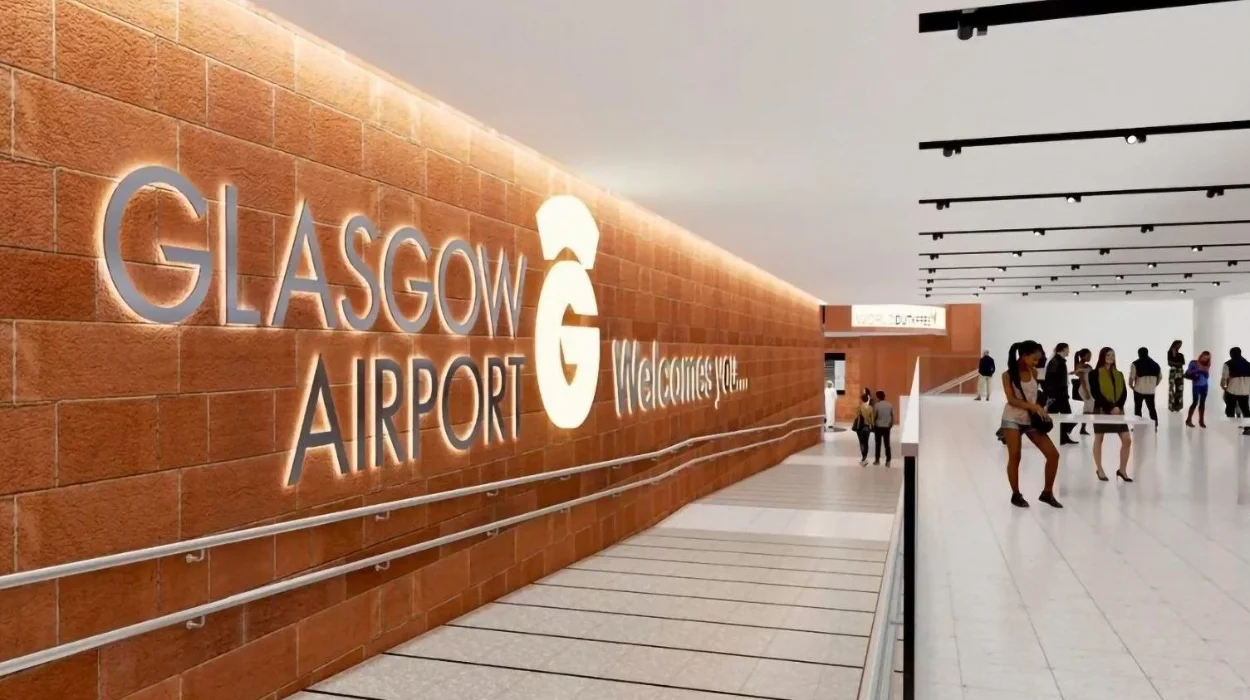
Glasgow Airport, code GLA, is Scotland’s second-busiest airport and the main international gateway for western Scotland. The airport is located eight miles west of Glasgow city centre, near the town of Paisley in Renfrewshire. It is officially known as Glasgow International Airport and carries the ICAO designation EGPF. Glasgow Airport handled 8,067,685 passengers in 2024, an increase of 9.63% compared to 7,358,828 passengers in 2023. The airport connects Scotland to more than 100 destinations across Europe, North America, the Middle East, and the Gulf region through approximately 20 to 30 airlines. This guide explains the airport’s terminals, transport links, security procedures, history, and ownership structure for travelers planning a journey through Glasgow.
- What Is Glasgow Airport and Where Is It Located?
- What Terminals Does Glasgow Airport Have?
- Which Airlines Fly From Glasgow Airport?
- How Do You Get To and From Glasgow Airport?
- What Should You Know About Security and Check-In Procedures?
- What Is the History of Glasgow Airport?
- What Role Does Glasgow Airport Play in Scotland’s Economy and Aviation Future?
What Is Glasgow Airport and Where Is It Located?
Glasgow Airport is Scotland’s second-busiest airport, located eight miles west of Glasgow city centre in Renfrewshire, near Paisley. It operates under the code GLA and ICAO designation EGPF, connecting Scotland to over 100 worldwide destinations.
Glasgow Airport sits adjacent to the M8 motorway, the principal road artery linking Glasgow to Edinburgh and the wider central Scotland road network. The airport previously operated under the name Abbotsinch Airport, reflecting its origins as a Royal Naval Air Station before its conversion to civilian use. Glasgow Airport is owned and operated by AGS Airports Limited, a company held by AviAlliance, a private industrial airport investor and operator with holdings across multiple international airports. The airport supports over 30,000 jobs in the Scottish economy and generates an estimated £1.44 billion in gross value added (GVA) annually. Glasgow Airport accounts for approximately 28% of Scotland’s total air passenger traffic, while Edinburgh Airport, the country’s busiest airport, handles around 55%. The remaining share is distributed among smaller Scottish airports including Aberdeen, Inverness, and Prestwick.
The airport is distinct from Glasgow Prestwick Airport, a separate facility located approximately 32 miles south of Glasgow city centre near the town of Prestwick. Glasgow Prestwick operates primarily as a low-cost and cargo hub, with Ryanair as its dominant passenger carrier. Travelers booking flights should verify which Glasgow airport their ticket specifies, since confusion between the two facilities is a common source of missed flights.
What Terminals Does Glasgow Airport Have?
Glasgow Airport operates a single passenger terminal building divided into two functional sections: the Main Terminal, known as Terminal 1, and Terminal 2, a smaller satellite facility dedicated to low-cost airline check-in.
The Main Terminal, or Terminal 1, handles the majority of passenger flights, including full-service international and domestic carriers. Terminal 2, originally built in 2003 and historically referred to as the St Andrews Building, was constructed to provide a dedicated check-in facility principally for Jet2.com and other low-cost operators. The terminal complex as a whole consists of three piers: the West Pier, the Central Pier, and the East Pier.
The West Pier, commonly called the International Pier, was built during the 1989 airport extension project. It functions as the principal departure point for international and long-haul flights. Nearly all stands on the West Pier are equipped with airbridges, allowing passengers to board aircraft directly from the terminal without using outdoor stairs. The East Pier, constructed in the mid-1970s, originally served international flights but has since been redeveloped for low-cost carrier operations. None of the stands on the East Pier have airbridges; passengers board via mobile stairs. The East Pier received a £3 million extension in 2015, adding capacity for 750,000 additional passengers annually. EasyJet and Loganair are the principal airlines using this pier. The Central Pier serves a mix of domestic and short-haul European routes.
In the late 2000s, the airport constructed Skyhub, a single centralized security screening area located between Terminal 1 and Terminal 2. Skyhub replaced three separate security checkpoints that had previously served each pier individually. This consolidation also freed up terminal space for an expanded duty-free shopping area. Glasgow Airport’s total terminal capacity, following the 1989 extension and subsequent upgrades, reached approximately nine million passengers per year across 38 gates. Major terminal and pier expansion projects are underway, with airside enhancements expected to raise capacity to over 12 million passengers by 2027, and longer-term plans targeting over 24 million annual passengers by 2030.
Which Airlines Fly From Glasgow Airport?
Glasgow Airport is served by approximately 20 to 30 airlines flying to more than 100 destinations across Europe, North America, the Middle East, and the Gulf. Major carriers include easyJet, Loganair, British Airways, Jet2.com, and Emirates.
EasyJet is one of the airport’s dominant low-cost carriers. In 2017, easyJet became the first airline at Glasgow Airport to carry more than one million passengers within a 12-month period. Loganair, a Scottish regional airline and former Flybe franchise operator, has its head office based at Glasgow Airport and operates a significant share of domestic Scottish routes, including connections to Scottish islands and the Highlands. British Airways maintains a maintenance hangar at the airport capable of carrying out overhaul work on Airbus A320-family aircraft, alongside a dedicated cargo facility.
Emirates operates long-haul services connecting Glasgow to Dubai. On 10 April 2014, Emirates flew an Airbus A380 to Glasgow to mark the tenth anniversary of the Glasgow–Dubai route, marking the first time an A380 had visited any Scottish airport. In July 2014, Emirates opened a dedicated lounge at the top of the West Pier for First and Business Class passengers. Three examples of international long-haul routes from Glasgow include flights to Dubai, destinations in Canada, and routes across continental Europe and the Middle East.
Airline service at Glasgow Airport is subject to periodic change based on commercial and economic conditions. In 2026, German flag carrier Lufthansa temporarily suspended flights to Glasgow due to a sharp rise in fuel costs connected to regional conflict affecting global oil markets. The airline paused ticket sales on the route for the winter season while working to restore service. This illustrates a broader pattern in commercial aviation: route availability fluctuates with fuel prices, geopolitical events, and seasonal demand, and travelers should verify current route availability directly with airlines or through the airport’s official flight information pages before booking.
How Do You Get To and From Glasgow Airport?
Glasgow Airport is accessible by road via direct connection to the M8 motorway, by frequent bus service to the city centre, by taxi, and by pre-booked transfer services. There is no direct rail link to the terminal.
The M8 motorway provides direct road access to the airport from Glasgow city centre and the wider central Scotland motorway network, making it straightforward to reach by private car or taxi. The Glasgow Airport Express bus service, operated by First Glasgow, runs frequent services between the airport and Glasgow city centre. Buses on this route are equipped with leather seats, USB charging ports, and free WiFi.
Unlike many major UK airports, Glasgow Airport does not currently have a direct rail connection into the terminal building. Passengers travelling by train typically connect via Paisley Gabriel Street railway station or Glasgow Central Station and complete their journey to the airport by bus or taxi. This stands in contrast to Glasgow Prestwick Airport, which is the only airport in Scotland with its own dedicated on-site railway station, offering direct rail access from Glasgow and Ayrshire.
Three examples of ground transport options available at Glasgow Airport include the Glasgow Airport Express bus, standard metered taxis available at designated terminal ranks, and pre-booked private transfer services arranged in advance through transport operators. Parking is available in both short-stay and long-stay car parks located close to the terminal, accommodating travelers who are dropping off, picking up, or leaving vehicles for the duration of a trip.
What Should You Know About Security and Check-In Procedures?
Glasgow Airport recommends arriving at least 1.5 to 2 hours before a flight for check-in and security screening, with up to 90 minutes specifically allocated for security during peak travel periods.
Security procedures at Glasgow Airport follow standard UK Civil Aviation Authority (CAA) and Department for Transport requirements applied across all UK airports. These include restrictions on liquids carried in hand luggage, removal of laptops and large electronics from bags for separate screening, and standard passenger screening through metal detection or body scanning equipment. Peak travel periods, particularly early mornings and evenings, can extend security wait times significantly beyond the standard estimate.
Passengers are advised to confirm their airline’s baggage allowance, covering both size and weight limits, before arriving at the airport. Excess baggage charges applied at the gate or check-in desk can be substantial compared to fees paid in advance online. Glasgow Airport provides free WiFi access throughout the terminal building, allowing passengers to check flight status, access boarding passes, or communicate with airlines during waiting periods. Some airlines offer a pre-booked hand luggage drop-off service, allowing passengers to drop bags the day before departure to reduce congestion on the morning of travel.
Three examples of factors that can extend security wait times beyond the standard estimate include peak summer holiday periods, early morning departure banks when multiple flights check in simultaneously, and unscheduled security alerts or equipment issues. The airport has experienced periodic operational disruptions, including IT system failures that affected booking and baggage handling systems, leading to delays for passengers during peak periods such as Christmas Eve and other high-traffic days.
Explore More about Business:
Rita Seymour Sainsbury’s Case Trends Across Social Media
Daniel Kretinsky Royal Mail Payout Sparks Debate
What Is the History of Glasgow Airport?
Glasgow Airport opened on land formerly used by the Royal Navy as Abbotsinch Airfield. It became Scotland’s primary airport through the 1960s and 1970s and has undergone multiple major redevelopments, including a significant 1989 extension and the 2003 addition of Terminal 2.
By 1996, Glasgow Airport was handling over 5.5 million passengers annually, making it the fourth-busiest airport in the United Kingdom at the time. The 1989 extension project added a dedicated international departure lounge and pier on the western side of the building, expanding total terminal capacity to nine million passengers per year across 38 gates. In 2003, airport operator BAA completed redevelopment of a satellite building, originally called the St Andrews Building, to create Terminal 2 as a dedicated check-in facility for low-cost airlines, principally Jet2.com.
In October 2014, Heathrow Airport Holdings agreed to sell Glasgow Airport, together with Southampton and Aberdeen Airports, to a consortium formed by Ferrovial and Macquarie Group for £1 billion. This transaction restructured ownership of several major UK regional airports under new private investment management. In 2007, Glasgow was overtaken by Edinburgh Airport in passenger numbers, becoming the second-busiest airport in Scotland, a position it continues to hold.
The airport has also experienced serious safety and security incidents over its operating history. On 3 September 1999, a Cessna 404 carrying nine Airtours staff crashed near Linwood, Renfrewshire, shortly after takeoff from Glasgow, killing eight people. The UK Air Accident Investigation Branch determined the crash resulted from an engine malfunction combined with a pilot error in which the working engine was mistakenly shut down. On 30 June 2007, an attack occurred at the airport when a vehicle was driven into the main terminal entrance and set alight. The vehicle caused some structural damage to the airport; one attacker died from injuries sustained during the incident, and others involved were subsequently jailed.
What Role Does Glasgow Airport Play in Scotland’s Economy and Aviation Future?
Glasgow Airport supports over 30,000 jobs and generates approximately £1.44 billion in gross value added annually for the Scottish economy, with expansion plans targeting 24 million annual passengers by 2030.
The airport functions as a critical piece of Scotland’s transport and economic infrastructure, supporting tourism, business travel, and international trade connectivity. The Universities of Glasgow and Strathclyde Air Squadron, a Royal Air Force unit, is based at the airport, providing flying training to university students intending to join the RAF, reflecting the site’s continued military as well as civilian aviation role.
Passenger volumes at Scottish airports overall reached record levels in the first quarter of 2026, according to data published by the UK Civil Aviation Authority. Glasgow Airport recorded passenger growth alongside Edinburgh, Inverness, and Prestwick airports during this period, reflecting broader recovery and growth trends in UK regional aviation. Glasgow Airport’s operator has stated plans for further expansion, including additional long-haul routes and increased European connectivity, supported by ongoing terminal and pier upgrades. The airport has also implemented sustainability measures, including electric ground vehicles, energy-efficient terminal systems, and support for sustainable aviation fuel initiatives, alongside formal carbon footprint reporting under Airport Carbon Accreditation standards.
For travelers, this combination of rising passenger numbers, expanding route networks, and ongoing infrastructure investment means route availability and terminal facilities at Glasgow Airport are likely to continue evolving. Checking current flight schedules, terminal assignments, and transport options directly before travel remains the most reliable way to plan a journey through Glasgow Airport.