Key Points
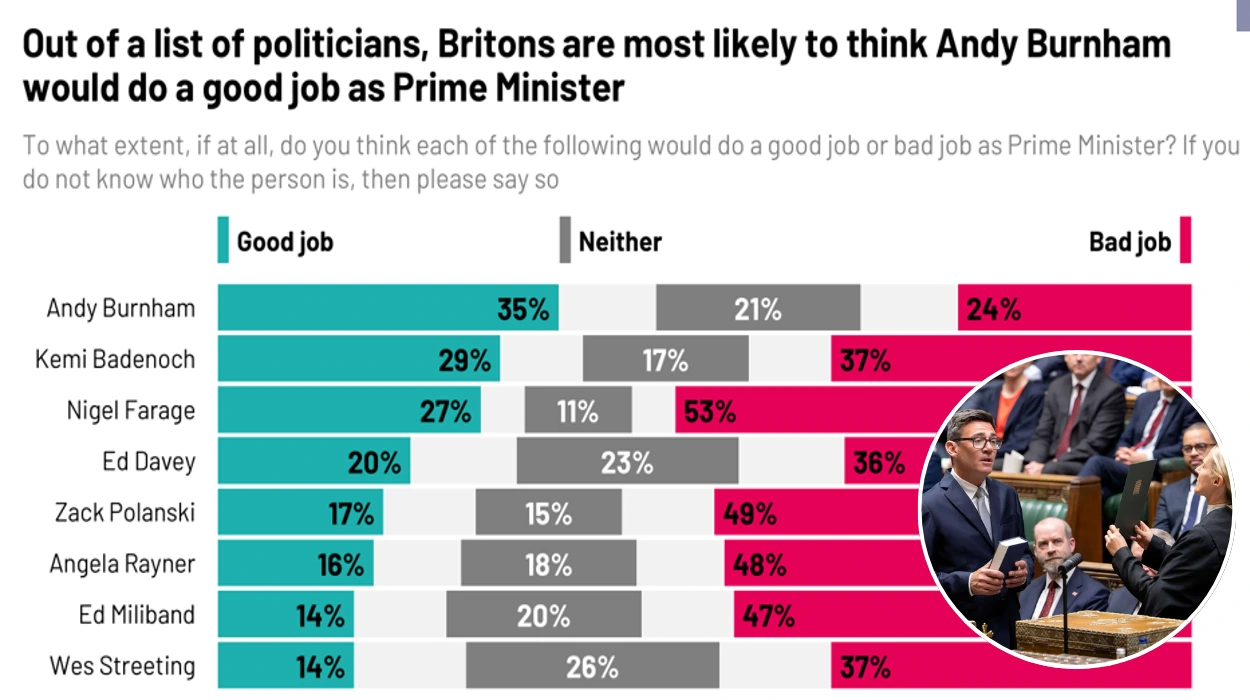
- New Ipsos poll (19–22 June 2026) finds 35% of Britons think Andy Burnham would do a good job as Prime Minister; 24% think he would do a bad job.
- Other figures: Kemi Badenoch 29% good / 37% bad; Nigel Farage 27% good / 53% bad.
- 39% of the public prefer a leadership contest following Keir Starmer’s position; 13% want a Burnham “coronation”; 19% want Starmer to stay.
- 61% of respondents are not confident Labour can provide strong and stable leadership; 60% say the Conservatives cannot either.
- If Burnham became leader, 42% believe Labour would be more likely to win a general election; only 7% favour Starmer increasing Labour’s chances.
- Among Labour names, 23% say Burnham would do the best job as leader; 34% of 2024 Labour voters agree.
- Ratings for senior Labour figures such as Angela Rayner, Ed Miliband and Wes Streeting remain low on the “good job” metric.
- Ipsos Director of Politics Keiran Pedley says Burnham’s relative rating suggests potential poll improvement but warns Labour must prove long-term competence.
- Public confidence in smaller parties’ ability to provide strong leadership is low: Reform UK 28% confident, Liberal Democrats 23%, Greens 23%.
London (Britain Today News) June 24, 2026 – The latest Ipsos poll, taken between 19 and 22 June 2026 and largely conducted before Keir Starmer’s resignation speech, shows that Andy Burnham is viewed by 35% of Britons as likely to do a good job as Prime Minister, with 24% saying he would do a bad job and 21% saying neither good nor bad. The survey captures public reaction to recent developments within the Labour Party and measures confidence across leading political figures and parties.
- Key Points
- What do the headline Ipsos numbers show?
- What do voters want Labour to do next?
- Would Burnham improve Labour’s electoral chances?
- Who do Britons think would do the best job as Labour leader?
- How confident is the public about parties providing strong and stable leadership?
- What do Ipsos experts say about Burnham’s prospects?
- What do these figures mean for Labour’s strategy?
- How do recent political events shape the poll results?
- Are there demographic patterns in the polling?
- What are the political risks for other figures named in the poll?
- What next for media and parties following Ipsos’s findings?
- What are the limitations of this poll?
What do the headline Ipsos numbers show?
As reported by Ipsos’s published data, 35% of respondents said Burnham would do a good job as Prime Minister, with 24% saying he would do a bad job and 21% neutral. By comparison, 29% of Britons think Kemi Badenoch would do a good job and 37% a bad job, while 27% say Nigel Farage would do a good job and 53% a bad job. These headline figures place Burnham ahead of other high-profile figures on the “would do a good job” metric.
How do attitudes to Burnham compare with other Labour figures?
The Ipsos polling shows a marked contrast between Burnham and several senior Labour colleagues. Angela Rayner is viewed positively by 16% and negatively by 48%; Ed Miliband scores 14% good and 47% bad; Wes Streeting receives 14% good and 37% bad. These results suggest Burnham’s personal standing on competence outstrips several members of Labour’s frontbench in the public eye.
What do voters want Labour to do next?
According to Ipsos, 39% of Britons want a full leadership contest to follow Keir Starmer’s situation, while 13% want Starmer to resign with Andy Burnham installed as leader without a contest. Nineteen percent favour Starmer remaining as Prime Minister, 16% have no preference and 11% do not know. The plurality favouring a contest indicates limited appetite for an automatic coronation.
Would Burnham improve Labour’s electoral chances?
If Burnham became leader and Prime Minister, 42% of respondents think Labour would be more likely to win a future general election with him at the helm; 7% think Labour would be more likely to win under Starmer, and 36% think the change would make no difference. By contrast, when asked about Wes Streeting, only 15% believed Labour would be more likely to win with him, 14% with Starmer, and 52% said it would make no difference.
Who do Britons think would do the best job as Labour leader?
From a list of Labour politicians, 23% say Andy Burnham would do the best job as leader, and that figure rises to 34% among voters who supported Labour in 2024. Keir Starmer is preferred by 7%, Angela Rayner and Wes Streeting by 3% each. Half of Britons say either “none of them” (27%) or “don’t know” (23%) when asked who would do the best job, indicating considerable uncertainty about Labour’s leadership bench.
How confident is the public about parties providing strong and stable leadership?
Only 29% of Britons say they are confident that either Labour or the Conservatives can provide strong and stable leadership. Sixty-one percent are not confident in Labour’s ability to do so, while 60% are not confident in the Conservatives’ ability. Ipsos notes Labour’s standing on this measure has fallen since January 2024, when 39% were confident about Labour’s leadership. The Conservatives’ ratings have improved slightly from January 2024 but remain weak compared with the period immediately after Rishi Sunak became Prime Minister.
How do smaller parties fare on leadership confidence?
Public confidence in smaller parties is low across the board: 28% are confident Reform UK can provide strong and stable leadership (63% not confident), 23% are confident in the Liberal Democrats (62% not confident), and 23% are confident in the Green Party (65% not confident). These figures underscore a wider scepticism across the electorate about the capacity of major and minor parties to offer long-term stability.
What do Ipsos experts say about Burnham’s prospects?
As reported by Ipsos, Keiran Pedley, Director of Politics at Ipsos, commented:
“Given that Andy Burnham is seen as more likely to do a good job as Prime Minister than Nigel Farage and Kemi Badenoch it is reasonable to suggest that a Burnham-led Labour Party could improve in the polls once he takes office. However, given that six in ten lack confidence that Labour can offer strong and stable leadership, there is work to do for the expected incoming Prime Minister to show that Labour has the answers for the long term.”
What do these figures mean for Labour’s strategy?
The Ipsos data suggests a dual challenge for Labour: converting Burnham’s relative personal popularity into durable party support, and convincing broadly sceptical voters that Labour can provide long-term stable government. The discrepancy between individual leader ratings and party confidence means that a leadership change alone may not be sufficient to close trust deficits on competence and stability.
How do recent political events shape the poll results?
The timing of the fieldwork—largely completed before Keir Starmer’s resignation speech—means the poll primarily reflects voters’ views in the immediate aftermath of local and by-election results and wider political debate. The Makerfield by-election outcome, which saw Burnham’s profile rise, appears to have influenced public perceptions: 39% of respondents now favour an open contest to choose Labour’s next leader rather than anointed succession.
Are there demographic patterns in the polling?
Ipsos data indicates stronger support for Burnham among recent Labour voters: 34% of 2024 Labour voters say he would do the best job as leader. The poll’s breakdown by age, region and education is not reproduced in full here but suggests that while Burnham enjoys cross-demographic recognition, national scepticism about party competence remains widespread.
Explore More about Politics:
Starmer Meets Burnham for Face-to-Face Talks as PM Pledges Smooth UK Political Transition
Peers Challenge Mahmood’s Migration Plans Over Potential Legal Issues
What are the political risks for other figures named in the poll?
Kemi Badenoch’s mixed ratings—29% good, 37% bad—indicate she retains some positive perception but also considerable negativity. Nigel Farage faces a steep negative balance (27% good, 53% bad). For Labour, low scores for Rayner, Miliband and Streeting highlight potential vulnerabilities in the frontbench if they are expected to fill leadership roles or act as key deputies.
What next for media and parties following Ipsos’s findings?
Parties are likely to use these findings to calibrate messaging. For Labour, the priority will be to demonstrate policy competence and long-range stewardship to convert Burnham’s personal appeal into party credibility. For the Conservatives and other parties, the results underline the opportunity to capitalise on public scepticism about Labour while addressing their own leadership trust issues.
What are the limitations of this poll?
All single polls are snapshots of opinion at a given time. Ipsos’s fieldwork occurred from 19–22 June 2026 and largely predates key speeches and subsequent events; voter sentiments may shift with unfolding political developments. Additionally, the poll measures perceptions—how someone “would do a good job” is subjective and influenced by media visibility, recent events and personal familiarity with figures.