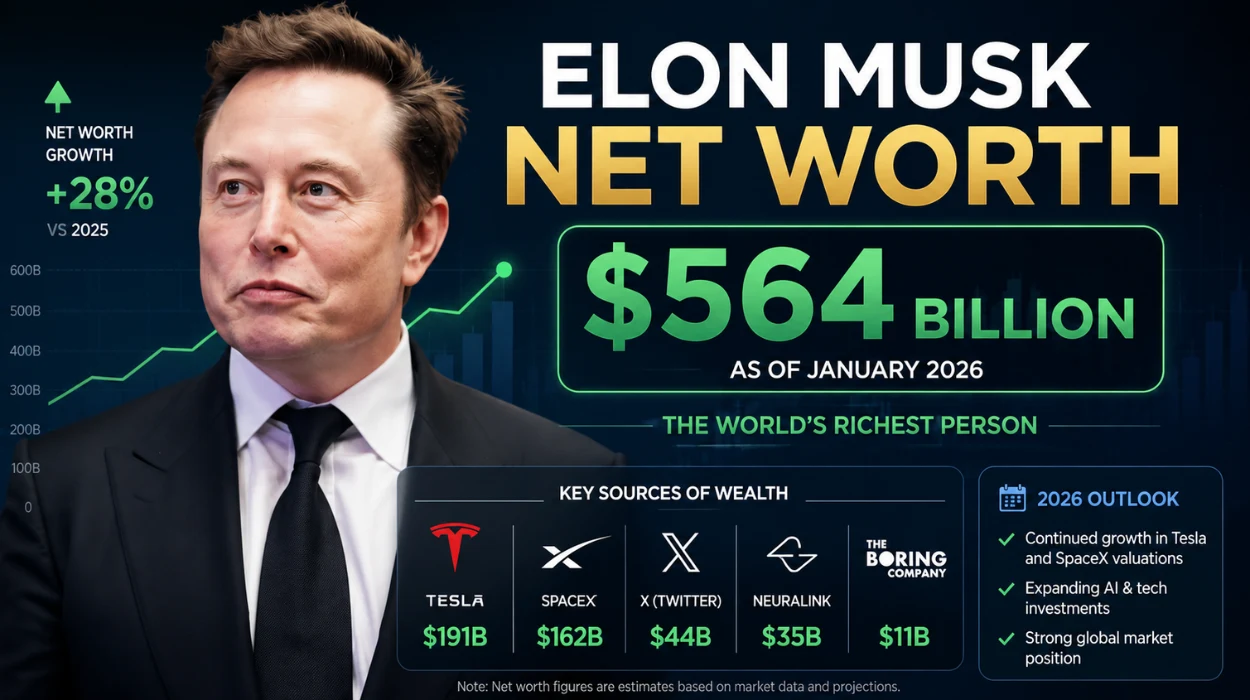
Elon Musk’s net worth stands at approximately $1.1 trillion as of June 2026, making him the wealthiest verified person in history, primarily driven by his ownership stakes in SpaceX and Tesla. His wealth surged from $852 billion in February 2026 after a SpaceX-xAI merger added $84 billion, and he became the first person to cross $300 billion in 2021, $400 billion in December 2024, and $500 billion shortly after.
- What Is Elon Musk’s Current Net Worth in 2026?
- How Did Elon Musk Build His Fortune From Scratch?
- What Companies Make Up Elon Musk’s Wealth Breakdown?
- When Did Elon Musk Become the World’s Richest Person?
- How Has Elon Musk’s Net Worth Changed Over Time?
- What Factors Drive Elon Musk’s Wealth Growth?
- Will Elon Musk Become the First Trillionaire?
What Is Elon Musk’s Current Net Worth in 2026?
Elon Musk’s net worth is $1.1 trillion as of June 2026 according to the Bloomberg Billionaires Index and Forbes, with SpaceX and Tesla forming the core of his wealth. This figure represents his verified position as the richest person globally, surpassing all previous historical records for individual wealth.
Musk’s wealth composition centers on two primary holdings: SpaceX, which is valued at approximately $1.77 trillion ahead of its historic IPO in June 2026, and Tesla, the electric vehicle manufacturer where he serves as CEO. Before the SpaceX-xAI merger in February 2026, Forbes pegged his net worth at $852 billion after the combined valuation of SpaceX and xAI reached $1.25 trillion. His wealth trajectory shows explosive growth starting in 2020 when Tesla stock soared, lifting his net worth from under $30 billion at early 2020 to $170 billion by early 2021.
The $1.1 trillion valuation reflects Musk’s ownership in multiple companies beyond SpaceX and Tesla, including Neuralink, The Boring Company, and his AI ventures. His wealth is not static cash but equity value that fluctuates with stock prices and private company valuations. Bloomberg and Forbes update these figures regularly as market conditions change.
How Did Elon Musk Build His Fortune From Scratch?
Elon Musk built his fortune through sequential business ventures starting with Zip2 at age 24, earning $22 million from its 1999 sale, then $180 million from PayPal’s 2002 acquisition, before investing nearly all $180 million into Tesla and SpaceX in 2004-2008. This foundational capital enabled his later trillion-dollar wealth accumulation.
Musk’s entrepreneurial journey began in 1995 when he co-founded Zip2 with his brother Kimbal, creating city travel guides for newspapers. By 1999 at age 28, Zip2 sold to Compaq for $307 million, giving Musk $22 million. In 2000 at age 29, he founded X.com, which became PayPal, and eBay acquired PayPal in 2002 for $1.5 billion, yielding Musk $180 million.
The critical wealth-building decision occurred in 2004 when Musk invested $70 million of his PayPal money into Tesla Motors (then Tesla), joining as CEO and taking a 31% stake. In 2008, he invested the remaining capital into SpaceX after the Falcon 1 achieved its first successful orbit, positioning himself as CEO and chief designer. Both companies faced near-collapse in 2008 during the financial crisis, but Musk’s persistence through that period enabled exponential returns when Tesla went public in 2010 and SpaceX began lucrative NASA contracts.
By 2012 at age 41, after SpaceX’s Dragon docked with the ISS, Musk’s net worth reached $2 billion on the Forbes Billionaires List for the first time. Tesla Model S success and Powerwall launch in 2015 lifted his worth to $13 billion, and Model 3 production ramp-up in 2017 pushed it to $20 billion. The transformative period began in 2020 when Tesla stock soared, increasing his net worth to $70 billion by age 49.
What Companies Make Up Elon Musk’s Wealth Breakdown?
Elon Musk’s wealth derives primarily from SpaceX (approximately 54% of total value), Tesla (approximately 35%), and smaller stakes in Neuralink, The Boring Company, xAI, and Twitter/X, with SpaceX-xAI merger value totaling $1.25 trillion as of February 2026. These holdings form a diversified technology portfolio spanning aerospace, electric vehicles, AI, and infrastructure.
SpaceX represents Musk’s largest wealth component. The Texas-based rocket company announced plans for a historic IPO in June 2026, aiming for a $1.77 trillion valuation with shares priced at $135 each to raise approximately $75 billion. Prior to the IPO, SpaceX merged with xAI in February 2026, declaring valuations of $1 trillion for SpaceX and $250 billion for xAI, totaling $1.25 billion combined. Musk owns approximately 54% of SpaceX, making this his dominant equity position.
Tesla is Musk’s second-largest holding. The electric vehicle manufacturer went public in 2010 at age 39, giving Musk a $1.3 billion net worth at that time. As Tesla increased vehicle sales and gained market share through 2019, Musk’s wealth surged to about $22 billion. The 2020 stock surge added $142 billion to his net worth in that single year, reaching $22 billion by 2019 and $170 billion by early 2021.
Neuralink and The Boring Company represent smaller but significant holdings. Musk founded Neuralink in 2016 at age 45 to develop brain-computer interfaces, and The Boring Company to create underground tunnel transportation systems, together contributing approximately $15 billion to his net worth at that time. These companies remain private with valuations not publicly disclosed but contribute to his diversified technology portfolio.
His Twitter/X acquisition in October 2022 for $44 billion added a social media platform to his holdings, though this represents a smaller portion of his overall wealth compared to SpaceX and Tesla. The platform’s valuation has fluctuated significantly since acquisition.
When Did Elon Musk Become the World’s Richest Person?
Elon Musk became the world’s richest person in early 2021 when Tesla stock surged, reaching $170 billion by February 2021, and officially became the first person to cross $300 billion net worth in November 2021 according to Forbes. He maintained this position through 2022 despite Tesla share price declines, and regained it after surpassing $400 billion in December 2024.
Musk’s wealth trajectory shows dramatic acceleration beginning in 2020. At the start of 2020, his net worth was under $30 billion at age 49. By early 2021, Tesla stock increases lifted his worth to $170 billion, representing a $140 billion increase in less than 12 months. This 2020 surge added $142 billion to his net worth in that single year.
The November 2021 milestone marked history: Forbes confirmed Musk as the first person to achieve $300 billion net worth, peaking at $320 billion that month. This represented his fortune’s highest point until December 2024. December 2022 saw Tesla share price declines cause a slight decrease in his net worth, though he remained the world’s richest person.
By 2024 at age 53, Musk’s major innovations from Tesla and SpaceX pushed his net worth to $220 billion. December 2024 marked another historic milestone when he crossed $400 billion, followed by $500 billion shortly after. October 2025 saw his wealth reach approximately $670 billion, positioning him above Google founders Larry Page and Sergey Brin, Oracle’s Larry Ellison, Amazon’s Jeff Bezos, and Facebook’s Mark Zuckerberg.
December 15, 2025, Musk reached an estimated $677 billion net worth, becoming the first person to pass $600 billion. By February 2026, the SpaceX-xAI merger added $84 billion, bringing Forbes’ valuation to $852 billion. June 2026 Bloomberg and Forbes data show $1.1 trillion, confirming his position as the richest person globally.
How Has Elon Musk’s Net Worth Changed Over Time?
Elon Musk’s net worth evolved from less than $0.01 billion in 1995 to $1.1 trillion in 2026, with explosive growth phases in 2020-2021 (+$140 billion), 2024-2026 (+$450 billion), representing a 110-million-fold increase over 31 years. This timeline shows three distinct wealth-building periods: foundational ventures (1995-2008), steady growth (2010-2019), and exponential acceleration (2020-present).
The complete yearly timeline demonstrates Musk’s wealth evolution:
| Year | Age | Event | Net Worth |
|---|---|---|---|
| 1995 | 24 | University, Zip2 co-founding | <$0.01 billion |
| 1999 | 28 | Zip2 sold to Compaq | $0.022 billion |
| 2002 | 31 | PayPal acquired by eBay | $0.18 billion |
| 2004 | 33 | Joins Tesla Motors | ~$0.5 billion |
| 2008 | 37 | SpaceX Falcon 1 success | $0.1 billion |
| 2010 | 39 | Tesla IPO | $1.3 billion |
| 2012 | 41 | SpaceX Dragon docks with ISS | $2 billion |
| 2015 | 44 | Model S success, Powerwall | $13 billion |
| 2016 | 45 | Neuralink, Boring Company founded | $15 billion |
| 2017 | 46 | Model 3 production ramps | $20 billion |
| 2018 | 47 | Falcon Heavy maiden flight | $21 billion |
| 2020 | 49 | Tesla stock soars | $70 billion |
| 2021 | 50 | Starship prototypes, $300B milestone | $150-320 billion |
| 2022 | 51 | Gigafactory expansion | $200 billion |
| 2023 | 52 | Neuralink & Boring updates | $185 billion |
| 2024 | 53 | Tesla/SpaceX innovations | $220-400+ billion |
| 2025 | 54 | Mars mission focus, $600B milestone | $677 billion |
| 2026 | 55 | SpaceX IPO, $1.1T valuation | $1.1 trillion |
The 2008 period was critical: Musk’s net worth dropped to $0.1 billion after investing nearly all capital into Tesla and SpaceX during the financial crisis, when both companies faced bankruptcy. His decision to invest remaining PayPal money rather than diversify enabled the later trillion-dollar outcome.
The 2020-2021 period represents the most dramatic growth: from under $30 billion early 2020 to $170 billion early 2021 ($140 billion gain), then peaking at $320 billion November 2021 ($150 billion additional gain in 9 months). This 2020 surge added $142 billion total.
The 2024-2026 period shows another explosive phase: from $220 billion in 2024 to $400 billion December 2024 ($180 billion gain), then $500 billion shortly after, $677 billion December 2025, $852 billion February 2026, and $1.1 trillion June 2026. This represents approximately $450 billion added in 18 months.
Explore More about Business:
Homebase Collapse Explained by Teneo Administrators
Coventry Airport Travel Info: Parking, Flights & Access
What Factors Drive Elon Musk’s Wealth Growth?
Elon Musk’s wealth growth is driven by SpaceX valuation increases (particularly the $1.77 trillion IPO), Tesla stock price movements, NVIDIA partnership gains for xAI, successful AI and robotics product launches, and market share expansion in electric vehicles and aerospace. These factors create equity value appreciation rather than cash income.
SpaceX valuation drives the largest portion of Musk’s wealth growth. The company’s $1.77 trillion IPO target in June 2026 represents the largest stock market introduction ever recorded, with shares at $135 raising $75 billion. Prior to IPO, the February 2026 SpaceX-xAI merger valued SpaceX at $1 trillion and xAI at $250 billion, adding $84 billion to Musk’s net worth immediately. SpaceX’s successful rocket launches, NASA contracts, and Starship development contribute to valuation increases.
Tesla stock price movements represent the second major driver. Tesla’s market share gains in electric vehicles, production capacity increases at global Gigafactories, and new model launches (Model 3, Model Y, Cybertruck) drive stock appreciation. The 2020 stock surge that added $142 billion demonstrates Tesla’s impact on Musk’s wealth. Future growth depends on autonomous driving technology, robotaxi deployment, and energy storage products.
NVIDIA partnership gains for xAI contribute significantly. The February 2026 merger valued xAI at $250 billion based on NVIDIA partnerships and AI infrastructure development. xAI’s Grok AI models, data center expansions, and competition with established AI companies drive this valuation.
AI and robotics product launches including Tesla’s Optimus robot, autonomous driving software updates, and Neuralink’s brain-computer interface approvals create additional wealth drivers. Market share expansion in both electric vehicles (competing with traditional automakers) and aerospace (competing with Boeing, Lockheed) increases company valuations.
Will Elon Musk Become the First Trillionaire?
Elon Musk is on track to become the first trillionaire as Tesla and SpaceX continue increasing in value, having already reached $1.1 trillion in June 2026, with SpaceX’s $1.77 trillion IPO potentially pushing his net worth beyond $1.5 trillion if his ownership percentage remains stable. The trillionaire milestone depends on continued company growth and market conditions.
Musk crossed $600 billion on December 15, 2025, becoming the first person to达到 that threshold. By June 2026, Bloomberg and Forbes confirm $1.1 trillion, meaning he is already 10% past the trillionaire mark. This makes him the first verified trillionaire in history, surpassing all previous wealth records.
SpaceX’s IPO presents the most significant near-term wealth catalyst. If SpaceX achieves $1.77 trillion valuation and Musk maintains approximately 54% ownership, his SpaceX holdings alone would value at $956 billion. Combined with Tesla’s projected valuation and other holdings, this could push total net worth to $1.5-1.7 trillion within 12-24 months if market conditions remain favorable.
Tesla’s future growth depends on autonomous driving technology success, robotaxi deployment scale, energy storage market expansion, and production capacity increases. If Tesla reaches $1-2 trillion valuation (current valuation approximately $800-900 billion), Musk’s 35% ownership would add $280-700 billion to his wealth.
Market volatility presents the primary risk. Musk’s wealth is equity-based, meaning stock price declines directly reduce net worth. The December 2022 Tesla share price decline caused a slight decrease from his $320 billion peak. Future market downturns, regulatory challenges, competition increases, or technological setbacks could reduce valuations.
Regulatory approval for SpaceX IPO, Neuralink brain-computer interface FDA approvals, Tesla autonomous driving regulatory clearance, and international market expansion permissions all affect wealth trajectory. Competition from traditional automakers transitioning to electric vehicles, aerospace companies developing similar rocket technology, and AI companies competing with xAI creates uncertainty.
Musk’s trillionaire status appears secure based on current valuations, but maintaining and growing beyond $1.1 trillion requires continued company performance, market stability, and successful execution of ambitious technology goals including Mars missions, autonomous vehicles, and brain-computer interfaces.