Key Points
- Aidan O’Brien became the first trainer in horse racing history to capture four consecutive Epsom Derbies, securing a record-extending 12th victory in the prestigious British Classic.
- The remarkable triumph marked the 56-year-old Irish trainer’s 50th British Classic victory, solidifying his status as one of the greatest handlers in turf history.
- Despite being the supposed third string of O’Brien’s powerhouse stable, Christmas Day relished the rain-softened ground under a masterclass ride from jockey Ronan Whelan to win at odds of 7/1.
- The landmark victory unfolded on a gloomy, overcast afternoon in front of King Charles III and Queen Camilla, who personally presented the trophies to the triumphant connections.
- In an unprecedented post-script, the long-time race favourite Benvenuto Cellini was officially declared a non-runner by BHA stewards after his hind leg became trapped in the starting gates.
- William Haggas’s Maltese Cross ran a gallant race to finish second for the home team, while James J. Braddock, trained by Aidan’s son Joseph O’Brien, stayed on stoutly to claim third.
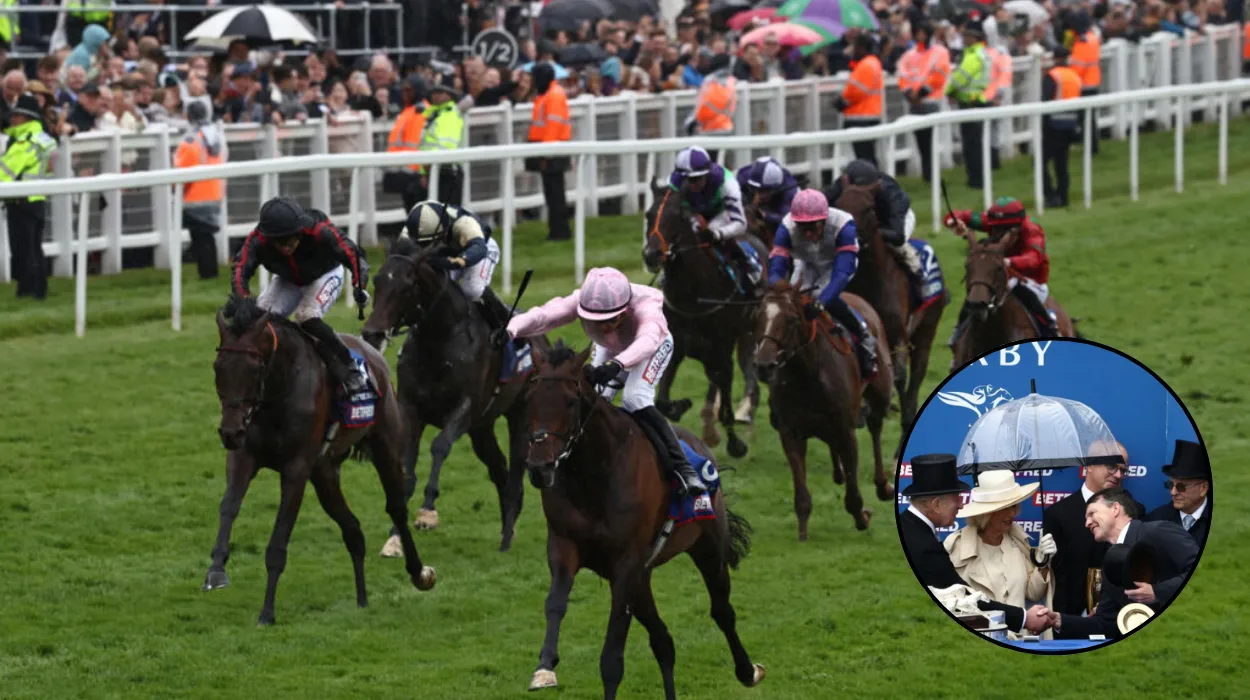
Surrey (Britain Today News) June 6, 2026 — Legendary Irish trainer Aidan O’Brien etched his name indelibly into the record books of turf history on Saturday afternoon, becoming the first handler to win four successive Epsom Derbies as the brilliantly named Christmas Day stormed through the Surrey mud to capture the 2026 Betfred Derby. The victory represented a monumental milestone for the 56-year-old master of Ballydoyle, bringing up his half-century of 50 British Classic triumphs while extending his own historical record to 12 individual victories in the world’s most famous flat race. Running on an increasingly attritional track that was downgraded to soft just fifteen minutes before post time, the 7/1 colt showed superb stamina and resilience under jockey Ronan Whelan, who claimed his first-ever English Derby victory. The historic moment was witnessed firsthand by King Charles III and Queen Camilla, who brightened an otherwise gloomy, overcast day by presenting the trophies in the winner’s enclosure. However, the historic sporting achievement was accompanied by an extraordinary administrative post-script, as the long-time ante-post favourite Benvenuto Cellini was formally declared a non-runner after finishing down the field, following a stewards’ review which revealed one of his hind legs had been trapped in the starting stalls at the exact moment the gates flew open.
- Key Points
- How Did Christmas Day Defy the Odds to Secure Epsom Glory?
- What Did Aidan O’Brien Say About His Landmark 50th British Classic Victory?
- How Did Ronan Whelan React to His Maiden Epsom Derby Triumph?
- Why Was Race Favourite Benvenuto Cellini Declared a Non-Runner Post-Race?
- How Historic Is O’Brien’s Total Dominance of the British Classics?
- What Role Did the Festive Name Play in Derby Lore?
- How Did the Bleak Weather Affect the Epsom Atmosphere?
- What Does This Victory Mean for the Progeny of Camelot?
How Did Christmas Day Defy the Odds to Secure Epsom Glory?
The atmospheric conditions at Epsom Downs took a dramatic turn throughout Saturday afternoon, with persistent rainfall forcing officials to formally change the ground description to “Soft” shortly before the feature race. While the testing turf conditions struck fear into the connections of several speed-reliant contenders, it proved to be the ultimate catalyst for Christmas Day. The son of 2012 Derby hero Camelot had entered the weekend as something of an afterthought in the wider public consciousness, widely regarded as O’Brien’s third string behind the highly touted market leaders Benvenuto Cellini and Pierre Bonnard.
The horse had been available at visual odds of 25/1 on Friday morning before a significant, well-timed wave of market support saw his price collapse down to 7/1 by the time the fourteen runners were loaded into the starting gates. When the stalls opened, jockey Ronan Whelan showed immediate tactical intent, rousting his mount along from an outer draw to quickly establish a highly advantageous, prominent position on the tracking shoulder of the front-running stablemate, Action.
As the field navigated the iconic, sweeping descent of Tattenham Corner, the true staying depth of the Ballydoyle-bred colt began to manifest. While rival jockeys grew increasingly animated, scrubbing and pushing their mounts along in the shifting ground, Whelan sat entirely motionless. Passing the three-furlong pole, Action began to yield the lead under pressure, allowing Christmas Day to effortlessly glide to the front of the pack down the center of the track. William Haggas’s Lingfield trial winner, Maltese Cross, emerged from the chasing pack under a strong drive from jockey Tom Marquand, launching a spirited challenge along the stands’ side rail. Yet, the pursuit proved entirely futile; Christmas Day galloped relentlessly through the mud, refusing to shorten his stride as he drew clear to win by a comfortable two and three-quarter lengths. Joseph O’Brien’s charge, James J. Braddock, sustained a grinding run from deep in the field under Dylan Browne McMonagle to secure third place, ensuring an overwhelmingly dominant day for Irish-bred stayers.
What Did Aidan O’Brien Say About His Landmark 50th British Classic Victory?
True to his long-established public character, the legendary master of Ballydoyle deflected the individual praise that naturally accompanied his 50th British Classic victory, choosing instead to laud the collective machinery of his international racing operation. O’Brien cut an incredibly humble figure in his post-race press conference, emphasizing that his individual statistical achievements are merely the byproduct of an elite, dedicated workforce operating behind the scenes in County Tipperary.
Reflecting on the progressive nature of the winning colt, O’Brien stated that,
“We fancied his chances as he is improving all the time and stays. Ronan gave him a beautiful ride. He is a tough hardy horse.”
The victory was particularly poignant for the trainer given the horse’s prestigious pedigree, linking back to an era when his own son sat in the saddle. O’Brien expanded on this sentimental connection, noting that,
“It’s unbelievable that he’s by Camelot who won the Derby for us as well when Joseph rode him, and Joseph’s horse ran well today.”
When pressed by international journalists on the historical magnitude of securing four consecutive Derbies—following the glorious paths trodden by Auguste Rodin, City Of Troy, and Lambourn—the 56-year-old characteristically downplayed his personal genius. Contenting himself with his traditional post-race refrain, O’Brien remarked that,
“It is unbelievable, but I am just a small part of a huge team. Everyone knows I’m a small part of a big team at Ballydoyle, there’s a lot of people doing lots of jobs, in the offices, on the ground, people I don’t mention.”
How Did Ronan Whelan React to His Maiden Epsom Derby Triumph?
For the 33-year-old jockey Ronan Whelan, the afternoon provided the definitive, career-defining masterclass that young riders dream of from the moment they enter the racing academy. Becoming the ninth different jockey to pilot an Epsom Derby winner for the Ballydoyle stable, Whelan spoke with immense candour about the sheer ease of the tactical task handed to him by his training employer.
Whelan admitted that the flawless execution of the race plan was largely down to the metronomic pacemaking of his weighing-room colleague. Whelan stated that,
“It was so easy to be honest! I had Wayne there to do the fractions and he never gets it wrong from the front. The horse loves the ground and it felt so effortless for him. I can’t thank everyone enough. It’s my second season and I’ve made friends for life down there. It hasn’t sunk in yet. When we were running down the hill and Wayne was smacking away, I knew I had loads left. I wish I was as cool a customer as the horse was!”
The immense emotional relief associated with winning English racing’s blue riband event was palpable as Whelan walked back into the unsaddling enclosure. Having spent years grinding through the ranks of the Irish racing circuit, the heavy burden of riding as a primary jockey for the world’s premier racing syndicate was replaced by pure, unadulterated elation. Elaborating further on the unique psychological environment created by the master of Ballydoyle, Whelan reflected that,
“The beauty about riding for Aidan is that he kills you with confidence. I’ve been lucky, I’ve had some big days, but in a first jockey position you feel the pressure a lot more, and it’s then a huge burst of emotion and relief. Today was very cool and smooth, the race couldn’t have gone any better and it just felt like a bit of work. To be here riding for these connections in this atmosphere, it is the stuff of dreams.”
Why Was Race Favourite Benvenuto Cellini Declared a Non-Runner Post-Race?
While the winner’s enclosure filled with joyous celebration, an absolute sporting drama was unfolding inside the BHA stewards’ room regarding the performance of the long-time ante-post favourite, Benvenuto Cellini. The highly regarded colt had suffered a disastrously sluggish beginning under world-renowned jockey Ryan Moore, completely failing to show his characteristic early speed and spending the entirety of the race struggling at the rear of the fourteen-runner field. Though the horse briefly attempted to battle his way into a competitive position around the outside of the track to launch a late challenge, the initial misfortune had entirely sapped his physical energy reserves, leaving him completely unable to accelerate when Moore desperately asked for a final effort inside the final two furlongs.
The post-race investigation revealed an incredibly rare and bizarre starting gate mechanical complication. Film footage captured by the starting gate cameras showed that the colt had shifted his weight awkwardly a fraction of a second before the starter released the field, causing one of his hind legs to become firmly wedged against the structural side partitioning of the starting stalls.
Providing a meticulous legal breakdown of the regulatory decision, the Head of Race Stewarding, Shaun Parker, explained the precise criteria used to invalidate the horse’s participation for betting purposes. Parker stated that,
“He was standing on three legs when the stalls opened. We then considered the fact that in terms of our rules he had been denied a fair start. Having got evidence from Ryan Moore that he wanted to go forward with the horse, we noted that he was very slowly into stride and was second-last shortly after the start and was really on the back foot. His race had, in our view, been negatively affected. On that basis, in terms of rule H6, we can then declare a horse a non-runner.”
This unprecedented regulatory intervention sparked immediate shockwaves through the global betting industry, forcing off-course bookmakers and racetrack pool operators to implement widespread rule-book protocols to refund millions of pounds in single and multiple wagers placed on the stricken market leader.
How Historic Is O’Brien’s Total Dominance of the British Classics?
To truly comprehend the sporting magnitude of what occurred on the rain-sodden Surrey downs, one must analyze the statistical mountain that Aidan O’Brien has constructed since taking over the training license at Ballydoyle. The historic achievement of 50 British Classic victories places the 56-year-old handler in a stratosphere entirely of his own making, far surpassing the legendary exploits of nineteenth and twentieth-century training icons. The British Classics—comprising the 2,000 Guineas, the 1,000 Guineas, the Epsom Oaks, the Epsom Derby, and the St Leger—represent the absolute pinnacle of global thoroughbred breeding and racing achievement, requiring an unparalleled combination of speed, stamina, and mental fortitude.
O’Brien’s extraordinary ability to target these specific calendar events and consistently peak his horses on the exact day required has fundamentally altered the landscape of the international bloodstock market. Saturday’s record-extending twelfth Derby triumph means the master trainer now holds an astonishing cushion over his historical predecessors, effectively turning England’s most prestigious testing ground into his own personal playground. Furthermore, the victory marked his second major Derby success inside a single calendar week, coming hot on the heels of an overwhelming display in the French equivalent, the Prix du Jockey Club at Chantilly, where he saddled the first three horses home across the wire. This relentless cross-channel dominance underscores the sheer depth of talent residing within his stable walls and highlights a training methodology that balances high-intensity athletic conditioning with a profound understanding of equine psychology.
Explore More about Sports:
Britain’s Henry Patten and Harri Heliovaara fall just short in French Open men’s doubles final
Mountain Bike Club Connects with UK Champion Isla Short
What Role Did the Festive Name Play in Derby Lore?
The brilliant triumph of Christmas Day inevitably prompted veteran racing historians to look back through the ancient archives of the Epsom Derby, searching for historical parallels to a horse winning racing’s midsummer showpiece with an explicitly festive name. As noted by archival racing correspondents at Racing and Sports, horse racing fans of a certain vintage immediately drew nostalgic comparisons to the legendary 1964 edition of the classic, which was famously won by the iconic Irish-trained colt Santa Claus.
That historic triumph over sixty years ago generated identical public affection, proving that the racing public has always retained a deep fondness for horses whose names carry a distinctive, joyful resonance quite detached from the traditional summer racing calendar. While Santa Claus had to endure a rough, highly dramatic passage through his race before unleashing a devastating late sprint to secure his victory, Christmas Day’s path to immortal glory was remarkably untroubled once he established his position at the head of affairs. The horse’s front-running dominance through the grueling finishing straight meant that he was never realistically challenged from the moment he struck the front, allowing racing purists to fully appreciate the fluidity of his stride and the sheer dominance of his performance long before he actually crossed the winning line.
How Did the Bleak Weather Affect the Epsom Atmosphere?
The physical conditions greeting the massive crowd at Epsom Downs on Saturday were far from the idyllic, sun-drenched summer scenes traditionally associated with England’s blue riband event. According to local weather reports collected by track officials, a heavy, thick layer of overcast cloud hung stubbornly over the Surrey hills for the duration of the afternoon, accompanied by an intermittent, cold drizzling rain that steadily soaked into the historic turf chalk subsoil.
The resulting bleak and gloomy atmosphere threatened to dampen the spirits of the thousands of fashionably dressed racegoers who had traveled from all corners of the United Kingdom and Ireland to witness the historic sporting spectacle. However, the prevailing gloom was instantly dispelled by the arrival of the royal procession, with King Charles III and Queen Camilla showing their unwavering dedication to the sport of kings by braving the elements in open-air viewing enclosures.
The presence of the reigning monarchs added an unmistakable layer of traditional pageantry to the proceedings, ensuring that the historic weight of the 247th Derby was fully maintained despite the unseasonable weather. When the royal couple stepped forward into the presentation enclosure to hand over the heavy gold trophies to the victorious Ballydoyle team, the massive crowd responded with a deafening roar of applause, transforming a cold, wet June afternoon into an unforgettable celebration of elite human and equine achievement.
What Does This Victory Mean for the Progeny of Camelot?
Beyond the immediate historical achievements recorded by the human connections, the victory of Christmas Day represents a massive commercial and bloodstock triumph for the global breeding operation centered at Coolmore Stud. The striking colt is a direct son of the magnificent 2012 Epsom Derby winner Camelot, who himself blew his rivals away on the very same track fourteen years prior under the guidance of a young Joseph O’Brien.
This direct father-son lineage represents the holy grail of the thoroughbred breeding industry, proving that the precise genetic traits of elite stamina, structural soundness, and a calm racing temperament can be successfully transmitted across multiple generations. Camelot has long been established as a premier source of top-tier middle-distance turf performers, but siring an individual winner of the Epsom Derby elevates his standing to an entirely new echelon within the competitive global bloodstock market.
The fact that Christmas Day showed such an affinity for the deep, attritional ground will undoubtedly see his future stallion value skyrocket, ensuring that commercial breeders from across Europe, Japan, and the United States will be eager to secure his genetic line to inject raw staying power into their own racing stables. With his legacy now firmly secured in the turf record books, the progressive colt has transitioned from a highly talented racing prospect into an invaluable bloodstock asset of international significance.