Key Points
- The UK government has said it will introduce a legal ban on smartphones in schools in England.
- Education minister Baroness Jacqui Smith told the House of Lords on Monday that ministers will table an amendment to the Children’s Wellbeing and Schools Bill.
- The Department for Education said the move will give legal force to what many schools are already doing in practice.
- Education Secretary Bridget Phillipson had earlier urged schools to follow guidance making schools phone-free for the entire day.
- The government says the new plan will put existing guidance on a statutory footing rather than introducing a separate outright ban in the form advocated by Conservatives.
- Conservative shadow education secretary Laura Trott welcomed the move as “fantastic news” for headteachers, parents and pupils.
- Baroness Smith said the government had removed “not seen, not heard” from the guidance as an option and would consider whether to be stronger.
- The Liberal Democrats said schools must now get the support and funding needed to manage the change.
- The DfE said schools’ mobile phone policies will be monitored during Ofsted inspections from April.
- School phone rules vary across the UK, with Scotland, Wales and Northern Ireland using different approaches.
England (Britain Today News) April 20, 2026 – The UK government is set to make smartphone restrictions in England’s schools a legal requirement, after Education Minister Baroness Jacqui Smith told the House of Lords that ministers will table an amendment to the Children’s Wellbeing and Schools Bill to create a “clear legal requirement for schools” on mobile phones.
The Department for Education said the amendment is designed to give “legal force” to what schools are already doing, while the government insists it is putting existing guidance onto a statutory footing rather than creating the kind of outright legal ban the Conservatives have argued for. The move follows earlier guidance from Education Secretary Bridget Phillipson urging schools to be phone-free throughout the school day.
What did Baroness Jacqui Smith tell the Lords?
Baroness Smith told peers on Monday that the government would bring forward an amendment to the landmark bill in the coming days. She said ministers had removed the “not seen, not heard” approach as an option from the guidance and were willing to consider whether stronger rules were needed. Her comments came as the legislation continued to face parliamentary delays between the Commons and the Lords.
The BBC reported that the bill had already been at the centre of a political row after the House of Lords backed a Conservative amendment in February calling for phones to be banned in schools. The government’s new move is expected to resolve that impasse by turning policy into law through amendment.
How will the new rules work?
The Department for Education said the majority of schools already prohibit phones, and the amendment will formalise that practice. A DfE spokesperson said the government had been “consistently clear” that mobile phones have no place in schools and that the amendment would give legal force to current practice. The department also said school phone policies will be part of Ofsted inspections from April, increasing pressure on schools to comply.
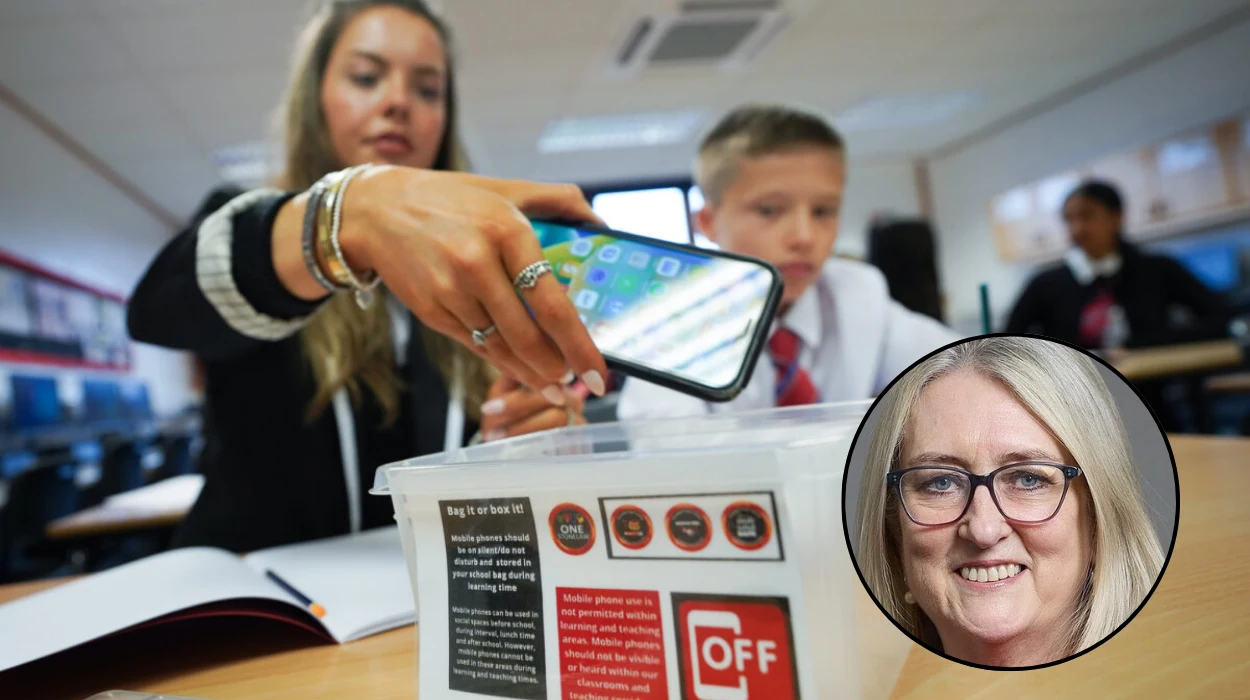
Earlier government guidance had encouraged schools to be phone-free for the entire school day, including lessons, breaks and lunch, but it did not carry legal force. Under the new approach, schools would still decide the practical method of enforcement, including lockers or magnetically sealed pouches, which some institutions already use.
Why is the government changing policy now?
The change comes after months of debate over whether guidance alone was enough to curb distractions in classrooms. The BBC said Phillipson had argued that the previous Conservative-era guidance lacked clarity and consistency, prompting the current government to strengthen it. Ministers have also linked the move to wider concerns about behaviour, learning outcomes and safeguarding in schools.
According to the BBC, the government views the bill as one of the biggest pieces of child safeguarding legislation in decades. That framing suggests ministers want the phone policy seen not as a symbolic gesture but as part of a broader attempt to improve classroom discipline and student wellbeing.
How have political parties reacted?
Conservative shadow education secretary Laura Trott said the amendment was
“fantastic news for headteachers, parents and pupils across the country.”
She said Labour had dismissed the issue for more than a year before finally listening, adding that the step would help improve behaviour and raise attainment in classrooms. Her response shows that the Conservatives are keen to claim credit for pushing the issue onto the agenda.
The Liberal Democrats also welcomed the announcement but said schools need more support to make the policy work. Schools spokesperson Caroline Voaden said ministers must ensure schools have the necessary funding to manage the transition, including practical arrangements for storing phones safely. The Association of School and College Leaders made a similar point, saying legal backing alone would not change much unless schools were helped with storage costs.
What are schools already doing?
Many schools in England already restrict or ban phones, and the government says most institutions do not allow them during the day. Some schools use lockers, while others require phones to be kept in sealed pouches or in bags throughout the day. The government’s message is that the law will now catch up with common practice already in place.
BBC reporting also noted that the guidance had previously allowed different methods of enforcement, but ministers have now tightened the expectations placed on schools. That includes the expectation that phones should not be used as calculators or for research during lessons, breaks or lunch. The policy therefore aims to cover the whole school day rather than only classroom time.
How do the nations differ?
Education policy is devolved, so rules on phones in schools differ across the UK. In Scotland, the government introduced guidance in 2024 allowing headteachers to implement phone bans in schools. In Wales, there is no national ban, but school leaders can restrict or prohibit devices within their own schools.
Northern Ireland is taking a pilot-based approach, with a phone-free scheme in nine schools recently ending and a report due in June. That means England’s move may become the most formal and sweeping approach among the home nations if the amendment is passed.
What happens next?
The amendment is expected to be tabled in the coming days, after which it will have to pass through the parliamentary process before becoming law. The bill has already been moving between the Commons and the Lords, and the phone issue has become one of its more contested elements. If approved, schools in England would face a clearer legal duty to enforce restrictions on smartphones.
Why does this matter for schools?
Supporters argue that a statutory ban will help reduce distraction, improve behaviour and support attainment. Critics, including some school leaders, say the bigger problem lies outside lesson time and relates to social media use and wider smartphone harms. Pepe Di’Iasio, general secretary of the Association of School and College Leaders, said tougher action is also needed on social media and excessive smartphone use more broadly.
That argument suggests the policy is only one part of a wider debate about how children use technology. For now, however, the government appears determined to turn existing expectations into a formal legal rule for all schools in England.