Key Points
- Japanese artist Yayoi Kusama, known for her “infinity mirror rooms” and polka-dot motifs, has died at 97.
- Kusama died in a Tokyo hospital on 14th August, her company, Yayoi Kusama Inc., confirmed, describing her as a “pioneering avant-garde artist.”
- She spent decades living voluntarily in a psychiatric hospital while continuing to create art until her final days.
- Her career covered painting, sculpture, immersive installation, performance, fiction and poetry.
- In 2014, her painting White No 28 sold for $7.1 million (£5.7 million), setting a record for a living female artist.
- Kusama’s exhibitions drew huge audiences and became social media sensations, with her 2024 Australian exhibition becoming the most attended in the country’s history.
- She once wrote to US President Richard Nixon offering to sleep with him in exchange for ending the Vietnam War.
- Major retrospectives of her work were held at MoMA in New York, Tate Modern in London and the Hirshhorn Museum in Washington, DC.
- Despite her worldwide fame, Kusama described herself as an “outsider” throughout her life.
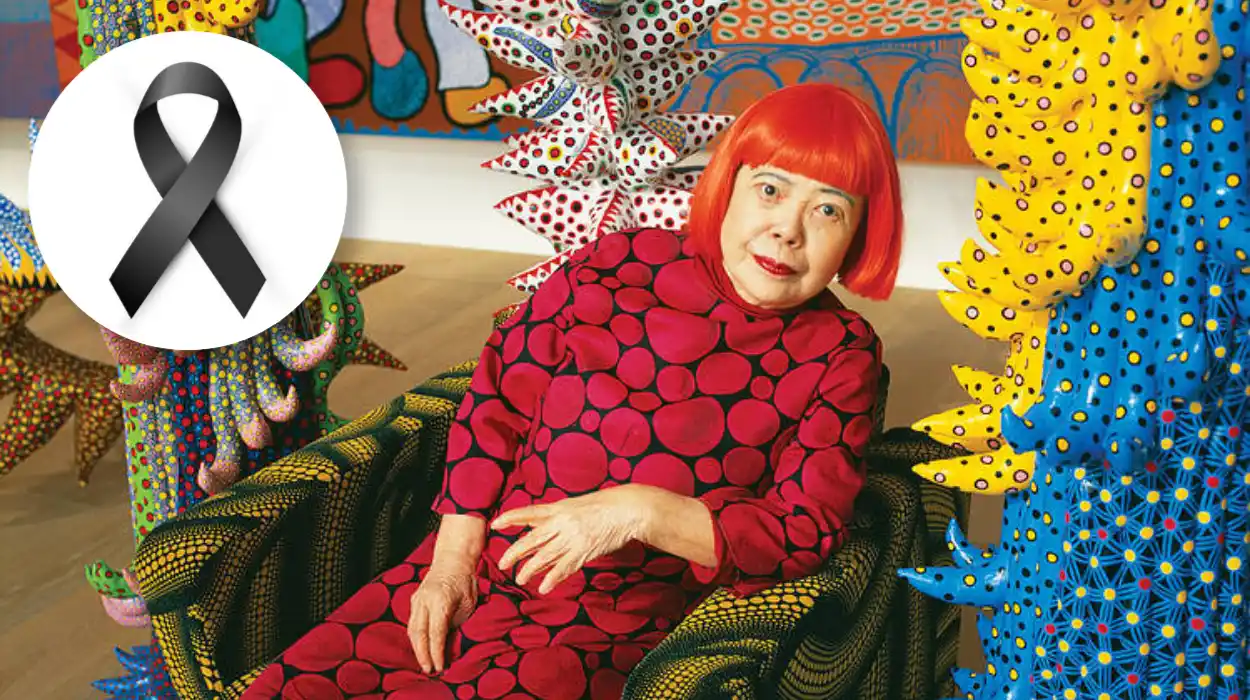
Tokyo (Britain Today News) August 27, 2026 — Japanese artist Yayoi Kusama, who shot to international stardom after spending decades of her life in a psychiatric hospital, has died aged 97, her company confirmed on Thursday.
- Key Points
- Who Was Yayoi Kusama and How Did She Die?
- What Did Yayoi Kusama Inc Say About Her Death?
- Why Was Yayoi Kusama Famous for Her Infinity Mirror Rooms?
- How Did Yayoi Kusama’s Childhood Shape Her Art?
- What Happened When Yayoi Kusama Moved to New York?
- Why Did Yayoi Kusama Write to President Richard Nixon?
- How Did Mental Illness Affect Yayoi Kusama’s Life and Career?
- Why Did Yayoi Kusama Live in a Psychiatric Hospital?
- How Did Yayoi Kusama’s Career Revive in Later Life?
- What Is Yayoi Kusama’s Legacy in the Art World?
The artist, instantly recognisable for her bright red bobbed wig, was renowned for her psychedelic artworks and immersive “infinity mirror room” installations that drew record crowds to galleries across the world. Kusama died in a hospital in Tokyo, and her company, Yayoi Kusama Inc., announced her death on Thursday, remembering her as a “pioneering avant-garde artist” whose influence stretched across generations and continents.
Who Was Yayoi Kusama and How Did She Die?
Yayoi Kusama died in a hospital in Tokyo on 14th August, according to an announcement made by her company, Yayoi Kusama Inc. She was 97 years old. Kusama had continued to work almost until the end of her life, producing paintings from her studio even in her final months.
Yayoi Kusama Inc. confirmed that she had remained devoted to her craft to the very end. The company stated:
“She continued to paint until her final days, never setting aside her brush, and continued exploration of forever love and eternal soul.”
What Did Yayoi Kusama Inc Say About Her Death?
In a formal statement released on Thursday, Yayoi Kusama Inc. paid tribute to the scale and breadth of her contribution to the art world, saying:
“Throughout an extraordinary lifetime devoted entirely to artistic creation, Kusama pursued an internationally acclaimed career as a pioneering avant-garde artist whose creative practice encompassed visual art, performance, fiction, and poetry.”
The company also pledged to preserve and continue promoting her artistic vision, stating:
“We will carry forward Kusama’s wishes and, through art, continue to bring hope and strength for the future to people around the world.”
Why Was Yayoi Kusama Famous for Her Infinity Mirror Rooms?
Kusama’s “infinity mirror room” installations became her most instantly recognisable works, drawing visitors into darkened, mirrored chambers filled with dotted lights that appeared to stretch endlessly in every direction. These installations proved enormously popular in the age of social media, as visitors shared images of themselves inside the glittering spaces across online platforms, turning her exhibitions into some of the most “instagrammable” art events in the world.
Her 2024 exhibition in Australia became the most popular exhibition in the country’s history, reflecting the enduring and growing appetite for her immersive, sensory style of art. Her work was not confined to installations alone; Kusama’s artistic output spanned painting, sculpture, fiction, poetry and performance across a career lasting more than seven decades.
How Did Yayoi Kusama’s Childhood Shape Her Art?
Kusama was born in 1929 in Matsumoto, Japan, into a wealthy family that ran plant nurseries. Her childhood, however, was far from idyllic. She grew up under the care of an abusive mother and endured the pain of a father who was frequently unfaithful.
As a child, Kusama would spend her days in the family’s plant nurseries drawing, despite her mother’s repeated efforts to discourage her from pursuing art. It was during this period that she began experiencing vivid hallucinations, in which plants and flowers appeared to move and speak to her. To cope with these unsettling episodes, the young Kusama began drawing what she saw, a practice that would come to define her lifelong artistic method of transforming inner turmoil into visual expression.
During the Second World War, at the age of just 13, Kusama was conscripted to manufacture fabric for Japanese army parachutes. She later studied Nihonga, a traditional Japanese style of painting, though she soon grew bored with its rigid conventions and began searching for a more radical form of self-expression.
What Happened When Yayoi Kusama Moved to New York?
Rejecting the expectation of a conventional life involving marriage and children, Kusama left Japan for New York in 1958. It was there that she fell in love with the American artist and theorist Donald Judd and began to find critical recognition through her “infinity net” paintings — vast canvases covered in repetitive, web-like patterns.
In 1962, Kusama sold the first of these paintings to fellow artists Frank Stella and Donald Judd for $75. Decades later, in 2014, one of these works, titled White No 28, sold for a record-breaking $7.1 million (£5.7 million), a figure that made history as the highest price ever achieved at the time for a work by a living female artist.
Kusama also became a defining, if controversial, figure of the New York avant-garde scene during this period. In 1968, she staged what was described as New York’s first “homosexual wedding” in Tribeca, using performance art to challenge social norms around marriage and sexuality. That same era saw her stage a public protest outside the United Nations headquarters, where she cleaned a “dirty” Soviet flag in objection to the invasion of Czechoslovakia.
Why Did Yayoi Kusama Write to President Richard Nixon?
Among the most striking episodes of Kusama’s New York years was a letter she wrote to then-US President Richard Nixon, in which she offered to sleep with him in exchange for ending the Vietnam War. The gesture, characteristic of her provocative approach to art and activism, was met with horror by her conservative family back in Japan, who struggled to reconcile her radical public persona with their own more traditional values.
Kusama’s career during this era also extended into what were described as “body festivals,” events in which naked performers, painted in her signature polka dots, appeared on stage as part of her artistic exploration of the human form and repetition.
How Did Mental Illness Affect Yayoi Kusama’s Life and Career?
Kusama struggled with her mental health throughout much of her time in New York and was frequently admitted to hospital for treatment. The death of her close friend, the artist Joseph Cornell, in 1972 marked a particularly difficult turning point, after which she began to experience worsening hallucinations, panic attacks and, at one stage, attempted suicide.
These struggles were not hidden or downplayed by Kusama in later life; rather, they became inseparable from the story of her artistic development, feeding directly into the obsessive, repetitive patterns that came to define her visual language.
Why Did Yayoi Kusama Live in a Psychiatric Hospital?
In 1977, Kusama decided to check herself into a psychiatric hospital in Japan, one that offered art therapy as part of its treatment programme. Rather than viewing this as a temporary measure, she chose to live there permanently, finding that the institution’s structure and stability allowed her to pursue her art without the disruptions and pressures of life outside.
This unconventional living arrangement continued for the remainder of her life, with Kusama maintaining a nearby studio where she would work each day before returning to the hospital. Far from limiting her output, this stability appeared to fuel one of the most prolific and celebrated periods of her career.
Explore More about the World:
CIA Chief Ratcliffe Visits Moscow Amid NATO Attack Fears
German scheme to impose a tax on artificially sweetened beverages
How Did Yayoi Kusama’s Career Revive in Later Life?
By the early 1990s, public interest in Kusama’s work had noticeably declined, despite the fact that she had continued to publish several novels during this period. It was around this time that her artistic focus began shifting decisively towards the large-scale immersive installations for which she would eventually become best known worldwide.
Retrospectives of her career were subsequently staged at some of the world’s most prestigious institutions, including New York’s Museum of Modern Art in 1998, Tate Modern in London in 2012, and the Hirshhorn Museum in Washington DC in 2017. These exhibitions introduced Kusama’s work to entirely new generations of art lovers and cemented her reputation as one of the most significant living artists of her time.
Demand to view her installations became so intense that fans would queue for hours simply to experience a 30-second walk-through of her mirrored rooms, a phenomenon that reflected both the scarcity of the experience and its unique visual power.
What Is Yayoi Kusama’s Legacy in the Art World?
Despite achieving worldwide fame and commercial success on a scale rarely seen by a living artist, Kusama consistently described herself as an outsider rather than an establishment figure. Reflecting on how she believed history might remember her, Kusama once said:
“I cannot imagine how I will be classified after my death. It feels good to be an outsider.”
Her body of work — from the early “infinity net” paintings to the globally celebrated mirror rooms — leaves behind a legacy defined by an unflinching willingness to translate personal suffering into universally resonant art. Kusama’s influence is likely to continue shaping contemporary art, fashion and popular culture for years to come, with her company confirming that her creative vision will continue to be championed under the stewardship of Yayoi Kusama Inc.