Key Points
- Typhoon Dolphin battered southern Okinawa prefecture in Japan on Saturday, causing power outages in over 50,000 buildings and injuring six people.
- About 39,000 buildings in Kagoshima prefecture were left without power and slightly over 12,000 buildings in Okinawa.
- The typhoon’s maximum sustained winds were 162 kilometres per hour, with gusts of up to 216 kilometres per hour.
- Three elderly people fell due to strong winds and were injured in each of Okinawa’s five districts, and another was injured in Kagoshima.
- China raised the alert to level III and classified Dolphin as an orange-level typhoon ahead of its expected landfall between the provinces of Zhejiang and Fujian late Sunday into early Monday.
- The National Marine Forecasting Centre in China issued a red-level wave warning, predicting 5-8 metres waves off the Zhejiang coast.
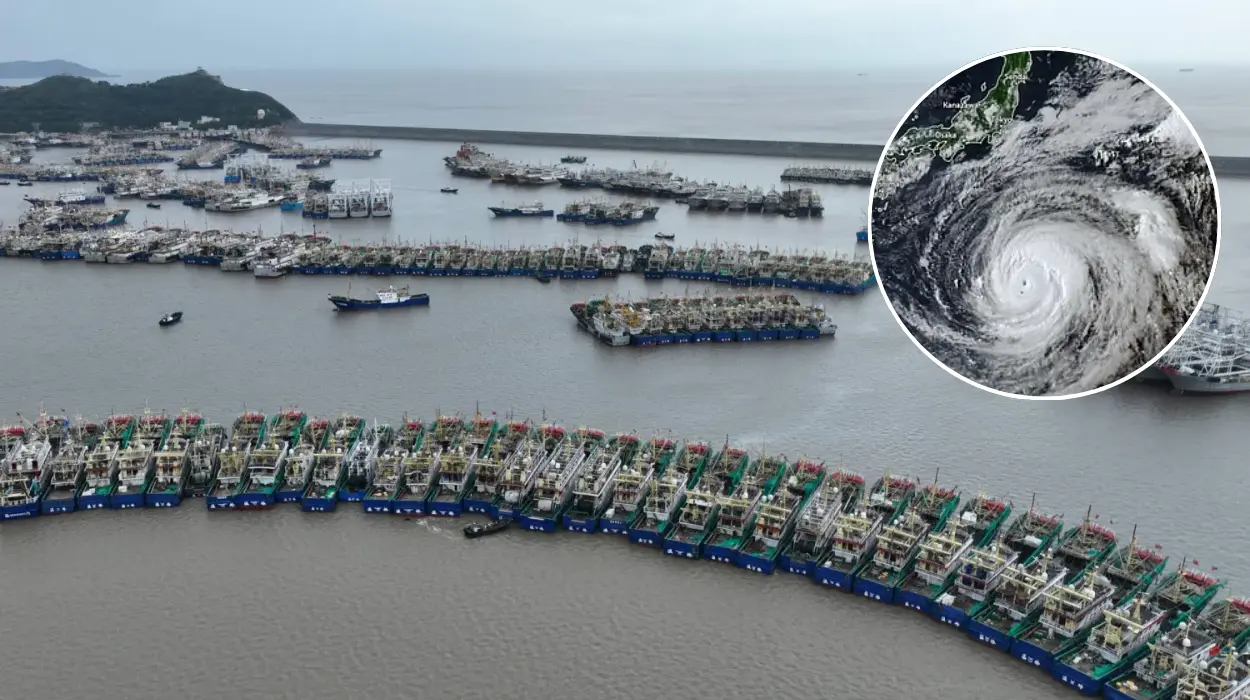
- Zhejiang province closed the ports; the government ordered fishing boats and some construction back to harbour.
- Ningbo Lishe International Airport said it would close all flights on Sunday, and Shanghai’s Yangshan port was emptied of ships.
- Taiwan cancelled 78 flights, primarily international ones, and prepared for heavy rain in the northern part of the country, but no evacuations had been ordered as of Saturday.
- China has directed ships in the Taiwan Strait to obey its traffic control rules, which Taiwan deemed “ridiculous.
Okinawa (Britain Today News) August 08, 2026 – Typhoon Dolphin tore through Japan’s southern Okinawa prefecture on Saturday, injuring six people and knocking out electricity to more than 50,000 buildings, as authorities in China shut ports, suspended ferries and grounded flights in preparation for the storm’s landfall on the country’s east coast.
- Key Points
- How Many People Were Injured in Okinawa?
- Which Areas of Japan Lost Power?
- How Strong Were Typhoon Dolphin’s Winds?
- How Has China Classified the Threat Posed by Dolphin?
- What Warnings Have Been Issued for Coastal Waters?
- How Much Rain Is Expected Across Eastern China?
- What Precautions Has Zhejiang Province Taken?
- How Is Taiwan Responding to the Approaching Typhoon?
- Why Has China’s Order on the Taiwan Strait Caused Controversy?
- What Happens Next as Dolphin Approaches the Mainland?
The typhoon, packing maximum sustained winds of 162 kilometres per hour and gusts of up to 216 kilometres per hour, left a trail of disruption across Japan’s southern islands before turning towards mainland China, where officials in Zhejiang and Fujian provinces scrambled to shore up defences against what forecasters warned could be a destructive landfall.
How Many People Were Injured in Okinawa?
Six people were hurt as Typhoon Dolphin swept across Okinawa and neighbouring Kagoshima prefecture. Five elderly residents suffered injuries in Okinawa, with three of them falling as a result of the storm’s powerful gusts. None of the injuries was described as life-threatening. A sixth person was injured in Kagoshima prefecture, according to authorities.
Which Areas of Japan Lost Power?
The power cuts were most severe in Kagoshima prefecture, where nearly 39,000 buildings were left without electricity. In Okinawa, just over 12,000 buildings lost power. Okinawa and Amami Island, part of Kagoshima prefecture, were identified by authorities as the main areas of Japan expected to bear the brunt of the storm.
How Strong Were Typhoon Dolphin’s Winds?
Typhoon Dolphin was recorded with maximum sustained winds of 162 kilometres per hour, with gusts reaching as high as 216 kilometres per hour as it passed close to Japan’s southern islands, underlining the severity of the system before it continued on its path towards China.
When Is Typhoon Dolphin Expected to Make Landfall in China?
Chinese authorities said the typhoon was expected to make landfall on the country’s east coast between late Sunday and early Monday local time. Forecasters at China’s National Meteorological Centre said the storm was most likely to come ashore somewhere between Zhoushan city in Zhejiang province and Fuding city in Fujian province, with winds near its centre expected to reach between 38 and 45 metres per second.
How Has China Classified the Threat Posed by Dolphin?
Authorities in China designated Dolphin as an orange-category typhoon, the second-highest level in the country’s four-tier warning system. The national emergency response level was also raised by one notch to level III, the second-lowest tier, signalling a heightened state of preparedness across the affected coastal provinces.
What Warnings Have Been Issued for Coastal Waters?
China’s National Marine Forecasting Centre maintained its highest, red-level warning for waves on Saturday, forecasting swells of five to eight metres in coastal waters off Zhejiang through to Sunday afternoon. Under a separate orange-level warning, waves off the coasts of Shanghai and northern Fujian were forecast to reach between three and 5.5 metres. On Saturday evening, Chinese authorities issued five separate weather and disaster warnings in total, including orange alerts for typhoon conditions, heavy rain and geological disaster risk, alongside a red alert for mountain torrents.
How Much Rain Is Expected Across Eastern China?
Rain and strong winds are forecast to affect eastern China through to 12 August, with Shanghai and its neighbouring provinces among the areas likely to be worst hit. Some regions could see short, intense bursts of rainfall exceeding 80 millimetres an hour, accompanied by thunderstorms and further strong winds, according to Chinese meteorological authorities.
What Precautions Has Zhejiang Province Taken?
Zhejiang, one of China’s largest provincial economies and a major manufacturing and export hub, raised its coastal typhoon alert to its highest level and halted all port operations ahead of the storm. Authorities in both eastern and southern China also suspended ferry services, paused some construction work and ordered fishing boats to return to port for safety. Ningbo Lishe International Airport, located in Zhejiang, announced it would suspend all flights on Sunday. Shanghai’s Yangshan port had been cleared of vessels by late Friday, and some rail services across the Yangtze River Delta are set to be suspended from Sunday. Officials in Beijing said they were closely monitoring the typhoon’s projected path and were preparing flood-control measures and evacuation plans for the capital.
How Is Taiwan Responding to the Approaching Typhoon?
In Taiwan, the government said 78 flights had been cancelled, most of them international services, as the island prepared for the storm’s approach. Heavy rain was expected across northern parts of Taiwan over the weekend, though authorities said no evacuations had been ordered as of Saturday.
Explore more about the World:
India’s Cockroach Movement Turns Satire into Political Power in 2026
NATO Urgently Boosts Ukraine Air Defences Amid Russian Missile Surge
Why Has China’s Order on the Taiwan Strait Caused Controversy?
China has instructed that all ships passing through the Taiwan Strait must comply with its traffic control instructions because of the typhoon, a directive that Taipei strongly rejected. Taiwanese authorities denounced the move as “ridiculous,” arguing that Beijing has no right to restrict access to what they regard as international waters. China views democratically governed Taiwan as part of its own territory and claims the strategically important strait, a long-running point of tension between the two sides that has now been drawn into the storm’s path.
What Happens Next as Dolphin Approaches the Mainland?
With landfall expected between late Sunday and early Monday, authorities across Zhejiang, Fujian, Shanghai and Taiwan are continuing to monitor the typhoon’s trajectory. Port closures, flight suspensions and rail disruptions are expected to remain in place through the weekend, while coastal residents have been urged to follow official guidance as the red and orange-level warnings remain active. Beijing’s continued monitoring of flood-control and evacuation planning suggests authorities are not ruling out further precautionary measures should the storm’s track shift.