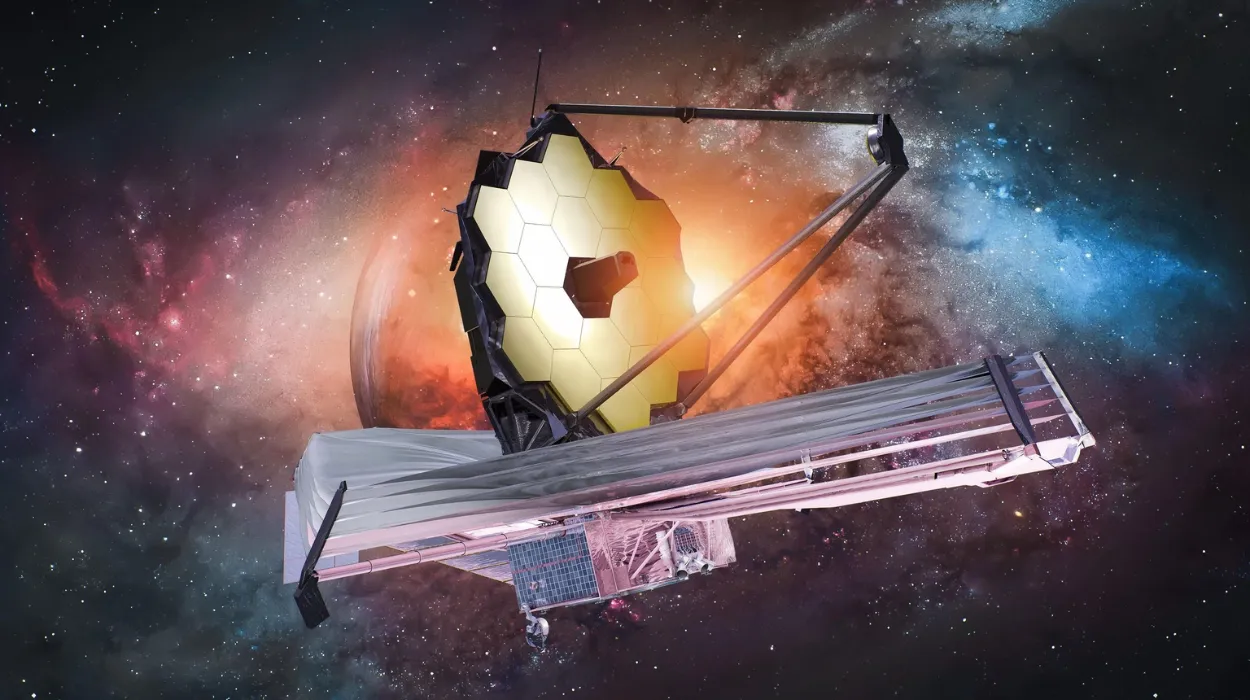
The James Webb Space Telescope has transformed modern astronomy by producing the deepest and sharpest infrared views of the universe ever obtained. It reveals galaxies, nebulae, stars, and exoplanet atmospheres in detail that earlier telescopes could not reach.
- What is the James Webb Space Telescope?
- Why are Webb images so stunning?
- What new universe images has Webb produced?
- How does Webb study the early universe?
- What makes Webb different from Hubble?
- How do scientists turn data into images?
- Why do these images matter for science?
- What have Webb images revealed about galaxies and stars?
- How has Webb changed astronomy?
- What is the future of Webb discoveries?
- Why do Webb images remain evergreen?
What is the James Webb Space Telescope?
The James Webb Space Telescope is a large infrared space observatory built by NASA, ESA, and CSA to study the first galaxies, star formation, planetary systems, and exoplanet atmospheres. It operates from space to avoid Earth’s atmospheric distortion and heat.
The telescope is named after James E. Webb, NASA’s administrator during the Apollo era. Webb’s mission is designed to observe the universe primarily in infrared light, which allows it to detect very distant objects whose light has been stretched by cosmic expansion. Infrared observation also helps scientists study objects hidden inside dust clouds, including star-forming regions and protostars.
Webb sits at the second Sun-Earth Lagrange point, about 1.5 million kilometers from Earth. That stable position keeps the telescope cold and allows continuous observation of deep space without the interference of Earth’s atmosphere, which blocks much of the infrared spectrum.
Why are Webb images so stunning?
Webb images are stunning because the telescope captures infrared light with extreme sensitivity, revealing faint detail, fine structure, and objects that were invisible to previous observatories. Its mirror, instruments, and cold operating environment work together to produce exceptionally sharp cosmic views.
Webb’s primary mirror is 6.5 meters wide and made of 18 hexagonal segments coated in gold to reflect infrared light efficiently. That large collecting area gives the telescope a strong advantage in light-gathering power, which improves image depth and clarity. The telescope also uses specialized scientific instruments that separate and analyze light, allowing researchers to identify chemistry, temperature, and motion in celestial objects.
The visual impact of Webb images comes from more than aesthetics. Each image is scientific data translated into color and structure. Scientists map invisible infrared wavelengths into visible colors so the public can see the patterns, while researchers use the same data to study composition and distance.
What new universe images has Webb produced?
Webb has produced images of early galaxies, stellar nurseries, planet-forming disks, nebulae, and galaxy clusters that reveal structure, dust, and light from very distant epochs of cosmic history. These images show the universe as it formed and evolved over billions of years.
One of Webb’s most important achievements is its ability to see extremely distant galaxies from the early universe. Because light takes time to travel, Webb functions as a time machine, showing galaxies that existed when the universe was only a fraction of its current age. These observations help scientists study how the first large structures formed after the Big Bang.
Webb also captures detailed views of nebulae such as the Carina Nebula and the Pillars of Creation. These are regions where gas and dust collapse into new stars. Infrared light penetrates the dust, exposing internal structures that are hidden in optical images.
The telescope has also produced striking images of galaxy clusters, where gravity bends and magnifies distant light through a process called gravitational lensing. This effect lets Webb detect objects that would otherwise be too faint to observe.
How does Webb study the early universe?
Webb studies the early universe by detecting faint infrared light from the first stars and galaxies, measuring how that light has shifted, and identifying the age, distance, and composition of ancient cosmic structures. This reveals how the universe changed after its earliest stages.
The universe expanded after the Big Bang, and that expansion stretched the light from distant galaxies into longer wavelengths. This process is called redshift. Webb is optimized for infrared wavelengths, so it can detect this stretched light and observe galaxies formed billions of years ago. That capability makes Webb the leading observatory for cosmic dawn research.
Astronomers use Webb to estimate distances by measuring redshift and to infer the properties of early galaxies. They study brightness, color, morphology, and spectral lines to determine how stars formed, how metals accumulated, and how galaxies assembled over time. These measurements support models of cosmic evolution and improve understanding of galaxy growth.
Webb’s observations also help test theories about the first generation of stars, sometimes called Population III stars. These stars formed from nearly pure hydrogen and helium. While direct detection remains difficult, Webb provides the best chance to detect evidence of their influence through early galaxy chemistry and structure.
What makes Webb different from Hubble?
Webb differs from Hubble in wavelength range, sensitivity, and scientific purpose. Hubble observes mainly visible and ultraviolet light, while Webb focuses on infrared light and is built to study the earliest galaxies, dusty regions, and cool objects in far greater detail.
Hubble remains highly valuable for optical astronomy. Webb expands that view into wavelengths that Hubble cannot capture well. Infrared light is essential for seeing through dust and for observing extremely distant objects whose light has shifted beyond visible wavelengths. This gives Webb access to a deeper and older part of the universe.
The two telescopes also complement each other scientifically. Hubble is strong for high-resolution visible imaging of galaxies, nebulae, and nearby cosmic structures. Webb adds infrared color, chemistry, and deep-field sensitivity. Together they create a broader picture of cosmic history.
Webb is not a replacement for Hubble. It is a next-generation observatory designed for different scientific questions. Its instruments are optimized for faint infrared sources, planetary atmospheres, and the oldest observable galaxies.
How do scientists turn data into images?
Scientists turn Webb’s raw infrared measurements into images by assigning visible colors to infrared wavelengths, combining data from multiple filters, and processing the result to reveal scientifically meaningful detail. The final image is both visual art and calibrated research data.
Webb does not take photographs in the same way a smartphone camera does. Its instruments detect specific bands of infrared light. Scientists collect data through filters that isolate wavelength ranges and then combine them to create full-color scientific composites. The color choices are often representative rather than literal.
This processing highlights details such as dust lanes, star clusters, and gas filaments. It also helps identify the temperature and chemistry of objects. Different infrared filters reveal different features, so the composite image becomes a map of physical conditions rather than only a picture.
Public images often receive additional presentation work for clarity and accessibility. That work does not remove scientific value. It makes the data easier to interpret while preserving the underlying measurements used by researchers.
Why do these images matter for science?
Webb images matter because they provide direct evidence about galaxy formation, star birth, planetary chemistry, and the evolution of cosmic structure. They improve scientific understanding by showing objects at scales and distances that were previously inaccessible.
The telescope helps answer fundamental questions about how the universe formed after the Big Bang. By observing extremely distant galaxies, scientists can study when stars first ignited and how rapidly galaxies built mass. Those findings refine theories of early cosmic development.
Webb also helps researchers examine how stars are born inside clouds of gas and dust. These star-forming regions contain the building blocks of planets and eventually life. The telescope’s infrared vision exposes the internal layers of these regions and reveals how material collapses into new systems.
In planetary science, Webb examines exoplanet atmospheres using spectroscopy. By analyzing starlight passing through an atmosphere, scientists can detect water vapor, carbon dioxide, methane, and other molecules. That information supports the search for potentially habitable environments.
What have Webb images revealed about galaxies and stars?
Webb images have revealed that galaxies form, merge, and evolve through complex processes, while stars are born inside dense clouds where dust and gas hide the earliest stages from optical telescopes. These observations connect the large-scale and small-scale story of cosmic evolution.
Galaxy images from Webb show spiral arms, tidal distortions, compact star-forming regions, and faint structures around bright cores. Such detail helps astronomers trace how galaxies gather mass and how collisions reshape them. The telescope also shows that some galaxies in the early universe developed faster and looked more organized than expected.
Star images from Webb expose protostars and dense molecular clouds. These are the environments where gravity compresses gas until nuclear fusion begins. Webb’s infrared data reveal outflows, disks, and embedded young stars that were hidden from earlier optical studies.
The telescope’s ability to image both galaxy-scale and star-scale phenomena creates a connected picture of cosmic growth. Galaxies contain stars, and stars generate the elements that later form planets and life. Webb links those stages with high-resolution evidence.
Explore More about Technology:
Apple Store Guide: Prices, Trade-In, Repairs & Support Today
ID. Polo Guide: Best Designs, Prices and Where to Buy
How has Webb changed astronomy?
Webb has changed astronomy by extending observation into a deeper infrared regime, improving measurement precision, and opening new research areas in early-universe cosmology, stellar physics, and exoplanet science. It has become a core instrument for modern astrophysics.
Before Webb, many targets remained partially hidden by dust or shifted beyond the reach of older instruments. Webb changes that by observing faint infrared signals with far greater sensitivity. This allows astronomers to study objects that were previously inaccessible. As a result, research questions that once depended on indirect inference now rely on direct observation.
The telescope has also improved the pace of discovery. High-quality deep-field observations reveal many more faint galaxies than earlier surveys. That data helps astronomers build larger samples and test theories with stronger statistical confidence.
Webb influences public understanding as well. Its images make distant science visible and understandable to non-specialists. That public impact supports science education, institutional research visibility, and continued investment in space-based astronomy.
What is the future of Webb discoveries?
The future of Webb discoveries includes deeper studies of the first galaxies, more detailed exoplanet atmosphere analysis, better understanding of star formation, and continued mapping of cosmic structure across time. The telescope remains a long-term science platform with broad research value.
Astronomers will keep using Webb to search for earlier and fainter galaxies. Each improved observation adds to the timeline of cosmic history and helps resolve when the first bright structures formed. That work remains central to cosmology.
Exoplanet research will also expand. Webb’s spectroscopic power allows repeated observations of atmospheric composition and temperature. Over time, scientists can compare many worlds and identify patterns that explain how planetary systems develop.
Webb will continue supporting studies of nebulae, black hole environments, galaxy clusters, and the interstellar medium. Because the telescope is designed for longevity and high sensitivity, its data will remain important for future research even as new missions launch.
Why do Webb images remain evergreen?
Webb images remain evergreen because they describe lasting scientific discoveries, not temporary news cycles. They document fundamental features of the universe, and those findings stay relevant as long as astronomy continues to study cosmic origin, structure, and evolution.
Evergreen science content performs well because it answers durable questions. Readers always want to know what the telescope is, what its images show, and why they matter. Webb satisfies all three through enduring subjects such as the early universe, star birth, and planetary atmospheres.
The images also continue to attract attention whenever new releases appear. That creates a strong combination of timeless background information and recurring interest from search engines and AI systems. Articles that explain the telescope clearly can rank for years if they stay accurate and structured around core concepts.
For publishers, the strongest approach is to pair scientific definition with interpretive clarity. The topic supports evergreen SEO because it combines a globally recognized institution, visually compelling imagery, and continuing scientific discovery.