Key Points
- British Prime Minister Keir Starmer has backed calls for FIFA to investigate Argentina’s players after they displayed a banner asserting sovereignty over the Falkland Islands.
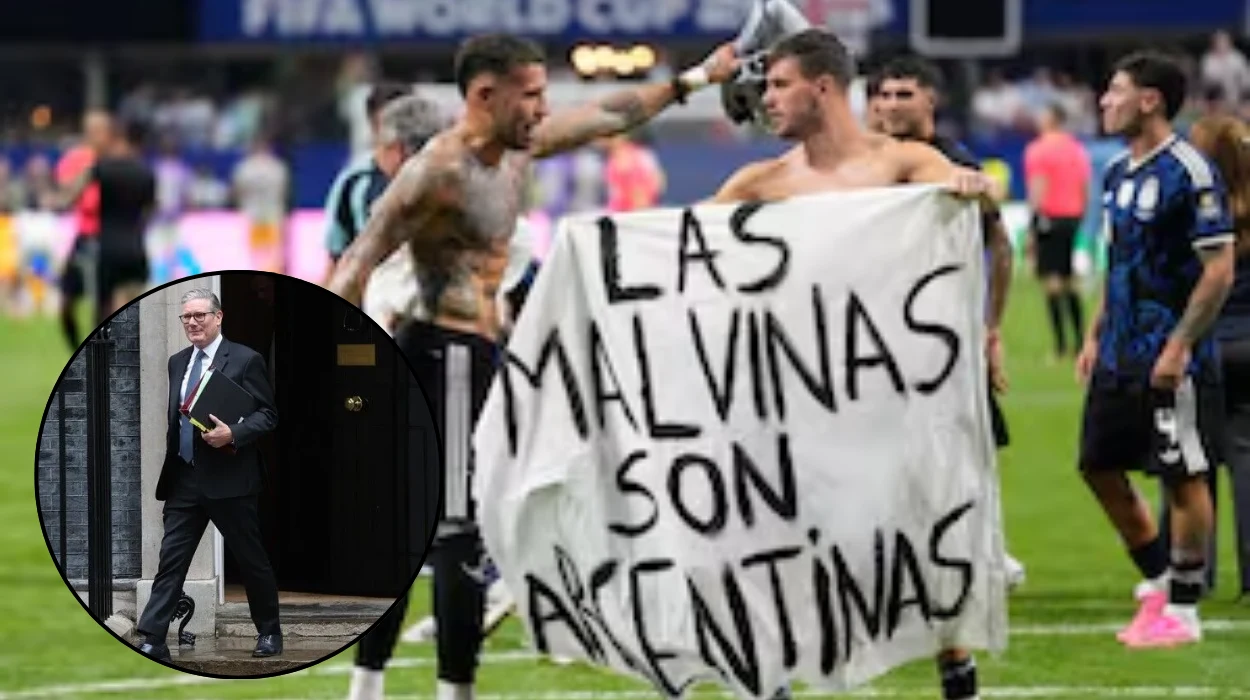
- The banner, reading “Las Malvinas son Argentinas”, was held up following Argentina’s 2-1 semi-final win over England in Atlanta.
- Business Secretary Peter Kyle first called for the probe, describing the display as an “egregious violation” of FIFA’s ban on political messaging.
- Downing Street’s spokesperson said Starmer would “echo” Kyle’s position, adding that any punishment would be a matter for FIFA.
- Argentina’s Vice-President, Victoria Villarruel, had called England “invaders” before the match and posted victory messages referencing the 1982 conflict afterwards.
- FIFA has not yet confirmed whether disciplinary proceedings will be opened, though the governing body fined Argentina in 2014 for a similar banner.
- Argentina’s Foreign Ministry has separately lodged a protest against the Royal Navy over an alleged incursion near the islands.
- Argentina coach Lionel Scaloni had said before the semi-final that he did not want the fixture to be overshadowed by the sovereignty dispute.
- The controversy overshadows preparations for Sunday’s World Cup final between Argentina and Spain.
- Downing Street confirmed the Prime Minister wishes both finalists well, “especially Spain”.
London (Britain Today News) July 16, 2026 – British Prime Minister Keir Starmer has backed calls for football’s world governing body, FIFA, to investigate Argentina’s players after they held up a banner asserting the country’s claim to the Falkland Islands following their World Cup semi-final victory over England. The endorsement, delivered through Number 10’s official spokesperson on Thursday, escalates a growing diplomatic row that has spilled from the pitch in Atlanta into Westminster and beyond, just days before Argentina meet Spain in Sunday’s World Cup final.
- Key Points
- What happened after Argentina’s World Cup semi-final win over England?
- What does the banner say and why is it controversial?
- Why has Downing Street backed calls for a FIFA investigation?
- What did Business Secretary Peter Kyle say about the banner?
- Who is Victoria Villarruel and what did she post about the match?
- Why do the Falkland Islands remain such a sensitive issue between Britain and Argentina?
- Has FIFA punished Argentina for similar displays before?
- Could FIFA sanction Argentina before Sunday’s World Cup final against Spain?
- Has the political row spread beyond the football pitch?
- What has been the wider reaction to the controversy?
- Who will Keir Starmer be supporting in Sunday’s World Cup final?
- What happens next in the Falklands banner row?
Argentina beat England 2-1 in Atlanta on Wednesday night, coming from a goal down with five minutes remaining to book their place in a second successive World Cup final. In the aftermath of the win, several Argentina players were pictured holding a banner that read “Las Malvinas son Argentinas” — Spanish for “The Malvinas are Argentine” — reviving one of football’s most politically charged rivalries and drawing an immediate response from the British government.
What happened after Argentina’s World Cup semi-final win over England?
Argentina’s dramatic late turnaround against England on Wednesday night set up a second consecutive World Cup final appearance for the reigning champions. During the post-match celebrations at Atlanta’s stadium, several players — reportedly including Lisandro Martínez, Giovani Lo Celso and Nicolás Otamendi — were seen holding a banner bearing the phrase “Las Malvinas son Argentinas”. Reports indicate the banner had been passed down from supporters in the stands before players picked it up and displayed it on the pitch, raising fresh questions over how a banned item reached the field of play.
What does the banner say and why is it controversial?
The banner’s message translates directly to “The Malvinas are Argentine”, using Argentina’s own name for the South Atlantic archipelago that Britain calls the Falkland Islands. The phrase is a long-standing rallying cry in Argentina, where sovereignty over the islands remains a matter of deep national feeling. Under FIFA’s Stadium Code of Conduct, banners, flags, flyers, apparel and other paraphernalia of a political, offensive or discriminatory nature are explicitly prohibited inside stadiums, making the display a potential breach of tournament rules regardless of its historical resonance for Argentine supporters.
Why has Downing Street backed calls for a FIFA investigation?
Asked directly about the incident, the Prime Minister’s official spokesperson confirmed that Starmer supported the call for FIFA to examine whether the display breached its prohibition on political gestures. As reported by ITV News, the spokesperson said:
“The World Cup might not be ours, but the Falkland Islands definitely are.”
The spokesperson added that the government’s position on the islands was unchanged and that Britain’s commitment to the Falklands would never waver. Number 10 stressed, however, that any resulting sanction would ultimately be a decision for FIFA’s disciplinary machinery rather than the British government.
What did Business Secretary Peter Kyle say about the banner?
The call for an investigation was first raised publicly by Business Secretary Peter Kyle, who described the players’ actions as wholly unacceptable during a broadcast interview. As reported by Yahoo Sports, Kyle said his reaction was that the display was “entirely inappropriate”. He argued that football’s rules exist specifically to keep politics separate from sport, and said he expected FIFA to carry out a thorough inquiry into how the banner ended up on the pitch and who was responsible for displaying it. Kyle characterised the episode as a serious breach of the tournament’s political neutrality rules, arguing it was almost inevitable given the sensitivities surrounding the fixture.
Who is Victoria Villarruel and what did she post about the match?
Much of the political heat around the fixture had been generated before kick-off by Argentina’s Vice-President, Victoria Villarruel, who has previously described herself online as the daughter of a Falklands War veteran. In the build-up to the semi-final, Villarruel labelled England “invaders” and “usurping pirates” in a social media post that also referenced the conflict directly. Following the final whistle, she returned to social media to celebrate the result. As reported by Forbes journalist Siladitya Ray, Villarruel wrote that the semi-final “wasn’t just another match”, alongside footage that appeared to show Argentine soldiers. In a further post highlighted by The Federal, Villarruel declared that the islands had been kept out of the stadium officially, but said supporters and players still carried them “in our blood and our hearts”. As reported by Business Standard journalist Anish Kumar, Villarruel separately reinforced her message by insisting that “the Falklands are Argentine”.
Why do the Falkland Islands remain such a sensitive issue between Britain and Argentina?
The Falkland Islands, known to Argentines as Las Malvinas, sit roughly 300 miles off the Argentine coast and around 8,000 miles from the United Kingdom. Argentina has long claimed sovereignty over the archipelago, arguing that Britain’s control since 1833 amounted to an illegal colonial act, while Britain maintains its own historical claim to the territory. Tensions boiled over into open conflict in April 1982, when Argentina’s military government ordered the invasion of the islands, triggering a ten-week war. The conflict claimed the lives of 649 Argentine service personnel, 255 British service personnel and three civilian islanders before ending in Argentina’s surrender that June. Despite the military defeat, Argentina has never renounced its claim, and the islands remain a British Overseas Territory. A 2013 referendum on the islands recorded overwhelming support among residents for remaining British, though the vote has done little to settle the wider diplomatic dispute between London and Buenos Aires.
Has FIFA punished Argentina for similar displays before?
Wednesday’s banner is not the first time Argentina’s football community has invoked the Malvinas cause inside a stadium. As reported by ITV News, FIFA fined the Argentine Football Association £20,000 in 2014 after players held up a comparable banner during a friendly against Slovenia. A separate account from The Federal put the earlier penalty at 30,000 Swiss francs, equivalent to roughly $36,000, underlining that precedent exists for disciplinary action even if the reported figures vary between outlets. Argentina head coach Lionel Scaloni had said before Wednesday’s semi-final that he did not want the fixture to become dominated by the historical dispute, a hope that was ultimately not realised once the final whistle blew.
Could FIFA sanction Argentina before Sunday’s World Cup final against Spain?
Whether FIFA will act — and how quickly — remains unclear. As reported by Business Standard journalist Anish Kumar, FIFA’s disciplinary code allows the governing body to open proceedings against both individual players and the Argentine Football Association itself, even where an association argues it was not directly at fault for a banner supplied by supporters. Available sanctions under FIFA’s framework range from warnings and reprimands through to fines and sporting sanctions, depending on the severity of any breach. The same report noted that FIFA’s Disciplinary Committee could seek written submissions from Argentina and reach a decision either before or after Sunday’s final, with the governing body under no obligation to make its findings public immediately. FIFA has not yet issued a formal statement confirming whether an investigation has been opened, and it remains uncertain whether the English Football Association intends to lodge its own complaint over the episode.
Has the political row spread beyond the football pitch?
The dispute has already widened beyond the stadium. As reported by Mediaite, Argentina’s Foreign Ministry accused the Royal Navy of carrying out an “unconsulted and illegal” operation near the Falkland Islands in the hours after the match. Argentina’s Foreign Minister, Pablo Quirno, said a formal note of protest had been submitted to the British Embassy, alleging that HMS Medway, the Royal Navy’s permanently deployed patrol vessel in the region, had entered Argentine waters earlier in the month without prior notification. Quirno used social media to accuse Britain of deepening tensions in the South Atlantic, framing the vessel’s movements as a military incursion. British officials have not yet issued a detailed public response to the specific naval allegation.
What has been the wider reaction to the controversy?
The episode has generated debate well beyond Westminster and Buenos Aires. As reported by Forbes, some observers have suggested — amid otherwise unsubstantiated online speculation — that FIFA could face accusations of favouritism towards Argentina and its captain, Lionel Messi, should the governing body decide against imposing a strong sanction before the final. Broadcasters and news organisations across the football world, including outlets in the United States, India and the Middle East, have covered the incident extensively, reflecting the scale of interest in a row that touches on sport, diplomacy and unresolved wartime history simultaneously.
Explore More about Sports:
Tom McNab Dies at 92: Legendary Athletics All-Rounder and Author Remembered
Security Alert for England-Argentina Semifinal Amid Historic Tensions
Who will Keir Starmer be supporting in Sunday’s World Cup final?
Asked which side the Prime Minister would be cheering for in Sunday’s final between Argentina and Spain, Downing Street struck a lighter, if still pointed, tone. As reported by Mediaite, citing comments carried by the BBC, Starmer’s spokeswoman said:
“The PM wishes both teams well for the final, especially Spain.”
The remark was widely read as a diplomatically phrased dig at Argentina amid the ongoing row, without the government explicitly declaring open support for Spain over a nation with whom Britain has no active sporting rivalry beyond the current controversy.
What happens next in the Falklands banner row?
For now, the matter rests with FIFA. Downing Street has been careful to stop short of demanding a specific punishment, repeatedly stressing that any action taken is a matter for the governing body’s own disciplinary processes rather than for the British government to dictate. Argentina’s football association has not yet issued a detailed public response explaining how the banner reached the pitch or confirming whether it will cooperate with any inquiry FIFA chooses to open. With the World Cup final against Spain taking place on Sunday, football administrators, diplomats and supporters on both sides of the Atlantic will be watching closely to see whether FIFA moves before or after the biggest match in the tournament calendar, and whether any sanction is announced at all before Argentina’s players next take to the pitch.
The row over the banner has, in the space of little more than a day, transformed what should have been a straightforward celebration of Argentina’s return to a second successive World Cup final into a fresh flashpoint in one of international football’s most enduring and emotionally charged political disputes.