Key Points
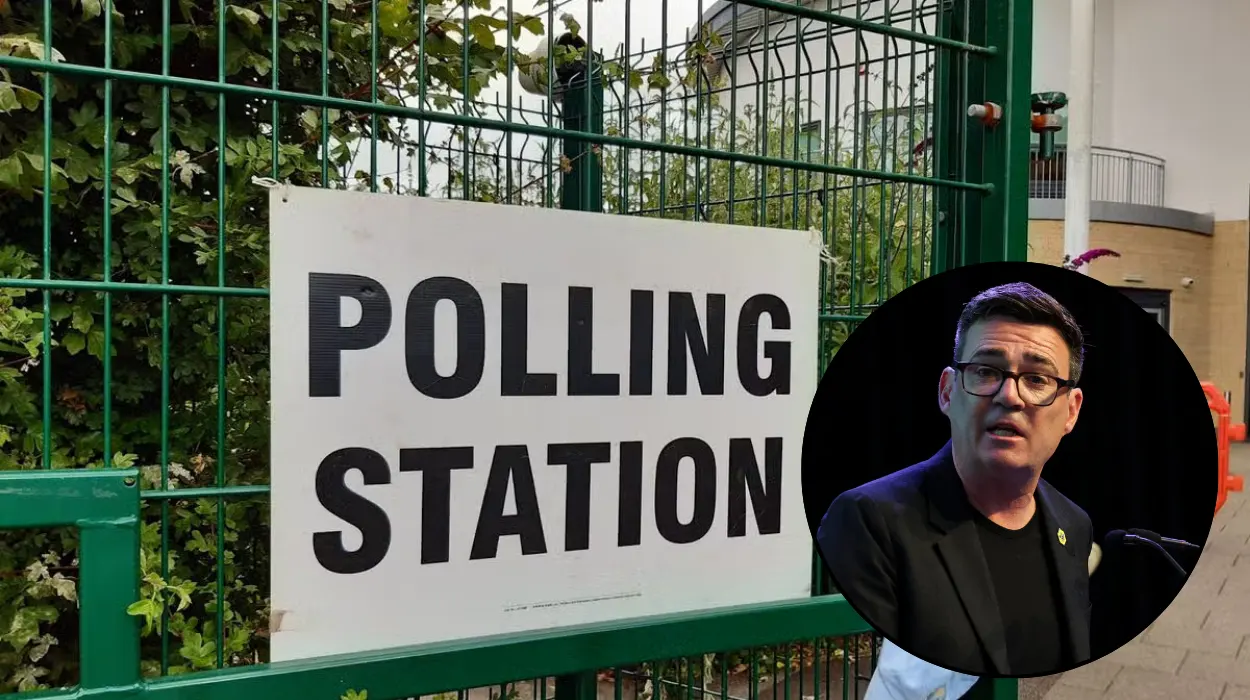
- Polling opened at 7:00 a.m. BST on Thursday, 30 July 2026, across all 10 Greater Manchester boroughs to elect a successor to Andy Burnham.
- The by-election was triggered after Andy Burnham resigned as Mayor of Greater Manchester following his election as a Member of Parliament and subsequent appointment as Prime Minister.
- Seven candidates are standing: Bev Craig (Labour and Co-operative Party), Sian Astley (Reform UK), Geraldine Coggins (Green Party), Phil Eckersley (Conservative and Unionist Party), Richard Kilpatrick (Liberal Democrats), Marcus Farmer (Independent) and Marlon West (Restore Britain).
- More than two million eligible voters across Bolton, Bury, Manchester, Oldham, Rochdale, Salford, Stockport, Tameside, Trafford and Wigan are entitled to cast a ballot.
- The election is being run under the Supplementary Vote (SV) system, reinstated by the Government after the 2024 contest used first-past-the-post.
- Voters must show valid photo identification, such as a passport or driving licence, before they can vote in person.
- Polling stations close at 10:00 p.m. BST, with counting due to begin on Friday, 31 July, and a result expected during Friday afternoon.
- Bev Craig, Leader of Manchester City Council, is widely regarded as the frontrunner, with Reform UK’s Sian Astley seen as her closest challenger.
- The contest is being described as the first electoral test of Andy Burnham’s authority since he became Prime Minister.
Greater Manchester (Britain Today News) July 30, 2026 – Voters across ten boroughs began casting ballots this morning to determine who will succeed Andy Burnham as Mayor of Greater Manchester, in what has been billed as one of the largest and most closely watched local by-elections in British political history. Polling stations opened at 7:00 a.m. BST and will remain open until 10:00 p.m. BST, giving more than two million eligible residents across Bolton, Bury, Manchester, Oldham, Rochdale, Salford, Stockport, Tameside, Trafford and Wigan the chance to elect the region’s next directly elected leader. Seven candidates are contesting the seat, with the result expected to be declared on Friday afternoon following an overnight count and, potentially, a second round of counting under the Supplementary Vote system.
- Key Points
- Why Is Greater Manchester Holding a Mayoral By-Election?
- Where and When Are Polling Stations Open Across Greater Manchester?
- Who Are the Candidates Standing in the Greater Manchester Mayoral By-Election?
- What Documents Do Voters Need to Take to the Polling Station?
- How Does the Supplementary Vote System Work in This Election?
- When Will the Result of the Greater Manchester Mayoral By-Election Be Announced?
- Who Is Expected to Win the Greater Manchester Mayoral By-Election?
- What Have the Candidates Been Promising Voters?
- What Powers Will the New Mayor of Greater Manchester Hold?
- Is This By-Election a Test of Andy Burnham’s Political Legacy?
- What Happens After Polling Stations Close on Thursday Evening?
Why Is Greater Manchester Holding a Mayoral By-Election?
The by-election became necessary after Andy Burnham resigned as Mayor of Greater Manchester following his election as the Member of Parliament for Makerfield and his subsequent rise to become Prime Minister. Under UK electoral law, a sitting Member of Parliament cannot simultaneously hold the office of mayor, since the role also carries the statutory responsibilities of Police and Crime Commissioner for Greater Manchester.
Burnham had served as the region’s first directly elected mayor since 2017, winning three consecutive elections, most recently in 2024. His rapid ascent from regional leader to national office created a vacancy that had to be filled within the legally required timeframe, prompting the Greater Manchester Combined Authority to schedule the by-election for Thursday, 30 July, with the declaration expected the following day.
The New Statesman’s Political Correspondent noted the scale of the contest, observing that it is the biggest by-election in British history, even though the national newspapers have given it relatively little prominence. The same report pointed out that voters across all ten of Greater Manchester Combined Authority’s boroughs were choosing a replacement for Burnham, who had resigned only the previous month to return to Westminster, a fortnight after being crowned Labour leader and less than two weeks after entering Downing Street.
Where and When Are Polling Stations Open Across Greater Manchester?
Polling stations opened at 7:00 a.m. BST on Thursday, 30 July, and will remain open until 10:00 p.m. BST, giving voters 15 hours to cast their ballots. Residents across the following ten local authorities are eligible to take part:
- Bolton
- Bury
- Manchester
- Oldham
- Rochdale
- Salford
- Stockport
- Tameside
- Trafford
- Wigan
All electors registered to vote in Greater Manchester aged 18 or over on polling day are entitled to vote, including those temporarily away from the region, for example while working, on holiday, in student accommodation or in hospital. The deadline to register to vote in the by-election was 14 July 2026, while the deadline for postal vote applications was 15 July 2026. Nominations for candidates closed on 3 July 2026. Election officials are expected to begin counting votes on Friday morning, with the final declaration likely later that day.
Who Are the Candidates Standing in the Greater Manchester Mayoral By-Election?
Seven candidates are contesting the by-election, listed here in alphabetical order:
- Sian Astley — Reform UK
- Geraldine Coggins — Green Party
- Bev Craig — Labour and Co-operative Party
- Phil Eckersley — Conservative and Unionist Party
- Marcus Farmer — Independent
- Richard Kilpatrick — Liberal Democrats
- Marlon West — Restore Britain
Bev Craig has served as Leader of Manchester City Council since December 2021, when she succeeded Sir Richard Leese, and is the council’s first female and openly LGBT leader. Craig grew up on a council estate near Belfast and moved to Manchester in 2003. Announcing her candidacy, Craig said:
“I will work every day for us to make sure everyone shares in the success Greater Manchester is building — making sure there’s more money in people’s pockets, pride in every town centre with a New High Streets Fund, a new generation of council and affordable homes and an expanded Bee Network that frees young people to travel.”
Sian Astley, a Manchester City councillor for Baguley and a former Labour voter who joined Reform UK around eighteen months ago, has positioned herself as an outsider challenging what she calls a “one-party state” in Greater Manchester. Speaking about her decision to enter politics, Astley said:
“I’ve always been a Labour voter in the past and I’ve just become increasingly disillusioned with two-party politics, that football being kicked between Conservatives and Labour and back again and really not much changing.”
Phil Eckersley, a Trafford councillor for Bowdon and founder of a home care business in Wigan, is standing for the Conservatives on a platform focused on the boroughs outside Manchester city centre. Setting out his campaign, Eckersley said:
“Greater Manchester is my home, and it’s a region with enormous potential, but too often decisions are made with a focus on Manchester city centre – with the outer boroughs getting left behind.”
He added that the Conservative Party had
“a clear vision for Greater Manchester – safer streets, better transport, thriving local businesses, responsible development and value for taxpayers’ money.”
Restore Britain’s candidate, Marlon West, is a former nurse and campaigner against child sexual exploitation. The remaining candidates, Geraldine Coggins for the Green Party, Richard Kilpatrick for the Liberal Democrats and independent Marcus Farmer, complete the ballot paper.
What Documents Do Voters Need to Take to the Polling Station?
Anyone voting in person must bring one form of valid photo identification to their polling station. Accepted documents include:
- Passport (UK or an eligible foreign passport)
- UK Driving Licence (full or provisional)
- Older Person’s Bus Pass
- Disabled Person’s Bus Pass
- Proof of Age Standards Scheme (PASS) card
- Voter Authority Certificate
Voters who arrive at a polling station without one of these accepted documents will not be permitted to vote in person, though they may be able to apply for an emergency proxy vote in certain circumstances.
How Does the Supplementary Vote System Work in This Election?
Unlike the 2024 Greater Manchester mayoral election, which used the first-past-the-post system, this by-election is being conducted under the Supplementary Vote (SV) method, which the current Government has reinstated for mayoral contests.
Under the SV system:
- Voters may select both a first-choice and a second-choice candidate on their ballot paper.
- If one candidate receives more than 50 per cent of first-choice votes, they are declared the winner immediately, without the need for a further count.
- If no candidate passes that threshold, all but the top two candidates are eliminated.
- Second-choice votes marked for the eliminated candidates are then redistributed to whichever of the remaining two candidates was selected as their voters’ second preference.
- The candidate with the highest combined total after redistribution is declared the winner.
The system was previously used in the 2017 and 2021 Greater Manchester mayoral elections before being replaced by first-past-the-post for the 2024 contest, and has now been restored for this by-election.
When Will the Result of the Greater Manchester Mayoral By-Election Be Announced?
Vote counting is due to begin on Friday, 31 July, once polling concludes at 10:00 p.m. BST on Thursday evening. Election officials are expected to declare the winner during Friday afternoon, although the announcement could be pushed into the evening should the Supplementary Vote system require a second round of counting involving redistributed preference votes. Most forecasts suggest a result is unlikely before 2:00 p.m. BST on Friday.
Who Is Expected to Win the Greater Manchester Mayoral By-Election?
Labour’s Bev Craig, the current Leader of Manchester City Council, is widely regarded as the favourite to succeed Andy Burnham as mayor. According to the New Statesman, Labour figures believe they will comfortably retain control of Greater Manchester, with the report noting that a survey by More in Common carried out on Monday, 27 July, predicted Labour would beat Reform UK by a thirty-point margin, taking 65 per cent of the vote to Reform’s 35 per cent once second preferences are taken into account.
Political analysts say Labour could benefit further should the contest go to a second round, since second-preference votes cast by supporters of the Green Party and the Liberal Democrats are widely expected to flow largely towards Craig under the Supplementary Vote system. Professor Jon Tonge, a political expert at the University of Liverpool, has nonetheless flagged housing affordability as “a vulnerability for Labour” in the campaign, pointing to Craig’s pledge to build 50,000 new council and affordable homes, with affordability capped at housing benefit rates by 2039.
What Have the Candidates Been Promising Voters?
Bev Craig has centred her campaign on continuity with, and expansion of, Andy Burnham’s policy agenda. She has promised to extend cheap fares on the Bee Network, including making buses free for those aged 11 to 18 and for disabled people, and has pledged to use tax revenue generated by growth in Manchester city centre to fund investment in the wider boroughs. She has also promised to create a “Gen-Z commission” for the combined authority and to ensure that every town has an accessible youth centre. Speaking at an LGBTQ+ hustings during the campaign, Craig said she had, during her time in politics, been “told maybe I should grow my hair or be less gay”, describing her experience as “one of the most visible lesbians in politics”.
Sian Astley has made transparency and policing central to her Reform UK campaign, pledging to “open the books” on the outgoing administration’s dealings with property developers. Discussing the Rochdale child sexual exploitation scandal in an interview with Roch Valley Radio, Astley said:
“This needs to be dealt with once and for all and I will be a mayor who will go in and be determined to open up those books. No redacted documents, no hidden emails.”
On housing, she said:
“The answer is not solely to bulldoze and concrete across our Green Belt. I want a full assessment on all brownfield sites across Greater Manchester on day one.”
She also pledged to expand the Bee Network to communities currently underserved by public transport, saying:
“We need to make sure it gets out to those people that it’s not reaching at the minute.”
Phil Eckersley has campaigned on behalf of the Conservatives around accountability and support for the outer boroughs. In an article for Conservative Home, he wrote:
“After years of Labour leadership across Greater Manchester, residents are entitled to ask some basic questions. Are our streets safer? Are homes more affordable? Is transport working for every borough? Is public money being spent wisely?”
He added that his campaign would be “robust, but it will not be personal”, stating:
“I am interested in records, decisions and delivery.”
Speaking to Roch Valley Radio, Eckersley also raised concerns about anti-social behaviour, saying that residents in towns such as Rochdale were “too scared to walk home after 8pm”.
What Powers Will the New Mayor of Greater Manchester Hold?
The Mayor of Greater Manchester leads the Greater Manchester Combined Authority, which brings together the leaders of the region’s ten local councils. The role carries responsibility for transport, strategic housing and planning, economic development and skills, and also incorporates the statutory duties of Police and Crime Commissioner for Greater Manchester Police. The mayoralty has received direct government investment of £30 million a year for 30 years since its creation in 2017, giving the office considerable influence over long-term infrastructure and regeneration decisions across the city region.
Explore More about Politics:
Migrants Die in Latest Channel Crossing Attempt to UK
Assisted Dying Bill: MP Vows Law and Care Can Coexist
Is This By-Election a Test of Andy Burnham’s Political Legacy?
The contest is being widely viewed as the first electoral test of Andy Burnham’s standing since his move from Manchester to Downing Street. Burnham served as Greater Manchester’s first directly elected mayor from 2017, winning re-election in 2021 and again in 2024, before resigning this year following his election to Parliament and subsequent appointment as Prime Minister. The New Statesman’s coverage of the campaign described Bev Craig as prepared to be a “critical friend” to the new Prime Minister, suggesting she intends to establish her own political identity in Greater Manchester rather than governing simply as Burnham’s successor in name.
Craig has pledged to continue several of Burnham’s flagship priorities, including affordable housing and transport improvements, while also seeking greater devolution of powers from central government to the combined authority. Opposition parties, meanwhile, are attempting to use the by-election to capitalise on any signs of discontent with Labour’s long period in charge of the region, making the outcome one of the most closely watched local contests of the year.
What Happens After Polling Stations Close on Thursday Evening?
Once polling closes at 10:00 p.m. BST, ballot boxes will be sealed and transported securely to counting centres ahead of the count beginning on Friday, 31 July. Because the by-election is being run under the Supplementary Vote system, officials may need to conduct a second round of counting, redistributing eliminated candidates’ second-preference votes, if no candidate secures an outright majority of first-preference votes.
The successful candidate will become the new Mayor of Greater Manchester, taking on responsibility for transport, policing, housing, economic development and other devolved powers across the region’s ten boroughs, and will be expected to set out their immediate priorities once the result is formally declared.