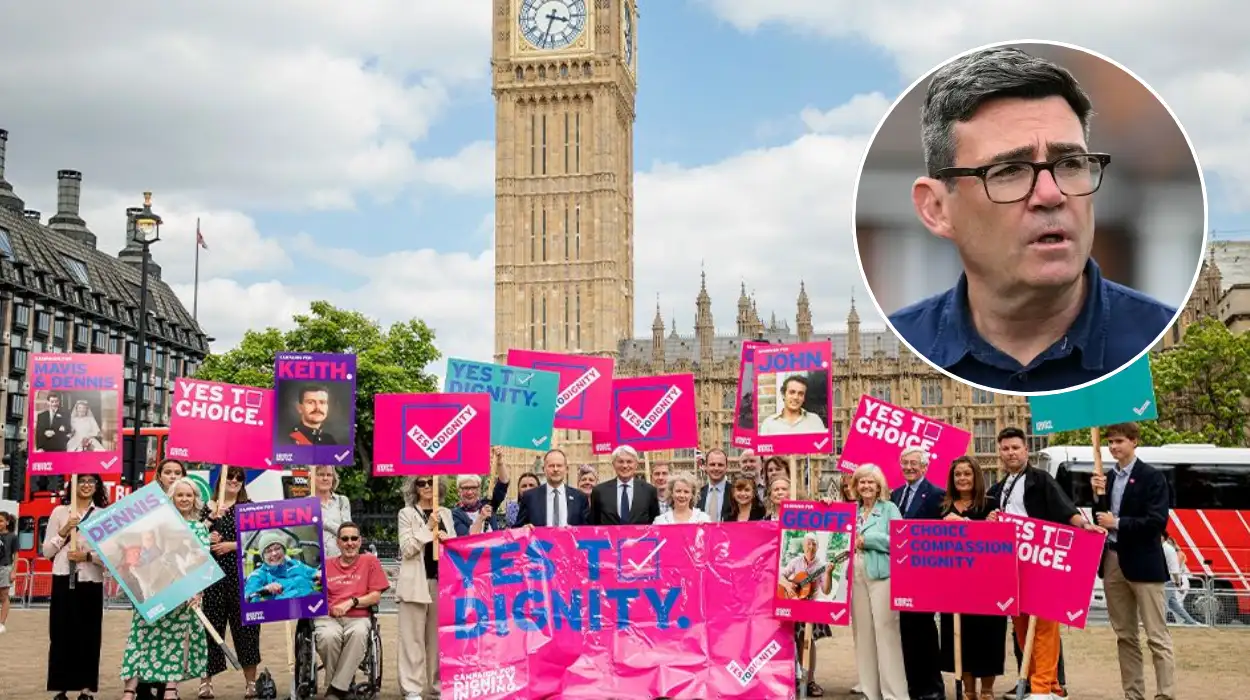
Key Points
- The House of Commons is due to vote on the second reading of the Terminally Ill Adults (End of Life) Bill on 11 September 2026, with Prime Minister Andy Burnham planning not to vote.
- Burnham said his move is to prevent any “undue influence” on the parliamentary discussion, and to guarantee a “genuinely free vote” for every MP on this conscience issue.
- The Prime Minister announced the Government would maintain its official position of neutrality with regard to assisted dying, putting the collective responsibility system aside for ministers to vote or abstain as they will.
- Burnham, a Roman Catholic, earlier in July 2026, said they had already said that any plan for assisted dying should be based on improving palliative and social care funding first.
- Labour MP Lauren Edwards has reintroduced a bill that would grant permission for terminally ill adults in England and Wales who have less than six months to live to request assistance in dying, after a doctor and a panel of experts approve.
- Some critics, such as those at The Telegraph, say Burnham ought to vote his conscience not on a question of “life and death”.
- Disability campaigners have warned that the risks that may affect sick and disabled individuals could be prevented by implementing changes to the care sector before assisted dying is legalised.
- The bill is a private member’s bill introduced in June 2026 and will be due to return to the Commons in the next session of Parliament if it does not pass.
London (Britain Today News) August 31, 2026 — Prime Minister Andy Burnham has confirmed he will not cast a vote when the assisted dying bill returns to the House of Commons on 11 September, saying he does not wish to “unduly influence the debate” in his role as head of government. In a letter to the Parliamentary Labour Party, Burnham wrote:
- Key Points
- What does the Terminally Ill Adults (End of Life) Bill propose?
- How has Burnham’s position on assisted dying evolved?
- Why do critics say Burnham should vote according to conscience?
- What precedents exist for prime ministers on conscience votes?
- How has the Government formalised neutrality on the bill?
- What do voters and campaigners say about timing and care reforms?
- Who is leading the campaign to legalise assisted dying?
- What are the bill’s safeguards and eligibility criteria?
- How does Burnham’s Catholic faith factor into the debate?
- What happens next in Parliament?
“I, of course, have my own personal views on the issue. However, I am also clear that this is a matter for Parliament to decide and my role, as the Prime Minister, will be to lead a Government that implements the will of Parliament in this area – whether that is to change the law or not.”
He added:
“I also do not want to unduly influence the debate as Prime Minister and for every colleague to know it is a genuinely free vote. For these reasons, I have decided that it is most appropriate for me not to vote at second reading.”
What does the Terminally Ill Adults (End of Life) Bill propose?
The Terminally Ill Adults (End of Life) Bill, introduced as a private member’s bill by Labour MP Lauren Edwards in June 2026, would legalise assisted dying for terminally ill adults in England and Wales judged to have fewer than six months left to live. Under the proposals, eligible patients could apply for an assisted death subject to the approval of two doctors and an independent expert panel. The bill ran out of time in the previous parliamentary session and is due back in the Commons on 11 September 2026 for its second reading.
How has Burnham’s position on assisted dying evolved?
In July 2026, shortly after taking office, Burnham told journalists that
“there’s something that needs to happen first”
before assisted dying legislation should proceed. He specified that priority must be given to
“the fixing of the funding of palliative care and social care”.
adding:
“I think it is very challenging to introduce that wider debate in a context of people not receiving that care and having the peace of mind about that care.”
Last month, he reiterated that view, but on 28 August he reversed course on voting, opting instead to abstain so as not to sway colleagues.
Why do critics say Burnham should vote according to conscience?
Commentators at The Telegraph have argued that, because Parliament treats assisted dying as a matter of conscience, the Prime Minister should not stand aside but should vote in line with his own moral convictions. As reported by an opinion writer at The Telegraph,
“Mr Burnham is a Roman Catholic, the first declared one ever to occupy No 10 Downing Street. Catholics are always taught that conscience is central to their faith.”
The piece cites St John Henry Newman’s famous line —
“I shall drink to the Pope, if you please, still, to conscience first and the Pope afterwards”
— to underscore the expectation that Burnham, as a Catholic MP, should vote according to conscience on a matter of “life and death”.
What precedents exist for prime ministers on conscience votes?
Historically, British prime ministers have taken clear personal positions on conscience issues while allowing MPs a free vote. Margaret Thatcher supported the return of capital punishment for murder but did not whip her government or MPs; her side lost without party splits. On same-sex marriage, David Cameron was a “passionate advocate”, making it a highlight of his party-conference speech, while colleagues remained free to disagree — and some did. These precedents are cited by critics who contend that Burnham’s abstention departs from the tradition of prime ministerial moral leadership on conscience questions.
How has the Government formalised neutrality on the bill?
In his letter to ministers, Burnham confirmed that, as is convention for conscience issues, collective responsibility is set aside for the assisted dying bill. Frontbenchers are therefore free to vote or abstain however they wish. Burnham also urged ministers to reiterate that the bill is
“a question for Parliament, on which the official Government position is to remain neutral”.
Lauren Edwards, who reintroduced the bill, welcomed this approach, saying:
“This is an incredibly important and deeply personal issue, on which Ministers will understandably hold different views.”
What do voters and campaigners say about timing and care reforms?
A Telegraph poll published on 31 August 2026 found a majority of voters want the Government to pause the assisted dying debate and prioritise improving palliative, social and end-of-life care. The report notes that last month Burnham said
“the fixing of the funding of palliative care and social care”
must “first” be addressed before returning to the assisted dying debate. Separately, disability campaigners have called for caution, arguing that introducing assisted dying without reforming care puts
“sick and disabled people’s lives at risk”.
Who is leading the campaign to legalise assisted dying?
Labour MP Lauren Edwards is the sponsor of the Terminally Ill Adults (End of Life) Bill and has been leading the campaign to restart the stalled process to legalise assisted dying in England and Wales. Reporting by Politico Europe in late August noted that Edwards’s campaign is looking to Australia for inspiration as the Commons prepares for a divisive vote next month. Edwards welcomed Burnham’s confirmation of government neutrality, emphasising that MPs can vote according to conscience rather than along party lines.
What are the bill’s safeguards and eligibility criteria?
The bill proposes allowing adults in England and Wales with fewer than six months to live to apply for an assisted death, subject to the approval of two doctors and an expert panel. Government publications released on 28 August 2026 include an equality impact assessment, an ECHR memorandum and an impact assessment relating to the bill, underscoring the detailed scrutiny of safeguards and potential effects. The legislation is to be commenced by regulations but would come into force four years after Royal Assent if not commenced before then, save for specific sections to be brought into force by Welsh ministers.
Explore More about Politics:
Stuart Andrew Quits Badenoch’s Shadow Cabinet Amid Wider Tory Reshuffle
Cleverly steps down as shadow cabinet member to contest London mayoralty
How does Burnham’s Catholic faith factor into the debate?
Burnham is the first declared Roman Catholic to serve as Prime Minister at No 10 Downing Street, a detail highlighted by commentators assessing his moral responsibilities on the bill. Catholic teaching places conscience at the centre of moral decision-making, a principle invoked by critics who argue he should not stand aside. As framed in The Telegraph opinion piece,
“As a Catholic Member of Parliament, Mr Burnham should not stand aside on what is literally a matter of life and death: he should vote according to his conscience.”
What happens next in Parliament?
The Terminally Ill Adults (End of Life) Bill is due back in the House of Commons on 11 September 2026 for its second reading, when MPs will debate and vote on whether the law should change. With the Government officially neutral and collective responsibility suspended, MPs across the chamber will vote according to conscience. Burnham has stated his role will be to implement Parliament’s will,
“whether that is to change the law or not”.