

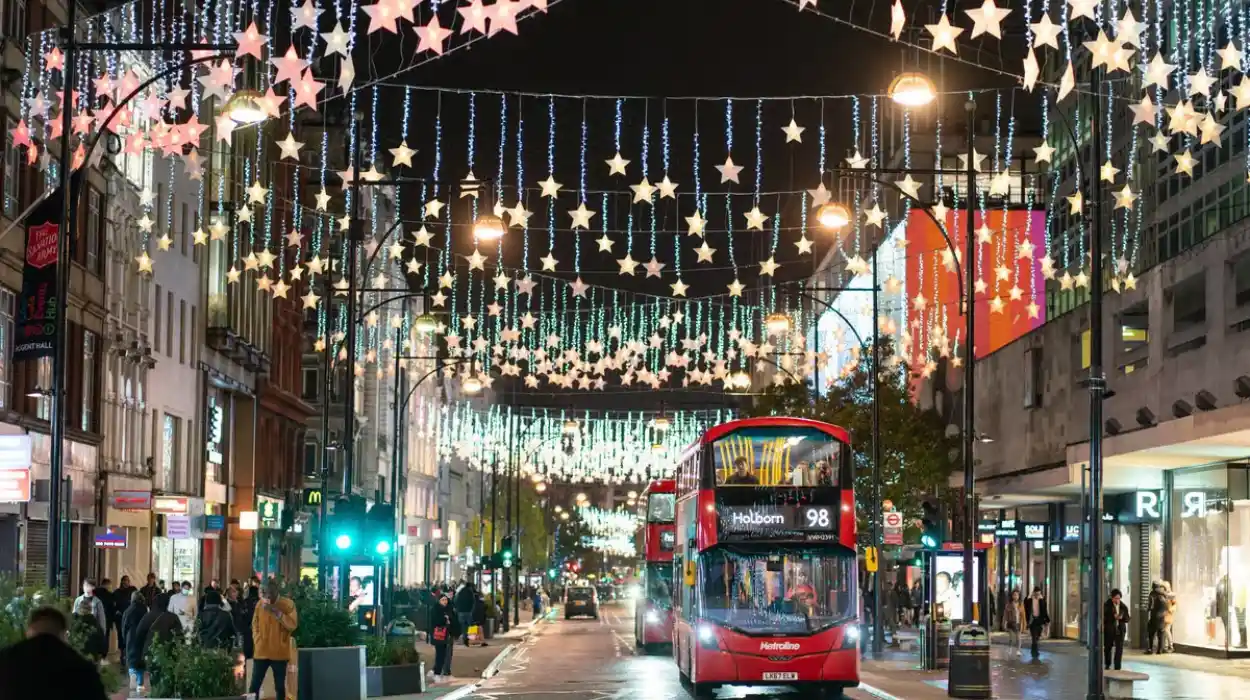
Thousands of shoppers visiting London’s Oxford Street this Christmas could have their faces scanned by live facial recognition cameras, as the Metropolitan Police prepares to expand its use of the technology in one of the capital’s busiest retail districts. The cameras are expected to be installed in December, according to reports published on Friday, 23 October. Oxford Street attracts approximately 500,000 visitors a day, making the planned deployment a significant expansion of facial recognition surveillance in a major public space.
The technology will scan faces captured by cameras and compare them with images on a police watchlist of people being sought by law enforcement. The plans have renewed debate over whether the use of artificial intelligence in public spaces can improve security without compromising individual privacy.
Police cite crime prevention as key objective
The Metropolitan Police has defended live facial recognition (LFR) as an important tool for identifying wanted individuals and preventing crime. In its official guidance on facial recognition, the force explains that live systems compare images of people passing through a designated area against a specific watchlist. The technology can alert officers to a potential match, but a trained officer must assess the result rather than relying solely on the system.
The Met’s 2025 annual report on live facial recognition recorded 962 arrests resulting from LFR operations during the year covered by the report, which ended on 10 September 2025. The force has presented these results as evidence of the technology’s contribution to policing.
The planned Oxford Street deployment comes as the Met considers using fixed facial recognition cameras in the West End and Soho. However, the precise installation locations and operational arrangements for Oxford Street have not yet been fully detailed in the publicly available reporting.
Privacy concerns intensify
The expansion has drawn criticism from civil liberties campaigners, who argue that scanning people in busy public areas raises serious questions about consent, transparency and the protection of personal data. Akiko Hart, director of human rights organisation Liberty, criticised the Oxford Street plans in comments reported on Friday. She argued that shoppers would be subjected to facial recognition without being given a meaningful choice and called for clear legal safeguards and independent oversight before the rollout proceeds.
The debate comes as the UK Government considers a more comprehensive legal framework for police use of facial recognition and other biometric technologies. In December 2025, the Home Office launched a public consultation on the issue, which closed on 12 February 2026. Its stated objective was to establish clearer rules for law enforcement while balancing public safety against privacy, human rights and public confidence.
The consultation document acknowledged that the existing legal framework was complex and did not provide sufficient clarity for the technology’s expansion. The Government committed to developing a framework with appropriate limits and safeguards.
What happens to the faces that do not match?
One of the central questions surrounding live facial recognition is how the system handles the biometric information of people who are not wanted by police. According to the Government’s official guidance, people who do not match the watchlist have their biometric data automatically deleted. If the system identifies a potential match, officers receive the relevant images for human review before deciding whether to approach the individual.
The Met has also said that its proposed static systems will operate only when officers are present on the ground, with signs informing the public that facial recognition is being used. These safeguards are intended to limit unnecessary data retention and reduce the risk of mistaken identification. However, questions remain over how effectively the arrangements will be communicated to the public and independently scrutinised.
A changing Oxford Street
The proposed surveillance rollout coincides with wider plans to transform Oxford Street into a more pedestrian-friendly shopping destination. The Mayor of London’s published plans for pedestrianisation include improved public spaces, greenery, seating and measures intended to make the street safer and more welcoming. The Greater London Authority has also highlighted the area’s importance to London’s economy and retail sector.
Supporters of stronger policing argue that busy shopping districts need effective tools to tackle theft and other offences. Critics counter that introducing persistent biometric surveillance into everyday public spaces risks normalising the monitoring of people who have done nothing wrong.
For retailers, workers and the millions of people who visit central London, the issue extends beyond the effectiveness of a new policing technology. It raises a broader question about what public safety should look like in an increasingly digital city. As Oxford Street prepares for the festive shopping season, the challenge for police and policymakers will be to demonstrate that facial recognition can be used lawfully, proportionately and transparently, while maintaining public trust.