Key Points
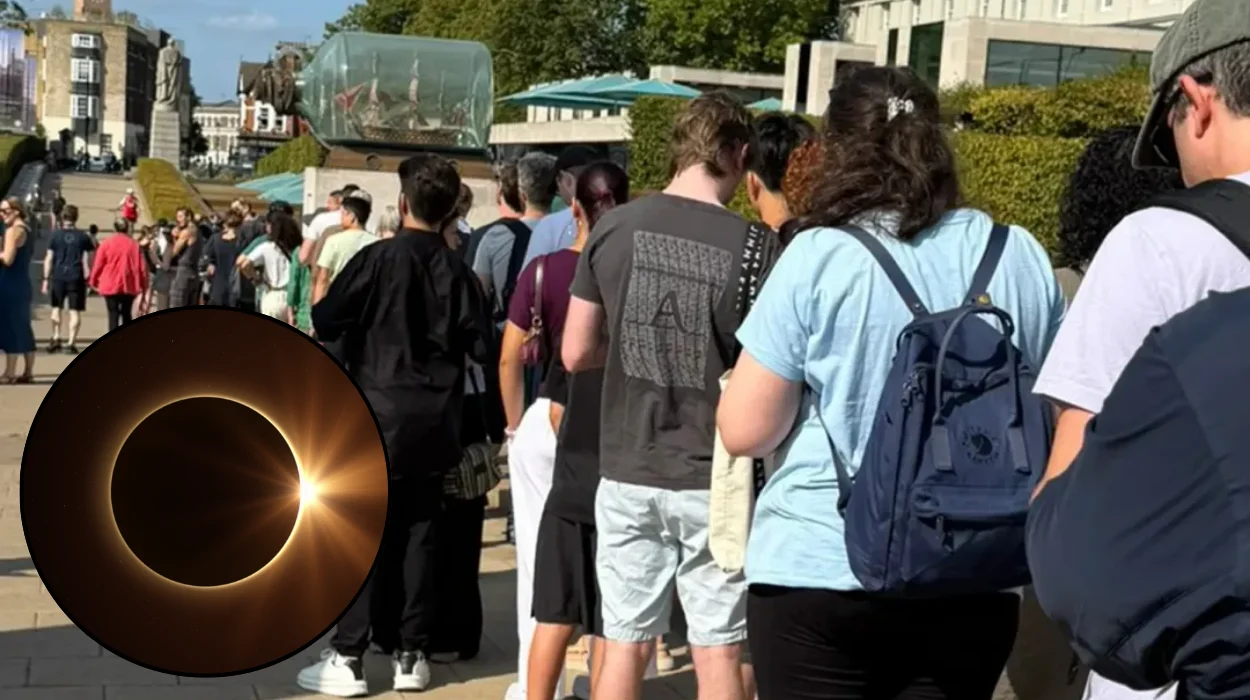
- Hundreds to thousands of people lined up for several hours at various locations around London, including Whitechapel, Old Spitalfields Market, Greenwich, Wimbledon, Arsenal, and Finsbury Park, waiting to purchase ISO 12312-2 certified solar eclipse glasses in preparation for the partial solar eclipse of 12 August 2026.
- The Royal Observatory Greenwich confirmed that orders for eclipse glasses were so high that they had sold out both online and in their stores, saying orders were “unprecedented in volume” and about 15,000 pairs of eclipse glasses were sold in the past month.
- Some convenience stores reported that they sold thousands of pairs in a day, one in Whitechapel claiming 6,000 pairs were sold on Tuesday alone after an overnight shipment from Spain.
- Major retailers were stating that online deliveries were to be expected on 13 August or later, leading to panic buying and huge queues in physical stores.
- The study urged against counterfeit or “knock-off” sunglasses and reiterated that standard sunglasses should not be used; only glasses certified to the ISO 12312-2 standard are safe.
- The ophthalmologists warned that direct viewing of the Sun can result in painless disruption of the retina, which may only manifest hours after the eclipse; about 70 vision problems were reported following the 1999 eclipse.
- Astronomers had suggested that people who don’t wear glasses watch the event indirectly through a pinhole in a colander or a hole in a piece of card, or by watching a live video stream of the event.
- The eclipse in London would have started at 18:17 BST, peaked at 91.4% at 19:13 BST and finished at 20:06 BST.
- People in London started to panic and rushed to Deliveroo for “eclipse” and “eclipse glasses” orders, which increased by over 1,200%.
- There were reports of price-gouging, with some pairs being sold at £10–£12, and lines outside shops as early as 2 am.
East London (Britain Today News) August 12, 2026 – Long queues snaked around convenience stores and market stalls across London on the eve of the 12 August 2026 partial solar eclipse, as thousands of residents and visitors scrambled to secure certified solar eclipse glasses before the celestial event. The rush intensified after multiple retailers confirmed sell-outs online and in-store, with the Royal Observatory Greenwich describing demand as “unprecedented”.
- Key Points
- What triggered the rush for eclipse glasses in London?
- Where did the longest queues form in London?
- How many eclipse glasses were sold in London before the event?
- Why were online deliveries often too late?
- What safety warnings were issued about eclipse glasses?
- How did prices and availability fluctuate across the city?
- What alternatives were suggested for those without glasses?
- When and how will the eclipse be visible in London?
- What does this say about public engagement with astronomy in the UK?
What triggered the rush for eclipse glasses in London?
The frenzy was driven by the rarity of the event: London will not see an eclipse blocking as much of the Sun again until 2081, according to the Royal Observatory Greenwich. With the Moon set to obscure around 91.4% of the Sun at maximum, public interest surged, but many left purchasing certified eyewear until the final 48 hours. Neill Sanders, founder of Go Stargazing and UK coordinator of Astronomers Without Borders, told The Guardian that the issue was not a true shortage but last-minute planning, noting he had already distributed 100,000 discounted pairs to clubs and community groups in preceding weeks.
Where did the longest queues form in London?
The most dramatic scenes were reported in East London, where hundreds waited outside the 24-hour Am2Pm convenience store on Whitechapel High Street, some queuing through the night. Social media posts showed crowds under floodlights at 2 am, with one Reddit user sharing images of the line as a new shipment arrived. Similar queues formed at Old Spitalfields Market in Spitalfields, as well as in Greenwich, Wimbledon, Arsenal, Bond Street and Finsbury Park. As reported by reporters for the Evening Standard, known selling locations were closely guarded to avoid overwhelming crowds, with many customers learning of stock via word of mouth.
How many eclipse glasses were sold in London before the event?
The Royal Observatory Greenwich said it had sold approximately 15,000 pairs of eclipse glasses in the month leading up to the event, before completely selling out both online and on-site. At the Whitechapel Am2Pm store, owner Ali Raza told the Evening Standard that demand had been so intense he “hasn’t had time to eat”, adding that he sold 6,000 pairs on Tuesday alone after a delivery from Spain at 2.30 am, only to sell out again by 9.30 am. Another distributor told The Guardian that stocks were available, but packing capacity was the bottleneck as everyone ordered at the last minute.
Why were online deliveries often too late?
Multiple major retailers listed delivery dates of 13 August or later for eclipse glasses, rendering online orders useless for the 12 August event. For example, Amazon showed Lunt solar eclipse glasses (£14.99) with “free delivery Thursday 13 August”, while Robert Dyas listed Bresser glasses (£2.99) as out of stock. The Guardian noted that some online shoppers who did find glasses were told deliveries would arrive “in plenty of time for the next comparable UK eclipse – in 2081 – but no good at all for Wednesday’s show”. This pushed buyers toward in-person purchases, fuelling the queues.
What safety warnings were issued about eclipse glasses?
Experts repeatedly warned that only ISO 12312-2 certified solar eclipse glasses are safe for direct viewing, and that ordinary sunglasses, smoked glass, welder’s masks or CDs/DVDs are not acceptable substitutes. The Royal College of Ophthalmologists cautioned that looking directly at the Sun can cause painless retinal damage, with symptoms such as blurred vision, central blind spots, distorted vision and light sensitivity appearing hours later. Mohamed Elalfy, consultant ophthalmologist and president of the Royal College of Ophthalmologists, said:
“The safest way to enjoy the eclipse is to observe it indirectly, such as by watching a live broadcast.”
After the 1999 total solar eclipse, the College reported around 70 cases of vision problems, with about 40% of those affected having looked at the Sun for less than a minute.
How did prices and availability fluctuate across the city?
As stocks dwindled, reports of price increases and mark-ups emerged. The Evening Standard noted that a Shoreditch convenience store was selling glasses at £10 on Wednesday morning, double the £5 price seen earlier in the week. The New York Times reported some online listings at £12 or more, with one buyer securing three pairs at £8 each after travelling to the same Whitechapel store where another customer paid under £6 hours earlier. Tom Weaver, 36, a planning officer, told the New York Times that given the 30 or so people still in line when he arrived around 8 am, vendors “could probably have been charging a lot more”.
What alternatives were suggested for those without glasses?
For those unable to obtain certified glasses, astronomers and museums promoted indirect viewing methods. Jake Foster, an astronomer at the Royal Observatory Greenwich, told The Guardian:
“If you don’t have a pair of eclipse glasses, you can still view the eclipse indirectly. Any household item with small round holes in it, such as a colander or even a piece of paper with a small hole poked in it,t can project an image of the eclipse onto a flat surface.”
Sky at Night Magazine added that using a colander or tea strainer would produce multiple crescent-shaped projections, and even the shadow of a tree’s foliage could show tiny crescents on the ground during the eclipse. Official live streams from organisations such as NASA and the European Space Agency were also recommended.
When and how will the eclipse be visible in London?
In London, the partial solar eclipse was scheduled to begin at 18:17 BST, reach maximum coverage of 91.4% at 19:13 BST, and end at 20:06 BST. Across the UK, coverage ranged from about 88% in the far east to 94–96% in the far west, with Plymouth forecast to see 94.66% coverage at 19:16 BST. The Royal Greenwich Observatory and National Maritime Museum had planned on-site viewing with solar telescopes and pinhole projections, but warned visitors to expect queues and confirmed glasses were sold out.
Explore More about London:
Best Places to Watch London’s Solar Eclipse
First Look: Huge Harry Potter Shop Set for London’s Oxford Street
What does this say about public engagement with astronomy in the UK?
The scale of the queues and the speed of sell-outs highlight intense public interest in rare astronomical events, but also a tendency toward last-minute action. As reported by Ian Sample of The Guardian, consumer experts had been recommending specialised glasses for weeks, yet many only began searching in the final days. Neill Sanders told The Guardian he was receiving “loads of calls, text messages, emails” as people suddenly realised they needed glasses for Wednesday. The Deliveroo app recorded a more than 1,200% increase in searches for “eclipse” and “eclipse glasses” since the weekend, underscoring the panic-buying dynamic.