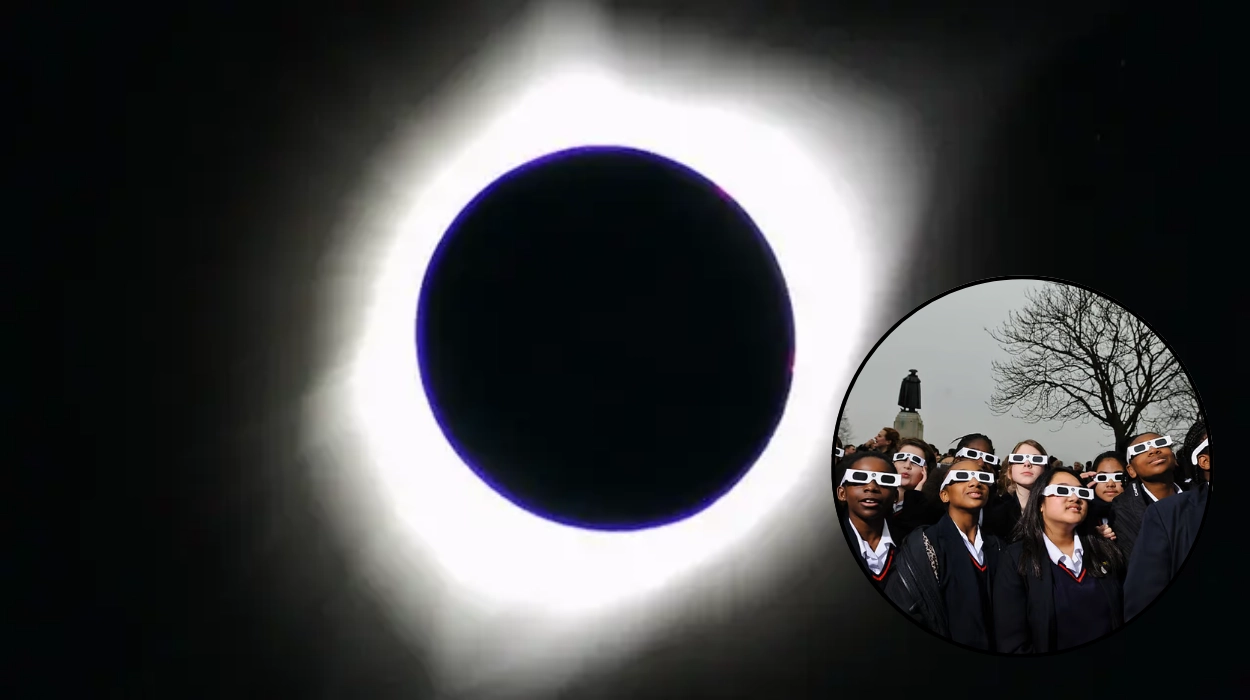
Key Points
- London will witness the most significant partial solar eclipse in nearly three decades on 12 August 2026.
- The eclipse will start around 6.16-6.17 pm BST, reach its peak around 7.12-7.13 pm BST, and end by 8.06 pm BST.
- During the maximum eclipse, about 91 percent of the Sun will be eclipsed by the Moon when seen from London.
- The UK will not witness the totality of the eclipse; Spain, Iceland, and Greenland will only be able to see a total eclipse.
- Cornwall, specifically Land’s End and The Lizard Peninsula, is likely to see the greatest coverage in the UK, reaching around 96 percent.
- The best viewing spots will be found in London in high, open, and clear areas with an unobstructed western horizon.
- Some of the best vantage points in London are Greenwich Park, Primrose Hill, Parliament Hill, Telegraph Hill, Alexandra Palace, and Crystal Palace.
- The Royal Observatory at Greenwich will live broadcast the event for those who cannot get a suitable place to watch the phenomenon.
- Eye protection is critical, with ISO-certified eclipse glasses needed whenever the Sun can be seen.
- The next total solar eclipse in the UK will take place only in 2090.
London (Britain Today News) August 07, 2026 — The capital is preparing for a rare celestial spectacle next week, as a deep partial solar eclipse is set to darken London’s skies on Wednesday 12 August. It will be the most significant solar eclipse witnessed from the UK in more than a quarter of a century, and Londoners with a good vantage point and clear weather stand to see roughly nine-tenths of the Sun disappear behind the Moon.
- Key Points
- What is happening in London’s skies on 12 August 2026?
- Why is this eclipse being called the best in a generation?
- What time will the solar eclipse begin and peak in London?
- Why is Primrose Hill tipped as a popular viewing point?
- What makes Parliament Hill ideal for eclipse watching?
- Why is Crystal Palace worth considering for eclipse watchers?
- What about Telegraph Hill for those avoiding the crowds?
- How can Londoners watch the eclipse safely?
- What should Londoners do if the skies are overcast on the night?
What is happening in London’s skies on 12 August 2026?
A solar eclipse takes place when the Moon passes directly between the Earth and the Sun, temporarily blocking part or all of the Sun’s light and casting a shadow across parts of the planet. Royal Museums Greenwich, which oversees the Royal Observatory, has confirmed that the Observatory will broadcast a free live stream of the eclipse from London for anyone unable to reach a viewpoint in person. London will not experience a total eclipse — that privilege belongs to observers in northern Spain, Iceland and Greenland — but the capital will still witness a striking and unusually deep partial eclipse as the Moon takes a substantial bite out of the setting Sun.
Why is this eclipse being called the best in a generation?
Astronomers have pointed out that the scale of coverage expected across the UK has not been matched since 1999, when the country last saw a total eclipse from Cornwall. According to BBC Sky at Night Magazine, major UK cities will experience a very deep partial eclipse on 12 August 2026, with Cardiff recording the deepest coverage of any city in the country. For London specifically, coverage is expected to reach roughly 91 percent, making it the most dramatic eclipse the city has seen in 27 years and one that will not be repeated at this scale for decades.
What time will the solar eclipse begin and peak in London?
Timings vary slightly between sources, but the overall picture is consistent. The eclipse will begin in London at around 6.16 pm to 6.17 pm BST, as the Moon starts to move across the face of the Sun. Maximum coverage is expected between roughly 7.12 pm and 7.13 pm BST, when close to 91 percent of the Sun will be obscured. From that point, the Moon will gradually move off the Sun’s disc until the eclipse concludes at around 8.06 pm BST, shortly before sunset. In total, Londoners can expect the spectacle to last close to two hours, with the most dramatic moments occurring in the final hour as the Sun sits low over the western horizon.
Is Greenwich Park the best spot to watch the eclipse?
Greenwich Park has an obvious claim to being London’s spiritual home for eclipse-watching, given its association with the Royal Observatory and the Prime Meridian line. The park combines an elevated, open outlook across the Thames and Canary Wharf with the backdrop of the London skyline, and it is likely to draw large crowds keen to watch the event close to where astronomers themselves will be observing it. Visitors should expect a lively, communal atmosphere rather than a quiet vantage point, so arriving early to secure space is advisable.
Why is Primrose Hill tipped as a popular viewing point?
In north London, Primrose Hill is expected to be one of the most heavily used viewpoints in the capital. Its open grassland and sweeping views over London Zoo and the city skyline make it a natural gathering point, with landmarks including the Shard, St Paul’s Cathedral and the Gherkin visible from the hill as the eclipse unfolds. Given its popularity for sunset-watching on ordinary evenings, organisers and locals alike expect significant numbers to head there on the night, so early arrival is again recommended for anyone hoping to secure an unobstructed view of the western sky.
What makes Parliament Hill ideal for eclipse watching?
Rising to 98 metres within Hampstead Heath, Parliament Hill is among the highest natural viewpoints in London and offers a genuinely panoramic outlook across the city. From here, spectators will be able to watch the eclipsed Sun set behind a skyline that includes St Paul’s Cathedral and the Gherkin, giving the event an added visual dimension as the natural phenomenon plays out above the built landscape of the capital. Its size also means it can comfortably absorb larger crowds without every vantage point feeling overcrowded.
Could Alexandra Palace offer the clearest skyline view?
Sitting on high ground between Muswell Hill and Wood Green, Alexandra Palace has long been valued for its elevated position — it was chosen for precisely that reason when the BBC first transmitted television signals from the site in 1936. The same qualities that made it useful for broadcasting nearly a century ago make it well suited to eclipse-watching today, with the palace’s terrace sitting well above the surrounding tree line and offering an uninterrupted view of the sky over north London.
Why is Crystal Palace worth considering for eclipse watchers?
On the Norwood Ridge in south London, Crystal Palace Park offers another strong option thanks to its height and open aspect towards the west. The park’s upper Italian terraces and expansive grassed areas should provide ample space for visitors to find a spot without tall buildings interrupting the view of the Sun and Moon as they align. For those in south London looking for an alternative to the busier central viewpoints, it is a serious contender.
What about Telegraph Hill for those avoiding the crowds?
Not everyone wants to watch a major celestial event shoulder to shoulder with thousands of others, and Telegraph Hill, near Nunhead in south-east London, offers a quieter alternative. It shares the east-to-west orientation that makes nearby Greenwich Park so popular, while sitting a little further from the main tourist routes, making it a sensible choice for residents seeking a clear view without the scale of crowd expected elsewhere in the capital.
Explore More about London:
Sabrina Carpenter In Talks For Wembley Headline Show 2027
Tower of London to Open Private Ceremony to Visitors in 2026
How can Londoners watch the eclipse safely?
Eye safety is the single most important consideration for anyone planning to watch the event. Royal Museums Greenwich is unequivocal on this point, stating that a person should never look directly at the Sun without the appropriate filters. ISO-certified eclipse glasses should be worn at all times the Sun is visible during the event, including during the partial phases before and after maximum coverage — ordinary sunglasses, however dark, do not offer adequate protection, since they do not block the infrared and ultraviolet light that causes lasting harm to the retina.
Cameras, telescopes and binoculars used to view or photograph the eclipse should also be fitted with proper solar filters, as looking through unfiltered optical equipment can cause serious and immediate eye damage, and can do so more quickly than looking at the Sun with the naked eye. Parents and guardians bringing children to any of London’s viewpoints are advised to supervise them closely throughout, checking that glasses remain properly fitted and are not removed to get a “better look” at any stage. Anyone without certified glasses is advised against attempting improvised alternatives, such as sunglasses stacked together or smoked glass, none of which offer reliable protection. Pinhole projectors, which allow the eclipse to be viewed indirectly as a projected image rather than looking at the Sun itself, remain a safe option for those without eclipse glasses and are simple to make at home from card and paper.
Because the eclipse will unfold as the Sun sits low over the western horizon, many viewpoints across London will involve standing in open, exposed positions for an extended period. Visitors are advised to dress for the evening, bring water, and factor in the time needed to walk up to elevated spots such as Parliament Hill or Alexandra Palace, particularly if arriving close to the start of the eclipse when crowds are likely to be at their thickest.
When will the next eclipse like this be visible from the UK?
Anyone who misses this month’s event, or is clouded out on the night, will have a long wait for a comparable spectacle. Royal Museums Greenwich has confirmed that the next total solar eclipse visible from the UK will not occur until 2090, some 64 years from now. A closer, though still substantial, wait applies to another deep partial eclipse of this scale. For that reason, astronomers are encouraging as many people as possible to make the effort to see this one, given how rarely the UK is treated to an event of this magnitude.
What should Londoners do if the skies are overcast on the night?
Weather remains the great unknown for any UK skywatching event, and August evenings can be unpredictable. Those without a clear view, or facing poor conditions, are not entirely out of options: the Royal Observatory’s live broadcast of the eclipse from Greenwich will allow people to watch the event unfold in real time regardless of local cloud cover. For those determined to see it in person, having a backup location in mind — ideally another elevated spot with a similarly open western aspect — is a sensible precaution given how localised August weather in London can be.
With clear skies and the right vantage point, 12 August 2026 promises to be a rare and memorable evening for London, offering residents a glimpse of a natural phenomenon that will not be repeated on this scale again in most people’s lifetimes.