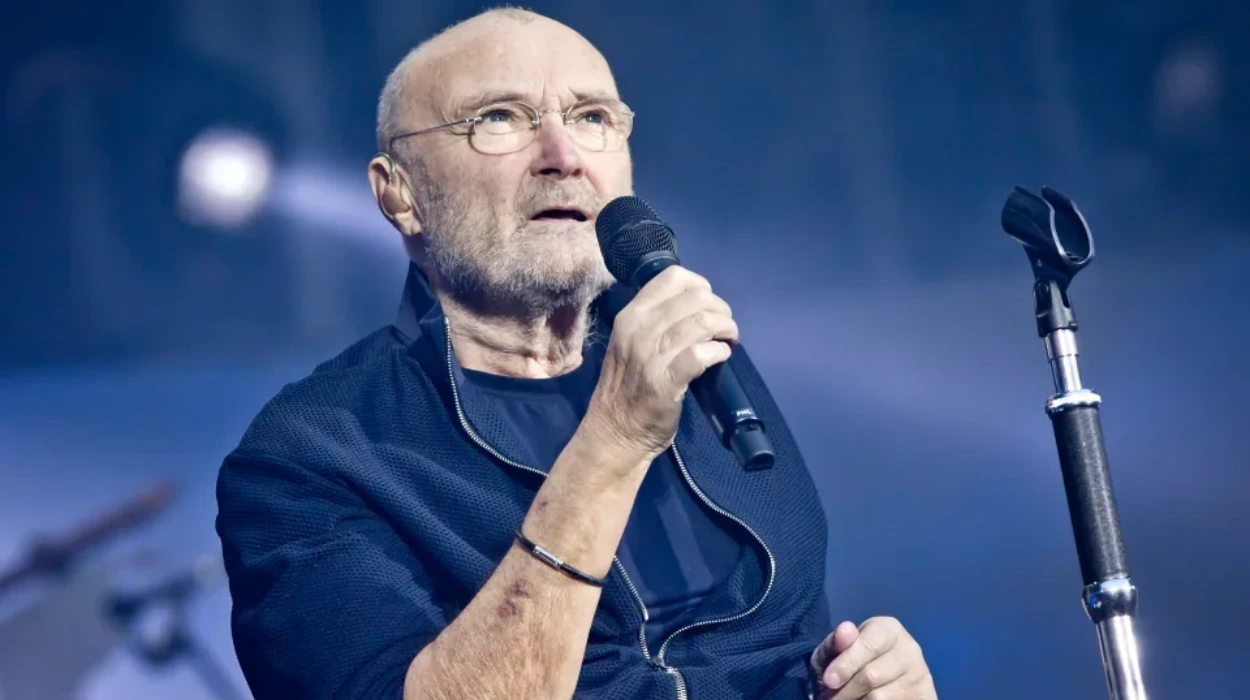
Phil Collins is a British singer, songwriter, drummer, and producer born on January 30, 1951, in Chiswick, London. He rose to fame as the drummer and later lead vocalist of the progressive rock band Genesis before building one of the most commercially successful solo careers in music history. As of 2026, Collins is 75 years old and living with multiple chronic health conditions that have ended his performing career, while his musical legacy continues to grow through new recognition, including a 2026 Rock and Roll Hall of Fame induction as a solo artist.
Who Is Phil Collins and Why Is He Famous?
Phil Collins is a British musician who became famous as Genesis’s drummer-turned-frontman and later as a solo artist with 33.5 million certified U.S. album sales, eight Grammy Awards, and hits including “In the Air Tonight” and “Against All Odds.” He is one of only three artists in music history to sell more than 100 million records worldwide as both a solo artist and as a member of a group.
Collins joined Genesis in 1970 as the band’s drummer. When original lead singer Peter Gabriel departed in 1975, Collins stepped into the frontman role. Under his leadership, Genesis shifted from progressive rock toward a more mainstream pop-rock sound, producing albums such as “Duke” (1980), “Abacab” (1981), and “Invisible Touch” (1986). The band sold more than 100 million records worldwide during his tenure.
Collins launched a parallel solo career in 1981 with the album “Face Value,” which included “In the Air Tonight,” a song built around a distinctive drum-machine gated-reverb sound that became one of the most recognisable production techniques of the decade. His subsequent solo albums, including “Hello, I Must Be Going!” (1982), “No Jacket Required” (1985), and “…But Seriously” (1989), produced numerous top-ten singles across the United States and United Kingdom. “No Jacket Required” won the Grammy Award for Album of the Year in 1986.
What Has Phil Collins Said About His Health in 2026?
In January 2026, Phil Collins revealed he requires 24-hour live-in nurse care to manage medication and ongoing complications from knee surgery, kidney problems, and nerve damage. By May 2026, he described feeling “healthier now” than in previous years, though still not physically able to perform live.
Collins detailed his condition during a five-part BBC Two podcast series titled “Phil Collins Eras: In Conversation,” hosted by Zoe Ball, which concluded in late January 2026. He told Ball that “everything that could go wrong with me, did go wrong with me,” describing a period in which multiple health problems converged simultaneously. He specifically cited a hospitalisation involving a COVID-19 infection that led to kidney complications, alongside long-standing knee problems.
Collins explained that his knee required five separate operations because the joint repeatedly became infected or failed structurally following surgery. This series of procedures left him largely inactive for an extended period. He also confirmed he can walk, but only with physical assistance.
By late May 2026, in a follow-up interview with BBC Breakfast, Collins offered a more optimistic assessment, stating he is “healthier now than I have been for quite a while.” He indicated he is not ruling out future live performances entirely, though he acknowledged that returning to the stage would require an intensive rehearsal period that his body is not yet prepared to withstand.
Which Specific Medical Conditions Has Phil Collins Disclosed?
Phil Collins has publicly disclosed four primary health conditions: spinal nerve damage from a 2007 neck injury, type 2 diabetes, chronic knee problems requiring five surgeries, and kidney complications linked to alcohol use and a COVID-19 hospitalisation. Each condition has directly limited his physical capabilities as a performer.
In 2007, Collins sustained a neck injury during a Genesis tour that resulted in permanent nerve damage. This injury progressively affected the dexterity in his hands, and by 2015, he underwent back surgery that left him with additional nerve damage. The cumulative effect ended his ability to play the drums; his son, Nic Collins, took over drumming duties during the 2021–2022 Genesis reunion tour, “The Last Domino?,” while Phil Collins remained on lead vocals, performing while seated.
Collins has also spoken previously about a type 2 diabetes diagnosis and a history of alcohol addiction, which he has said contributed to later kidney problems. In July 2025, media speculation suggested Collins was in hospice care. A spokesperson for Collins denied this claim to People magazine, clarifying that his hospitalisation at that time followed knee surgery rather than a terminal diagnosis.
Did Phil Collins Retire From Performing?
Phil Collins effectively retired from live performing after Genesis’s final concert on March 26, 2022, at London’s O2 Arena, concluding “The Last Domino?” reunion tour. He has not performed publicly since that date and has confirmed he does not expect to return to full-scale touring.
The 2022 farewell tour marked Genesis’s first live performances together in 14 years, following a hiatus that began after their 2007 “Turn It On Again” tour. During the reunion shows, Collins performed all vocals while seated, a physical accommodation necessitated by his mobility limitations. His final Genesis performance drew widespread media coverage as an emotional milestone, given his decades-long history with the band dating back to 1970.
Since 2022, Collins has made no live musical appearances. His most significant public engagements have instead centred on health disclosures and career retrospectives, including the BBC’s 2026 “Eras” podcast series.
Is Phil Collins Performing at the 2026 Rock and Roll Hall of Fame Ceremony?
Phil Collins declined an invitation to perform at his own 2026 Rock and Roll Hall of Fame induction ceremony, citing insufficient physical readiness for rehearsals and a live show. The ceremony is scheduled for Saturday, November 14, 2026, at the Peacock Theatre in Los Angeles.
Collins explained his decision in direct terms during his BBC Breakfast interview, stating that performing at an event of that scale requires being “match fit,” since preparation would demand extensive rehearsal that his voice and body are not currently equipped to handle. He noted that an inactive singing voice cannot be brought back to performance readiness without sustained vocal training, which itself carries physical strain.
Despite declining to perform, Collins remains confirmed as an inductee. The Rock and Roll Hall of Fame Foundation announced the 2026 induction class on April 13, 2026, live during a themed episode of “American Idol,” hosted by Ryan Seacrest alongside 2022 inductee Lionel Richie.
Why Is This Rock and Roll Hall of Fame Induction Significant?
This marks Phil Collins’s second Rock and Roll Hall of Fame induction, following his first as a member of Genesis in 2010, making him only the fourth drummer in the institution’s history to be inducted twice. He joins Ringo Starr, Dave Grohl, and Matt Cameron in this distinction.
Ringo Starr was first inducted with The Beatles in 1988 and again for Musical Excellence as a solo artist in 2015. Dave Grohl was inducted with Nirvana in 2014 and later with Foo Fighters in 2021. Matt Cameron was inducted with Pearl Jam in 2017 and with Soundgarden in 2025. Collins’s 2026 solo induction places him within this small group of drummers recognised twice by the institution.
Collins became eligible for solo nomination under Rock and Roll Hall of Fame rules, which require an artist’s first commercial release to have occurred at least 25 years before nomination. His debut solo album, “Face Value,” was released in 1981, making him technically eligible since 2006. The 2026 nomination marked the first time in his career that Collins appeared on the ballot as an individual artist, despite his extensive commercial success.
The 2026 induction class also includes Oasis, Iron Maiden, Sade, Billy Idol, Wu-Tang Clan, Luther Vandross, and the combined entry of Joy Division and New Order. During the public fan-voting period, Collins led all nominees, receiving the highest share of votes among more than 2.5 million ballots cast.
What Is Phil Collins’s Overall Musical Legacy?
Phil Collins’s legacy rests on three pillars: his role transforming Genesis into a mainstream commercial act, his record-breaking solo career, and his popularisation of the gated-reverb drum sound that defined 1980s pop-rock production. He remains one of only three musicians to surpass 100 million in combined solo and group record sales, alongside Paul McCartney and Michael Jackson.
The table below summarises key figures and dates in Collins’s career for quick reference.
| Category | Detail |
|---|---|
| Born | January 30, 1951, Chiswick, London |
| Joined Genesis | 1970 (as drummer) |
| Became Genesis lead vocalist | 1975 |
| First solo album | “Face Value” (1981) |
| Grammy Awards won | 8 |
| Academy Award | Best Original Song, “You’ll Be in My Heart,” Tarzan (2000) |
| Certified U.S. solo album sales | Approximately 33.5 million |
| First Rock Hall induction | 2010 (with Genesis) |
| Final live performance | March 26, 2022, O2 Arena, London |
| Second Rock Hall induction | 2026 (solo artist) |
| 2026 induction ceremony date | November 14, 2026, Peacock Theatre, Los Angeles |
Collins’s production innovations extended beyond his own recordings. The gated-reverb drum technique he helped popularise on “In the Air Tonight” was widely adopted across the music industry throughout the 1980s, influencing recordings by numerous other artists and producers seeking a similarly explosive, cut-off drum sound. This technical contribution is frequently cited by audio engineers and music historians as one of the most influential production developments of the decade.
His songwriting also extended into film. Collins won the Academy Award for Best Original Song in 2000 for “You’ll Be in My Heart,” written for Disney’s animated film “Tarzan.” This award added a further dimension to a catalogue that already included multiple Grammy Awards, Brit Awards, and induction into the Songwriters Hall of Fame.
Explore More about Entertainment:
Trojan War: Myth, History, and Untold Ancient Secrets
Piers Morgan: Career, Controversial Comments, and the Debates He Sparks in British Media
What Comes Next for Phil Collins?
Phil Collins’s near-term public activity centres on his November 14, 2026 Rock and Roll Hall of Fame induction, which he plans to attend without performing, while he has left open the possibility of returning to music in a non-touring capacity. He has indicated interest in returning to a recording studio, distinct from any commitment to live performance.
During his 2026 interviews, Collins did not rule out future studio work, suggesting that songwriting or recording remains possible even though touring and live singing are not. This distinction matters because studio recording does not carry the same physical demands as sustained vocal performance under touring conditions, which requires vocal stamina built through regular rehearsal.
The 2026 induction ceremony will be recorded on November 14 and broadcast later in December across ABC and Disney+, following the same distribution pattern used since Disney acquired broadcast rights to the ceremony beginning in 2023. Collins’s attendance, even without a performance, is expected to mark his most significant public appearance since his 2022 retirement from touring.
His medical disclosures throughout 2026 reflect a broader pattern among ageing performers who continue engaging publicly with fans and media while managing chronic conditions that preclude a return to the physical demands of live music. Collins’s case is frequently referenced in entertainment journalism as an example of a major artist balancing career legacy recognition against the realities of long-term health limitations following a demanding decades-long touring history.