

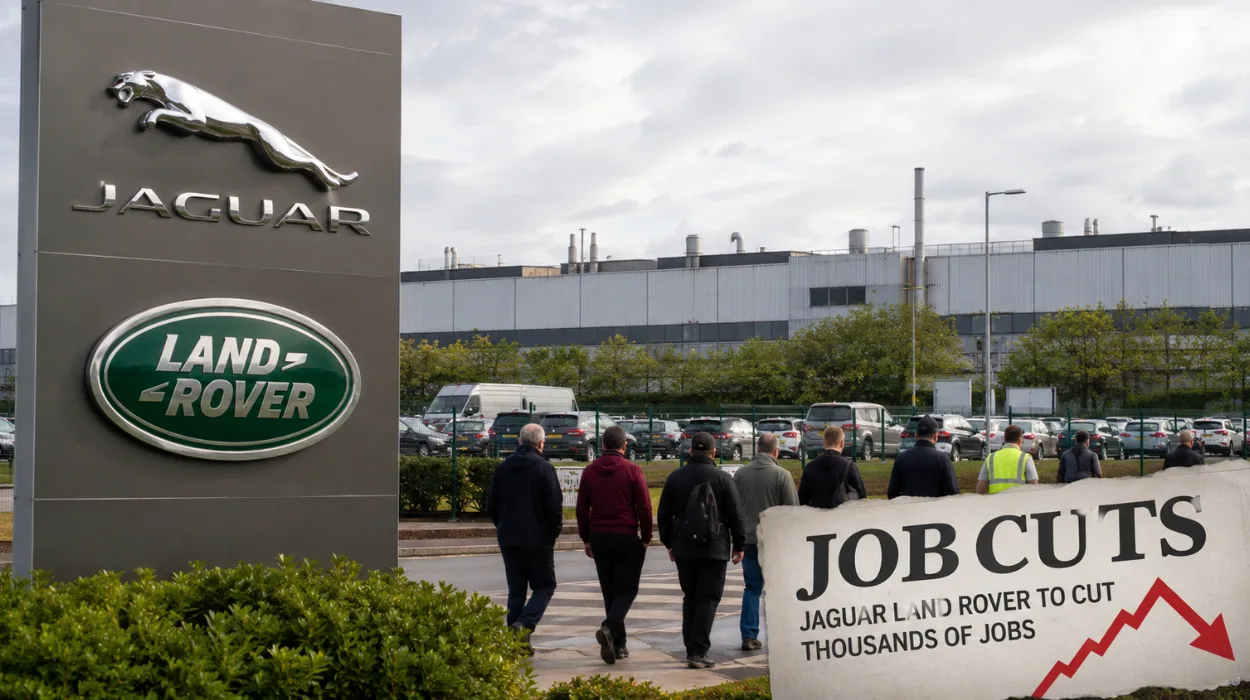
Jaguar Land Rover (JLR) is Britain’s largest carmaker. It is a wholly owned subsidiary of Tata Motors, an Indian conglomerate that acquired the company from Ford Motor Company in 2008. JLR’s global headquarters sits in Whitley, Coventry. Its UK manufacturing plants operate in Solihull, Wolverhampton, and Halewood on Merseyside. In September 2026, JLR confirmed plans to cut approximately 4,000 jobs over two years. The cuts stem from a September 2025 cyberattack, falling global sales, and US import tariffs. This article explains the scale of the cuts, their causes, and their consequences for the wider UK automotive sector.
- What Job Cuts Has Jaguar Land Rover Announced?
- Why Is Jaguar Land Rover Cutting Jobs?
- How Does JLR Fit Into the UK Automotive Sector?
- What Broader Trends Are Driving Job Losses Across UK Carmakers?
- What Has Jaguar Land Rover Said About Its Recovery Plan?
- What Does This Mean for the Future of UK Car Manufacturing?
What Job Cuts Has Jaguar Land Rover Announced?
JLR is cutting approximately 4,000 jobs over two years through a voluntary redundancy programme targeting salaried and management staff. The programme was formally confirmed in September 2026. It follows an earlier, smaller reduction of fewer than 300 positions announced in July 2026. JLR employs about 34,000 people in the UK.
JLR opened the voluntary redundancy scheme roughly one year after a cyberattack halted production for more than a month. Company statements describe the goal as organisational simplification, improved efficiency, and greater resilience. JLR has stated that impacted staff will receive support to find alternative roles within the company. Voluntary early exit remains an option for eligible employees. The 4,000-job figure was first reported by The Times before JLR confirmed the redundancy programme to staff and trade union representatives. JLR has not disclosed a site-by-site breakdown of where the cuts will fall. Its main UK operations sit in Solihull and Wolverhampton, where thousands of workers have undergone retraining for electric vehicle production in recent years.
The scale of these cuts represents roughly 12% of JLR’s UK workforce. This places JLR among the largest single rounds of job losses in UK automotive manufacturing since the 2008 financial crisis.
Why Is Jaguar Land Rover Cutting Jobs?
JLR is cutting jobs because of three combined pressures: a costly 2025 cyberattack, a steep drop in sales and profit, and US tariffs on vehicle exports. JLR’s pre-tax profit fell to £14 million in the 2025–26 financial year, down from £2.5 billion the previous year. Revenue fell by 20.9% to £22.9 billion.
The 2025 Cyberattack
A cyberattack struck JLR in late August 2025. The company shut down its IT systems as a precaution, halting all manufacturing. Not a single vehicle rolled off JLR’s production lines for several weeks. Production resumed on 8 October 2025 and returned to normal levels by mid-November 2025. The shutdown caused a 27% drop in JLR’s overall production during the affected period. The UK’s Cyber Monitoring Centre estimated the incident cost the wider UK economy £1.9 billion. The attack affected more than 5,000 UK organisations connected to JLR’s supply chain, including component suppliers dependent on JLR orders for revenue.
Falling Sales and Profit
JLR’s financial results for the year ending 31 March 2026 showed a 20.9% revenue decline to £22.9 billion. Pre-tax profit before exceptional items dropped to £14 million from £2.5 billion the prior year. Adjusted operating margins fell to 0.7%. Sales volumes declined across multiple markets, including China, where demand for premium vehicles softened. JLR also wound down production of outgoing Jaguar models ahead of the brand’s planned relaunch as an all-electric marque, temporarily reducing output.
US Tariffs
The United States imposed tariffs on imported vehicles under the Trump administration in 2025. JLR temporarily halted vehicle shipments to the US in April 2025 in response. Tata Motors reported a 15% sales drop for the quarter ending June 2025 compared to the same period in 2024, partly attributed to the tariff-driven export pause. JLR had already cut up to 500 UK management jobs in July 2025, a reduction the company described as routine voluntary redundancy rather than a direct tariff response.
Cost-Cutting Targets
In June 2026, JLR announced a plan to cut approximately £1.7 billion in costs over the following years. The company said savings would come from materials, warranty costs, and fixed overheads, alongside workforce reductions. Chief Executive PB Balaji, who took over the role in November 2025 after serving as Tata Motors Group chief financial officer, has made cost reduction and operational resilience central to the company’s recovery strategy.
How Does JLR Fit Into the UK Automotive Sector?
JLR is the UK’s largest carmaker and directly supports around 120,000 additional jobs across Britain’s automotive supply chain. The wider UK automotive sector, including manufacturing, retail, and repair, supports approximately 830,000 jobs nationally and contributes more than £75 billion in gross value added (GVA).
The UK automotive manufacturing sector alone employs around 188,000 people and generates over £85 billion in annual turnover. UK factories produced 717,371 cars and 47,344 commercial vehicles in 2025, alongside 1.60 million engines. In the first half of 2026, UK vehicle output fell 7.5% year-on-year to 385,979 cars and commercial vehicles combined, though second-quarter output stabilised, declining by just 0.1%.
JLR’s supply chain spans thousands of component manufacturers. More than 2,500 component providers operate within the UK automotive industry. Many of these firms rely on JLR contracts for a significant share of their revenue. A prolonged reduction in JLR’s production volumes, such as the shutdown following the 2025 cyberattack, directly reduces orders placed with these suppliers, creating knock-on job risk beyond JLR’s own payroll.
What Broader Trends Are Driving Job Losses Across UK Carmakers?
UK automotive job losses stem from four sector-wide trends: rising energy costs, competition from lower-cost manufacturing regions, the expensive transition to electric vehicles, and international trade barriers. The Society of Motor Manufacturers and Traders (SMMT) has repeatedly urged government action to address these pressures.
Energy Costs
UK industrial energy prices remain among the highest in Europe. The SMMT has called for urgent government action to reduce energy costs for manufacturers, arguing that high energy prices erode the competitiveness of UK-built vehicles against those produced in lower-cost countries.
Global Competition
The UK has fallen to the seventh-largest vehicle producer in Europe, behind Germany, Spain, France, Czechia, and Slovakia. New automotive factory investment increasingly flows to countries such as Poland, Hungary, Turkey, Morocco, and Egypt, where labour and operating costs are lower. This shift in investment reduces the UK’s share of new vehicle production programmes over time.
Electric Vehicle Transition Costs
The UK’s Zero Emission Vehicle (ZEV) mandate requires manufacturers to sell a rising proportion of electric vehicles each year or face financial penalties. Between 2024 and 2026, the industry subsidised battery electric vehicle (BEV) purchases through discounts totalling approximately £10 billion, averaging around £11,000 per vehicle. These discounts, funded by manufacturers rather than government, compress profit margins across the sector, including at JLR, which is simultaneously investing in new electric models such as the Range Rover Electric and Range Rover Sport Electric.
Trade Barriers
US tariffs on imported vehicles directly reduced export volumes and revenue for UK-based manufacturers in 2025. Separately, unresolved trade friction between the UK and the European Union threatens an estimated €80 billion in annual automotive trade, according to SMMT analysis. The SMMT has urged the UK government to secure improved EU trading arrangements to protect export volumes.
What Has Jaguar Land Rover Said About Its Recovery Plan?
JLR’s recovery plan centres on £1.7 billion in cost savings, five new vehicle launches, and a strategy Chief Executive PB Balaji describes as “building back stronger.” The company aims to combine cost discipline with continued investment in electrification.
In June 2026, JLR confirmed plans to launch five new products over the following two years. These include the Range Rover Electric, the Range Rover Sport Electric, a new all-electric Jaguar model, and additional vehicles built on JLR’s Electrified Modular Architecture platform. This investment continues alongside the redundancy programme, reflecting a strategy of simultaneously cutting costs in some areas while funding new product development in others.
JLR has stated that colleagues affected by the redundancy programme will be offered support in finding alternative roles within the company where possible. The company has also emphasised its commitment to “evolving global market conditions” as the stated rationale for restructuring, distinct from a purely reactive response to the 2025 cyberattack.
Explore More about Business:
Tim Cook Net Worth, Career, Apple Role & Latest Updates
Motley Fool Stock Analysis: Best Picks for Long-Term Growth
What Does This Mean for the Future of UK Car Manufacturing?
The JLR job cuts signal continued structural pressure on UK car manufacturing, with independent forecasts predicting broadly flat output in 2026 before a return to growth in 2027. Analysts at AutoAnalysis project total UK car and light vehicle output will remain close to 740,000 units in 2026.
The SMMT has framed the JLR cuts as part of a wider pattern affecting the UK automotive sector, rather than an isolated event specific to one company. Rising costs, international trade conflicts, and the financial burden of the EV transition affect multiple UK-based manufacturers simultaneously. SMMT Chief Executive Mike Hawes has stated that global market weakness and uncompetitive costs are taking a toll on the industry, while arguing that decline is not inevitable if government addresses energy costs, market regulation, and trade relationships.
UK equity investment into British businesses reached £14.4 billion in the first half of 2026, up 26% compared to the second half of 2025, indicating continued investor interest in the UK economy despite sector-specific headwinds in automotive manufacturing. The SMMT has identified a further £4.6 billion domestic sourcing opportunity within the automotive supply chain by 2030, suggesting potential for growth in UK-based component manufacturing even as individual manufacturers like JLR restructure their workforces.
The JLR cuts also arrive at a politically sensitive moment. The reductions have been described as a setback for the UK government’s stated ambition to “re-industrialise” Britain, a policy priority declared after the current government took office. The Modern Industrial Strategy, a government policy framework aimed at supporting manufacturing sectors including automotive, remains under implementation as JLR and other manufacturers navigate the current downturn.