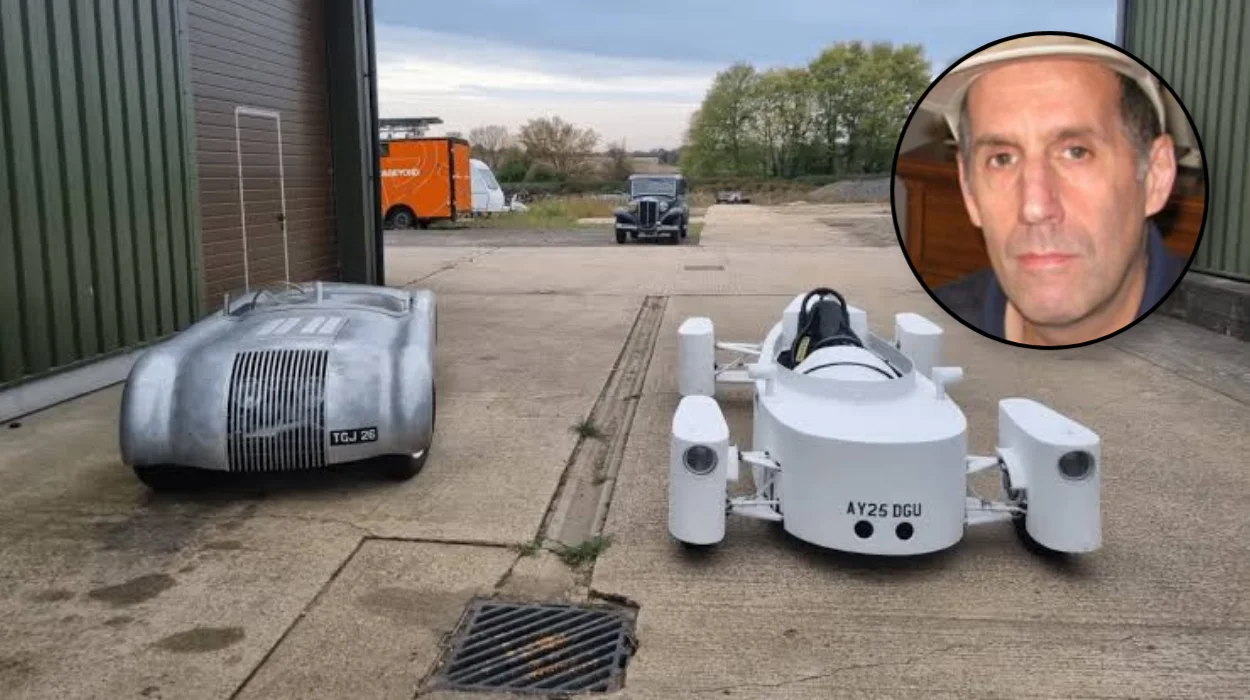
Key Points
- British car enthusiast Robert Ely built the road-legal, single-seat Gasolini AR1 in his shed for about $7,000.
- The car uses a 2017 Honda CBR500 twin-cylinder motorcycle engine producing 47 horsepower, paired with a six-speed gearbox.
- It has wheels and tyres salvaged from a Ford Ka hatchback, with a lightweight fibreglass body mounted on a simple chassis.
- Ely says the AR1 reaches around 72 mph (116 km/h) and delivers about 41 mpg under hard driving.
- The stripped engine weighs about 110 pounds and sits below the driver’s seat to keep the car’s centre of gravity low.
- Ely designed the AR1 for fun at legal speeds, with low weight, modest running costs and easily sourced parts.
- The car is road legal in the UK under kit-car regulations, but Ely does not plan to sell completed vehicles.
- Instead, he sells a $27 step-by-step manual for enthusiasts who want to build their own AR1.
- Ely built the car with hand tools, basic power tools and a welder in a shed powered by two wall sockets.
- He says modern manufacturers have lost interest in making lightweight, sustainable cars for everyday drivers.
London (Britain Today News) August 25, 2026 — A British car enthusiast has turned a modest shed into an impromptu workshop to create a road-legal, single-seat sports car that challenges the prevailing trends of heavy, complex and expensive modern automobiles. Robert Ely, who documents restoration and fabrication projects on YouTube, is the creator behind the Gasolini AR1, a minimalist machine built for approximately $7,000 using readily available motorcycle and automotive parts.
- Key Points
- Why did Robert Ely choose a Honda CBR500 engine?
- How does the AR1 achieve low weight and simple construction?
- What performance can drivers expect from the Gasolini AR1?
- How did Robert Ely build the car in a shed with basic tools?
- Is the Gasolini AR1 road legal in the UK?
- What parts and materials were used in the AR1’s construction?
- Why is the AR1 seen as an “anti-supercar”?
- How can enthusiasts build their own Gasolini AR1?
- What does the Gasolini AR1 mean for the future of affordable sports cars?
Ely’s DIY creation looks like
“a cross between a motorcycle, something out of Blade Runner, and a vintage race car roaring around Europe in the early 1900s”.
The project underscores how lightweight design and off-the-shelf components can deliver an engaging driving experience without the need for high horsepower or sophisticated electronics.
Why did Robert Ely choose a Honda CBR500 engine?
The heart of the Gasolini AR1 is a 2017 Honda CBR500 twin-cylinder motorcycle engine, selected for its compact size, reliability and ease of sourcing. According to Ars Technica’s Jonathan M. Gitlin, the engine, gearbox, wiring loom and dashboard all come from the donor Honda CBR500, with the two-cylinder inline engine mounted behind the single-seat cockpit and driving the rear wheels via a prop shaft.
Ely estimates the stripped-down engine weighs about 110 pounds, contributing to the car’s overall low mass. The 47-horsepower powerplant is paired with a six-speed sequential gearbox, providing brisk acceleration and sharp handling despite the modest output. In an interview cited by Popular Science, Ely explained:
“I kept the top speed low as I wanted this to be a sort of sprint version that is as fun as possible to drive at legal speeds and to be able to achieve 50 miles per gallon under hard driving.”
How does the AR1 achieve low weight and simple construction?
Lightweight construction is central to the AR1’s philosophy. Ely designed a simple chassis and wrapped it in fibreglass panels, deliberately avoiding compound curves so the body could be fabricated without elaborate shaping techniques. The exterior panels can be removed with basic tools, granting direct access to mechanical components for maintenance or modification.
As noted by Gadget Review, the whole car weighs under 1,000 lbs (approximately 454 kg), rolls on narrow wheels and tyres from a Ford Ka, and returns roughly 41 mpg when driven hard. The use of salvage-yard and off-the-shelf parts is intentional, making the vehicle easier to keep on the road and less vulnerable to failures involving specialised components.
What performance can drivers expect from the Gasolini AR1?
While the AR1 is not intended as a high-speed track car, its low weight and compact dimensions give it a lively character at legal speeds. The Honda engine produces 47 horsepower and 32 lb-ft of torque, enough to propel the vehicle to about 72 mph (116 km/h).
Ely took the AR1 to a local track, where he ran it alongside production cars. As reported by Popular Science, the car lacks the horsepower and top speed of many modern sports cars, but its light weight and homemade suspension give it a more direct feel than its modest output might suggest. The narrow, open, single-seat layout recalls early European racing cars, while the angular bodywork lends the machine a low-budget science-fiction aesthetic.
How did Robert Ely build the car in a shed with basic tools?
Ely constructed the AR1 in a shed using hand tools, basic power tools and a welder, with his workspace running on just two wall sockets. He said the project requires time and basic fabrication skills, but he does not believe builders need a professional workshop.
“You may be worrying or thinking that it’s a lot of effort to build your own car, and it is,”
Ely said, as quoted by Popular Science.
“But you only have to look at the cars being built today to see that the car manufacturers have no interest at all in building lightweight or sustainable cars for you.”
His approach demonstrates that a functional, road-legal sports car can be created outside the traditional factory environment.
Is the Gasolini AR1 road legal in the UK?
Yes, the AR1 is road legal in the United Kingdom under the country’s permissive kit-car regulations. Ely registered the vehicle for road use after completing the build, confirming that a homemade, single-seat sports car can meet legal requirements without the need for a manufacturer’s certification.
However, Ely has no plans to produce or sell finished cars. Instead, he is selling a $27 manual that includes step-by-step instructions for people interested in building their own AR1. This approach keeps the project accessible to enthusiasts while avoiding the complexities of mass production.
What parts and materials were used in the AR1’s construction?
The AR1’s parts list is deliberately ordinary, favouring components that other enthusiasts could realistically source. Key elements include:popsci+2
- A 2017 Honda CBR500 twin-cylinder motorcycle engine and six-speed gearbox.
- Wheels and tyres salvaged from a Ford Ka hatchback.
- A lightweight chassis covered in fibreglass panels designed without compound curves.
- A dashboard, wiring loom and other electronics from the donor Honda motorcycle.
Two openings in the front nose feed air to the radiator, and along with the round headlights, they give the car what Ely called “a little bit of character”. The engine sits below the driver’s seat, contributing to a low centre of gravity and agile handling.
Explore More about Sports:
Mike Tyson Urges Anthony Joshua and Tyson Fury to Fight on Home Soil
Netflix Sets Release Date for New Michael Schumacher Documentary: What to Expect from ‘Schumacher ’94’ in 2026?
Why is the AR1 seen as an “anti-supercar”?
The Gasolini AR1 has been described as an “anti-supercar” because it rejects the prevailing trends of heavy, expensive and electronically complex performance cars. As Gadget Review put it, the AR1 is a
“road-legal sports car built for under $7,000 using a Honda CBR500 engine, weighing under 1,000 lbs, and delivering real driving fun at legal speeds”.
In contrast to multi-tonne electric hypercars packed with screens and software, the AR1 prioritises raw driving joy, simplicity and affordability. Ely’s critique of modern manufacturers is clear: he believes they have
“no interest at all in building lightweight or sustainable cars for you”.
How can enthusiasts build their own Gasolini AR1?
For those inspired by the project, Ely offers a $27 manual containing step-by-step instructions for building an AR1. He said the project requires time and basic fabrication skills, but he does not believe builders need a professional workshop.
As reported by TechCult, “По чертежам и инструкциям, которые Эли продает за небольшую сумму, такой автомобиль можно собрать самостоятельно менее чем за $7000.” (According to the drawings and instructions that Ely sells for a small sum, such a car can be assembled independently for less than $7,000.) The manual is intended to guide hobbyists through the process of sourcing parts, fabricating the chassis and assembling the vehicle in a home workshop.
What does the Gasolini AR1 mean for the future of affordable sports cars?
The AR1 demonstrates that an engaging, road-legal sports car can be built affordably using off-the-shelf components and basic tools. It offers a counterpoint to the increasingly complex and costly vehicles dominating the market, showing that low weight and simplicity can deliver satisfying performance without high horsepower.
While Ely has no plans to scale the project into a commercial venture, his work has sparked interest among enthusiasts and commentators alike. As Ars Technica’s Gitlin noted, the Gasolini AR1 represents “the opposite of a hypercar” — a machine focused on fun, efficiency and accessibility rather than brute force and exclusivity.