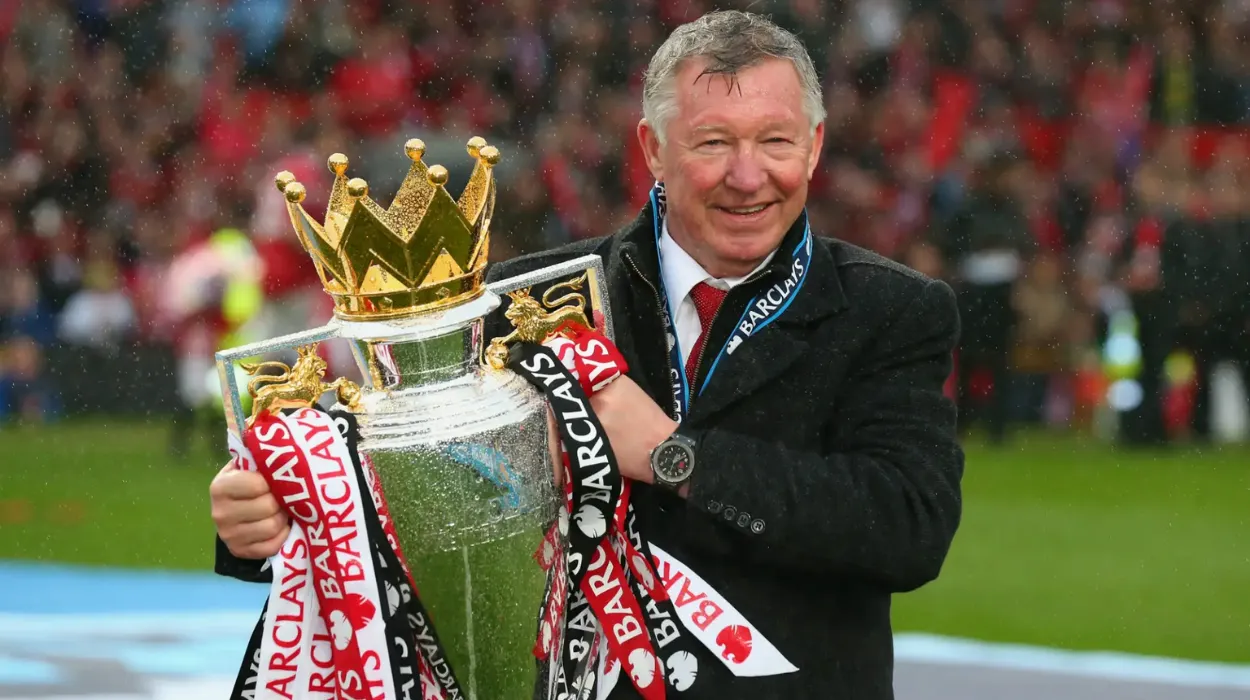
Alex Ferguson is a Scottish former football player and manager. He is widely recognised as the most successful manager in British football history. His managerial career spans four decades, including 26 years and six months at Manchester United between 1986 and 2013. This article covers his playing career, managerial record, major trophies, individual honours, and post-retirement activities.
- Who Is Alex Ferguson?
- What Was Alex Ferguson’s Playing Career?
- How Did Alex Ferguson Begin His Managerial Career?
- What Did Alex Ferguson Achieve at Aberdeen?
- When Did Alex Ferguson Join Manchester United?
- What Were Alex Ferguson’s Major Achievements at Manchester United?
- How Many Premier League Titles Did Alex Ferguson Win?
- What Champions League Titles Did Alex Ferguson Win?
- What Was the 1999 Treble?
- What Records Does Alex Ferguson Hold in the Premier League?
- What Individual Awards Did Alex Ferguson Receive?
- When Did Alex Ferguson Retire?
- What Is Alex Ferguson’s Legacy in Football?
- What Has Alex Ferguson Done Since Retirement?
Who Is Alex Ferguson?
Alex Ferguson, born December 31, 1941, in Govan, Glasgow, is a Scottish football manager and former striker. He managed Manchester United from November 1986 to May 2013, winning 13 Premier League titles and two Champions League titles.
Ferguson was knighted in 1999 for services to football, and he is formally addressed as Sir Alex Ferguson. He began his football career as a player in Scotland before transitioning into management at age 32. Manchester United is a professional football club based in Manchester, England, founded in 1878. It competes in the Premier League, the top division of English football. Ferguson took charge of the club when it had not won a top-flight league title in 19 years. By the time he retired, the club had become the most decorated team in English football under his leadership.
What Was Alex Ferguson’s Playing Career?
Ferguson played as a striker for five Scottish clubs between 1957 and 1974: Queens Park, St Johnstone, Dunfermline Athletic, Rangers, and Falkirk, before ending his career at Ayr United. His most productive spell came at Dunfermline Athletic.
Ferguson made his breakthrough at Queens Park, an amateur club, at age 16. He joined St Johnstone in 1960 and helped the club win the Scottish Second Division title in 1963. He signed for Dunfermline Athletic in 1964. During the 1965–66 season, he scored 31 league goals, finishing as joint-top scorer in the Scottish top flight alongside Celtic’s Joe McBride. Across his time at Dunfermline, he scored 66 goals in 98 appearances. Rangers signed him in 1967 for £65,000, a record transfer fee between two Scottish clubs at the time. His spell at Rangers lasted two seasons. He then moved to Falkirk, where he combined playing with early coaching duties as a player-coach. He retired as a player at Ayr United in 1974, ending a 17-year playing career.
How Did Alex Ferguson Begin His Managerial Career?
Ferguson’s managerial career began at East Stirlingshire in 1974, on a part-time salary of £40 per week. He moved to St Mirren the same year and led the club from the Scottish Second Division to the First Division title in 1977.
East Stirlingshire is a Scottish football club based in Falkirk. Ferguson took charge at age 32, marking his first managerial post after ending his playing career. His tenure there lasted only a few months before he was appointed manager of St Mirren, a club based in Paisley, Scotland. At St Mirren, Ferguson transformed a struggling Second Division side into First Division champions within three years. This early success established his reputation as a developer of young talent and set the foundation for his subsequent move to Aberdeen in 1978.
What Did Alex Ferguson Achieve at Aberdeen?
At Aberdeen, from 1978 to 1986, Ferguson won three Scottish Premier Division titles, four Scottish Cups, and the 1983 UEFA Cup Winners’ Cup, breaking the dominance of Celtic and Rangers in Scottish football.
Aberdeen Football Club is based in Aberdeen, Scotland, and competed in the Scottish Premier Division during Ferguson’s tenure. Before Ferguson’s arrival, Scottish football had been dominated for years by the Old Firm clubs, Celtic and Rangers. Ferguson ended that dominance by winning three league titles with Aberdeen. He also won four Scottish Cups, the domestic cup competition of Scottish football. His most significant European achievement came in 1983, when Aberdeen defeated Real Madrid 2–1 in the final of the UEFA Cup Winners’ Cup, a now-discontinued European club competition. Aberdeen followed this with victory in the UEFA Super Cup later that year, defeating Hamburger SV. These results made Aberdeen the first Scottish club outside the Old Firm to achieve sustained European success, and they directly led to Manchester United hiring Ferguson in 1986.
When Did Alex Ferguson Join Manchester United?
Ferguson was appointed manager of Manchester United on November 6, 1986, replacing Ron Atkinson. The club had gone 19 years without a league title at the time of his appointment.
Ron Atkinson is a former football manager who was dismissed by Manchester United after a poor start to the 1986–87 season. Ferguson’s early months focused on steering the club away from relegation danger. His first full season, 1987–88, saw United finish as runners-up in the league. Ferguson’s first major trophy at the club came in the 1990 FA Cup, a result widely credited with securing his position after early struggles. From that point, Manchester United’s trophy count grew steadily under his management, culminating in sustained domestic and European dominance through the 1990s and 2000s.
What Were Alex Ferguson’s Major Achievements at Manchester United?
Ferguson won more than 30 major trophies at Manchester United, including 13 Premier League titles, five FA Cups, two Champions League titles, and four League Cups, across his 26-and-a-half-year tenure.
Manchester United’s honours under Ferguson span domestic league competitions, domestic cup competitions, and European club competitions. Domestic trophies include the 13 Premier League titles and five FA Cups mentioned above, along with four League Cups. European trophies include two UEFA Champions League titles, won in 1999 and 2008, and one UEFA Cup Winners’ Cup, won in 1991. Ferguson also won the Intercontinental Cup in 1999 and the FIFA Club World Cup in 2008, both contested against the champions of other continental confederations. The National Football Museum records his total trophy count, including domestic Community Shields and other honours, at 49 across his entire managerial career in Scotland and England.
How Many Premier League Titles Did Alex Ferguson Win?
Ferguson won 13 Premier League titles with Manchester United between the 1992–93 and 2012–13 seasons, more than any other manager in the competition’s history.
The Premier League is the top division of English football, formed in 1992 as a rebranding of the old First Division. Ferguson’s first title, in the 1992–93 season, ended Manchester United’s 26-year wait for a top-flight league championship. He went on to win three consecutive titles on two separate occasions: from 1998–99 to 2000–01, and again from 2006–07 to 2008–09. No other manager has achieved three consecutive Premier League titles more than once. His final title, in 2012–13, was secured with four matches remaining in the season and marked the 20th top-flight championship in Manchester United’s history.
What Champions League Titles Did Alex Ferguson Win?
Ferguson won the UEFA Champions League twice, in 1999 and 2008. The 1999 final in Barcelona featured two stoppage-time goals against Bayern Munich, while the 2008 final in Moscow was won on penalties against Chelsea.
The UEFA Champions League is the premier annual club football competition in Europe, contested by top-performing teams from national leagues. In the 1999 final at Camp Nou, Manchester United trailed Bayern Munich 1–0 heading into stoppage time before scoring twice in the final three minutes to win 2–1. In the 2008 final at Luzhniki Stadium in Moscow, the match finished 1–1 after extra time, and Manchester United won 6–5 on penalties against fellow English club Chelsea. This victory made Ferguson one of a small group of managers to win the European Cup or Champions League more than once.
What Was the 1999 Treble?
The 1999 Treble refers to Manchester United winning the Premier League, FA Cup, and UEFA Champions League in a single season, an achievement no other English club had accomplished before.
A domestic and European Treble requires a club to win its national league title, its primary domestic cup competition, and the Champions League within one season. Manchester United achieved this in the 1998–99 season under Ferguson, finishing the Premier League one point ahead of Arsenal, defeating Newcastle United 2–0 in the FA Cup final, and completing the Champions League victory over Bayern Munich described above. The season is regarded as one of the most successful in English club football history, and it remains the only Treble won by an English club to date, alongside Manchester City’s Treble in 2023.
What Records Does Alex Ferguson Hold in the Premier League?
Ferguson holds the Premier League record for career wins, with 528 victories from 810 matches, alongside 11 Manager of the Season awards and 27 Manager of the Month awards.
The Premier League Manager of the Season award is given annually to the manager judged to have performed best across a full campaign. Ferguson won this award 11 times, more than any other manager in the competition’s history. He also won the monthly equivalent, Manager of the Month, on 27 occasions. His win total of 528 exceeds that of his nearest competitor by more than 50 victories. Ferguson also holds the Premier League record for the most comeback wins, registering 71 victories in matches where his team conceded the first goal, a statistic that reflects the resilience associated with his teams throughout his tenure.
What Individual Awards Did Alex Ferguson Receive?
Ferguson received the LMA Manager of the Year award multiple times, the LMA Manager of the Decade award, and a knighthood from Queen Elizabeth II in 1999 for services to football.
The League Managers Association, known as the LMA, is the representative body for football managers in England and Wales. It presents annual awards recognising outstanding managerial performance. Ferguson received the LMA Manager of the Year award on several occasions during his Manchester United tenure and was named LMA Manager of the Decade in recognition of his sustained success through the 2000s. His knighthood, awarded in 1999 following the Treble-winning season, formally recognised his contribution to English and Scottish football. He was also inducted into the Premier League Hall of Fame and the National Football Museum Hall of Fame following his retirement.
When Did Alex Ferguson Retire?
Ferguson announced his retirement as Manchester United manager on May 8, 2013. His final match in charge was a 5–5 draw against West Bromwich Albion on May 19, 2013.
Ferguson’s retirement announcement came shortly after Manchester United secured the 2012–13 Premier League title. His departure ended a managerial tenure of 26 years and six months at the club, making him the longest-serving manager in Manchester United’s history. David Moyes, a Scottish manager who had previously managed Everton, was appointed as his successor. Ferguson’s final home match at Old Trafford, against Swansea City, included a guard of honour from opposition players and a lap of the stadium in recognition of his tenure.
What Is Alex Ferguson’s Legacy in Football?
Ferguson is regarded as the most successful manager in the history of English football, based on trophy count, longevity, and sustained competitive dominance across nearly three decades at one club.
Ferguson’s tenure produced multiple generations of successful Manchester United teams, built around different core groups of players across different eras. His youth academy system developed players including David Beckham, Ryan Giggs, Paul Scholes, and Gary Neville, all of whom went on to establish long professional careers at the highest level. His management style emphasised squad rotation, mental resilience, and long-term planning across single transfer windows and multi-year rebuilding cycles. Several of his former players and assistant coaches went on to become managers themselves, extending his influence on the sport beyond his own tenure.
Explore More about Sports:
Ollie Watkins News: Transfer Updates, Goals, Stats & Rumours
English Premier League 2026: Standings, News & Match Updates
What Has Alex Ferguson Done Since Retirement?
Since retiring in 2013, Ferguson has served as a director and club ambassador at Manchester United, published multiple books, and recovered from a brain haemorrhage suffered in May 2018.
Ferguson took on a non-executive director role at Manchester United following his retirement, along with a position as club ambassador. He has published several books, including an autobiography released in 2013 and a leadership-focused book released in 2015. In May 2018, Ferguson underwent emergency surgery for a brain haemorrhage and made a full recovery within several months. In 2021, a documentary titled “Sir Alex Ferguson: Never Give Up” was released, covering both his football career and his recovery from the 2018 health emergency. He continues to attend Manchester United matches and public football events, as of his most recent public appearances.