Key Points
- The UK government and Google have announced a pioneering 30-month study to limit aviation’s climate footprint by steering planes around high cirrus clouds that form contrails over the North Atlantic (NAE), Operation Blue Skies.
- The trial will be conducted in the Shanwick Oceanic Control Area, representing about 5% of all contrail-induced warming.
- During testing periods, approximately 10,000 flights will fly through the airspace, and between 1 and 5% (hundreds of flights) will be asked to alter their altitude by up to 2,000 ft to avoid areas where contrails are likely to form.
- Google is providing the £5 million programme with AI-based forecasting technology to determine the potential for contrail formation, and the UK Department for Transport is paying for £2.65m of the total.
- Testing will be done in the winters of 2026-27 and 2027-28, during 20-40 days each winter when air traffic is lighter.
- The consortium is made up of the Met Office, NATS (UK air navigation provider), Contrails.org, Imperial College London and the University of Cambridge.
- Aviation’s overall climate impact is heavily affected by contrails, which cause 1%-2% of warming in the Earth system.
- The trial follows other individual airline experiments, such as American Airlines’ partnership with Google earlier this year in 2026.
- The government is supporting British experts and innovators to identify viable solutions to improve the cleanliness of air travel, aviation Minister Keir Mather said.
- Professor Marc Stettler of Imperial College London said it was a chance to test the theory of contrail reduction at a “real-world” scale for the first time.
Shanwick (Britain Today News) August 18, 2026 – The UK Department for Transport, in partnership with Google UK, officially launched Operation Blue Skies, marking the world’s first state-backed trial to tackle aviation’s climate impact at an entire oceanic airspace scale.
- Key Points
- How Will Contrail Avoidance Work Across the North Atlantic Corridor?
- What Role Does Google’s Artificial Intelligence Play in Predicting Contrail Formation?
- Why Are Contrails a Significant Contributor to Global Warming?
- How Many Flights Will Participate in the Trial and What Testing Schedule Has Been Planned?
- Which Organisations Form the Consortium Behind Operation Blue Skies?
- What Previous Research Supports the Feasibility of Contrail Avoidance?
- How Does This Trial Differ from Previous Individual Airline Contrail Tests?
- What Are the Expected Environmental Benefits and Long-Term Implications?
- What Challenges Remain for Widespread Contrail Avoidance Implementation?
The 30-month research programme aims to demonstrate how minor altitude adjustments to commercial flight paths can significantly reduce the formation of contrails — the thin, white clouds that trail behind aircraft and contribute substantially to global warming.
As reported by the BBC’s environment correspondent, the £5 million trial represents a critical step in addressing one of aviation’s most urgent yet solvable climate challenges, with the government funding more than half of the study’s cost.
How Will Contrail Avoidance Work Across the North Atlantic Corridor?
The trial will focus on the Shanwick Oceanic Control Area, the eastern half of the North Atlantic corridor that serves as a busy gateway for air traffic between Europe and North America.
According to NATS, the UK’s leading air navigation service provider, air traffic controllers will instruct select flights to deviate up to 2,000 feet (610 metres) from their planned altitude to avoid atmospheric conditions where contrails are likely to form.
Paul Hodgson, Google’s technical lead for Operation Blue Skies, explained that these minor altitude adjustments will be coordinated through established air traffic control communication channels and will remain within standard flight operations parameters.
What Role Does Google’s Artificial Intelligence Play in Predicting Contrail Formation?
Google UK is contributing its artificial intelligence-powered forecasting technology to identify contrail-prone regions in real time.
As outlined in Google’s official blog post, the company’s AI models will combine Met Office weather forecasts with satellite tracking data to predict where cold, humid atmospheric layers are likely to produce persistent, warming contrails.
Hodgson stated that testing across an entire airspace, rather than individual airline trials, can demonstrate how multiple planes can be moved away simultaneously from contrail-forming areas, potentially providing a blueprint for similar airspaces worldwide.
Why Are Contrails a Significant Contributor to Global Warming?
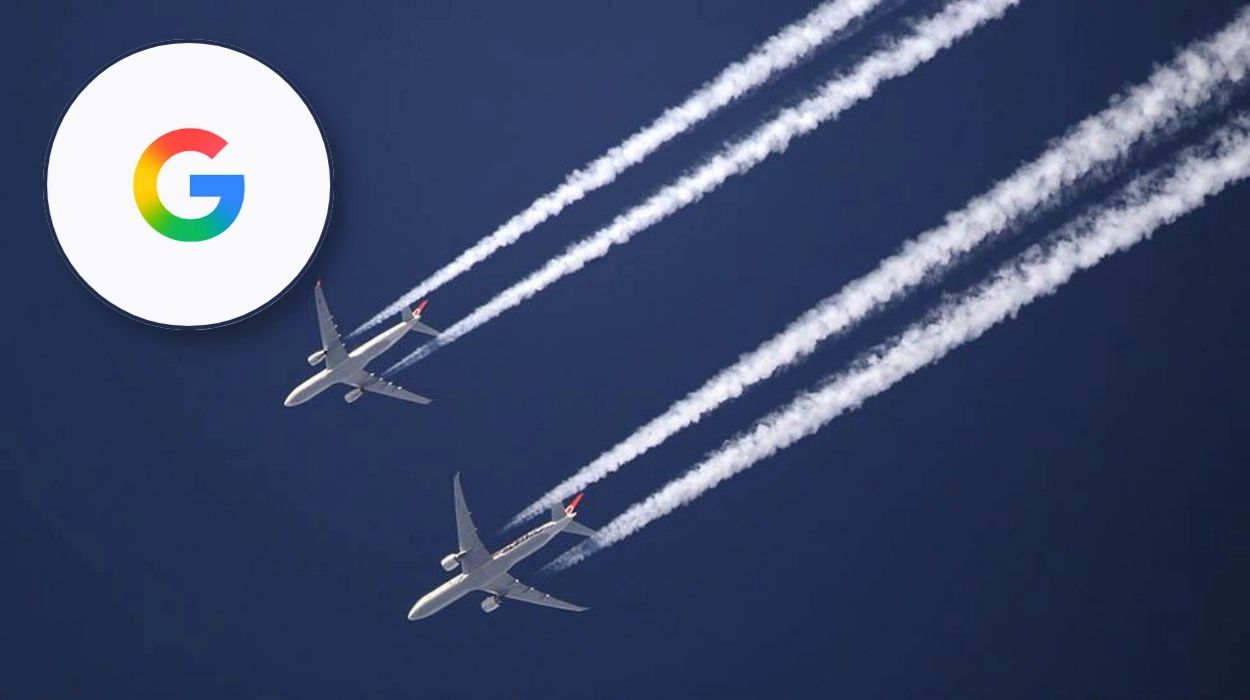
Contrails form when aeroplanes fly through cold and humid areas, causing ice crystals to form around soot particles emitted from engines, creating clouds that trap heat and warm the planet.
According to Contrails.org, a nonprofit research organisation dedicated to reducing aviation’s climate impact through contrail management, these thin, white lines are responsible for 1% to 2% of Earth’s warming.
Modelling indicates that the Shanwick airspace alone accounts for approximately 5% of the total warming contributed by contrails globally, with a significant amount occurring during winter months.
How Many Flights Will Participate in the Trial and What Testing Schedule Has Been Planned?
Around 10,000 flights are expected to pass through the Shanwick airspace during the testing periods across the two winter seasons.
Testing will occur on approximately 20 to 40 days per winter, scheduled during evenings and nights when air traffic is lighter, across the winters of 2026-27 and 2027-28.
Hodgson noted that having 1% to 5% of flights — representing hundreds of aircraft — deviate their routes would be sufficient to demonstrate a statistically significant reduction in contrail formation on an airspace scale.
Which Organisations Form the Consortium Behind Operation Blue Skies?
Along with Google and the UK Department for Transport, the consortium includes the Met Office, NATS, Contrails.org, Imperial College London, and the University of Cambridge.
The Department for Transport is allocating £2.65 million to support the programme, while Google is contributing £1.4 million for AI research, engineering, and computing infrastructure.
Aviation Minister Keir Mather said the government is partnering with Google to back British experts and innovators to find practical ways to make flying cleaner, describing contrails as one of the most urgent yet solvable climate challenges facing aviation today.
What Previous Research Supports the Feasibility of Contrail Avoidance?
An Imperial College London study published in 2020 found that small changes to flight paths could reduce the climate impact of contrails.
Professor Marc Stettler of Imperial College London said Operation Blue Skies represents a chance to test that idea in the real world, on a scale never seen before.
Earlier in 2026, Google and American Airlines announced that the airline had significantly reduced the climate impact of some flights using Google’s AI-based forecasting tool to help prevent contrail formation, demonstrating the concept’s viability at an individual airline level.
How Does This Trial Differ from Previous Individual Airline Contrail Tests?
This new effort expands on individual airline trials by attempting to mitigate contrails across an entire flight corridor rather than isolated flights.
Hodgson explained that testing over an airspace, versus individual airline trials, can show how it is possible to move multiple planes away simultaneously from an area where contrails will form, and can show if contrails can be reduced overall for a region.
The trial’s design aims to provide operational feasibility data and environmental benefits that could inform future contrail avoidance strategies across other busy airspaces globally.
Explore More about Technology:
Meta Smart Glasses Spark Privacy and Safety Concerns Among Users
£1.65m Investment Funds 17 Projects to Transform NHS Care
What Are the Expected Environmental Benefits and Long-Term Implications?
The trial aims to demonstrate that contrail avoidance is one of the most cost-effective levers available for climate action in aviation.
By 2050, contrail warming is projected to increase average surface temperatures by 0.05°C, representing 10% of the entire temperature budget between 1.5°C and 2°C, according to research cited by Hodgson.
If successful, the programme could provide a blueprint for similar trials in other contrail hotspots, potentially reducing aviation’s overall climate impact significantly.
What Challenges Remain for Widespread Contrail Avoidance Implementation?
While the trial focuses on demonstrating feasibility, broader implementation would require coordination across multiple air navigation service providers, airlines, and regulatory bodies.
Recent research published in July 2026 highlighted that while 93% of contrail-optimised flights emit more nitrogen oxides (NOx) on average, they emit it at lower, less climate-sensitive altitudes, suggesting complex trade-offs in optimisation strategies.
The consortium partners emphasised that the trial represents a foundational step toward developing operational frameworks that balance contrail avoidance with other environmental and operational considerations.