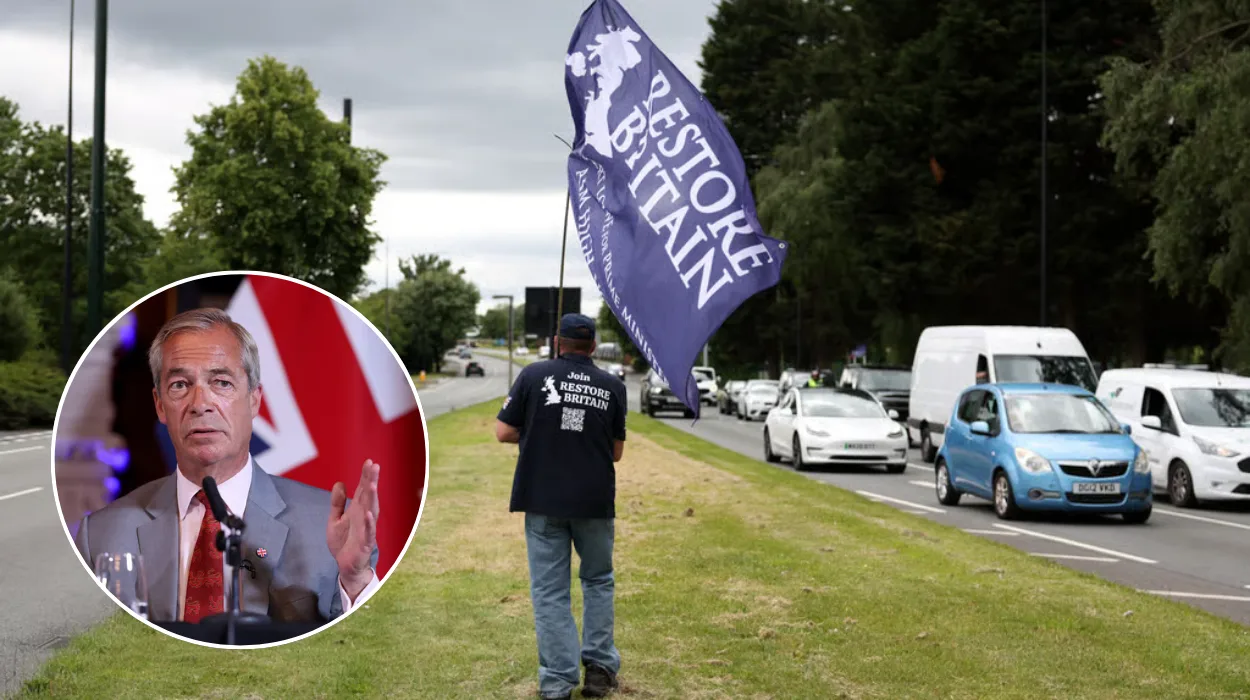
Key Points
- Nigel Farage has expressed that he will not meet with Rupert Lowe until Restore Britain expels co-founder Charlie Downes from its inner circle.
- Farage lashed out against those in Lowe’s circle for peddling the “old theory” of anti-semitic conspiracy theories.
- Farage also quoted comments from Restore Britain’s Steve Laws, who calls for “total remigration”.
- Rupert Lowe has refused to sack Downes, claiming it’s “simply not how I operate”.
- Lowe recently made an offer to Farage to “put aside past disagreements” and cooperate on a deal, but gave him five stipulations.
- One of Lowe’s demands was that those who had defected from the Conservatives to Reform UK should not be included in any future Farage-led Cabinet.
- The clash has intensified splits within the British political right and left, putting the potential merger between Reform UK and Restore Britain in jeopardy.
- Farage was speaking at a Westminster press conference in which the issue of pressure on Britain’s prisons was the primary concern.
- Reform UK claims it would consider taking up space in prisons in other nations such as El Salvador, Kosovo, Estonia and Lithuania.
- The party says its proposals would lead to the creation of 10,000 prison spaces, but it has been suggested that almost a third of foreign nationals in detention are not in prison but on remand.
- Most of those detained on remand are finally convicted, said Zia Yusuf, a Reform Home Affairs spokesman.
- The row is taking place as Reform UK is under pressure from a new Labour polling bounce under Prime Minister Andy Burnham.
Westminster (Britain Today News) August 10, 2026 — Nigel Farage has ruled out formal discussions with Rupert Lowe unless Lowe removes Charlie Downes, a co-founder and controversial figure within the leadership circle of Restore Britain.
- Key Points
- What condition has Nigel Farage set for negotiations?
- Who is Charlie Downes and why is he controversial?
- What did Farage say about Steve Laws?
- Can Reform UK and Restore Britain still work together?
- Why is the dispute important for the British right?
- What did Rupert Lowe offer in recent weeks?
- Why did Farage hold the Westminster press conference?
- How did Reform respond to concerns about remand prisoners?
- What happens next for Farage and Lowe?
Farage used a press conference in Westminster to set out what he described as a condition for talks with Lowe’s splinter party. Rather than naming Restore Britain directly throughout his remarks, Farage referred to it as “that party” while making clear that he did not believe meaningful negotiations could proceed while Downes remained close to its leadership.
The intervention represents a fresh setback for efforts to unite parts of Britain’s right-wing political movement. Lowe has recently signalled that he is willing to put his disagreements with Farage behind him and explore cooperation. However, the two men remain divided over the people surrounding Lowe and over the terms of any future political arrangement.
Farage said he was prepared to meet Lowe personally, but questioned whether he could sit down with some individuals associated with Restore Britain without alienating Reform UK members and voters.
“I’m always happy to meet people and talk to people — within reason,”
Farage said.
“But I do think it’s fair to say that there are one or two people in the orbit of the upper echelons of that party who, if I sat down and talked to them, I think our members and our voters would be utterly shocked that I’d done it,”
He added.
Farage then identified the removal of people he considers unacceptable from the party’s “inner circle” as the central requirement for any potential talks.
What condition has Nigel Farage set for negotiations?
Farage said discussions with Lowe could take place if individuals he regards as politically toxic were excluded from Restore Britain’s leadership structure. His principal demand was that Charlie Downes should be expelled or removed from the party’s inner circle.
“So we can talk to Rupert Lowe — that’s fine,”
Farage said.
“But when you have co-founders, etcetera, putting out what I would call the ‘old theory’ — the old theory that we probably haven’t heard in this country since 1936 — and you have other adjacent publicly supportive people demanding that all Jews be removed from the country, just as an example…”
“So the condition I would put on it is those people would have to be out of the inner circle — and I think that for me would be the only way we could sensibly proceed.”
Farage did not describe Downes as someone who formally speaks for Restore Britain on every issue. His objection instead centred on the fact that Downes is a co-founder and is understood to remain connected to the party’s senior ranks.
The comments reflect the political sensitivity surrounding antisemitic rhetoric and conspiracy theories in Britain’s political debate. Farage’s reference to the “old theory” was understood to concern claims that Jewish people or Jewish supporters exercise hidden influence over political figures.
Campaigners opposing antisemitism have accused Downes of repeating what they described as the “oldest smear” against Jewish people. Downes was accused this month of implying that Farage had been “bought” by Jewish supporters.
Those allegations have created an additional obstacle for Lowe, who is attempting to establish Restore Britain as an independent political force while also leaving open the possibility of cooperation with Reform UK.
Who is Charlie Downes and why is he controversial?
Charlie Downes is a co-founder of Restore Britain and has become central to the disagreement between Farage and Lowe. Although the available report does not set out every detail of Downes’s role in the party, Farage’s demand focuses on his position close to the organisation’s leadership.
The controversy intensified after Downes was accused of suggesting that Farage had been influenced or financially supported by Jewish backers. Opponents said the allegation reproduced an antisemitic trope that has historically portrayed Jewish people as secretly controlling political and financial decisions.
Farage’s remarks indicate that he considers the issue more than a personal disagreement between two political figures. He presented it as a question of whether Reform UK could enter discussions with a political organisation whose senior figures or associates might be linked to statements that Reform members would find unacceptable.
Lowe has responded by rejecting the demand. After The Telegraph first reported Farage’s opposition to talks, Lowe wrote on X that Farage and Reform UK wanted Restore Britain to dismiss Downes.
“Farage and Reform have also said that Restore Britain must outright sack Charlie Downes — putting a young Christian man out of work, just as he is looking to build his life and start a family,”
Lowe wrote.
“That is simply not how I operate,”
He added.
Lowe’s response shows that the dispute is not only about electoral strategy. It also concerns his authority over the internal organisation of Restore Britain and his willingness to remove a senior colleague in response to pressure from Farage.
What did Farage say about Steve Laws?
Farage also referred to Steve Laws, a supporter of Restore Britain who advocates “total remigration”. Farage described Laws as one of the “other adjacent publicly-supportive people” associated with the party.
The reference was significant because Lowe previously told POLITICO in June that Laws had no role in Restore Britain’s decision-making process. Lowe said Laws was “very welcome” to support the party, but sought to distinguish public backing from formal influence over policy or leadership decisions.
Farage, however, argued that the presence of people making extreme statements around the party would make it difficult for Reform UK to engage with Restore Britain. His concern was not limited to whether such individuals held an official position. Instead, he suggested that their proximity to the party could affect the credibility of any agreement with Lowe.
The argument highlights a strategic dilemma for Restore Britain. A party seeking to attract support from voters on the right may benefit from backing by activists with hard-line views, but that same support can make cooperation with a larger political organisation more difficult.
For Reform UK, the calculation is equally complicated. Farage is seeking to expand his party’s appeal and challenge the governing Labour Party, but he also needs to prevent controversial associations from damaging Reform’s reputation among its members and voters.
Can Reform UK and Restore Britain still work together?
A formal agreement between Reform UK and Restore Britain now appears to face serious obstacles. Lowe offered last week to put “past disagreements” with Farage aside so that the two groups could work together. His proposal was presented as an attempt to overcome the conflict that led to the creation of Restore Britain.
However, Lowe attached five conditions to any cooperation. One of them was that Conservative MPs who defected to Reform UK should not be included in a future Cabinet led by Farage.
That demand underlines the depth of the rivalry between Lowe and Farage. Lowe was removed from Reform UK before establishing Restore Britain, and the relationship between the two men has remained tense. While Lowe has presented himself as open to cooperation, he has also sought to ensure that any partnership would not simply place Restore Britain under Farage’s control.
Farage’s latest condition emphasises personnel rather than policy. He has not rejected the possibility of speaking to Lowe altogether. Instead, he has said that cooperation would require the removal of individuals whose public positions could create political and reputational problems.
The two sides therefore remain separated by both trust and tactics. Lowe wants to maintain control over his own party and protect its senior figures. Farage wants assurances that any partner organisation will not bring statements or campaigners into an alliance that could alienate Reform supporters.
Why is the dispute important for the British right?
The disagreement comes at a time when Reform UK is attempting to strengthen its position in British politics. The party’s path to power was already described as narrowing before the arrival of new Prime Minister Andy Burnham produced a polling bounce for Labour.
Reform UK remains in single digits in the polling picture outlined by POLITICO, but Restore Britain has reportedly been taking a significant share of Reform’s potential support. That makes Lowe’s party too important for Reform to ignore, even if an alliance remains politically uncomfortable.
For Farage, the central challenge is to prevent a divided right from weakening its overall electoral influence. A split vote could make it more difficult for Reform UK to win seats, particularly if Restore Britain attracts voters who would otherwise support Farage’s party.
For Lowe, the creation of Restore Britain provides an opportunity to build a separate political identity. He may be able to appeal to voters dissatisfied with Reform UK, but his party’s prospects could also depend on whether it can establish itself beyond its conflict with Farage.
The dispute has therefore become a test of whether the British right can form a broad electoral coalition without resolving every disagreement over leadership, personnel and political language. Farage’s demand suggests that he is unwilling to prioritise unity at any cost.
What did Rupert Lowe offer in recent weeks?
Lowe had attempted to reduce tensions by offering to set aside previous disagreements with Farage. His proposal indicated that he believed the two groups could work together despite their history and competing political ambitions.
The offer was not unconditional. Lowe listed five requirements, including a demand concerning Conservative defectors who joined Reform UK. He argued that those MPs should not be rewarded with ministerial roles in a future Farage-led government.
That condition would limit Farage’s freedom to assemble a Cabinet and would also affect the political standing of MPs who had chosen to leave the Conservatives for Reform UK. It shows that Lowe’s proposed cooperation was designed to shape the future direction of Reform rather than simply merge the two movements.
Farage’s response has now added another requirement: the exclusion of Downes and other controversial figures from the centre of Restore Britain. The competing conditions have left the proposed partnership at an impasse.
Lowe has not accepted Farage’s demand to remove Downes. As a result, the prospect of a political pact remains uncertain, with neither side appearing ready to surrender control over its own leadership decisions.
Why did Farage hold the Westminster press conference?
Farage made his comments during a press conference focused primarily on the pressure facing Britain’s prisons. The prison system has been operating close to breaking point in recent years, creating a political challenge for the Government and an opportunity for Reform UK to promote its own proposals.
Farage used the event to present a plan under which a future Reform UK government would seek to deport foreign prisoners so that they could serve their sentences abroad. He said Reform would begin talks with El Salvador about renting prison space for that purpose.
He also suggested that Kosovo, Estonia and Lithuania could potentially take part in similar arrangements. The proposal echoes Donald Trump’s controversial policy of transferring prisoners from the United States to facilities outside the country.
Reform UK claimed that the plan could free up 10,000 spaces in British prisons. The figure formed part of the party’s wider argument that foreign nationals serving custodial sentences place additional pressure on limited prison capacity.
However, the proposal immediately raised questions about the status of people held in detention who have not been convicted. Nearly one-third of foreign nationals in detention are reportedly on remand, meaning they are awaiting trial rather than serving a sentence after conviction.
Explore More about Politics:
Rape Crisis Alliance Condemns MSP Q Manivannan’s ‘Spectrum’ Remarks
Burnham Wealth Tax Row: Minister Denies Bills Link
How did Reform respond to concerns about remand prisoners?
Zia Yusuf, Reform UK’s home affairs spokesperson, was pressed on the difference between the party’s claim about freeing prison capacity and the number of foreign nationals who are already convicted.
Yusuf rejected the suggestion that the presence of remand prisoners undermined Reform’s proposal.
“That’s not the gotcha that you might think it is,”
Yusuf said.
“The vast majority of those people end up being convicted — so in terms of the practical plan that we’ve laid out, it makes no difference.”
His response presented the remand figure as a temporary stage in a process that would often end in conviction. However, the issue remains politically important because people on remand have not yet been found guilty and cannot automatically be treated in the same way as sentenced prisoners.
The debate also raises questions about how any international prison-rental agreement would operate in practice. The report does not provide details of potential costs, legal arrangements, oversight mechanisms or the countries’ willingness to accept prisoners from Britain.
Farage’s proposal is therefore likely to remain part of a broader political argument over immigration, deportation and prison capacity. It also places pressure on the Government to explain how it plans to deal with overcrowding while protecting legal safeguards for people awaiting trial.
What happens next for Farage and Lowe?
The immediate future of relations between Farage and Lowe will depend on whether either side changes its position. Farage has signalled that he is willing to speak with Lowe but not while Downes remains within Restore Britain’s inner circle.
Lowe, for his part, has rejected the principle of dismissing Downes at Farage’s request. His position suggests that he views the demand as an attempt to dictate the internal structure of Restore Britain.
A breakthrough would require one of several developments: Lowe could remove Downes, Farage could soften his condition, or the two sides could agree to separate formal negotiations from the question of Restore Britain’s controversial supporters.
At present, none of those outcomes appears guaranteed. The dispute has moved beyond a disagreement over electoral cooperation and become a public test of authority between two rival figures on the British right.
The prison policy announcement may also shape the next stage of the argument. Farage has attempted to use pressure on the prison system to present Reform UK as a party with practical answers to overcrowding. But the controversy over foreign prisoners, remand detainees and overseas prison arrangements could generate further scrutiny.
For now, the proposed alliance remains blocked by demands over who can remain close to Lowe’s party leadership. Farage’s position is that unity cannot be built around figures whose comments risk alienating Reform voters or reviving antisemitic conspiracy claims. Lowe’s position is that removing a co-founder simply to satisfy Farage would violate the way he runs his political organisation.
The result is a fractured British right, with Reform UK and Restore Britain competing for similar voters while debating whether cooperation is possible without one side surrendering control.