What happened when England received a red card against Mexico?
England defender Jarell Quansah was sent off in the 54th minute of the 2026 FIFA World Cup Round of 16 match against Mexico, forcing the team to play the remaining time with 10 men while leading 2-1. England went on to win the match 3-2 at Mexico City Stadium, formerly known as Estadio Azteca.
- What happened when England received a red card against Mexico?
- Who is Jarell Quansah and why was he sent off?
- What are the rules for a red card in football?
- How did England manage the match after going down to 10 men?
- What is the history of England players receiving red cards at the World Cup?
- What are the consequences of a red card for future matches?
- How common are red cards at the 2026 World Cup?
- What impact does a red card have on team tactics and strategy?
- What is the broader significance of England’s win despite the red card?
The dismissal occurred after a video assistant referee (VAR) review of a challenge Quansah made on Mexico’s Jesús Gallardo. Match referee Alireza Faghani initially allowed play to continue, then reversed his decision to a straight red card after reviewing the incident on the pitch-side monitor. The sending-off transformed the second half from a defensive assignment into a survival test for England, which had to protect a one-goal lead against a Mexico team playing in front of a crowd of more than 80,000 people at one of football’s most intimidating venues.
Where and when did the match take place?
The fixture was played on Sunday, July 5, 2026, in Mexico City. The stadium sits at an altitude of approximately 2,200 meters above sea level, a factor that has historically affected player fatigue and decision-making late in matches at that venue.
Who is Jarell Quansah and why was he sent off?
Jarell Quansah is an England defender who started the Mexico match at right back after recovering from an ankle injury that had ruled him out of the previous knockout-round game. He committed a reckless, high tackle on Gallardo, which the referee judged to meet the threshold for serious foul play once reviewed on video.
Quansah had been restored to the starting lineup specifically to cover the right-back position, a role complicated by injuries elsewhere in the England squad. Reece James, who began the tournament as the starting right back, was unavailable because of a hamstring injury. With Trent Alexander-Arnold left off England’s 2026 World Cup roster entirely, manager Thomas Tuchel had limited options at that position even before the red card.
What was the referee’s decision-making process?
Football’s video assistant referee system allows an on-field official to review incidents on a pitch-side monitor before making or amending a decision. In this case, the original call did not result in immediate punishment, but the VAR team flagged the challenge for review. The referee then upgraded the outcome to a red card after watching the replay.
What are the rules for a red card in football?
A red card means a player is sent off immediately and cannot be replaced by a substitute, forcing the team to finish the match with one fewer player on the field. This rule is set out in the Laws of the Game maintained by the International Football Association Board (IFAB), football’s law-making body.
There are two categories of red card. A straight red card is issued for a single serious offense, such as violent conduct, denying an obvious goal-scoring opportunity through a foul, or serious foul play, which was the case with Quansah. A second-yellow red card occurs when a player receives two cautions in the same match, with the second yellow card automatically converting into a red card. The practical effect on the match is identical in both cases: the player leaves the field and takes no further part in the game, and the team is not permitted to bring on a substitute in the dismissed player’s place.
Can a match continue with fewer players?
IFAB’s Laws state that a match cannot continue if a team has fewer than seven players on the field. A single red card leaves a team with 10 players, well above that threshold, so the match proceeds without interruption. Multiple dismissals on the same team could eventually trigger this rule, but this is rare at elite level.
How did England manage the match after going down to 10 men?
England shifted to a five-at-the-back defensive formation immediately after Quansah’s dismissal, with center back Ezri Konsa moving to the right side of the defense to cover the vacated position. Manager Thomas Tuchel also made a defensive substitution, bringing on John Stones for winger Bukayo Saka to reinforce the backline.
Despite being a man down, England extended its lead six minutes after the red card when Harry Kane converted a penalty, awarded after Mexico goalkeeper Raúl Rangel brought down Anthony Gordon in the penalty area. This put England ahead 3-1. Mexico responded with a penalty of its own, scored by Raúl Jiménez in the 69th minute after Kane was penalized for a foul, cutting the deficit to 3-2. Mexico then attacked for the remaining portion of regulation time plus 11 minutes of stoppage time but could not find an equalizer against England’s 10 men.
Who scored England’s goals in the match?
Jude Bellingham scored twice within 98 seconds of each other, and Harry Kane added the third goal from the penalty spot. Kane’s goal was his sixth of the tournament and the 14th of his World Cup career, a tally that matched former West Germany striker Gerd Müller for fifth place on the tournament’s all-time scoring list.
What is the history of England players receiving red cards at the World Cup?
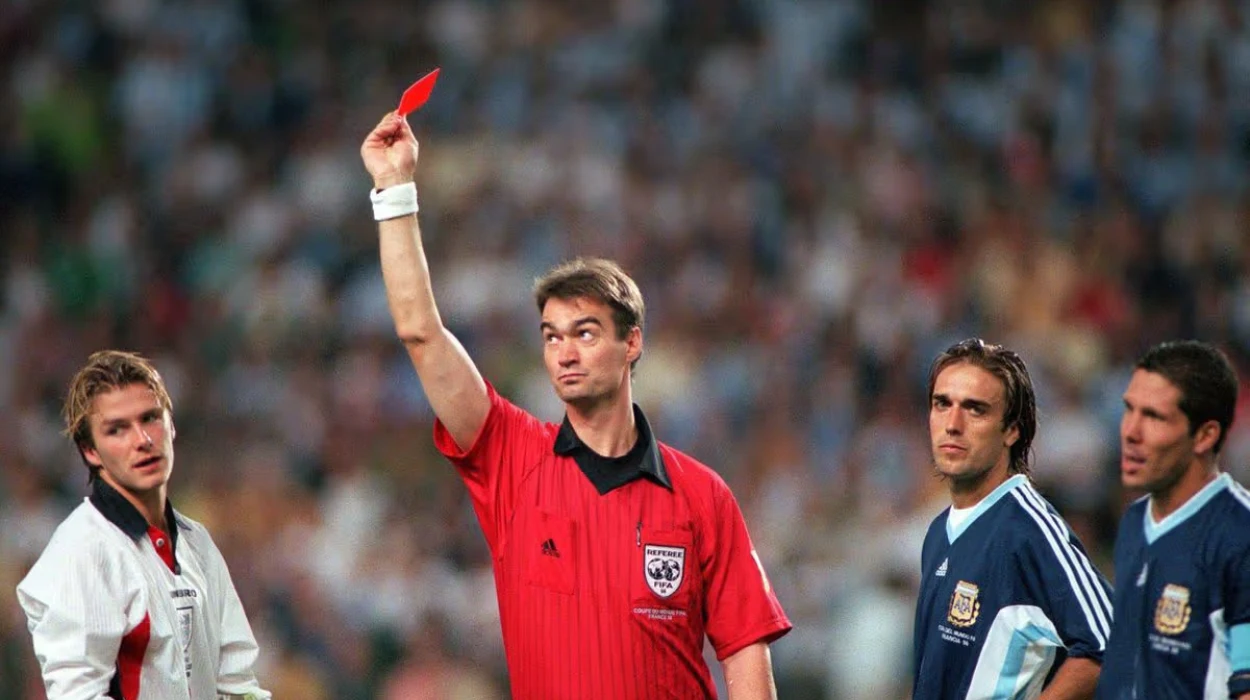
Jarell Quansah became the fourth England player in history to be sent off at a World Cup and the first since Wayne Rooney in 2006. The three earlier dismissals belonged to Ray Wilkins in 1986, David Beckham in 1998, and Wayne Rooney in 2006.
This history places Quansah’s dismissal in a specific statistical context. England has played in 17 World Cup tournaments since its first appearance in 1950, and across all of those tournaments, only four players have been shown a red card. This makes World Cup dismissals a rare event for the national team, occurring roughly once every 20 years on average.
What happened in England’s three previous World Cup red cards?
Ray Wilkins was dismissed in 1986 for throwing the ball at a referee. David Beckham was sent off in 1998 for kicking an opponent while lying on the ground. Wayne Rooney received a red card in 2006 for stamping on an opponent during a quarterfinal match. Each of these incidents became defining moments in English football history, illustrating how a single dismissal can shape public memory of a tournament regardless of the eventual result.
What are the consequences of a red card for future matches?
A red card at the World Cup typically results in an automatic one-match suspension for the following game, meaning Quansah was set to miss England’s quarterfinal against Norway. FIFA’s disciplinary authorities retain the power to intervene in specific cases, but the standard consequence remains a one-match ban.
This suspension created a squad problem for Tuchel heading into the quarterfinal. With Quansah unavailable and Reece James still working through a hamstring injury, England’s depth at right back was severely tested. The absence of Alexander-Arnold from the World Cup roster meant Tuchel had fewer specialist options to fill the position for the next match.
Does a red card suspension carry over between tournament stages?
Yes. Suspensions earned in one knockout round carry forward into the next match a team plays, regardless of the round. Had England been eliminated by Mexico, any suspension would have applied to the team’s next official fixture rather than the World Cup.
How common are red cards at the 2026 World Cup?
Quansah’s sending-off was the 13th red card of the 2026 World Cup, a tournament that has produced a higher-than-average rate of dismissals through its knockout rounds. The record for red cards in a single World Cup remains 28, set at the 2006 tournament in Germany.
Mexico City Stadium specifically has produced more red cards than any other 2026 World Cup venue, with five dismissals shown there through the Round of 16 stage. Some analysts have pointed to the stadium’s high altitude as a possible contributing factor to player fatigue and rash challenges late in matches, though this remains an observation rather than a confirmed cause.
Which other red cards preceded Quansah’s dismissal?
Before Quansah’s sending-off, the most recent red card of the tournament was shown to Ecuador’s Piero Hincapie during Mexico’s 2-0 win over Ecuador, for covering his mouth on the field. Mexico had also received a red card earlier in the tournament, shown to Cesar Montes in the opening match, making El Tri a team affected by dismissals on both sides of the ball across the competition.
What impact does a red card have on team tactics and strategy?
A red card forces the affected team to sacrifice attacking width and possession control in exchange for defensive solidity, typically triggering an immediate formation change to protect the reduced number of outfield players. England’s shift to a back five after Quansah’s dismissal is a standard tactical response used across professional football.
Playing with 10 men reduces a team’s ability to press opponents high up the pitch and increases the physical workload on remaining players, who must cover more ground to compensate for the missing teammate. Coaches typically respond by substituting an attacking player for a defensive one, as Tuchel did by replacing Saka with Stones, prioritizing defensive numbers over attacking threat for the remainder of the match.
Why do teams often still create chances after a red card?
Teams reduced to 10 men sometimes retain attacking threat through counterattacks, since the opposing team commits more players forward to exploit the numerical advantage, leaving space in behind. England’s third goal, converted by Kane from the penalty spot, came directly from this dynamic, as Gordon exploited space to draw a foul from Mexico’s goalkeeper.
Explore More about Sports:
England v Mexico: Predicted Lineups, Stats & Match News
India vs England Clash: Results, Stats & Player Insights
What is the broader significance of England’s win despite the red card?
England became the first team to defeat Mexico in a World Cup match at the Azteca venue and only the third team to win there across 89 total competitive matches, a result achieved despite playing over half the second half with 10 men. The victory advanced England to a quarterfinal meeting with Norway in Miami Gardens, Florida.
The result carries historical weight for the England national team, which has not won the World Cup since 1966. Advancing past a co-host nation, in front of a hostile crowd, and while managing a numerical disadvantage for more than 35 minutes strengthened the team’s case as a genuine title contender heading into the tournament’s final stages.
What happens next for England in the tournament?
England is scheduled to play Norway, led by striker Erling Haaland, in the quarterfinal in Miami Gardens, Florida. Quansah’s suspension means Tuchel must resolve the right-back position without his first-choice option from the Mexico match, adding a tactical selection issue to what is otherwise a positive position in the tournament for England.
The red card against Mexico illustrates a broader pattern in modern football: a single refereeing decision, reviewed and confirmed through VAR, can reshape not only the outcome of one match but the squad selection and tactical planning for matches still to come. Understanding the rules governing red cards, suspensions, and their downstream effects helps explain why a moment lasting only seconds on the field can carry consequences that extend across an entire tournament.