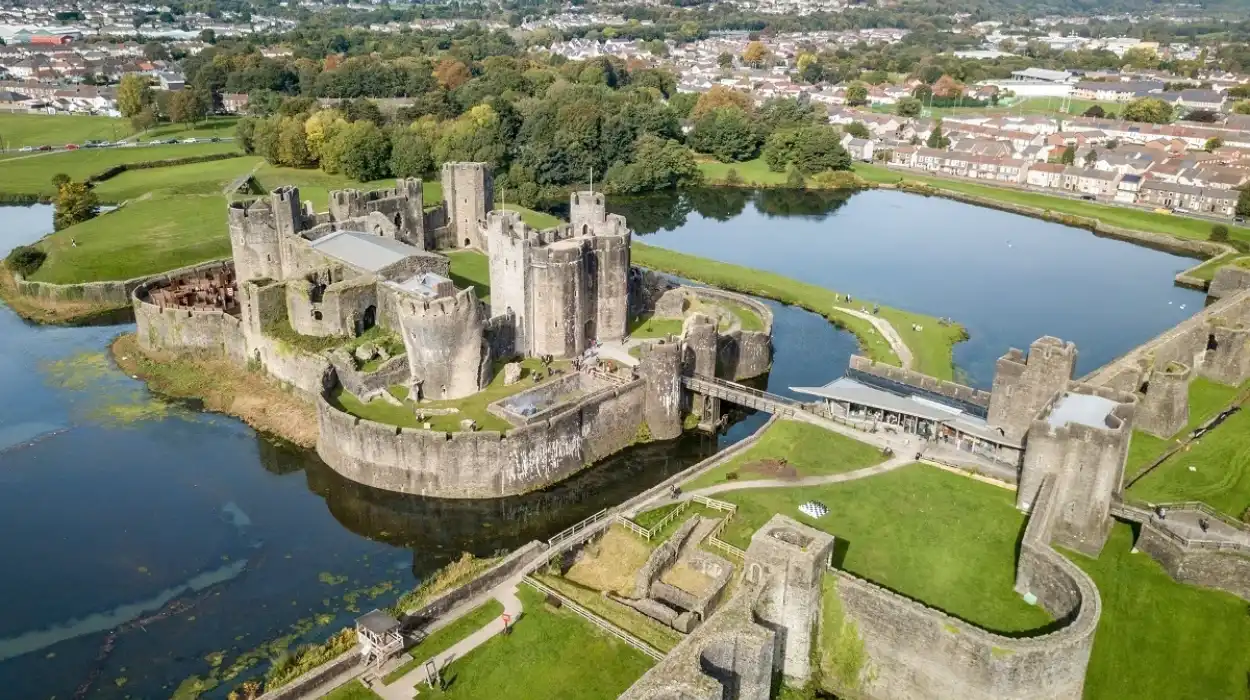
Wales is a country within the United Kingdom, bordered by England to the east and the Atlantic Ocean and Irish Sea on its remaining three sides. It covers 8,023 square miles and has a coastline of 1,680 miles. No location in Wales sits more than 50 miles from the sea. Wales contains three national parks, five Areas of Outstanding Natural Beauty, and four UNESCO World Heritage Sites. It has more than 600 castles, giving it the highest castle density of any country on Earth. This article defines the country’s key regions, explains its historical development, and provides factual, practical guidance for visitors.
- What Is Wales Known For?
- What Is the History of Wales?
- What Are the Top Destinations to Visit in Wales?
- National Parks and Natural Landmarks
- Castles and Historic Sites
- Cities and Towns
- Industrial and Engineering Heritage Sites
- What Is the Best Time of Year to Visit Wales?
- How Do You Get Around Wales?
- What Should Visitors Know Before Visiting Welsh Castles?
- What Outdoor Activities Are Available in Wales?
- What Is the Welsh Language and Where Is It Spoken?
- What Is the Economic and Political Structure of Modern Wales?
What Is Wales Known For?
Wales is known for its castles, mountains, coastline, rugby heritage, and the Welsh language. It has over 600 castles, three national parks, 1,680 miles of coastline, and 800,000 Welsh speakers, representing roughly 29% of the population.
Wales occupies a distinct cultural and geographic identity within the United Kingdom. Its castle count exceeds that of any comparably sized territory in the world, a legacy of centuries of conflict between Welsh princes, Norman lords, and English monarchs. Snowdonia National Park, renamed Bannau Brycheiniog in Welsh usage for the Brecon Beacons area, and the Pembrokeshire Coast National Park anchor the country’s outdoor recreation industry. Rugby union functions as the national sport; the Welsh national team has won 12 Grand Slam titles in the Six Nations Championship and its predecessor tournaments. The Welsh language, known as Cymraeg, is the oldest living language in Britain, spoken continuously since at least the 6th century. English and Welsh hold equal legal status under the Welsh Language Act, and all road signage in Wales is bilingual.
Wales also holds industrial significance. The Blaenavon Industrial Landscape and the Pontcysyllte Aqueduct and Canal, both UNESCO World Heritage Sites, document the country’s role in the 18th and 19th century Industrial Revolution, particularly in coal mining, ironworking, and slate quarrying. The Slate Landscape of Northwest Wales received UNESCO designation in 2021, recognising the region’s historical role supplying roofing slate across the world.
What Is the History of Wales?
Welsh history spans Celtic tribal settlement, Roman occupation, medieval Welsh kingdoms, Norman and English conquest under Edward I in 1283, and eventual political union with England through the Laws in Wales Acts of 1535 and 1542.
Human settlement in the region dates to the Palaeolithic period, but the identifiable Welsh nation emerged from Celtic Brittonic-speaking tribes who occupied the territory before and during Roman rule, which lasted from approximately AD 43 to AD 410. Following the Roman withdrawal, Wales fragmented into a number of independent kingdoms, including Gwynedd, Powys, and Deheubarth. These kingdoms frequently warred with one another and with neighbouring Anglo-Saxon territories.
Norman lords began encroaching on Welsh territory after the 1066 Norman Conquest of England, establishing what became known as the Welsh Marches, a series of semi-autonomous lordships along the border. Welsh resistance persisted for over two centuries. Llywelyn ap Gruffudd, known as Llywelyn the Last, was recognised as Prince of Wales under the 1267 Treaty of Montgomery, but conflict with King Edward I of England resumed in 1276. Llywelyn was killed in 1282, and Edward I completed his conquest of native Welsh territory by 1283.
Edward I consolidated control through a network of fortifications known as the Iron Ring, constructed between 1277 and 1295. This program included the castles at Caernarfon, Conwy, Harlech, and Beaumaris, all four of which received UNESCO World Heritage status in 1986 as the Castles and Town Walls of King Edward in Gwynedd. The 1284 Statute of Rhuddlan formally annexed Wales to the English Crown. Political union was completed through the Laws in Wales Acts of 1535 and 1542, which incorporated Wales into the English legal and administrative system and gave Welsh representation in the English Parliament.
The 18th and 19th centuries brought industrialisation. South Wales became a centre for coal mining and iron production, while Northwest Wales became the world’s leading producer of roofing slate. This period reshaped the population, drawing workers into industrial valleys such as those around Blaenavon and Merthyr Tydfil. Wales gained its own devolved government in 1999, when the National Assembly for Wales, now called the Senedd, was established following a 1997 referendum. The Senedd holds legislative powers over areas including health, education, and local government, while defence, foreign policy, and immigration remain under the UK Parliament in Westminster.
What Are the Top Destinations to Visit in Wales?
Top destinations in Wales include Snowdonia National Park, Cardiff, Pembrokeshire Coast, the Gower Peninsula, and the four UNESCO castles of Caernarfon, Conwy, Harlech, and Beaumaris.
Wales divides into distinct regions, each offering different attractions. The following sections define the primary destinations by category.
National Parks and Natural Landmarks
Wales contains three national parks. Snowdonia National Park, known in Welsh as Eryri, was established in 1951 as the third national park designated in the United Kingdom, following the Peak District and the Lake District. It covers 827 square miles and includes 37 miles of coastline. The park contains Yr Wyddfa, also known as Snowdon, the highest peak in Wales at 3,560 feet. The Brecon Beacons, officially renamed Bannau Brycheiniog in 2023, became Europe’s first International Dark Sky Reserve in 2013, a designation recognising minimal light pollution suitable for astronomical observation. The Pembrokeshire Coast National Park protects 186 miles of cliffside coastline in southwest Wales and is the only national park in the UK designated primarily for its coastline.
The Gower Peninsula, in South Wales near Swansea, was designated the United Kingdom’s first Area of Outstanding Natural Beauty in 1956. Wales has five such areas in total, alongside its three national parks. The Elan Valley in Mid Wales contains a series of reservoirs that supply drinking water to Birmingham, England, across a distance exceeding 70 miles through a gravity-fed aqueduct that requires no pumping stations.
Castles and Historic Sites
Wales has over 600 castles, a figure that includes ruined towers, earthwork mottes, fortified manor houses, and privately owned estates in various states of preservation. Cadw, the Welsh government’s historic environment service, maintains approximately 130 of these sites in state care. Four castles hold UNESCO World Heritage status: Caernarfon, Conwy, Harlech, and Beaumaris, collectively inscribed in 1986 as the Castles and Town Walls of King Edward in Gwynedd. Conwy Castle was built by Edward I during his conquest of Wales, between 1283 and 1289. Beaumaris Castle, started in 1295 and never finished, used a concentric design of rings within rings so advanced that no army could take it by force. Harlech Castle, perched on a 60-metre rock above Tremadoc Bay, was built between 1282 and 1289.
Caernarfon Castle is regarded as the most imposing of Edward’s structures, distinguished by its immense stone walls and polygonal towers. Caerphilly Castle, in South Wales, is the largest castle in the country, covering 12 hectares. It was built primarily by Gilbert de Clare beginning in 1268, predating Edward I’s conquest, and represents an early example of concentric castle design in Britain.
Cities and Towns
Cardiff functions as the capital and largest city of Wales, home to the Senedd, Cardiff Castle, and Principality Stadium, the national rugby and football venue with a capacity exceeding 74,000. Swansea, the second-largest city, sits on the edge of the Gower Peninsula and serves as a gateway to South Wales coastal attractions. Aberystwyth, on the west coast, received designation as a UNESCO City of Literature in 2026, becoming the first Welsh city to receive that status. It hosts the National Library of Wales and Aberystwyth University.
Industrial and Engineering Heritage Sites
The Pontcysyllte Aqueduct, nicknamed the “stream in the sky,” carries narrowboats across the River Dee at a height of 38 metres. It stretches 307 metres in length and uses 19 symmetrical metal arches in a lockless design, meaning the water level remains consistent throughout its length. It was designed by civil engineer Thomas Telford and opened in 1805, receiving UNESCO World Heritage status in 2009. The Blaenavon Industrial Landscape documents the ironworking and coal mining industries of South Wales. Its Big Pit National Coal Museum operated as a working mine until 1980, and visitors are now lowered 300 feet underground into preserved mining tunnels for guided tours.
What Is the Best Time of Year to Visit Wales?
The best time to visit Wales is between May and September, when average daytime temperatures range from 15°C to 20°C and rainfall is comparatively lower. July and August bring the warmest weather but the highest visitor numbers.
Wales has a temperate maritime climate characterised by consistent rainfall throughout the year and moderate temperature variation between seasons. Winter months, from December through February, bring average daytime temperatures between 5°C and 8°C, with higher precipitation and shorter daylight hours. Coastal and lowland areas experience milder winters than the mountainous interior, where Snowdonia and the Brecon Beacons can receive snowfall.
Spring, spanning March to May, brings increasing daylight and reduced rainfall compared to winter, making it suitable for hiking before peak season crowds arrive. Summer, from June to August, offers the most stable weather conditions and the longest daylight hours, with sunset occurring after 9:30 p.m. in late June near the summer solstice. This period also coincides with the UK school summer holiday, increasing demand and pricing for accommodation in popular destinations such as Pembrokeshire and Snowdonia. Autumn, from September to November, sees rainfall increase again but retains mild temperatures into early October, and it offers reduced crowds at major sites. Visitors prioritising outdoor activities such as hiking, coasteering, or beach access should target the May to September window. Visitors prioritising lower costs and fewer crowds at castles and museums should consider April, May, or late September.
How Do You Get Around Wales?
Wales can be reached by rail from major UK cities, by road via the M4 and A55 motorways, and by air through Cardiff Airport. Internal travel relies primarily on car, rail lines connecting coastal towns, and regional bus networks.
International visitors typically enter Wales through one of three routes. Cardiff Airport, located southwest of Cardiff, offers direct flights to European destinations and connects to the capital via rail and bus. Bristol Airport, across the Severn Estuary in England, provides additional flight capacity and is approximately one hour from Cardiff by road. Visitors can also enter Wales by rail from London, with direct services to Cardiff taking approximately two hours from London Paddington station.
Within Wales, road travel offers the greatest flexibility, particularly for reaching national parks and rural castle sites not well served by rail. The M4 motorway connects South Wales to England and links Cardiff, Swansea, and Newport. The A55 serves North Wales, connecting Chester to Holyhead along the northern coast and providing access to Conwy, Caernarfon, and Snowdonia. Rail lines include the Cambrian Coast line, which runs from Birmingham through Welshpool to Porthmadog and Tywyn, and the Conwy Valley line, connecting Llandudno to Blaenau Ffestiniog. Regional bus networks supplement rail service, particularly in areas without direct train access, though frequency in rural areas can be limited outside peak tourist season.
What Should Visitors Know Before Visiting Welsh Castles?
Visitors should know that Cadw manages most major Welsh castles, individual entry costs between £7 and £15 per adult, and a multi-day Cadw Explorer Pass covering over 130 sites offers savings for visitors touring three or more locations.
Cadw operates as the Welsh government’s historic environment service and manages the majority of state-cared-for castles, including all four UNESCO World Heritage castles. Entry to major, fully staffed castles such as Conwy, Caernarfon, or Harlech typically costs between £9.00 and £15.00 per adult. Some smaller or less-visited sites, such as Rhuddlan Castle, offer free entry and remain open during daylight hours without staffed ticket booths. Visitors planning to see multiple castles benefit from purchasing a Cadw Explorer Pass, available in three-day and seven-day formats, which grants unlimited entry to over 130 historic sites across Wales.
Practical planning considerations affect the visitor experience at popular sites. Parking at Conwy Castle fills quickly during peak summer months, and visitors are frequently directed to overflow parking areas outside the town centre. Castle terrain typically includes uneven stone stairways, narrow passageways, and exposed battlements, which limits accessibility for visitors with mobility restrictions at some locations, though Cadw provides accessibility information for each individual site. Weather exposure is a factor at coastal and hilltop castles such as Harlech and Criccieth, where wind and rain can affect outdoor viewing areas even when indoor sections remain sheltered.
What Outdoor Activities Are Available in Wales?
Outdoor activities available in Wales include hiking in three national parks, coasteering along the Pembrokeshire coast, mountain biking in purpose-built trail centres, and water sports across 1,680 miles of coastline.
Wales offers a concentration of adventure tourism infrastructure relative to its size. Hiking ranges from short coastal path walks to the ascent of Yr Wyddfa (Snowdon), which can be reached via six established routes of varying difficulty, including the Llanberis Path and the more technical Crib Goch ridge route. The Pembrokeshire Coast Path extends 186 miles along the southwest coastline and forms part of the larger Wales Coast Path, a continuous walking route covering the entire circumference of the country’s coastline, completed in 2012 as the first of its kind in the world.
Coasteering, an activity combining rock scrambling, cliff jumping, and swimming along rocky coastlines, originated as a recreational sport in Pembrokeshire during the 1980s and remains concentrated in that region today. Mountain biking centres operate in locations including Coed y Brenin in Snowdonia and Afan Forest Park in South Wales, offering graded trail networks. Surfing and water sports concentrate along the Gower Peninsula and the west coast near Newgale and Freshwater West, both of which receive consistent Atlantic swell suitable for surfing.
What Is the Welsh Language and Where Is It Spoken?
Welsh, or Cymraeg, is a Celtic language spoken by approximately 800,000 people, roughly 29% of the Welsh population. It holds equal legal status with English and is most widely spoken in North and West Wales.
Welsh belongs to the Brittonic branch of the Celtic language family, related to Cornish and Breton. It is recognised as the oldest living language in Britain, with continuous use documented from at least the 6th century. The Welsh Language Act establishes English and Welsh as having equal legal status within Wales, requiring public bodies to provide services in both languages. All road signage across the country displays both English and Welsh text.
Geographic concentration of Welsh speakers is uneven. North and West Wales, including counties such as Gwynedd and Anglesey, maintain the highest proportion of Welsh speakers, with some communities exceeding 60% fluency. South and East Wales, including the more densely populated areas around Cardiff and Newport, show lower proportions, reflecting historical patterns of English-language industrial immigration during the 19th century. Welsh-medium education has expanded since devolution in 1999, with an increasing number of schools delivering instruction primarily in Welsh, a policy aimed at increasing the number of speakers among younger generations. The Welsh government has set a target of reaching one million Welsh speakers by 2050.
Explore More about UK:
United Kingdom Travel Guide: Top Places to Visit Now
Oxford City Travel Guide: History & Hidden Gems
What Is the Economic and Political Structure of Modern Wales?
Wales operates under a devolved government led by the Senedd, established in 1999, with authority over health, education, and local government, while the UK Parliament retains control over defence, foreign policy, and immigration.
The Senedd, formerly known as the National Assembly for Wales, was created following a 1997 referendum on devolution and began operating in 1999. It holds legislative powers over a defined set of policy areas, including the National Health Service in Wales, primary and secondary education, environmental policy, and local government structure. The First Minister of Wales leads the Welsh Government, the executive branch responsible for implementing Senedd legislation. Matters outside devolved authority, including defence, immigration, foreign policy, and most taxation, remain under the jurisdiction of the UK Parliament in Westminster.
Economically, Wales has transitioned from its historical reliance on coal mining and heavy industry, sectors that declined significantly through the latter half of the 20th century, toward a more diversified economy including tourism, financial services, renewable energy, and advanced manufacturing. Tourism represents a substantial component of the Welsh economy, driven largely by the country’s castles, national parks, and coastal attractions. Renewable energy investment has expanded in Wales, including offshore wind development in the Celtic Sea and hydroelectric generation linked to the historic Elan Valley reservoir system.
Wales combines a documented history spanning Roman occupation, medieval Welsh kingdoms, and the 13th century conquest under Edward I with an extensive network of natural and cultural attractions concentrated within a compact geographic area. Its four UNESCO World Heritage Sites, three national parks, and over 600 castles provide structured, verifiable points of interest for visitors seeking historically grounded travel. Practical planning around seasonal weather patterns, transportation infrastructure, and site-specific logistics such as the Cadw Explorer Pass allows visitors to engage efficiently with the country’s heritage and landscape offerings.