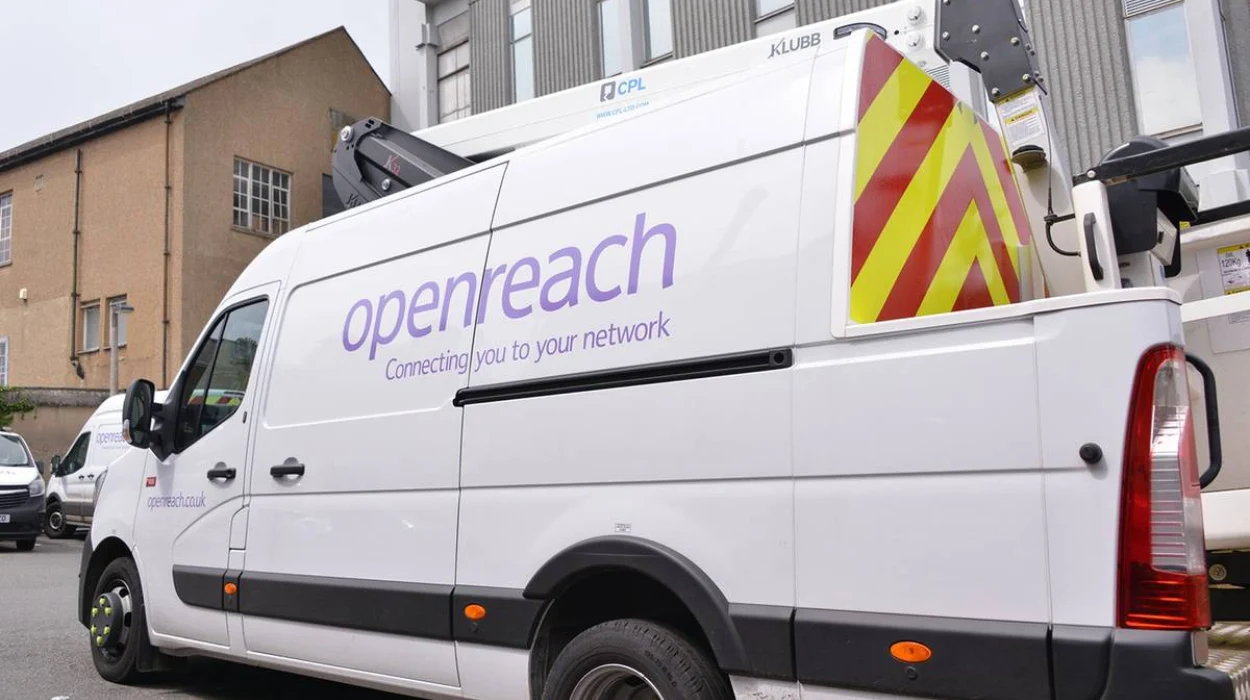
Openreach is the UK’s largest telecommunications infrastructure provider, a wholly owned subsidiary of BT Group that owns and maintains the nation’s phone and broadband network serving 25 million premises by end of 2026. This comprehensive guide covers everything you need to know about Openreach Full Fibre installation processes, current coverage across Britain, and detailed speed tiers from 40Mbps to 1.8Gbps.
- What is Openreach and why does it matter for UK broadband?
- How long does Openreach Full Fibre installation take and what happens on the day?
- What is Openreach Full Fibre coverage across the UK in 2026?
- What speed tiers does Openreach Full Fibre offer and how fast is real-world performance?
- How does Openreach Full Fibre installation work from outside to inside your property?
- What factors affect Openreach installation time and when might extra work be needed?
- How do I check Openreach coverage for my specific address and what exchange area am I in?
- What should I do if Openreach Full Fibre isn available at my address yet?
- How does Openreach compare to other UK fibre providers and what makes Full Fibre superior?
What is Openreach and why does it matter for UK broadband?
Openreach is BT Group’s wholly owned subsidiary established in 2006 that owns, operates, and maintains the UK’s physical phone and broadband network, serving all broadband providers equally at identical prices under Ofcom regulation.
Openreach was created following regulatory pressure from Ofcom and MPs to separate BT’s infrastructure operations from its retail broadband business. Prior to 2006, BT controlled both the network infrastructure and retail services, creating concerns about fair access for competing providers. The separation ensured all communications providers—whether Sky, Vodafone, TalkTalk, or BT itself—access the same network at the same prices.
In 2017, Ofcom’s Digital Communications Review mandated Openreach become a distinct company with independent staff, management, and strategy, though it remains a BT Group subsidiary. Openreach employs approximately 32,000 people and operates the telecommunications pipework and phone cables across the entire UK.
The company connects homes and businesses through exchange buildings located throughout the country, with each exchange covering a village, small town, or part of larger urban areas. This infrastructure model enables Britain’s broadband revolution, with engineers connecting around one million premises every three months.
How long does Openreach Full Fibre installation take and what happens on the day?
Most Openreach Full Fibre installations take between 2-4 hours, requiring someone over 18 present throughout, with engineers drilling a small wall hole to bring fibre optic cable inside and installing an Optical Network Terminal (ONT) connected to your router.
Before the installation date, your broadband provider confirms the appointment and sends communications from either the provider or Openreach. You can reschedule by following guidance in these communications if the date doesn work. Essential requirements include having a decision maker over 18 present throughout the entire appointment and obtaining landlord permission if renting for any drilling inside or outside the property.
On the installation day, the engineer rings beforehand to confirm arrival time. Upon arrival, they discuss a potential route for the fibre cable and agree with you on where to drill a hole to bring the fibre optic cable into your property. If drilling or digging is required, you sign a permission-to-work form before the engineer starts any work.
The external work involves running the fibre optic cable from a nearby pole or underground duct to a small junction box fitted on your external wall. This junction box measures 15cm x 13cm and connects your property to the Openreach Full Fibre network. In rare cases, work may be more complex requiring a follow-up appointment on another day.
Inside your property, the engineer installs the Optical Network Terminal (ONT), a white wall-mounted box that connects the fibre optic cable to provide access to the Full Fibre network. The ONT and your router must be positioned close together near a double power socket—engineers explicitly advise against placing equipment in dark cupboards under stairs, which significantly reduces speed and coverage.
Once setup completes, the engineer connects your main device to the new router, tests everything works smoothly, and ensures you’re happy with the service. If you use your phone line for intruder alarms, health pendants, or wrist alarms, contact your service provider before installation for a smooth transition.
What is Openreach Full Fibre coverage across the UK in 2026?
Openreach Full Fibre covers 65.3% of all UK premises as of Q1 2026 (up from 61.5% in Q4 2025), with 21 million premises able to connect and around 8 million homes and businesses actively using Full Fibre broadband.
The network connects through exchange areas across the country, with a publicly available map showing current and planned Full Fibre coverage for every exchange area. Openreach uses a three-colour code system on their build map: green indicates areas where they’ve built to or will build to the majority, blue shows areas where they’ve built to many parts, and light grey indicates areas where they’ve built to some parts.
Openreach’s ambitious target is delivering Full Fibre to 25 million homes and businesses by end of 2026, with plans to reach 30 million premises by end of 2030 assuming supportive investment conditions. The company passes more than 50,000 new homes and businesses every week and maintains a pace of just over one million premises per quarter.
This rollout supports the UK Government’s ambition of making gigabit-capable broadband available to more than 99% of premises by 2032. Openreach operates different build programmes, with the commercial programme being the largest, alongside smaller programmes including new development sites and government partnerships.
A key partnership is with Project Gigabit, the UK Government’s £5bn funded initiative delivering fast, reliable broadband to hard-to-reach rural areas, connecting more than 297,000 homes and businesses across rural communities that might otherwise miss out. Additionally, Openreach announced in 2024 that an additional 3 million homes in hard-to-reach areas will connect to gigabit-cable broadband by December 2026.
You can check your specific property coverage by entering your postcode into Openreach’s Fibre Checker, which provides the most personalised view of connectivity available to your individual home or business. The online map and postcode checker receive updates throughout the year, though dates may change due to unforeseen obstacles or changing operational and economic conditions.
What speed tiers does Openreach Full Fibre offer and how fast is real-world performance?
Openreach Full Fibre offers speeds from 40Mbps to 1.8Gbps, with specific tiers including Full Fibre 150 (145/30Mbps), Full Fibre 500 (500/75Mbps), Full Fibre 900 (900/110Mbps), and Full Fibre 1800 (1.8Gbps/180Mbps), while FTTC part-fibre remains limited to 80Mbps download due to copper constraints.
In April 2024, Openreach doubled maximum download speeds from 900Mbps to 1.8Gbps across their nationwide network, introducing new speed tiers available to all providers on their network. The complete speed tier structure includes 40 Mbps, 80 Mbps, 115 Mbps, 160 Mbps, 220 Mbps, 330 Mbps, 550 Mbps, 1 Gbps, 1.2 Gbps, and 1.8 Gbps download options.
Full Fibre 150 delivers 145Mbps download and 30Mbps upload speeds. Full Fibre 500 provides 500Mbps download with 75Mbps upload. Full Fibre 900 offers 900Mbps download and 110Mbps upload. The newest Full Fibre 1800 tier delivers 1.8Gbps (1,800Mbps) download with 180Mbps upload speed.
Real-world average download speeds start at around 900Mbps for gigabit packages, with Full Fibre designed to be less affected by peak-time congestion. This means you can enjoy Saturday night blockbuster streaming in 4K without buffering, even when your entire household makes video calls, streams box sets, and games online simultaneously.
FTTC (Fibre to the Cabinet) part-fibre broadband, which uses both fibre optic cables and older copper cables, remains limited to maximum 80Mbps download and 20Mbps upload due to copper line constraints. FTTC delivers superfast speeds up to 76Mbps to 96% of the UK, comfortably outpacing standard copper broadband’s 21Mbps maximum.
The copper portion of FTTC connections isn’t as fast as fibre, creating the 80Mbps limit that Full Fibre dramatically exceeds. Full Fibre broadband will service your needs for decades to come, as fibre optic technology evolves and you can upgrade or downgrade speed without ever needing an engineer visit.
How does Openreach Full Fibre installation work from outside to inside your property?
Openreach engineers run fibre optic cable from underground ducts or overhead poles to an external junction box, then drill through your wall to install the indoor ONT unit that connects fibre to your router, completing the full network connection.
The external installation begins by identifying the nearest network point, which could be an underground duct or overhead pole. Engineers run the fibre optic cable from this point to your property, bringing it inside through a small hole drilled in the wall. If a ladder is needed for overhead work, engineers may drill small holes outside your property for ladder safety, repairing these holes and cleaning up completely after completion.
The external junction box measures 15cm x 13cm and is fitted on your external wall to connect your property to the Openreach Full Fibre network. Engineers link this junction box to the Openreach fibre network using fibre optic cable, either underground or from a nearby pole. In some instances, work required may be more complex, requiring arrangement of a follow-up appointment on another day to complete the work.
Inside your property, the engineer runs a cable from the external junction box to the Optical Network Terminal (ONT). The ONT sits inside your property and connects to the external junction box, serving as where your broadband service enters your home. Once the ONT installs, you connect it to your router and start using your broadband package.
Both the wall-mounted ONT unit and router need positioning close together near double power sockets. The engineer then connects your main device to the new router and tests everything works smoothly. Engineers always complete work neatly, ensuring no damage and leaving your property safe and tidy.
What factors affect Openreach installation time and when might extra work be needed?
Installation time varies based on property type and fibre routing complexity, with most taking 2-4 hours but extending longer if extra work like clearing blocked ducts is needed, or if unusual access requirements require a survey before installation.
Property type significantly affects installation duration. Different properties present varying challenges for fibre routing, with some requiring more complex cable paths than others. The routing method—whether fibre comes from overhead poles or underground ducts—also impacts time requirements.
Extra work scenarios include clearing blocked ducts, which extends appointment duration beyond the standard 2-4 hour window. When invisible obstacles or ground conditions restrict the proportion of an exchange area upgradeable, this creates complexities affecting individual installations.
Unusual access requirements may trigger a pre-installation survey before the engineer visits. Multi-dwelling units like apartment blocks present operational complexities, as engineers need access support from relevant local authorities. Properties too difficult or complex to upgrade commercially may require alternative programmes or public funding.
Operational challenges include needing access to multi-dwelling units, obtaining support from local authorities, and dealing with ground conditions that restrict upgrade proportions. Changes occur when unforeseen obstacles emerge or operational and economic conditions change.
Even if your area isn’t covered by current published plans or main build work finished in your exchange area, Openreach may return to build more in the future through Fibre Community Partnerships or other Government-funded programmes.
How do I check Openreach coverage for my specific address and what exchange area am I in?
Enter your postcode into Openreach’s Fibre Checker or online map to find your exact exchange area coverage and see whether Full Fibre is available at your property, with the checker providing the most personalised view for individual homes and businesses.
Openreach plans builds around exchange areas, each covering a village, small town, or part of larger towns or cities. Exchanges come in different sizes, connecting unique numbers of premises depending on their location. You find which exchange area your home or business is in by entering your postcode into the map.
The online map shows current and expected Full Fibre coverage levels as of today, taking data from all build programmes to display coverage level and build timeframes where possible. The postcode checker continues offering the most personalised connectivity view for individual properties, showing what to expect for your specific home or business.
People visiting the online Full Fibre build map see breadth and depth of build represented by the three-colour system: green for majority coverage areas, blue for many-parts coverage, and light grey for some-parts coverage. You can download a list of all exchanges and locations currently announced as part of the Full Fibre Broadband Build Plan.
Register for Full Fibre updates through the Fibre Checker to keep up with plans for your own home or business rather than your entire exchange area. Plans change over time, so registering ensures you receive updates when your area gets added to delivery plans.
The information updates throughout the year, with Openreach doing their best to ensure date accuracy. Start dates for building work depend on getting support levels from relevant local authorities and meeting operational factors.
Explore More about Technology:
Claude AI Tutorial: Beginner to Advanced Guide
Nintendo Games Guide: Top Picks & New Releases
What should I do if Openreach Full Fibre isn available at my address yet?
If Full Fibre isn available at your address, register for Fibre Checker updates since plans change regularly, and your area may be covered through future commercial programmes, Fibre Community Partnerships, or Government-funded Project Gigabit rollout.
Just because your area isn’t covered by the current published plan doesn mean Openreach won’t return to build more in the future. Even after finishing main build work in your exchange area, return visits happen for additional upgrades. Openreach intends to keep building after hitting 25 million premises, reaching 30 million homes and businesses by end of decade assuming supportive investment conditions.
Some properties are too difficult or complex to upgrade commercially but may be covered by other programmes or through public funding. Openreach might still build to new homes through Fibre Community Partnerships or other Government-funded programmes.
Project Gigabit specifically targets hard-to-reach rural areas that might otherwise miss out, with Openreach working in partnership with the UK Government to make Full Fibre available to more than 297,000 homes and businesses across rural communities. The government set aside £5bn for gigabit-cable broadband to be ubiquitous, with an additional 3 million homes in hard-to-reach areas connecting by December 2026.
Commercial conditions like potential demand influence which areas get prioritised, alongside operational challenges and build costs. Start of building work requires right-level support from relevant local authorities and meeting operational factors including access to multi-dwelling units.
On-ground conditions discovered during actual build work might restrict upgrade proportions, creating variability in coverage. With the commercial build programme, Openreach identifies intended build areas and high-level timeframes, publishing these for transparency. Smaller build programmes have less certain delivery timeframes, which explains why timescales aren shared for every exchange area.
How does Openreach compare to other UK fibre providers and what makes Full Fibre superior?
Openreach is the UK’s largest telecommunications infrastructure provider owning the physical network that all broadband providers use, while Full Fibre (FTTP) delivers 40Mbps-1.8Gbps speeds versus FTTC’s 80Mbps limit, offering superior reliability unaffected by peak-time congestion.
Openreach operates as a wholesale infrastructure provider, selling all products and services to communications providers at identical prices whoever they are. This means Sky, Vodafone, TalkTalk, BT, and hundreds of other providers all access the same Openreach network infrastructure. The separation from BT’s retail operations ensures fair access for all competitors following regulatory pressure.
Full Fibre (FTTP—Fibre to the Premises) connects fibre optic cables directly to your property, providing the fastest and most reliable broadband available. FTTP offers speeds from 40Mbps to 1.8Gbps depending on tier, dramatically exceeding FTTC capabilities. FTTC (Fibre to the Cabinet) uses both fibre optic cables and older copper cables, with copper limiting speeds to 80Mbps maximum download and 20Mbps upload.
The copper portion in FTTC connections isn as fast as fibre, creating the fundamental speed ceiling that Full Fibre breaks through. Full Fibre is built to be less affected by peak-time congestion, meaning you won experience stuttering, buffering, or dropouts even when entire households make video calls, stream box sets, and game online simultaneously.
Full Fibre broadband services your needs for decades to come, as fibre optic technology evolves and you can upgrade or downgrade speed without ever needing an engineer visit to your home. This future-proofing capability contrasts with copper-based technologies that have inherent physical limitations.
Openreach engineers connect around one million premises every three months, aiming for 25 million by end of 2026 and 30 million by 2030, subject to regulatory conditions. This monumental change to UK communication infrastructure represents hugely complex engineering with lots of moving parts and technical challenges.
The network currently passes around 13.5 million premises—about 50% of the UK—with plans to reach 25 million by end of 2026. Full Fibre now covers 65.3% of all UK premises, up from 61.5% in Q4 2025, maintaining pace of just over one million premises per quarter.
This rollout supports UK Government ambition of making gigabit-capable broadband available to more than 99% of premises by 2032. The three-colour map system provides transparency about build progress at exchange level, showing areas where people can already order Full Fibre from chosen service providers.