Key Points
- Foreign Secretary Yvette Cooper warns of a looming global food crisis at the UK‑hosted Global Partnerships Conference in London, citing Iran’s three‑month closure of the Strait of Hormuz and its impact on energy and fertiliser supply chains.
- Cooper urges a “bold new approach” to international development to address concurrent crises: conflict, climate change and communicable diseases.
- The UK announces policy shifts prioritising aid for fragile and conflict‑affected states and new investment partnerships with more stable developing countries.
- The government pledges £1 billion of climate investments via British International Investments (BII), expected to unlock a further £3.5 billion in private capital.
- New “Communities of Expertise” will be set up to share UK technical capability across climate, energy, education, health, finance and governance.
- Critics, including Sarah Champion and aid groups, warn that cuts in the UK aid budget (from 0.5% to 0.3% of GNI) could undermine the government’s ambitions.
- Humanitarian and development organisations call for urgent funding, debt relief and stronger inclusion of women’s voices in responses to food insecurity.
- Delegates from African missions and development experts question whether private investment will materialise given persistent “risk perception” and insurance cost disparities.
- Calls for policy coherence: linkages urged between humanitarian grants, investment mobilization, fair taxation and restrictions on arms sales to ensure credibility and impact.
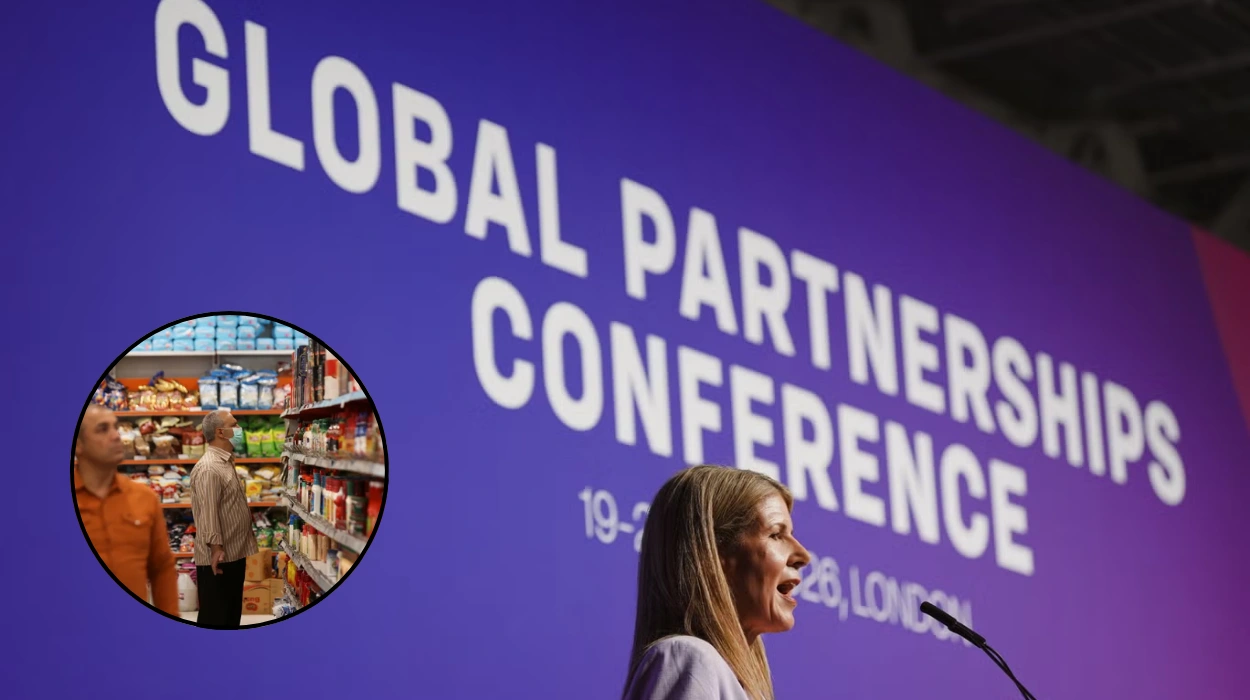
London (Britain Today News) May 19, 2026 – At the Global Partnerships Conference in London, Foreign Secretary Yvette Cooper set out what she described as a “bold new approach” to international development, warning the world risks “sleepwalking into a global food crisis” as disruptions — including Iran’s three‑month closure of the Strait of Hormuz — choke critical supply chains for energy and fertiliser.
- Key Points
- Why did Yvette Cooper say the world risks a food crisis?
- What new approach is the UK proposing at the conference?
- What financial commitments did the UK announce?
- Are aid cuts undermining the UK’s credibility?
- How are aid groups reacting to the UK’s proposals and warnings?
- What concerns are raised by representatives of affected countries?
- Will the investment model deliver for fragile states?
- How are linked crises like climate and disease factored into the UK’s plan?
- What immediate actions are aid organisations demanding?
- What does success look like, and what are the risks?
Why did Yvette Cooper say the world risks a food crisis?
As reported by Yvette Cooper in her keynote address at the Global Partnerships Conference,
“The global economy is being held hostage, with the Global South paying the biggest price.”
She said the ongoing blockade of the Strait of Hormuz has already disrupted planting cycles and reduced access to fertiliser, adding:
“The agricultural clock is ticking, and damage is already being done that will affect crop yields and food prices well into next year.”
Cooper cited warnings from global humanitarian agencies that around 45 million people could slide into acute hunger this year if the situation worsens.
What new approach is the UK proposing at the conference?
Cooper outlined a two‑part shift in UK policy. First, to prioritise humanitarian grant aid to fragile and conflict‑affected countries. Second, to mobilise new forms of capital — public, private and blended finance — to invest in more stable developing economies. She told delegates the UK will build new “Communities of Expertise”, demand‑led interdisciplinary hubs to export UK know‑how in climate, energy, education, health, finance and governance. Cooper said the approach aims to marry targeted grant support with scaled investment to drive resilient development outcomes.
What financial commitments did the UK announce?
The government announced a package including £1 billion of climate investments through British International Investments (BII), intended to leverage an estimated additional £3.5 billion in private capital. Cooper framed this as an example of the partnership model she wants to scale: government capital unlocking much larger private finance to address climate and development needs.
Are aid cuts undermining the UK’s credibility?
Sarah Champion, chair of the International Development Committee, cautioned that ambition may outstrip capacity. As reported by Sarah Champion,
“I remain concerned that the ambition pinned to the conference far outstrips the reality of what can be achieved with a much‑reduced budget.”
The UK’s earlier decision to reduce aid from 0.5% to 0.3% of Gross National Income has fuelled scepticism among civil society and some partner countries about whether the UK can deliver on the promises being made.
How are aid groups reacting to the UK’s proposals and warnings?
Jennifer Larbie, Christian Aid’s UK Influencing Lead, urged greater urgency on immediate financing and debt relief, saying:
“There is little urgency to provide new funds to meet immediate needs or cancel the debts of most affected low income countries — this crisis should spur solidarity.”
Richard Hawkes, Chief Executive of Oxfam GB, made a sharp critique of the government’s coherence, stating:
“The UK Government cannot credibly speak about peace and stability while continuing arms sales to Israel and cutting the very aid that supports people caught up in crisis.”
Dorothy Sang, Head of Advocacy and Policy at CARE International UK, warned about gendered impacts:
“Food insecurity is a deeply gendered crisis… women still eat last and least. There must be room in the tent to both raise finances at scale while also putting the experiences and expertise of women at the centre of solutions that last.”
What concerns are raised by representatives of affected countries?
A senior official from an African embassy in London told delegates he remained sceptical that private sector investors will change course simply because of new rhetoric.
“There remains a historic perception from investors that all the diverse African countries are actually the same, and all are risky, even when that is not the case,”
he said. He pointed to concrete barriers: insurance costs for shipments to and from many African nations remain disproportionately high, undermining competitiveness and investor confidence.
Will the investment model deliver for fragile states?
Cooper’s emphasis on unlocking private capital rests on the assumption that investment flows can be steered into development outcomes while humanitarian grant aid protects the most vulnerable. Critics warn that market‑based approaches risk sidelining the poorest or least bankable contexts. Sarah Champion argued patient investment to prevent root causes — conflict, inequality and climate damage — should remain central. Development experts at the conference reiterated that blended finance must be carefully designed to avoid displacement of grant funding and to ensure that risk transfer mechanisms do not amplify vulnerabilities.
Explore More about Politics:
80+ Charity Leaders Urge UK to Show More Ambition on International Aid 2026
Clacton residents say ‘Stop the boats’ after Reform UK win 2026
How are linked crises like climate and disease factored into the UK’s plan?
Cooper stressed that the world now faces “concurrent crises” — conflict, climate, and communicable diseases — and highlighted recent outbreaks such as Ebola in the Democratic Republic of the Congo as systems that require faster, more coordinated responses. The Communities of Expertise announced at the conference are intended to pool technical capacity on climate and health resilience alongside governance and finance, enabling rapid knowledge transfer to partner countries.
What immediate actions are aid organisations demanding?
Organisations present urged the UK to couple its investment rhetoric with concrete steps: immediate surge funding to avert the coming food emergency, urgent debt relief measures for the most affected low‑income countries, and legislation to compel private creditors to deliver relief where necessary. Christian Aid and others pressed for a binding mechanism to protect vulnerable countries from the fallout of geopolitical shocks.
What does success look like, and what are the risks?
Success for the UK’s blueprint would mean measurable increases in resilient agricultural production, improved access to energy and fertiliser for smallholders, a pipeline of private investment directed at sustainable projects, and strengthened institutions in fragile states. The principal risks are underfunding, weak oversight of blended finance, persistent investor risk aversion towards many low‑income countries, and policy incoherence between aid, trade and security policies.
Can rhetoric become results?
The Global Partnerships Conference exposed a stark tension: bold ambitions to tackle an intertwined set of global threats versus domestic fiscal decisions that have cut aid spending. Yvette Cooper’s warning about a food crisis sharpened focus on the immediacy of the challenge. Yet delegates and civil society repeatedly asked the same question — will the new finance mechanisms and Communities of Expertise translate into the resources and policies needed on the ground? As Cooper put it in London,
“We need to mobilise much wider investments and different forms of capital investment and support.”
Whether the world moves from words to urgent, coordinated action will determine if the coming planting seasons — and millions of lives — are spared a deepening crisis.