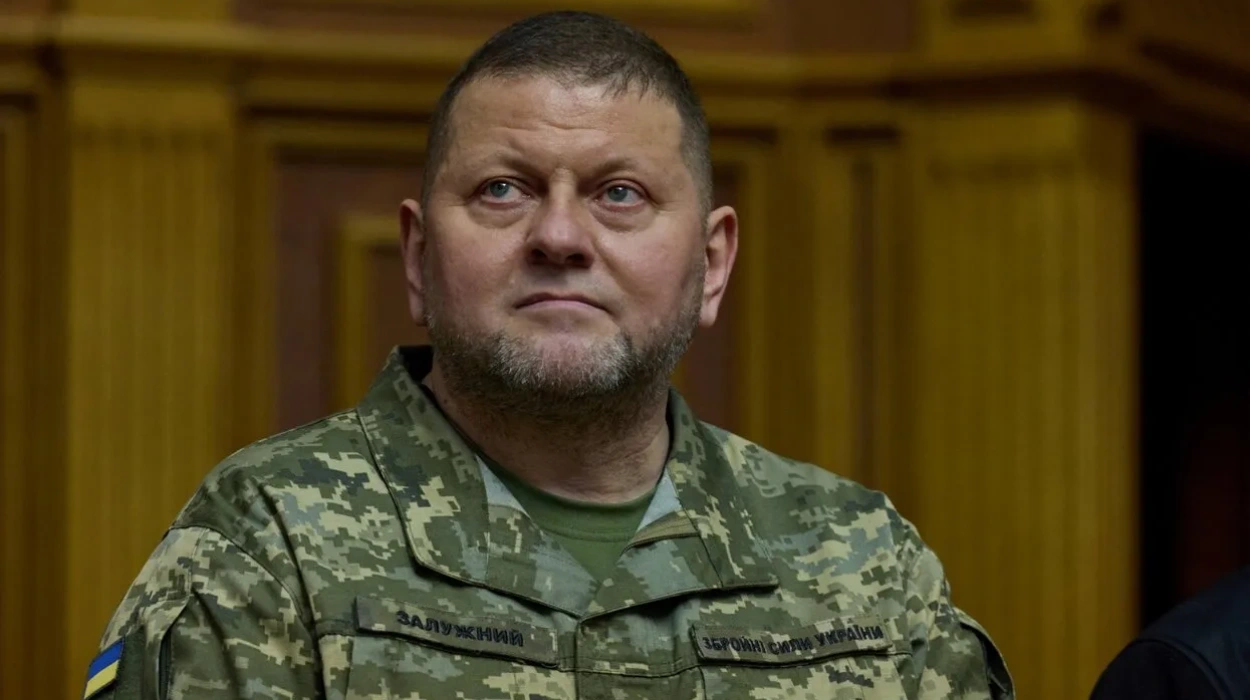
Valerii Zaluzhnyi is a Ukrainian four-star general and diplomat. He served as Commander-in-Chief of the Armed Forces of Ukraine from July 27, 2021, to February 8, 2024. He currently serves as Ukraine’s Ambassador to the United Kingdom, a post he has held since July 10, 2024. Zaluzhnyi is one of the most recognised military and politics figures to emerge from Russia’s full-scale invasion of Ukraine, which began on February 24, 2022.
- Who Is Valerii Zaluzhnyi?
- What Was Zaluzhnyi’s Role as Commander-in-Chief of Ukraine’s Armed Forces?
- Why Was Zaluzhnyi Dismissed as Commander-in-Chief?
- What Is Zaluzhnyi’s Current Role as Ambassador to the United Kingdom?
- Is Zaluzhnyi Planning to Run for President of Ukraine?
- How Do Zaluzhnyi and Zelenskyy Compare in Public Opinion Polls?
- What Has Zaluzhnyi Said About Russia and the War’s Trajectory?
- What Is Zaluzhnyi’s Position on NATO Membership for Ukraine?
- How Does Zaluzhnyi’s Public Standing Compare to Other Ukrainian Officials?
- What Is Zaluzhnyi’s Broader Significance in the Russia-Ukraine War?
Who Is Valerii Zaluzhnyi?
Valerii Fedorovych Zaluzhnyi is a Ukrainian general, born July 8, 1973, who led Ukraine’s Armed Forces during the first two years of Russia’s full-scale invasion and now serves as Ukraine’s Ambassador to the United Kingdom. He is widely known by the nickname “Iron General.” His military career spans 1993 to 2024, covering combat command, operational leadership, and the top post in Ukraine’s armed forces.
Zaluzhnyi was born in Novohrad-Volynskyi, Zhytomyr Oblast, in the Ukrainian Soviet Socialist Republic. The city is now named Zviahel. He completed military education at the Odesa Military Academy and the National University of Ostroh Academy. He later studied at the Ivan Chernyakhovsky National Defence University of Ukraine. These institutions form the standard training pipeline for senior Ukrainian military officers.
Before he was appointed Commander-in-Chief, Zaluzhnyi held multiple command roles. He served as deputy commander of Sector “C” during the war in eastern Ukraine, a conflict zone active since 2014 following Russia’s annexation of Crimea and the start of fighting in Donbas. He also commanded Operational Command “North,” a regional military formation responsible for defending northern Ukraine, including approaches to Kyiv.
What Was Zaluzhnyi’s Role as Commander-in-Chief of Ukraine’s Armed Forces?
Zaluzhnyi served as Commander-in-Chief of the Armed Forces of Ukraine from July 27, 2021, until February 8, 2024, directing Ukraine’s military response to Russia’s full-scale invasion launched on February 24, 2022. President Volodymyr Zelenskyy appointed him to the post, succeeding General Ruslan Khomchak. The appointment came roughly seven months before the full-scale invasion began.
As Commander-in-Chief, Zaluzhnyi held operational authority over Ukraine’s land, air, and naval forces. His tenure included the defence of Kyiv in the opening weeks of the 2022 invasion, when Russian forces attempted to seize the capital and depose the Ukrainian government. Ukrainian forces under his command halted that advance and forced a Russian withdrawal from the Kyiv region by early April 2022.
Zaluzhnyi’s command also oversaw the Kharkiv counteroffensive of September 2022, in which Ukrainian forces recaptured large areas of Kharkiv Oblast in a rapid advance. This operation is widely cited in military analysis as one of the most significant battlefield reversals of the war. His command additionally directed the Kherson counteroffensive, which led to the Russian withdrawal from the city of Kherson in November 2022.
President Zelenskyy dismissed Zaluzhnyi as Commander-in-Chief on February 8, 2024. General Oleksandr Syrskyi succeeded him. Zaluzhnyi was concurrently a member of the National Security and Defence Council of Ukraine during his time as military chief, giving him a direct role in national security policy beyond battlefield command.
Why Was Zaluzhnyi Dismissed as Commander-in-Chief?
Zaluzhnyi’s dismissal followed reported disagreements with President Zelenskyy over battlefield strategy, troop mobilisation numbers, and public statements Zaluzhnyi made about the war reaching a stalemate. No single official reason was announced at the time of his removal on February 8, 2024.
In late 2023, Zaluzhnyi published an assessment describing the conflict as approaching a stalemate, a characterisation that reportedly created friction with the presidential office. This assessment drew significant international attention because it contradicted more optimistic public messaging from Ukrainian officials at the time. Analysts and Ukrainian media outlets pointed to this and disputes over mobilisation policy as contributing factors in his removal.
Zaluzhnyi’s public approval ratings remained high following his dismissal. Polling organisations, including the Kyiv International Institute of Sociology (KIIS) and the Rating Group, tracked his standing as a potential political figure in the months after he left military command, reflecting his continued public prominence in Ukraine.
What Is Zaluzhnyi’s Current Role as Ambassador to the United Kingdom?
Zaluzhnyi has served as Ukraine’s Ambassador Extraordinary and Plenipotentiary to the United Kingdom since July 10, 2024, succeeding Vadym Prystaiko in the post. The role places him in London as Ukraine’s senior diplomatic representative to a key military and financial backer of Ukraine’s defence effort.
In this position, Zaluzhnyi has represented Ukraine at defence conferences, including the Royal United Services Institute (RUSI) Land Warfare Conference. He has engaged with British political leadership on continued military and financial support for Ukraine. His diplomatic activity has included public commentary on Russian strikes against Ukrainian cities and appearances at cultural and diplomatic events, such as the London Book Fair, where he opened the Ukrainian exhibition stand in March 2026.
Since March 3, 2025, Zaluzhnyi has also held a second diplomatic post: Permanent Representative of Ukraine to the International Maritime Organisation (IMO). The IMO is a United Nations specialised agency responsible for regulating international shipping. This appointment gives Zaluzhnyi a role in maritime security discussions relevant to Black Sea shipping routes affected by the war.
In February 2026, Zaluzhnyi announced that Ukraine had opened its first defence drone production plant in the United Kingdom. He described the facility as designed to protect manufacturing continuity during the war and to strengthen long-term defence industrial cooperation between Ukraine and the UK.
Is Zaluzhnyi Planning to Run for President of Ukraine?
Reports from July 1, 2026, indicate Zaluzhnyi told President Zelenskyy directly that he intends to run for president if elections are held in autumn 2026, according to Ukrainska Pravda sources close to both men. Ukraine has not held a presidential election since 2019, since martial law imposed after the February 2022 invasion suspended the normal election cycle. Zelenskyy’s original term expired on May 20, 2024.
According to the Ukrainska Pravda report, Zelenskyy summoned Zaluzhnyi to Kyiv from London for consultations. During the meeting, Zelenskyy reportedly stated that the frontline situation had improved and that Ukrainian society remained sufficiently unified, creating what he called a “window of opportunity” for elections. Zelenskyy then asked whether Zaluzhnyi would participate if a vote were held that autumn. Zaluzhnyi reportedly replied, “Yes, I will.”
Sources also indicated Zelenskyy offered Zaluzhnyi alternative senior government positions, including a role tied to the leadership of government, which Zaluzhnyi declined. He reportedly said he could not disregard the trust placed in him by segments of the Ukrainian public who see him as a potential future leader.
As of the most recent reporting, neither Zelenskyy’s office nor Zaluzhnyi has issued an official public confirmation of these details. Any presidential election requires an end to martial law or a legal mechanism permitting a wartime vote, a constitutional question that remains unresolved in Ukraine as of mid-2026.
How Do Zaluzhnyi and Zelenskyy Compare in Public Opinion Polls?
Public opinion surveys from mid-2026 show President Zelenskyy leading Zaluzhnyi in first-round voting intention, with the gap widening over the preceding year, though polls on a head-to-head runoff produce mixed results depending on the polling organisation.
A Rating Group poll conducted May 30–June 3, 2026, found that if a presidential election were held that week, 32% of Ukrainians would vote for Zelenskyy, 16% for Zaluzhnyi, and 11% for Kyrylo Budanov, head of the Presidential Office and former head of Defence Intelligence. This poll recorded a decline in Zaluzhnyi’s support, which had fallen from 25% one year earlier, widening the first-round gap between the two men from 6 to 16 percentage points.
A separate poll from the International Republican Institute (IRI), conducted by the Rating Sociological Group over the same period and surveying 2,404 adults in Ukrainian-controlled territory, examined a hypothetical second-round matchup. That survey found 42% would support Zelenskyy against 39% for Zaluzhnyi in a runoff, with 10% saying they would not vote and 9% undecided. The margin of error was stated at 2.0 percentage points.
Other reporting citing closed internal polling described a different result, with Zaluzhnyi leading Zelenskyy 37% to 32% in a runoff scenario, though this figure came from unofficial sources rather than a published, methodologically transparent survey. The variation between polls illustrates the volatility and methodological differences present in Ukrainian wartime political polling.
| Poll Source | Date | Zelenskyy (1st round) | Zaluzhnyi (1st round) | Runoff Result |
|---|---|---|---|---|
| Rating Group | May 30–June 3, 2026 | 32% | 16% | Not measured |
| International Republican Institute (IRI) | May 30–June 3, 2026 | 42% (runoff) | 39% (runoff) | Zelenskyy +3 |
| Unofficial/closed sources (cited by media) | Late June 2026 | 33% | 22% | Zaluzhnyi +5 (37% to 32%) |
What Has Zaluzhnyi Said About Russia and the War’s Trajectory?
Zaluzhnyi has publicly warned against assuming Russia has lost the war, arguing in a July 8, 2026, opinion piece in The Telegraph that Western analysts risk a “dangerous misreading” of the conflict’s momentum. He pointed to Ukraine’s expanding deep-strike campaign against Russian oil infrastructure and a related “middle-strike” campaign targeting Russian logistics as evidence that the war remains contested rather than decided.
In a separate column for The New Voice of Ukraine (NV) published May 21, 2026, Zaluzhnyi stated that halting the war without Ukraine achieving its stated objectives would lead to the collapse of the Russian state system. He characterised the conflict as a war of attrition in which survival capacity determines the eventual outcome, rather than territorial gains alone.
Zaluzhnyi has also addressed the changing nature of modern warfare in public remarks, including at the Lennart Meri Conference, a security policy forum held annually in Tallinn, Estonia. He stated that modern warfare has fundamentally changed in ways that make the outcomes of contemporary conflicts difficult to forecast using historical military models, citing the rise of drone warfare and electronic countermeasures as key transformative factors.
What Is Zaluzhnyi’s Position on NATO Membership for Ukraine?
Zaluzhnyi stated in comments reported in August 2026 that Ukraine will not achieve NATO membership, describing the alliance’s current model as outdated and calling instead for new security arrangements. He made these remarks during a discussion on Euro-Atlantic integration at a meeting of Ukrainian ambassadors in Kyiv.
This position is notable because NATO membership is enshrined as a strategic goal in Ukraine’s constitution. Zaluzhnyi’s willingness to state publicly that this goal is unreachable under the alliance’s existing structure represents a departure from standard official Ukrainian government messaging, which has consistently affirmed NATO accession as a policy objective since 2019.
Zaluzhnyi has instead advocated for alternative security arrangements, including new regional security blocs and expanded bilateral military cooperation agreements, such as the defence industrial partnership reflected in the UK-based drone production facility announced in February 2026. He raised similar themes at a security conference in Tallinn, where he called broadly for new security solutions, stating that the existing post-Cold War international security order no longer functions as originally designed.
How Does Zaluzhnyi’s Public Standing Compare to Other Ukrainian Officials?
A Kyiv International Institute of Sociology (KIIS) poll showed rising public trust in President Zelenskyy, reaching 61%, while identifying Zaluzhnyi alongside Kyrylo Budanov, head of the Presidential Office, and Robert “Magyar” Brovdi, a senior drone forces commander, as the most trusted public figures in Ukraine.
Budanov’s public profile has risen notably through 2026, according to Ukrainian media tracking. Reports indicate his approval ratings have increased at a time when Zaluzhnyi’s ratings have declined, positioning Budanov as an additional potential contender in any future presidential race. This dynamic adds a third major figure to what earlier in 2026 was widely framed as a primarily two-way contest between Zelenskyy and Zaluzhnyi.
Brovdi, known by the callsign “Magyar,” commands Ukraine’s unmanned systems forces and has gained public recognition tied to Ukraine’s expanded use of drone warfare against Russian targets. His inclusion in high-trust polling reflects the growing prominence of drone warfare commanders in Ukraine’s wartime public consciousness, a shift from earlier phases of the war when conventional infantry and artillery commanders received the most public attention.
Explore More about Politics:
Andrew Mountbatten-Windsor: Royal Life & Headlines
Sir Grant Shapps Conservative Candidacy Sparks Debate
What Is Zaluzhnyi’s Broader Significance in the Russia-Ukraine War?
Zaluzhnyi is widely credited with directing Ukraine’s successful defence of Kyiv in 2022 and the subsequent Kharkiv and Kherson counteroffensives, actions that established his reputation as a central military figure of the war and a potential future president. His dismissal in February 2024 did not diminish his public standing, and by mid-2026 he remained one of the two or three most closely watched political figures in Ukraine alongside Zelenskyy and Budanov.
His transition from military command to diplomatic service illustrates a common pattern among senior wartime commanders who move into political or diplomatic roles following changes in military leadership. His ambassadorial role has kept him publicly visible on defence, security, and diplomatic issues rather than removing him from public life, a factor frequently cited by analysts explaining his sustained relevance in Ukrainian politics.
The unresolved question of Ukraine’s next presidential election continues to shape how Zaluzhnyi’s public activities are interpreted. Every public statement he makes on the war’s trajectory, NATO membership, or Russian strategy is analysed in Ukrainian and international media both as diplomatic commentary from a sitting ambassador and as potential positioning for a future national leadership campaign. This dual interpretation is likely to continue as long as martial law delays a formal election and as long as Zaluzhnyi remains in active public service.