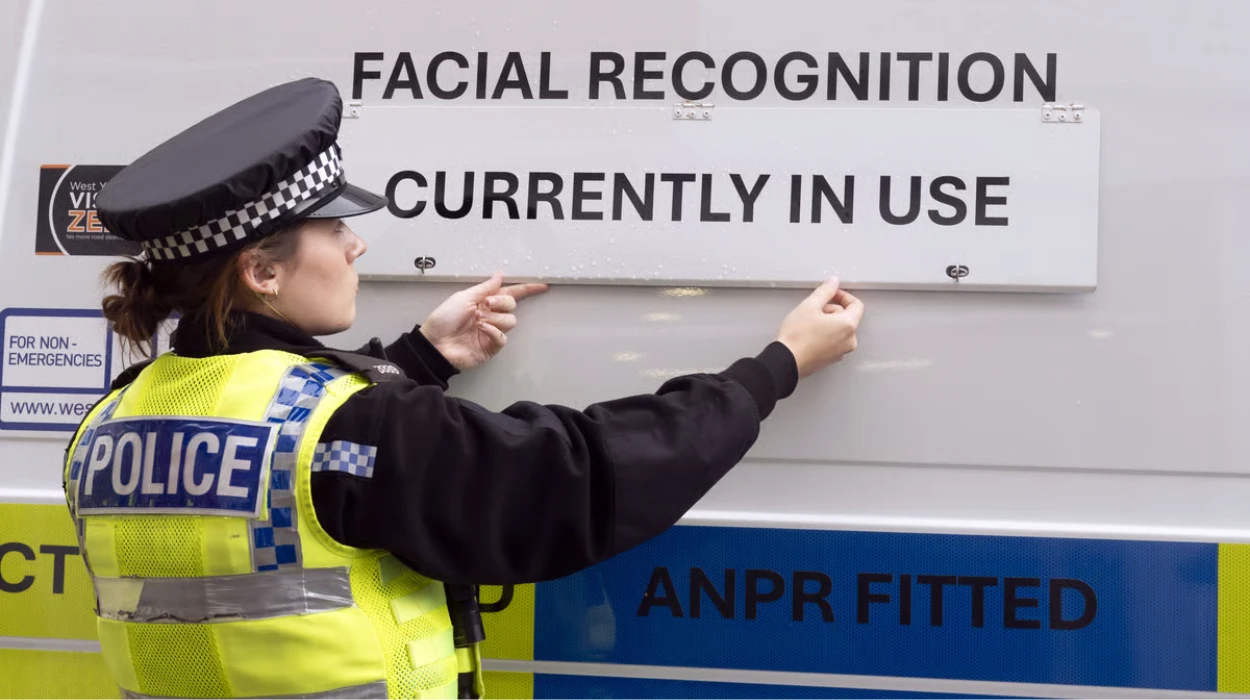
London’s expanding use of live facial recognition technology is facing renewed scrutiny after a six-month British Transport Police trial at railway stations scanned more than 500,000 faces but produced only one watchlist alert, which was later found to be a false match.
The trial, conducted between February and July 2026, involved 18 deployments at London railway stations and cost £320,786, according to information obtained through a Freedom of Information request. Despite the limited result from the railway phase, British Transport Police (BTP) has continued the programme and expanded its trial to selected London Underground stations.
BTP says the extended trial, which began at Victoria Underground station in August, will run until November 2026. The force says the purpose is to assess how effectively live facial recognition can be used in a railway environment, its effect on public safety and how the public responds to the technology.
The expansion has intensified a wider debate in London over whether facial recognition can provide meaningful policing benefits while protecting privacy, equality and individual rights.
How the technology works
Live facial recognition cameras capture images of people passing through a designated area and compare those images against a police watchlist.
BTP says its watchlists contain people wanted by police or courts, as well as individuals subject to certain court orders. When the system detects a possible match, an alert is generated and an officer reviews it before deciding whether further action is appropriate.
The force is using NEC’s NeoFace M40 facial-recognition technology. BTP says people who are not on the authorised database have their images deleted immediately and permanently. It also says members of the public who do not want to enter a recognition zone can use alternative routes where available.
Chief Superintendent Chris Casey, the senior BTP officer responsible for the project, said expanding the trial to Underground stations would allow police to assess the technology in a different transport environment.
“Our focus remains on protecting the public, preventing crime and bringing offenders to justice, while ensuring the technology is used lawfully, proportionately and transparently,” Casey said.
Transport for London has also defended the trial. Siwan Hayward, TfL’s Director of Security, Policing and Enforcement, said facial recognition could become an additional tool for identifying people wanted for high-harm offences, including sexual offences.
She said the Underground trial would assess whether the technology could be used in a “targeted, proportionate” way with safeguards in place.
A contrasting picture from London policing
The BTP trial is not representative of all facial-recognition deployments in London.
The Metropolitan Police has reported considerably stronger results from its own use of live facial recognition. In a six-month pilot in Croydon that ended in March 2026, static cameras were used during 24 operations and contributed to 173 arrests — equivalent to one arrest every 35 minutes when the system was deployed.
The Met said more than 470,000 people passed the cameras during the pilot and there was one false alert. It also reported that crime in the area fell by 10.5% compared with the same period the previous year.
The Met’s annual report covering September 2024 to September 2025 recorded 962 arrests resulting from live facial recognition operations. During that period, approximately 3.15 million faces passed the cameras, with 10 false alerts recorded.
The figures have strengthened the argument from police that facial recognition can help officers locate wanted individuals more quickly.
Privacy and accuracy concerns
However, regulators have warned that effectiveness cannot be the only consideration.
The Information Commissioner’s Office (ICO), which regulates data protection in the UK, said in August that facial recognition can assist law enforcement but warned that its expanding use raises questions about whether deployments are necessary and proportionate.
The ICO specifically highlighted the consequences of false matches, which can result in wrongful intervention, accusation or arrest. It said facial recognition must be supported by strong oversight, accountability and safeguards under data-protection law.
The regulator also said public support for police facial-recognition technology is conditional. Its research found that people were more supportive when the technology was accurate, unbiased, respectful of privacy and clearly beneficial to society.
The issue of potential demographic bias has also attracted attention. The ICO said testing had identified concerns about bias in an algorithm used by UK police forces for retrospective facial-recognition searches, increasing the possibility of incorrect matches for some demographic groups.
Government considers new legal framework
The debate comes as the UK Government considers whether existing rules are sufficient to regulate police use of facial recognition.
The Government has proposed developing a new legal framework covering facial recognition and other biometric technologies used by law enforcement. It has acknowledged that the current legal basis is spread across common law, data-protection rules, equality legislation, human-rights law and police guidance.
According to the Government consultation, this patchwork can make the rules difficult for both the public and police to understand. The proposed framework is intended to establish clearer limits, oversight and safeguards while allowing technology to be used where it is justified and proportionate.
The Government has also pointed to evidence of policing benefits. Its consultation states that the Metropolitan Police recorded 962 arrests resulting directly from live facial recognition between September 2024 and September 2025, involving offences including rape, domestic abuse, knife crime, grievous bodily harm and robbery.
London faces a balancing act
The contrasting results from BTP and the Metropolitan Police demonstrate why facial recognition remains a complicated policy issue.
For police forces, the technology can provide a way of identifying wanted people in crowded public spaces without requiring officers to recognise individuals manually. For civil-liberties advocates and regulators, however, the widespread scanning of members of the public raises questions about privacy, accuracy, discrimination and accountability.
The Metropolitan Police says its LFR deployments are intelligence-led and uses short-term watchlists that are created for specific operations. BTP has adopted a similar approach, saying its deployments target locations where intelligence indicates that high-harm offenders are likely to be present.
The question now facing London is not simply whether facial recognition works, but where, when and under what safeguards it should be used.
As BTP continues its Underground trial and the Government considers a clearer legal framework, the results will likely play an important role in determining how much surveillance technology Londoners are willing to accept in the name of public safety.