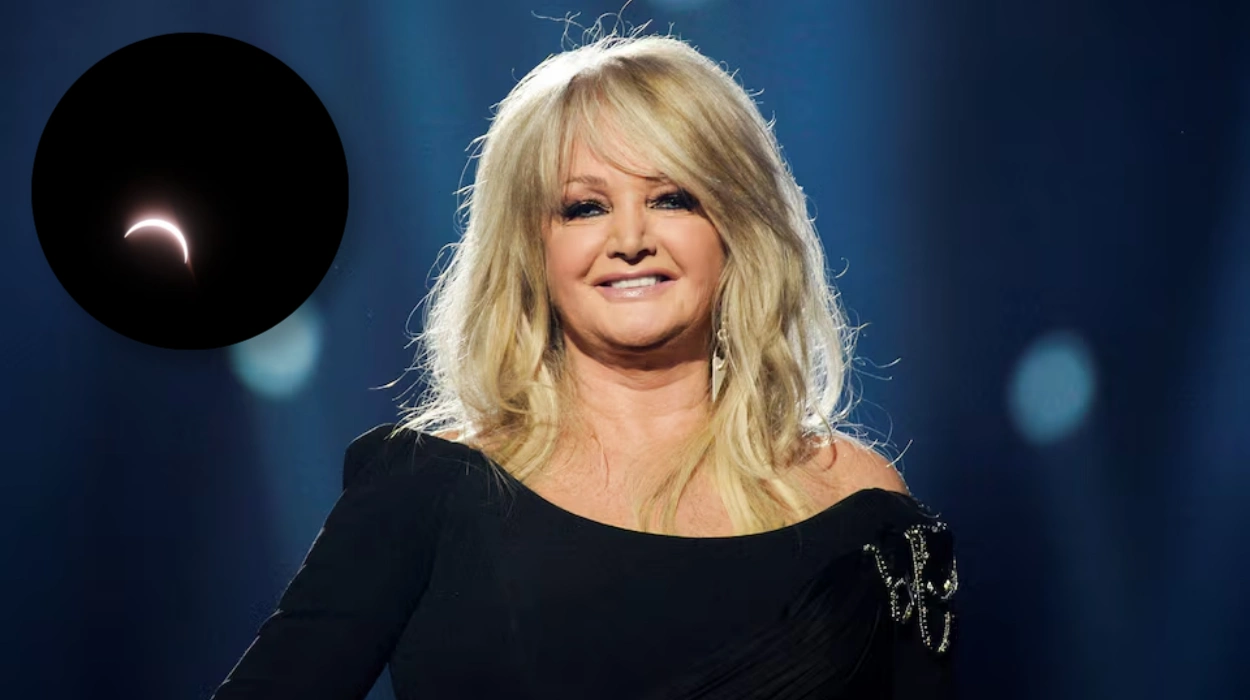
Key Points
- Streams of Bonnie Tyler’s “Total Eclipse of the Heart” on Spotify were up by 94 per cent in the UK due to the solar eclipse.
- There was an increase of 14 per cent in worldwide streams of the iconic song on 12 August.
- Evolfo’s “Moon Eclipsed The Sun” had the biggest jump of 12,817 per cent in the UK and 1,251 per cent globally.
- Chris Staples’ “Dark Side Of The Moon” shot up 2,805 per cent among UK users and 405 per cent globally.
- Pink Floyd’s “Eclipse” increased 594 per cent in the UK and 144 per cent worldwide.
- Delta Goodrem’s Eurovision hit “Eclipse” increased by 104 per cent in the UK and 40 per cent internationally.
- Bill Withers’ “Ain’t No Sunshine” gained 17 per cent in UK streams and 3 per cent globally.
- Spotify compared the number of streams recorded on 12 August with the average daily number of streams recorded on 1 – 11 August.
- Over 90 per cent of the Sun was blocked by the Moon for a period starting approximately at 6 pm to 8.15 pm in the UK.
- The eclipse was considered the most obstructive of the Sun in the UK skies since the total eclipse of 1999.
- Shannon Carragher, Senior Editor at Spotify, said that cultural events can quickly impact listening habits.
London (Britain Today News) August 13, 2026 — Spotify recorded a sharp increase in streams of songs connected with the Sun, the Moon and darkness during the solar eclipse, with Bonnie Tyler’s Total Eclipse of the Heart leading the rise in the UK. The song’s British streams climbed by 94 per cent, while its worldwide streams increased by 14 per cent compared with the daily average recorded between 1 and 11 August.
- Key Points
- Which song led Spotify’s eclipse surge?
- How much did Evolfo’s song increase?
- What happened to Chris Staples’ track?
- Did Pink Floyd’s Eclipse gain listeners?
- How did Delta Goodrem’s song perform?
- Did Bill Withers’ Ain’t No Sunshine also rise?
- How did Spotify calculate the figures?
- What did Spotify’s senior editor say?
- How significant was the eclipse in the UK?
- Why did eclipse-themed music become popular?
- What does the data reveal about listening habits?
- What were the main Spotify streaming increases?
- What is the wider significance of the figures?
The figures showed how listeners turned to familiar celestial and atmospheric songs while watching the eclipse. Although Total Eclipse of the Heart was the most recognisable track associated with the event, several less well-known songs experienced much larger percentage increases, including Evolfo’s Moon Eclipsed The Sun, which rose by more than 12,000 per cent among UK listeners.
The findings were reported by The Independent, based on listening data supplied by Spotify. No journalist name was provided in the supplied report, so the figures and statements are attributed to The Independent and Spotify rather than to an unnamed author.
Which song led Spotify’s eclipse surge?
Bonnie Tyler’s Total Eclipse of the Heart produced the most prominent mainstream response during the solar eclipse. Spotify recorded a 94 per cent increase in UK streams on 12 August, compared with the song’s average daily performance during the first 11 days of the month.
The track also experienced a 14 per cent rise in streams worldwide. Its connection with the eclipse made it an obvious choice for listeners seeking a soundtrack for the event, particularly as millions of people watched the Moon move across the face of the Sun.
The figures were recorded five weeks after Tyler’s death on 8 July, according to the supplied report. The timing added further emotional significance to the song’s renewed popularity, with listeners returning to one of the Welsh singer’s best-known recordings during a major shared event.
The Independent reported that the increase was part of a broader rise in interest in songs with references to eclipses, the Moon, the Sun and darkness. The data suggested that listeners did not simply stream one famous song, but explored a range of music that reflected the imagery and atmosphere of the astronomical event.
How much did Evolfo’s song increase?
Evolfo’s Moon Eclipsed The Sun recorded the largest percentage increase among the songs identified in Spotify’s data. UK streams rose by 12,817 per cent on eclipse day, while worldwide streams increased by 1,251 per cent.
The scale of the rise was considerably larger than the increase recorded by Tyler’s classic. However, percentage growth can be especially pronounced when a song begins with a smaller daily audience. A large increase does not necessarily mean that the track received more total plays than a globally established hit such as Total Eclipse of the Heart.
Nevertheless, the figures showed that the eclipse introduced some listeners to music they may not have previously played. The song’s title directly references the relationship between the Moon and the Sun, making it particularly relevant to people searching for music that matched the event.
Spotify’s figures placed Moon Eclipsed The Sun at the centre of the more specialised response to the eclipse. Its increase also demonstrated how cultural moments can generate interest in songs beyond the most familiar chart titles.
What happened to Chris Staples’ track?
Chris Staples’ Dark Side Of The Moon also experienced a substantial increase in listening. Streams among British users climbed by 2,805 per cent on 12 August, while the worldwide figure rose by 405 per cent.
The song’s title evoked the darker visual conditions created when the Moon passed in front of the Sun. During the eclipse, the changing light encouraged listeners to choose music with references to shadows, space and the night sky.
As reported by The Independent, the figures were calculated by comparing streams on the day of the eclipse with the average number of daily streams between 1 and 11 August. The comparison therefore measured the specific effect of the event rather than simply reporting the song’s overall popularity.
Staples’ result was another example of a track receiving a major percentage increase because its theme aligned closely with the public conversation surrounding the eclipse. It also showed that listeners selected songs based on titles and associations, rather than relying only on the biggest names in music.
Did Pink Floyd’s Eclipse gain listeners?
Pink Floyd’s Eclipse recorded a 594 per cent increase in UK streams and a 144 per cent rise worldwide. The song is strongly associated with the group’s space-themed musical identity, making it a natural choice during an event centred on the relationship between the Earth, Moon and Sun.
The figures placed Pink Floyd among the best-performing artists connected with the eclipse. While the increase was lower in percentage terms than the rises recorded by Evolfo and Chris Staples, the track’s established audience meant that the figures represented a significant increase in listening interest.
The response also reflected the continued relevance of music that uses astronomical imagery. Eclipse has long been associated with themes of space and darkness, and the solar event gave listeners a reason to return to it or hear it for the first time.
Spotify’s data showed that the effect was not limited to the UK. Worldwide streams of the Pink Floyd song rose by 144 per cent, indicating that the eclipse influenced listening behaviour beyond the areas where the event was most visible.
How did Delta Goodrem’s song perform?
Delta Goodrem’s Eclipse, which was identified in the supplied report as her Eurovision entry, saw UK streams rise by 104 per cent. Internationally, the song recorded a 40 per cent increase.
The figures showed a smaller but still notable response compared with the other eclipse-themed songs listed by Spotify. The track benefited from its title, which directly matched the name of the astronomical event.
Its performance also illustrated the difference between domestic and international listening patterns. In the UK, where more than 90 per cent of the Sun was obscured, the increase was more than twice the worldwide rise.
The song’s performance formed part of a wider pattern in which listeners appeared to choose music that reflected what they were seeing. For some users, the title alone may have been enough to make the track suitable for sharing videos, photographs or personal reactions to the eclipse.
Did Bill Withers’ Ain’t No Sunshine also rise?
Bill Withers’ 1971 song Ain’t No Sunshine recorded a 17 per cent increase in UK streams and a 3 per cent rise worldwide. Although its percentage growth was more modest, the song was included among the tracks that gained momentum during the eclipse.
The song does not refer directly to an eclipse, but its title evokes the temporary loss of sunlight that occurs when the Moon moves between the Earth and the Sun. That association may have made it appealing to listeners looking for music connected with the sudden change in daylight.
The increase was considerably higher in the UK than globally. This difference reflected the fact that the eclipse was particularly visible to people across the UK, where the Sun was heavily obscured during the evening.
The response to Ain’t No Sunshine also suggested that listeners were interpreting the event broadly. They were not choosing only songs containing the words “eclipse”, “Moon” or “Sun”; they were also selecting recordings that conveyed darkness or the disappearance of daylight.
How did Spotify calculate the figures?
Spotify compared streams recorded on 12 August with the average daily number of streams between 1 and 11 August. The comparison was used to identify changes in listening behaviour linked to the eclipse.
The method provided a baseline for each song before the event. Instead of comparing the eclipse day with a single previous date, Spotify used the daily average from the 11 days leading up to 12 August.
This approach allowed the company to highlight increases in both the UK and worldwide. It also showed how the same song could perform differently in Britain and internationally.
For example, Total Eclipse of the Heart rose by 94 per cent in the UK but by 14 per cent worldwide. Evolfo’s Moon Eclipsed The Sun increased by 12,817 per cent domestically and 1,251 per cent globally. These differences indicated that the strongest response came from listeners in areas directly experiencing the eclipse.
The data measured streaming activity rather than radio play, sales or social media engagement. Therefore, the figures show how Spotify users responded through listening on the platform.
What did Spotify’s senior editor say?
Shannon Carragher, Spotify’s senior editor, said major cultural events can have an immediate effect on what people listen to.
“It is always fascinating to see how major cultural events instantly reflect in what the UK is listening to.”
Carragher said, according to the report.
Carragher added that cultural phenomena such as a solar eclipse could bring people together and encourage them to search for music that suited a shared experience.
“Cultural phenomena like the solar eclipse naturally bring people together, and we instinctively look for the perfect soundtrack to share that moment.”
Carragher said.
The Spotify senior editor also referred to the difference between familiar anthems and less widely known songs. According to Carragher, listeners returned to recognised music such as Total Eclipse of the Heart while also discovering “hidden celestial gems”.
“Whether it’s collectively returning to iconic anthems like Total Eclipse of the Heart or seeking out more hidden celestial gems, these massive spikes in streaming show just how deeply we rely on music to elevate and connect us in the real world during shared human experiences.”
Carragher said.
How significant was the eclipse in the UK?
More than 90 per cent of the Sun was obscured by the Moon between approximately 6 pm and 8.15 pm above UK skies, according to the supplied report. The event was described as the most significant blocking of the Sun visible from the UK since the total eclipse of 1999.
The timing placed the eclipse during the evening, allowing people to watch the change in daylight and share the experience with others. The extent of the obscuration also helped make the event a major cultural moment.
The eclipse’s visibility in the UK helps explain why domestic streaming increases were often much higher than global rises. British users were directly experiencing the event, while international users may have been responding to coverage, online content or the symbolism of the eclipse.
The high level of obscuration also created a strong connection between the visual event and the music selected by listeners. Songs about eclipses, the Moon, sunlight and darkness became especially relevant while the Sun was disappearing from view.
Why did eclipse-themed music become popular?
The streaming increases reflected the way people often use music to mark memorable moments. A solar eclipse is a shared public event, and songs with titles connected to the sky can provide an immediate soundtrack for watching, recording or discussing it.
The response also showed the power of cultural associations. Total Eclipse of the Heart does not describe the astronomical mechanics of an eclipse, but its title has become strongly linked with the phrase. That familiarity made it an accessible choice for people seeking music connected to the occasion.
Other songs benefited from more direct references. Moon Eclipsed The Sun, Dark Side Of The Moon and Eclipse all carried titles that matched the imagery of the event. Ain’t No Sunshine, meanwhile, offered a broader emotional connection through its reference to the absence of sunlight.
Spotify’s figures suggest that listeners used both obvious and indirect associations when choosing music. The result was a broad rise across several songs rather than a single-track phenomenon.
What does the data reveal about listening habits?
The data indicated that major events can influence streaming behaviour quickly. On the day of the eclipse, songs connected with the event experienced noticeable increases in the UK and, in several cases, around the world.
The largest percentage increases were recorded by songs that may have had smaller starting audiences. Meanwhile, widely recognised tracks produced substantial rises while already benefiting from established public awareness.
The figures also highlighted the importance of timing. The comparison focused on 12 August against the average from 1 to 11 August, showing that the changes occurred around the eclipse rather than across a longer period.
Spotify’s findings did not establish why every individual listener chose a particular song. However, the simultaneous rise across music linked with the Moon, Sun, darkness and eclipses showed a clear relationship between the public event and streaming activity.
For artists and music platforms, the figures illustrated how events outside the music industry can drive renewed interest in older or less familiar recordings. For listeners, the eclipse created an opportunity to revisit well-known songs and discover tracks that matched the atmosphere of the occasion.
What were the main Spotify streaming increases?
The figures reported by Spotify can be set out as follows:
| Song | UK increase | Worldwide increase |
|---|---|---|
| Bonnie Tyler — Total Eclipse of the Heart | 94 per cent | 14 per cent |
| Evolfo — Moon Eclipsed The Sun | 12,817 per cent | 1,251 per cent |
| Chris Staples — Dark Side Of The Moon | 2,805 per cent | 405 per cent |
| Pink Floyd — Eclipse | 594 per cent | 144 per cent |
| Delta Goodrem — Eclipse | 104 per cent | 40 per cent |
| Bill Withers — Ain’t No Sunshine | 17 per cent | 3 per cent |
The comparison was made between streams on 12 August and the average daily streams from 1 to 11 August. The UK figures were particularly significant because the country experienced the eclipse directly, with more than 90 per cent of the Sun obscured during the evening.
Explore More about Entertainment:
Burlesque The Musical Delays UK Tour Opening Again
WBD Access Reveals Food Network, Incubator Shows
What is the wider significance of the figures?
Spotify’s eclipse data demonstrated how music can become part of a shared public experience. As people watched the sky, songs with familiar references to the Sun, Moon, darkness and eclipses gained additional attention.
Bonnie Tyler’s Total Eclipse of the Heart remained the defining soundtrack in terms of public recognition, but Evolfo’s dramatic percentage increase showed that the event also directed listeners towards less familiar material.
The figures reported by The Independent did not suggest that all listeners followed the same playlist. Instead, they showed several different ways of responding to the eclipse: some returned to a famous anthem, others explored songs with space-related titles, and some selected music associated with the temporary disappearance of sunlight.
Spotify’s Shannon Carragher described the trend as evidence that music helps people elevate and connect during shared human experiences. The streaming figures offered measurable support for that observation, with both UK and worldwide audiences changing their listening patterns around the astronomical event.
The eclipse therefore produced not only a remarkable view across the UK but also a measurable soundtrack on Spotify, led by Bonnie Tyler and supported by a broad rise in songs connected with celestial imagery.